Malpaga Castle: A Renaissance Military Residence in Italy



Site at a Glance
- Rating
- 4.4
- Popularity
- Medium
- Country
- Italy
- Primary era
- Medieval
- External website
- Open
- Eras represented
- Medieval, Early Modern
- Civilizations
- Holy Roman Empire, Venetian
- Site type
- Military
- Remains
- Castle
On this page11 sections
History
Malpaga Castle is a fortified residence in Cavernago, Italy, whose development as a castle belongs broadly to the twelfth through fifteenth centuries and whose architecture has a Late Gothic or International Gothic character. Originally a military fortification, it later became a noble residence and, under Bartolomeo Colleoni, a center of military command, political representation, and Renaissance court life.
Medieval origins
An early medieval castle stood on the site before an assault or raid in the 1440s left it in ruins. In 1456, Bartolomeo Colleoni acquired the ruined castle from the commune of Bergamo. A condottiero, meaning a professional military commander who served rulers or city-states under contract, Colleoni was also captain-general of Venice.
Colleoni’s fortified court
Colleoni enlarged and rebuilt Malpaga as a base for his troops, a fortified residence, and the political center of the territory he effectively controlled. He transformed the military site into a Renaissance court, combining defense with aristocratic display, cultural patronage, formal hospitality, tournaments, and hunting. The castle became a luxurious retreat intended to express his social and military success.
The court received prominent guests, including Borso d’Este, the sons of Francesco Sforza, Charles the Bold, Duke of Burgundy, and Christian I, King of Denmark, who visited in 1474. Humanists from Bergamo, among them Jacopo Tiraboschi and Giovanni Michele Carrara, also gathered there, as did visitors such as Pagello and Antonio Cornazzano. Cornazzano wrote a laudatory biography of Colleoni at his commission. In 1483, the Venetian humanist and travel writer Marin Sanudo described the castle in his Itinerary through the Venetian Mainland.
Later ownership and recognition
After Malpaga passed to the Martinengo, a prominent noble family of Lombardy, the castle underwent further changes during the fifteenth and sixteenth centuries. Its later identity continued to combine the appearance of a stronghold with the functions of a noble court. Malpaga is recognized as an Italian cultural property.
Remains
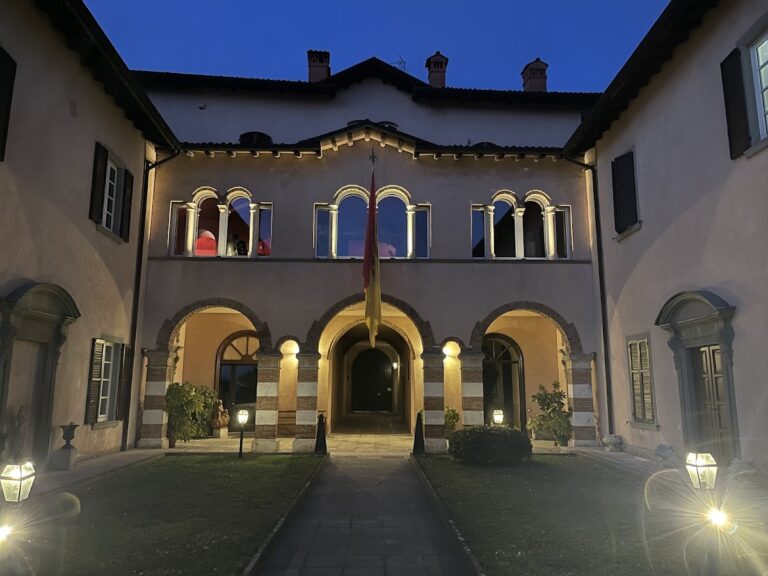
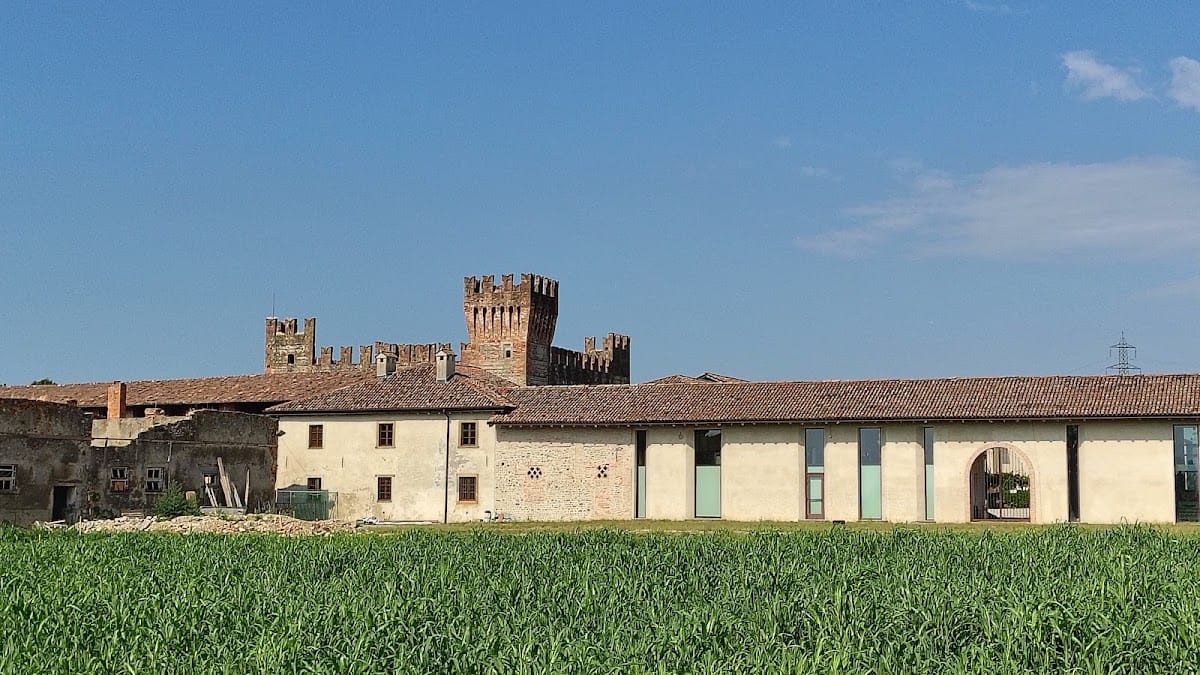
Malpaga Castle has a square plan and is built in brick. Its severe exterior retains a strongly military character, while the interior was decorated as a princely residence. Two lines of crenellated walls and a moat once enclosed the complex. The outer fortification line has disappeared, but substantial remains of the moat are still visible.
Defensive enclosure
The surviving castle presents the inner fortified complex, while the vanished outer line formerly contained the stables and barracks. The moat and the crenellated defensive arrangement express the site’s original military purpose. Inside this austere exterior, extensive painted decoration altered the character of the residence without removing its fortified form.
Frescoed interiors
Banquet hall
The banquet hall contains a fresco cycle commissioned by Colleoni’s heirs around 1520–1530 to glorify the family’s most famous member. Attributed to Il Romanino, a sixteenth-century Italian Renaissance painter associated especially with fresco cycles in northern Italy, the paintings celebrate Christian I of Denmark’s visit in 1474. They show the royal procession, Colleoni’s hospitality, banquets, tournaments, hunting scenes, and hunting expeditions. Colleoni and Christian I appear as idealized figures rather than exact portraits.
Battle of Molinella fresco
A fresco on the courtyard wall facing the entrance is also attributed to Il Romanino. It depicts the Battle of Molinella, also called the Battle of Riccardina, which Colleoni fought near Bologna in 1467. Exposed outdoors, the painting has suffered from weather and strong sunlight, although it remains broadly legible. Its treatment of combatants, armor, horses, and movement is marked by vivid realism.
Seventeenth-century upper-floor frescoes
Frescoes from the seventeenth century survive on the upper floor. Their artistic execution is modest, but their colors remain vivid. Among the subjects are allegories such as Silence, represented by an old man making a gesture associated with silence or secrecy and with the obligations of the castle’s personnel.
Colleoni’s private room
Colleoni’s former private room has no fireplace, apparently as a security measure intended to prevent enemies from entering through the chimney. Its windows were fitted with bars. The room also contains a small fifteenth-century sacred fresco by an unknown artist. Tradition holds that Colleoni particularly loved this image.