Castell de Sallent: A Medieval Fortress in Catalonia, Spain

Visitor Information
Google Rating: 4.5
Popularity: Very Low
Google Maps: View on Google Maps
Official Website: www.sallentturisme.cat
Country: Spain
Civilization: Unclassified
Remains: Military

History
Castell de Sallent is a medieval fortress situated in the municipality of Sallent, Spain. It was constructed by the feudal nobility of the region during the early Middle Ages.
The earliest record of the castle dates back to 1023, where it is mentioned as “kastrum quod dicunt Sallent,” indicating an established fortified site by that time. Initially, the castle was part of the holdings of Countess Ermessendis, widow of Count Ramon Borrell. She pledged the fortress to Bernat Sendred, son of Sendred de Gurb, linking the property to a significant noble family. Throughout the 11th and early 12th centuries, the castle, along with the surrounding lands, remained under the control of the Gurb-Queralt lineage. By the year 1032, the fortress was located within the boundaries of the County of Manresà, a territorial division in medieval Catalonia.
Alongside the primary ruling family, the Sallent family emerged as secondary castellans, or castle keepers, serving the Gurb-Queralt lords. This arrangement reflected the complex feudal hierarchy where local vassals managed fortified sites on behalf of higher nobility such as the Counts of Barcelona.
In 1209, a significant transition took place when Berenguer III de Queralt and his wife relinquished control of Castell de Sallent and the neighboring estate of Sant Ponç to King Peter the Catholic. This transfer returned the castle to royal hands, emphasizing its strategic or administrative value. Later, in 1246, King James I the Conqueror granted the castle to the Bishop of Vic. This ecclesiastical authority further consolidated its position by acquiring the rights of the castellan from Pere de Santa Coloma in 1253, establishing a period of church dominion.
The castle remained under episcopal administration until the dissolution of feudal domains in 1812, indicating its continuous relevance across several centuries. Feudal lords connected to the site included the families of Calders, Talamanca, and Santa Coloma, reflecting the shifting noble proprietors throughout its history. In the mid-14th century, records from 1358 mention the nearby village as having 42 hearths, marking a permanent settled community. Although the castle itself is not referenced during the mid-15th-century conflict known as the war of the Generalitat against King John II, the village played a role as a gathering point for peasants and locals, hinting at the area’s social dynamics during periods of unrest.
Remains
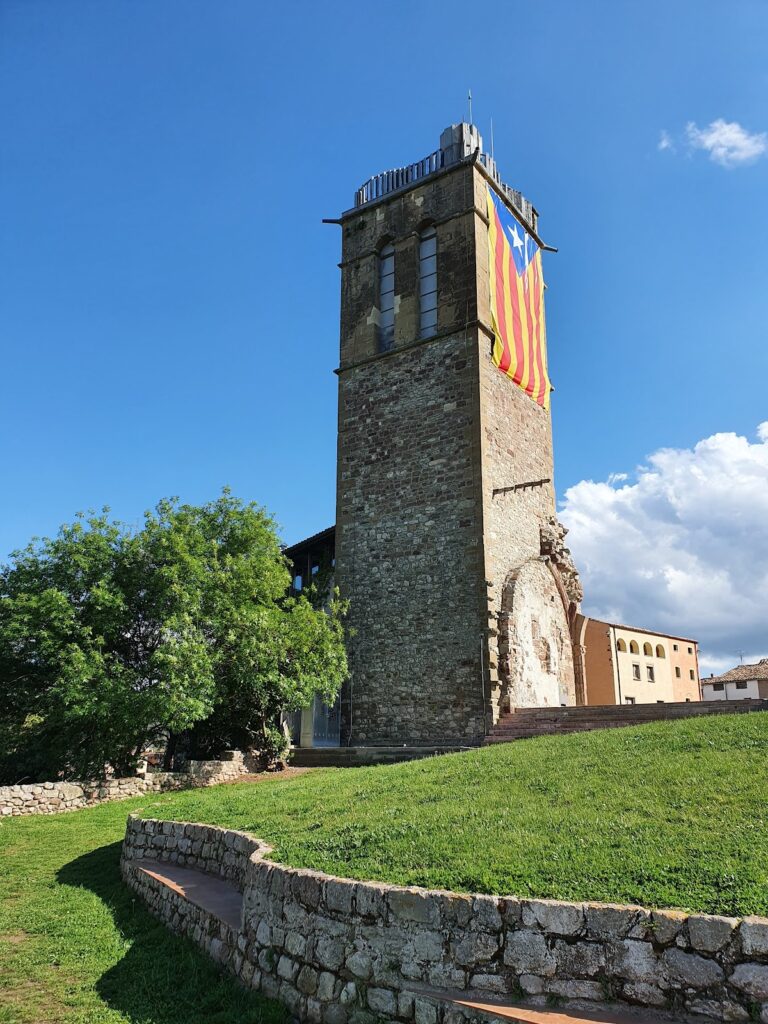
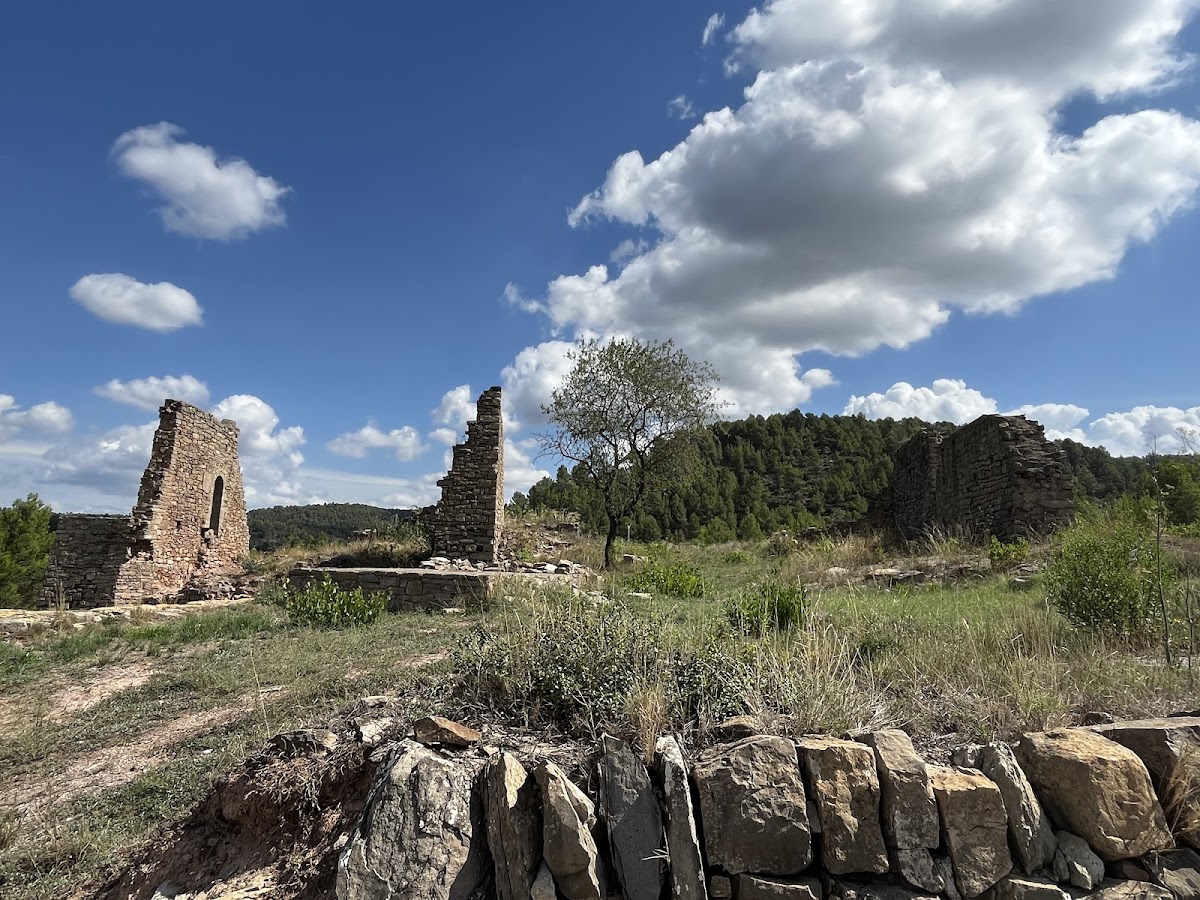
Located atop a small hill known as Sant Sebastià, south of Sallent town, the ruins of Castell de Sallent reveal a site that once combined military strength with ecclesiastical presence. The fortress occupies the upper part of the hill, where substantial portions of its defensive walls remain visible. These walls include both the enclosure of the upper fortress and a lower circuit of walls fortified by four square-shaped buttresses. Such features are linked to remodeling efforts undertaken in the 14th century, suggesting a phase of significant reinforcement during that period.
The surviving structures display characteristics of Romanesque architectural style, which was prevalent in medieval Catalonia. Among the remains are parts of walls and half-round towers, typical of this style’s fortified constructions. The semicircular shapes of these towers offer insights into defensive strategies employed by builders in that era. These elements survive in a fragmented state but contribute to understanding the castle’s layout and fortification techniques.
Adjacent to the castle lies the former parish church of Sant Sebastià, notable for being the largest Romanesque rotunda in Catalonia. This church presents a distinctive circular plan, featuring a semicircular main apse and two smaller semicircular apsidioles, or subsidiary chapels. The apses are adorned with arcades—rows of arches—located just below the roof eaves, while double-splayed windows punctuate the central parts of each apse. These windows are designed with openings that widen inward and outward to enhance light and visibility.
Inside the northern apsidiole, a semicircular niche is embedded within the thickness of the wall, an architectural detail often used for liturgical or decorative purposes in Romanesque churches. Together, the church and castle stand in proximity atop the hill, indicating a close relationship between the fortress’s defensive role and the spiritual needs of the settlement.
Today, the site is recognized as a cultural asset of national importance in Catalonia, preserving the ruins as a testament to the region’s medieval past and the intertwined nature of noble and religious power.
Nearby sites