Castell de Peratallada: A Medieval Castle in Catalonia, Spain


Visitor Information
Google Rating: 4.6
Popularity: Medium
Google Maps: View on Google Maps
Official Website: www.castellperatallada.com
Country: Spain
Civilization: Unclassified
Remains: Military

History
The Castell de Peratallada is located in the municipality of Peratallada in Spain and was constructed by medieval Catalan nobility. The earliest known record of the castle dates to 1065, where it is mentioned as “castro de Petra Taliata,” indicating its origins likely extend further back in time. Early lords such as Guillem de Peratallada around 1039 and Bernat de Peratallada in 1054 governed the castle and held considerable influence within the Empordà region and greater Catalonia.
By 1068, the Peratallada family had established significant political standing, as members took part in a pact involving Count Ramon Berenguer I and the viscounts Ramon Bernat Trencavel and Ermengarda. Their role continued through the 12th century, exemplified by Dalmau de Peratallada’s position as guarantor in a 1153 agreement between the Count of Barcelona and the Republic of Genoa. This highlights the family’s ongoing involvement in regional diplomacy and alliances.
The castle passed through inheritance when Guilleuma, sister of Ponç de Peratallada who died in 1250, married Gilabert de Cruïlles in 1266. This union merged two noble houses, integrating their estates and influence. Although the family maintained extensive landholdings, the 13th century brought economic challenges that affected their fortunes.
The 14th century marked a flourishing era for the castle and its lords, now under the Cruïlles family. The castle became the preferred residence of these nobles and even hosted Aragonese royalty, including King Joan I in 1390. Historical chronicles, such as the “Crònica de Ramon Muntaner,” note Gilabert de Cruïlles and his son Bernat who joined King Pere in the 1283 competition held in Bordeaux, showcasing the family’s military and courtly roles. At the same time, the Crown maintained strong rights over the lordship during this century.
Prominent lords in this period included Bernat and Gilabert V de Cruïlles, the latter of whom died in the Black Death pandemic of 1348. Gilabert’s sarcophagus is preserved in the local church of Sant Esteve de Peratallada, indicating the family’s religious and social ties within the community.
The 14th and 15th centuries also brought internal conflicts among the Cruïlles family and tensions with the remensa peasants, a class of serfs with grievances, who at one point nearly set the castle aflame. During the Catalan Civil War, from 1462 to 1472, Bernat Gilabert de Cruïlles opposed the monarchy, while other family members supported King Joan II, reflecting divided loyalties within the household. After the conflict, Pere Galceran de Cruïlles assumed lordship in 1483. The castle remained in the hands of the Cruïlles lineage until 1916, when it was sold at auction. Later, in 1964, ownership passed to the counts of Torroella de Montgrí.
Remains
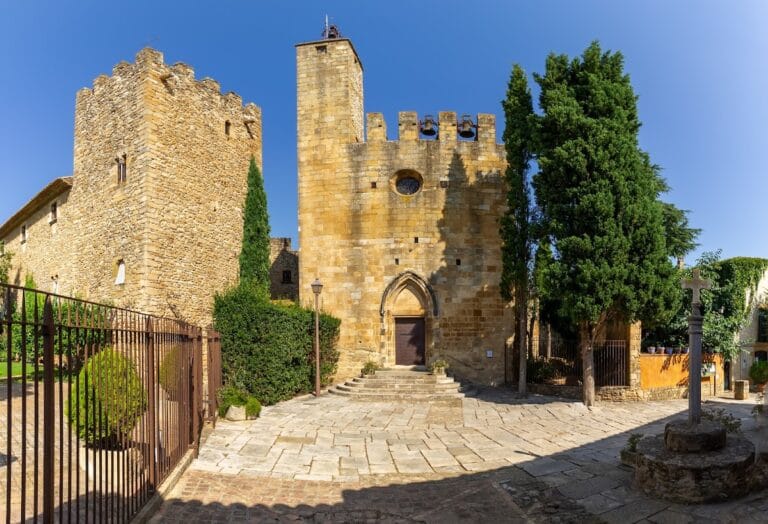
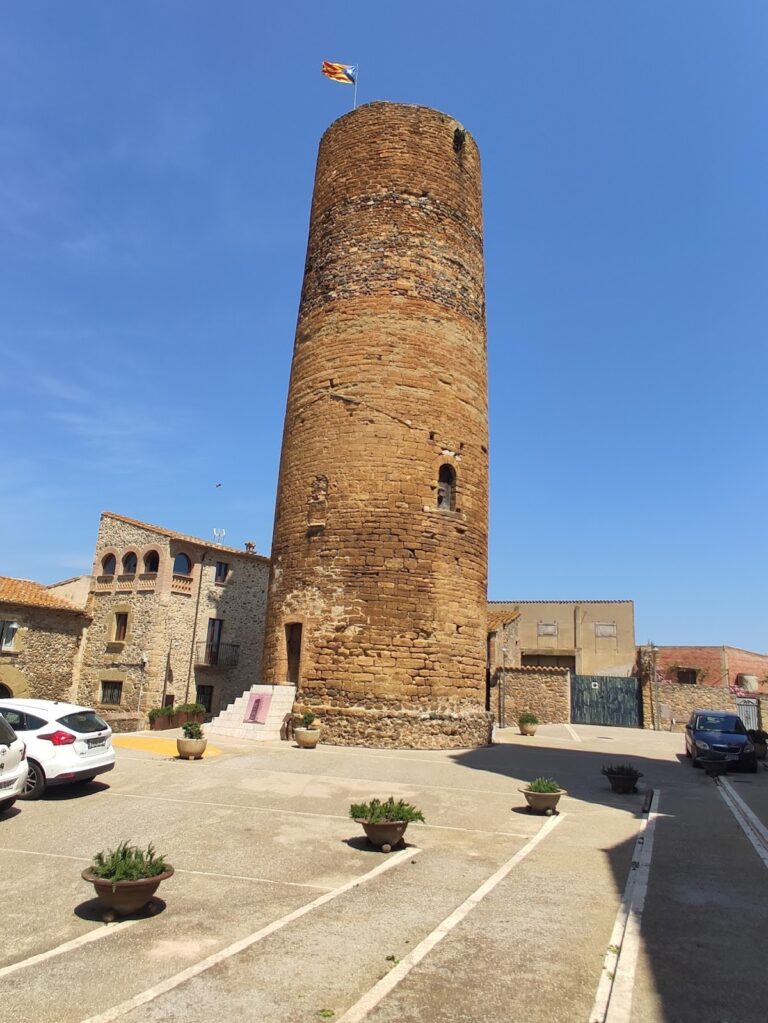
The Castell de Peratallada sits atop elevated terrain that has been shaped by cutting the natural rock vertically, creating a noticeable height difference from the surrounding ground. The castle complex centers around a rectangular keep, or fortified tower, which is encircled by an initial defensive wall. This arrangement reflects typical medieval military architecture aimed at maximizing defense through natural and man-made elevations.
Within the fortified nucleus lies the palace, a collection of buildings arranged around a rectangular courtyard, situated near the main castle. The section of the palace closest to the castle is rectangular in shape, two stories tall, and constructed upon the foundations of an earlier circular tower. On its upper floor, a richly colored polychrome diaphragm arch remains preserved, demonstrating the artistic detailing employed in the castle’s interior design.
Two additional wings, each with a T-shaped floor plan and including Romanesque construction elements, complete the courtyard’s enclosure. Romanesque architecture, characterized by semi-circular arches and robust stonework, signals the continuity of building styles from earlier centuries within the complex.
The palace façade that faces the castle square has undergone significant alterations over time. It currently features ground and upper floors separated by a rectangular entrance door inscribed with the date 1745, providing a clear indication of 18th-century modifications. Architectural openings on this façade include a small Romanesque window and a large ground-floor window composed of two trilobed arches — arches with three rounded lobes — as well as two triforate windows (windows divided into three parts) and two paired windows on the upper floor. Extensions flanking the central body of the façade are distinguishable by their differing window styles and construction materials, reflecting various phases of addition and repair.
Elements within the castle and palace span several centuries, with some dating from as early as the 12th century and others extending into the 17th century. Gothic features—such as halls and portions of defensive walls—highlight the architectural evolution of the site during the later medieval period. The castle’s layered construction presents a rich tapestry of historical building techniques and styles preserved within its surviving structures.
Nearby sites