Burgruine Khünburg: A Medieval Fortress in Austria


Visitor Information
Google Rating: 4.7
Popularity: Very Low
Google Maps: View on Google Maps
Official Website: www.hermagor.at
Country: Austria
Civilization: Unclassified
Remains: Military

History
Burgruine Khünburg stands near the village of Khünburg within the municipality of Hermagor in Austria. This medieval fortress was constructed by the Austrian noble family known as the Kuenburgs, with origins tracing back to the late 12th century. Its initial builders belonged to the Christian civilization shaping much of central Europe during that period.
The castle first appears in written records in 1189, when it was owned by Count Pero de Kinburch, a ministerial nobleman serving the Kuenburg lineage. Throughout the 13th century, control of the castle shifted to the Bishopric of Bamberg, reflecting the overlapping influence of secular and ecclesiastical powers common in the region. By 1311, the fortress was pawned to Duke Heinrich of Carinthia, indicating its involvement in regional political and financial dealings.
A disastrous fire around 1540 or 1541 led to the castle’s abandonment. Following this event, the Kuenburg family relocated their residence to Schloss Khünegg at Egg, near Hermagor. Without ongoing maintenance, the once-fortified site gradually fell into ruin. Early efforts to restore the main tower began in the early 20th century, signaling renewed interest in preserving the castle’s historical significance.
Remains
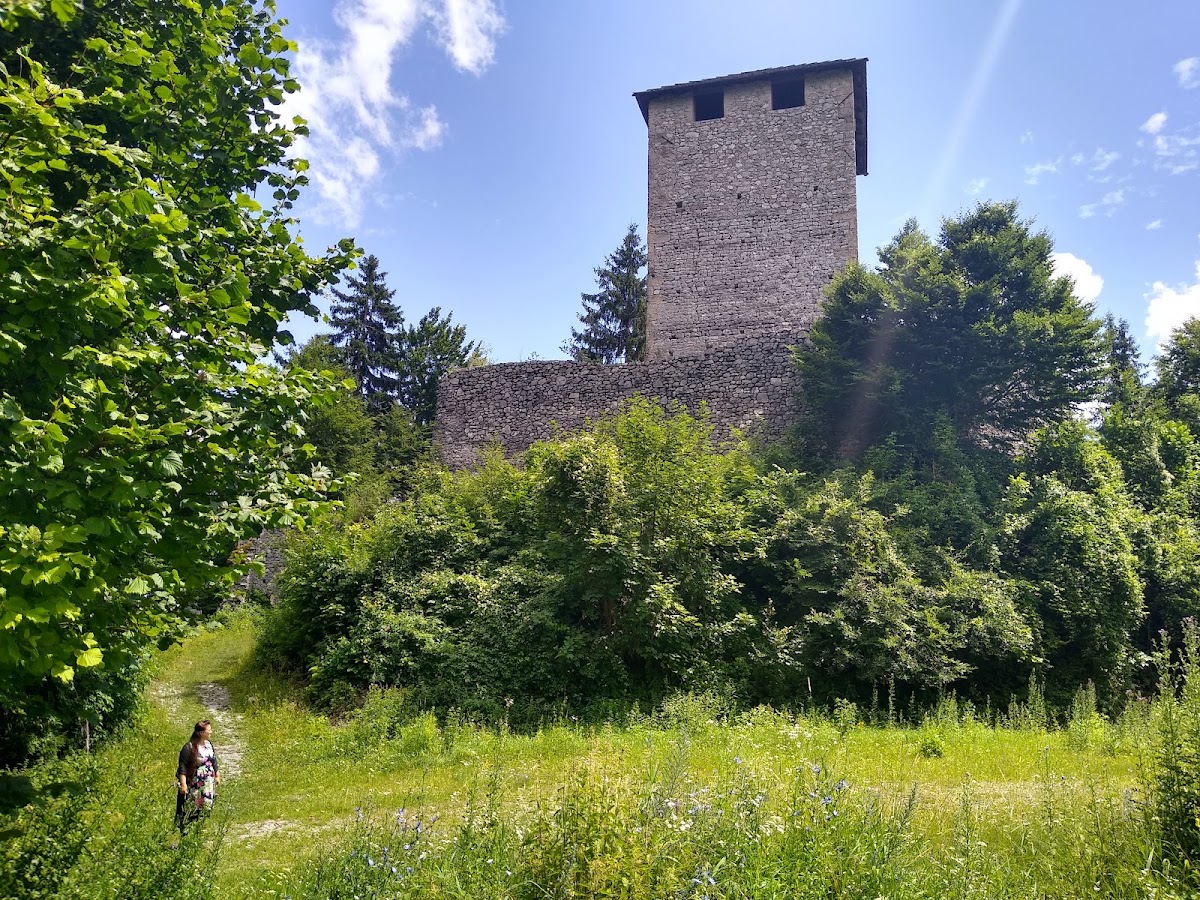
Burgruine Khünburg covers an area roughly thirty by forty meters and was built around the year 1200 using the Romanesque architectural style. The fortress’s design has remained largely unchanged since the mid-14th century, offering a clear view of medieval construction methods from that era.
The most prominent surviving structure is the bergfried, or main tower, constructed of natural stone on a nearly square base measuring just under nine meters per side. Rising about 22.5 meters high, it is topped with a pyramid-shaped roof. Access to the tower is provided through an arched doorway, leading inside to a wooden staircase that winds along the interior walls. This staircase includes seven flights and six landings, totaling ninety-eight steps ascending to an observation platform approximately seventeen meters above the ground.
At the top, thick walls one meter wide contain two square window openings on each side, offering broad views across the adjoining Gail Valley and surrounding mountains. Large sections of the surrounding ring wall, standing between five and eight meters tall, remain in place around the site, preserving the castle’s defensive perimeter. South of the main tower, the ground floor walls of a residential building are also visible, providing further insight into the castle’s internal layout.
Restoration work over the twentieth and early twenty-first centuries has focused primarily on stabilizing and roofing the bergfried, ensuring that this key feature remains accessible and protected from the elements. These efforts have strengthened the structure’s timber framework and preserved its distinctive silhouette on the rocky hill where it stands.
Nearby sites