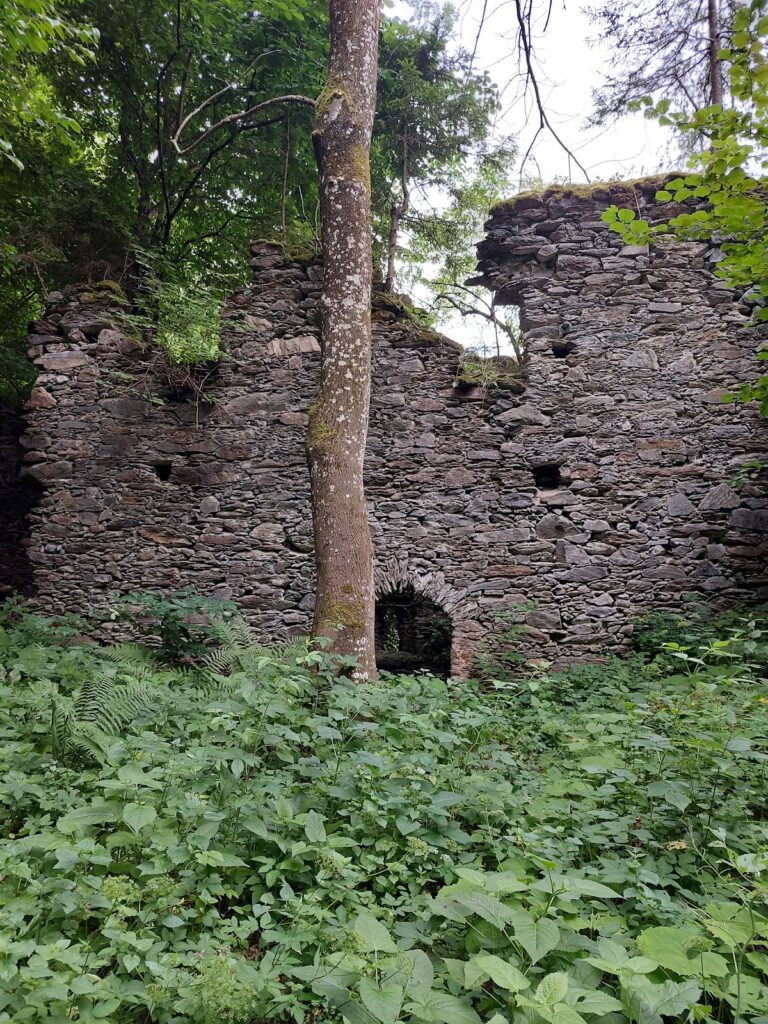
Burgruine Altrosegg: A Medieval Castle and Cultural Monument in Austria


Visitor Information
Google Rating: 4.3
Popularity: Very Low
Google Maps: View on Google Maps
Country: Austria
Civilization: Unclassified
Remains: Military

History
Burgruine Altrosegg stands above the municipality of Rosegg in Austria and was originally built during the Middle Ages by the Lords of Rož, a noble family connected to the Carinthian region. Its origins trace back to the late 12th or early 13th century, a period marked by the establishment of fortified hilltop residences across Europe.
The castle first appears in written records in 1239 and likely functioned as the third main residence for the Lords of Rož, also known in German as Herren von Ras. This family, noted for its semi-autonomy and allegiance to the Dukes of Carinthia, rose to prominence through their service as ministeriales—unfree knights or officials—serving the neighboring duchy of Styria. During the 12th and 13th centuries, they amassed considerable feudal lands, establishing a lordship that included judicial authority over the surrounding district.
Following the end of the male Rož lineage in 1318, Altrosegg changed ownership multiple times, passing through various noble houses such as the Wallsee, Pettau, Schaunberg, Perkheim, Losenstein, Raitenau, Aichelburg, and Rosenberg families. Throughout these transitions, the castle maintained its role as a local stronghold and administrative center.
A notable historical moment occurred in 1478 when the castle successfully withstood a Turkish assault. The fortress provided shelter to the local population, demonstrating its strategic importance in regional defense during a time of frequent Ottoman incursions into Central Europe.
After suffering a destructive fire, extensive repairs took place before 1688 to restore the structure. The Orsini-Rosenberg family, among its later owners, continued to maintain Altrosegg even after constructing a manor house in the valley below in 1772, intending to shift the administrative center away from the hilltop fortress.
During the early 19th century, specifically around the French wars circa 1801, the castle’s stones were repurposed to build a protective wall at the hill’s base and later for a church construction in 1806 and 1807. The site sustained further damage in 1813 due to actions by French troops, resulting in most of the castle being ruined, leaving primarily the main tower intact.
In 1829, entrepreneur Peter Ritter von Bohr acquired the site and created a zoological garden within the grounds. Ownership then transferred to Prince Johann of Liechtenstein in 1833, whose descendants continue to hold the estate, which still encompasses the castle ruins and the surrounding zoo today. Archaeological investigations in 2014 and 2015 have since added to our understanding of the site’s historical layers.
Remains
The remains of Burgruine Altrosegg are situated on the northern side of a rocky hill, now encompassed by the Rosegg zoo. The site is protected as a cultural monument and preserves elements that reflect its long history as a heavily fortified castle.
Among the most prominent features is the partially surviving Romanesque bergfried, the main defensive tower built in the earlier phase of the castle. This thick-walled tower served as a last refuge during sieges but was abandoned by the end of the 19th century due to concerns about its structural stability.
Encircling the castle site are extensive outer defensive walls from the late Gothic period. These fortifications include several small, semicircular towers projecting outward, designed to provide better angles for defense. A notable architectural component is a wedge-shaped bastion that juts out from the curtain wall, demonstrating advancements in military design during the castle’s later phases.
While the castle’s great hall originally occupied the highest point of the hill and was guarded by an inner circular wall, only scant traces of this structure remain. The hall once functioned as an important space for administrative and residential purposes but has largely been lost over time.
Stone from surrounding economic buildings within the complex appears to have been quarried and reused, especially during the 19th century. These reused stones predominantly contributed to building the walls enclosing the zoo, most of which continue to stand today, serving as tangible links between the castle’s past and its modern adaptation.
Together, these remnants provide insight into the castle’s defensive capabilities and its evolution from a medieval fortress intertwined with regional noble families to a historical ruin integrated into the contemporary landscape.
Nearby sites