Laurenburg Castle: An Early Hill Castle in Germany


Site at a Glance
- Rating
- 4.3
- Popularity
- Very Low
- Country
- Germany
- Primary era
- Medieval
- External website
- Open
- Eras represented
- Medieval
- Civilizations
- Holy Roman Empire
- Site type
- Military
- Remains
- Castle
On this page7 sections
History
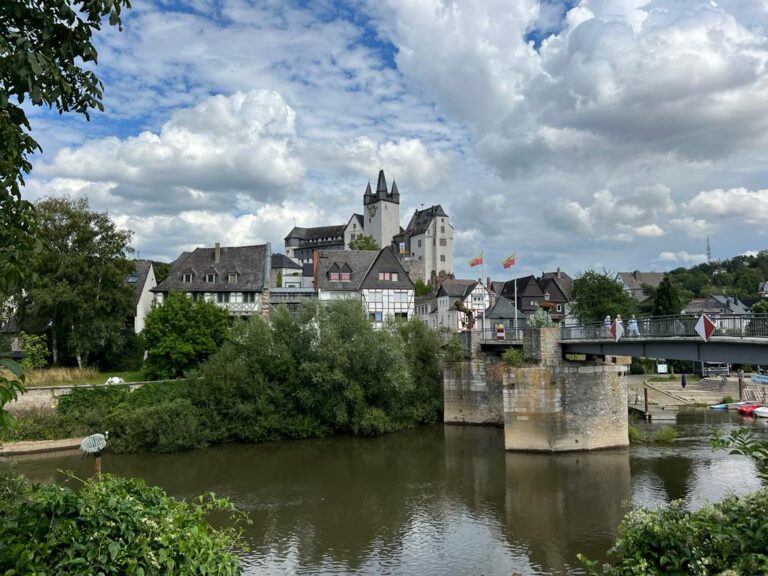
Laurenburg Castle is an early medieval hill castle in Germany, built around 1090 above the town of Laurenburg. Its first documented mention dates to 1093. Count Dudo of Laurenburg, the first known named representative of the House of Nassau, founded it with his father Ruprecht. The family probably previously held its seat near Lipporn.
The Laurenburg Counts and the House of Nassau
Only a few decades after the castle was built, the counts moved their residence to Nassau, where they constructed Nassau Castle. They then adopted the name Nassau. The House of Nassau was a German noble dynasty whose later branches produced rulers and grand dukes in several European territories.
Shared Possession and Feudal Transfers
Laurenburg Castle changed hands several times during the Middle Ages. In 1343, Adolf of Nassau and his brother Johann concluded a castle peace agreement for Laurenburg. Such an arrangement regulated shared possession, administration, or defense and limited conflict among the parties involved.
In 1347, the knights Dietrich von Staffel and Friedrich Brenner bought half of the castle from Count Johann of Nassau-Hadamar, his wife, and his brother Emich. In 1354, Count Adolf of Nassau-Idstein transferred his half to Archbishop Balduin of Trier as a feudal holding, part of his wife’s dower. A feudal holding was a fortification or estate granted by a superior lord in return for obligations, while a dower provided property or income to support a wife.
Decline, Restoration, and Later Ownership
Peter Melander von Holzappel, a field commander from Niederhadamar, purchased the castle in 1643, when it was already severely dilapidated. He repaired the keep, while the other buildings remained in ruins. Later owners included the Anhalt-Bernburg-Schaumburg-Hoym family, Archduke Stephen of Austria, and the princes of Waldeck-Pyrmont. Laurenburg Palace was built below the castle in 1800.
The castle was purchased by its current private owner in 1985. The keep was restored and is also used as a residence. The knights’ hall contains a small military museum and serves as a wedding room. Laurenburg Castle is recognized as a cultural monument in Rhineland-Palatinate.
Remains
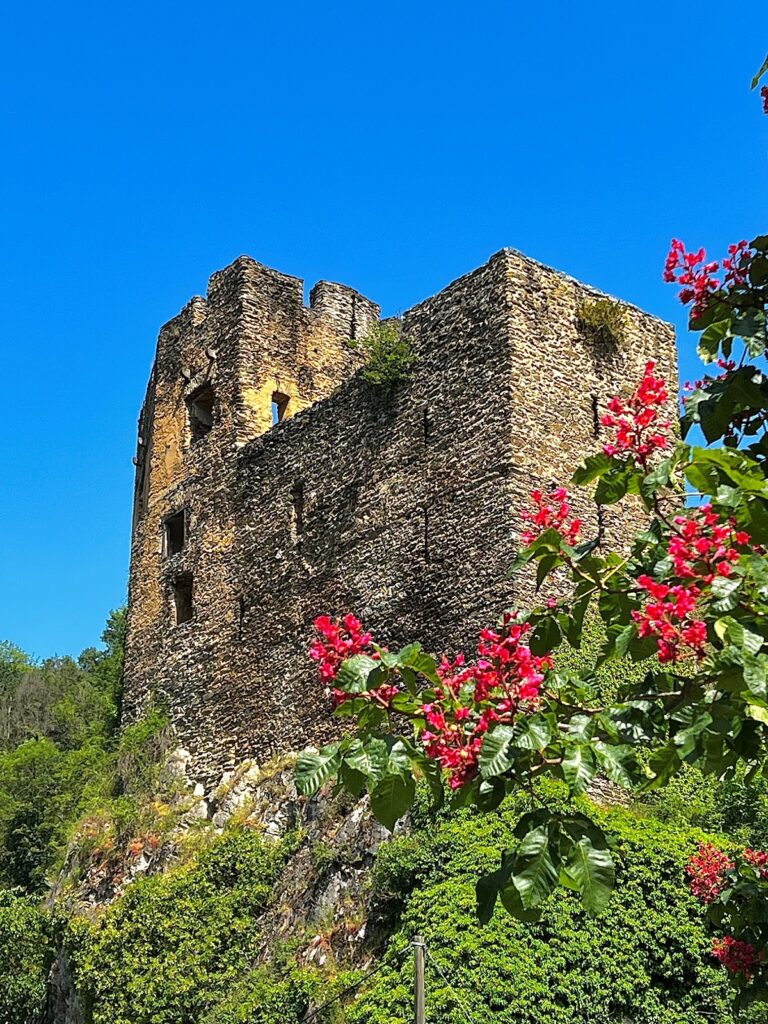
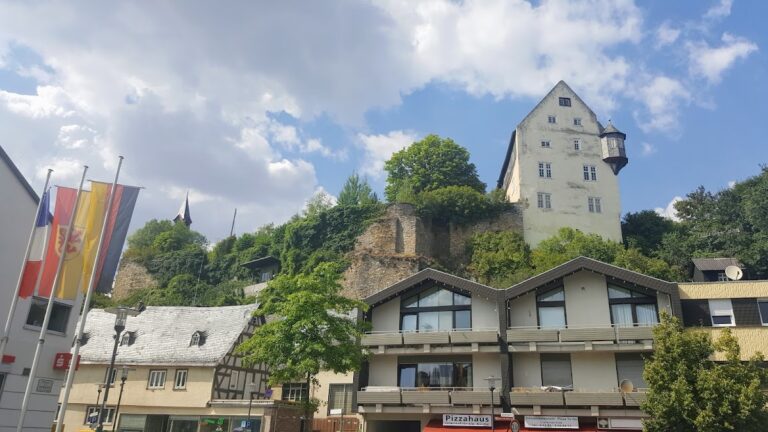
The castle stands 178.9 metres above sea level on a spur of the Turmberg, between the Lahn valley to the south and the Waselbach valley to the west. The surviving complex is centered on a five-sided, four-storey stone keep approximately 22 metres high, with the remains of a curtain wall and a dry neck ditch defining its former defensive arrangement.
The Keep and Interior Access
The keep probably dates from the twelfth or thirteenth century. An external wooden staircase on its western side reaches the elevated entrance, with the knights’ hall immediately behind it. A second wooden staircase connects the hall with the residential storey above. From there, a spiral staircase in a stair turret built into the keep’s eastern corner rises to the viewing platform on the flat roof.
Defensive Boundaries and Viewpoint
The former castle was enclosed by a curtain wall, the defensive wall linking fortified points, and protected on its landward approach by a dry neck ditch. The roof platform looks over Laurenburg and the Lahn valley, while the keep remains the principal surviving structure of the castle.