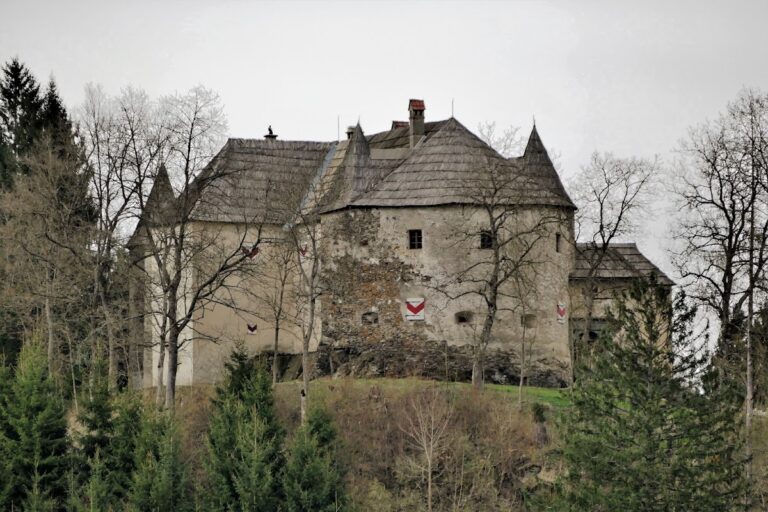
Glanegg Castle Ruins: A Medieval Hilltop Fortress in Austria


Site at a Glance
- Rating
- 4.8
- Popularity
- Low
- Country
- Austria
- Primary era
- Medieval
- External website
- Open
- Eras represented
- Medieval, Early Modern
- Civilizations
- Habsburg, Holy Roman Empire
- Site type
- Military
- Remains
- Castle
On this page7 sections
History
Glanegg Castle Ruins is a medieval hilltop fortress in Austria, in the municipality of Glanegg, Carinthia. Dating from the twelfth century, the complex incorporates Romanesque and Renaissance architectural phases and was built to control passage through the valley of the Glan River. It is described as the third-largest historic defensive complex in Carinthia, after Hochosterwitz Castle and Landskron Castle.
Twelfth-Century Origins and Noble Succession
The castle is first documented in 1121, when it belonged to Heinrich III, Duke of Carinthia, a member of the Eppenstein dynasty. The Eppensteins were a noble family whose members ruled Carinthia during the eleventh and early twelfth centuries. After Heinrich’s death in 1122, the castle passed to his nephew, Count Bernhard von Spanheim. Bernhard later bequeathed it to his nephew, Margrave Ottokar III of Styria. A margrave was a high-ranking territorial ruler, originally responsible for governing a frontier territory.
After Ottokar III died, his son Ottokar IV held the castle. When Ottokar IV died in 1192, it passed to Duke Leopold V, one of the principal territorial rulers of the medieval Holy Roman Empire. The property subsequently changed hands among numerous noble owners.
Threats, Expansion, and Later Ownership
Glanegg was threatened during the Turkish incursions of 1473 to 1478, although it was not captured. In 1534, King Ferdinand I transferred the castle to Ulrich II von Ernau as security for debts. Ulrich expanded the fortress and converted it into a castle residence. His heirs obtained full ownership in 1588.
The property later passed from the Ernau family to the Carinthian Seenuhs, another noble family of the region. In 1713, it came into the possession of Count Stampfer, who had the first road through the Glan Valley built. During the War of the Sixth Coalition, the castle was placed in a state of defensive readiness in 1813, but no military action took place there.
Decline and Preservation
In 1818, Hofrichter Hirzegger von Ossiach purchased the castle and gave it to his daughter Josefine as a marriage portion. A Hofrichter was a high judicial official in the historical German-speaking territories. Through Josefine’s marriage to a man named Klinzer, the property entered that marriage. From about 1860, it was owned by Anton Kinz, a wine merchant and mayor of Bregenz.
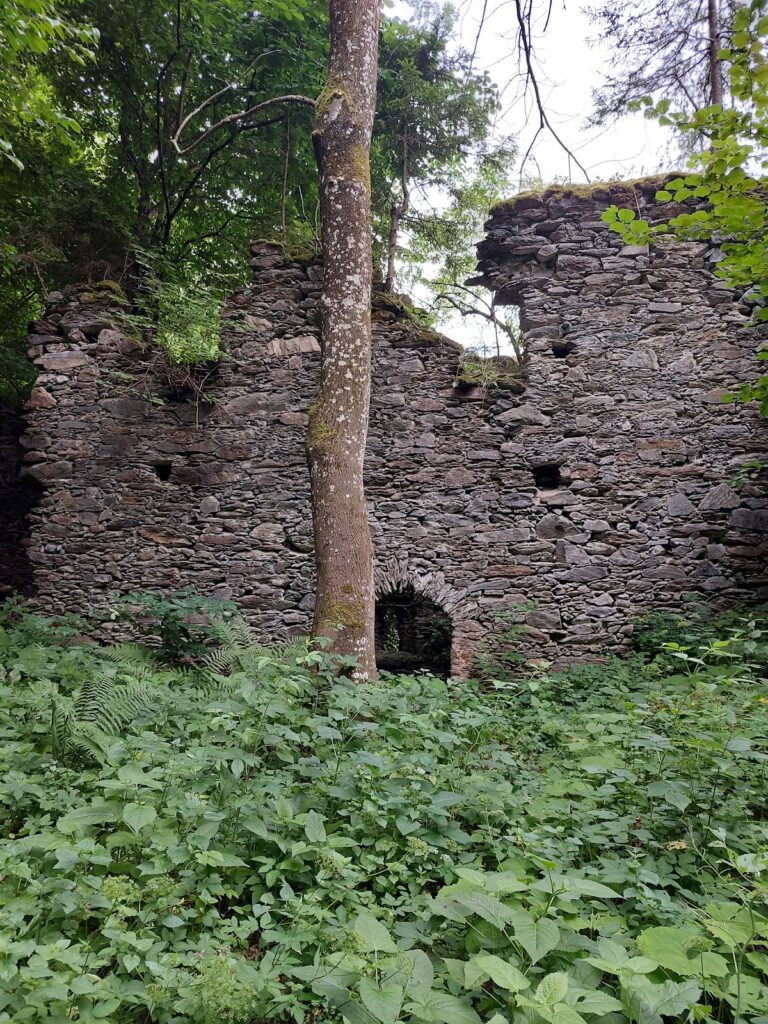
The castle’s decline began during Kinz’s ownership. Its roofs were removed and its wooden components dismantled, reportedly because of the roof tax introduced by Emperor Joseph II in the late eighteenth century. Part of the complex was allegedly still inhabited near the end of the nineteenth century. A drawing from 1850 shows the castle still completely preserved at that time. The ruin is now owned by the Zwillink family. In 1996, the municipality of Glanegg leased it for 25 years and entrusted it to the Burgverein Glanegg, a local association dedicated to the castle’s preservation and revitalization.
Remains
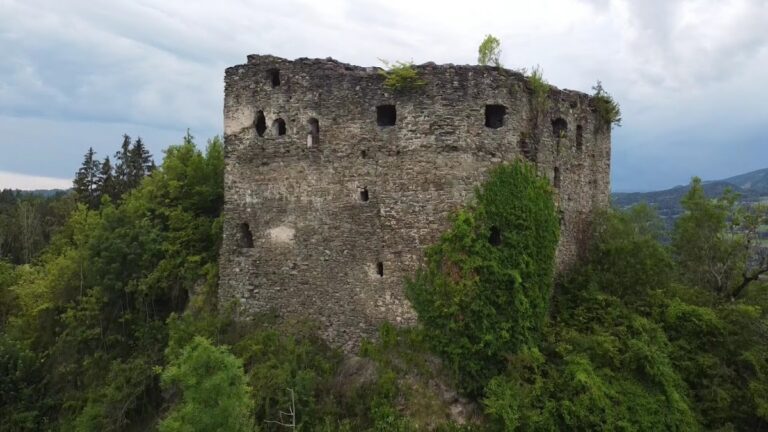
The surviving complex extends across a hilltop in the Glan Valley. Its form reflects successive building and alteration from the Romanesque period, a medieval style characterized by massive masonry, thick walls, and relatively small openings, through the Renaissance, which drew on renewed interest in classical forms. The extensive fortress retains a defensive layout centered on a Romanesque keep and an imposing entrance approach.
Romanesque Keep
The core of Glanegg is a Romanesque keep, the principal fortified tower of the castle. It includes a signal window, a feature associated with communication and observation within the defensive complex. The keep represents the earliest architectural phase identified in the surviving buildings, while later alterations extended the fortress and contributed Renaissance elements to the overall structure.
Entrance and Round Tower
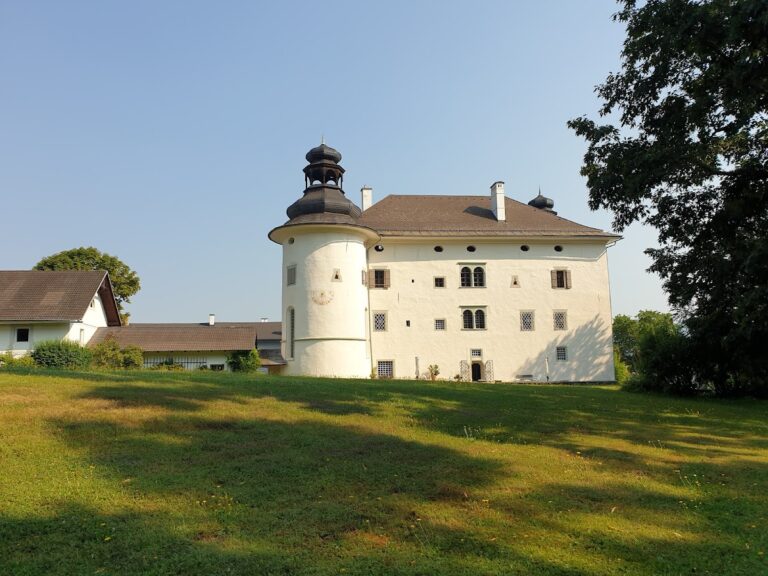
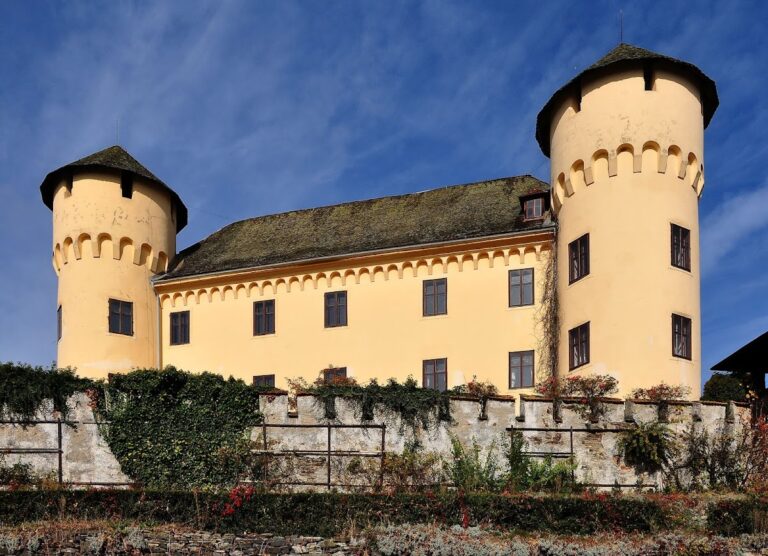
A huge round tower protects the entrance to the castle. It is the most distinctive feature of the approach and forms a major part of the defensive architecture. Together with the keep and the surrounding hilltop complex, the tower preserves the physical organization of Glanegg as a fortress controlling movement through the Glan Valley. The roofs and wooden components were dismantled after the nineteenth-century decline, leaving the masonry structures in ruinous form today.