Burg Thalberg: A Medieval Castle in Austria
Visitor Information
Google Rating: 5
Popularity: Very Low
Country: Austria
Civilization: Unclassified
Site type: Military
Remains: Castle

History
Burg Thalberg is located in the municipality of Schlag bei Thalberg in modern-day Austria. It was constructed by people of the medieval Holy Roman Empire during the late 12th century as part of efforts to secure the border region against incursions from the neighboring Kingdom of Hungary.
The castle’s origins trace back to between 1171 and 1180 when Leopold von Erlach commissioned its building as a territorial fief. It appeared in written records for the first time in 1209, naming Leopold’s sons, Erhard and Heinrich von Krumbach, as the owners. Over the following centuries, the fortress changed hands several times among noble families. In 1346, Ulrich den Tursen took possession, and during the 15th century, the Neuberg family as well as the Herren von Rottal held the estate. Beginning in 1523, the Dietrichstein family controlled the castle until 1557, after which ownership passed to the Rauber family from 1565 onward.
During the turbulent 16th century, the castle assumed a significant role as a center for Protestant worship in the northern Styrian region. This period also brought military challenges; around 1530, Burg Thalberg suffered damage during raids by Turkish forces. Later, the fortress provided sanctuary for local people during major conflicts such as the Turkish War in 1683 and also during Kuruc (anti-Habsburg Hungarian insurgents) attacks in the early 18th century, specifically in 1704 and 1708.
In 1603, Wolfgang Unverzagt became the owner before the property was transferred to the Jesuit order based in Graz in 1610. The Jesuits maintained control until their dissolution in 1773, after which the castle became state property. By 1797, it was sold at auction. Over the 19th century, Burg Thalberg gradually fell into decay and was partially dismantled to serve as a source of building stones.
At the beginning of the 20th century, restoration efforts were initiated by Anna Potzinger, an owner with an interest in preserving the structure. During this time, the castle was repurposed for use as a guesthouse and a facility for convalescence. Since 1918, the Hauke-Gißlinger family, now known as Gisslinger, has owned Burg Thalberg and has continued renovation and preservation work.
Remains
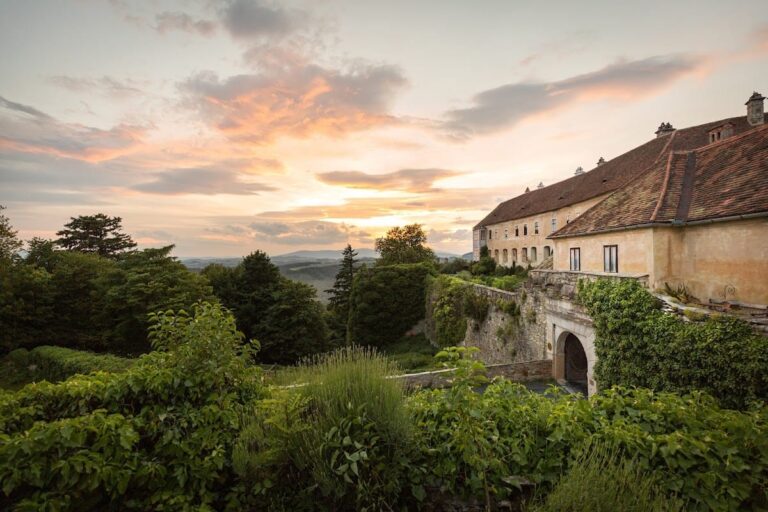
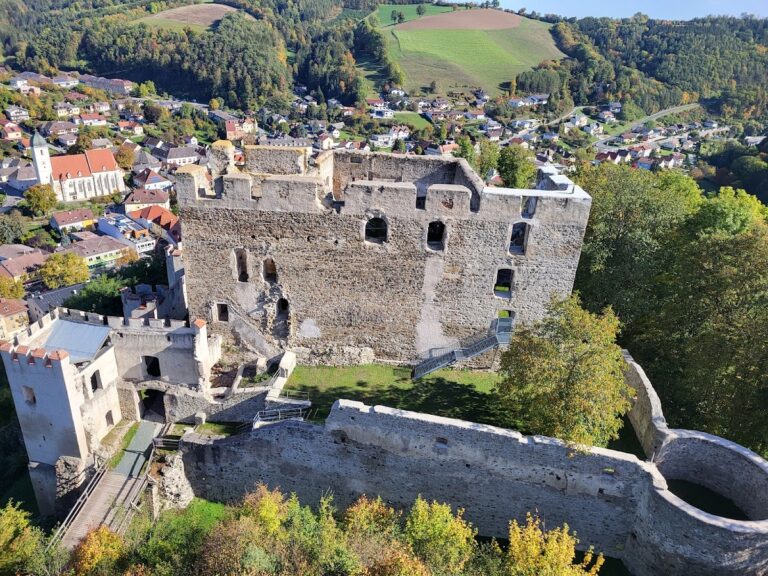
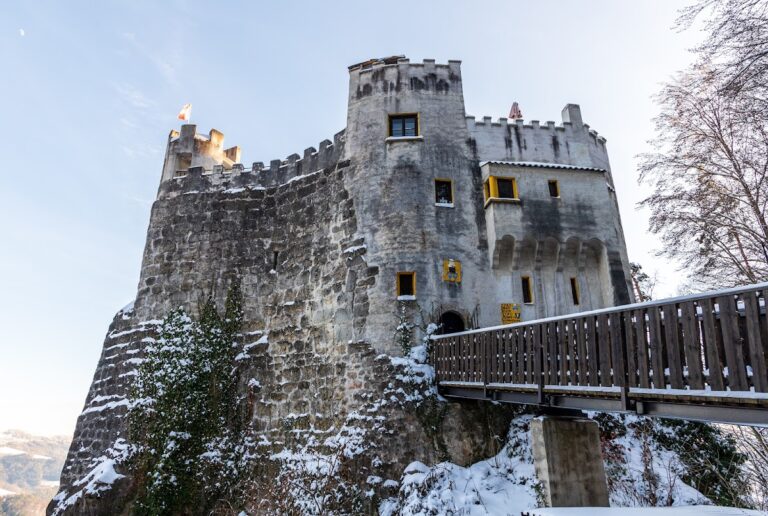
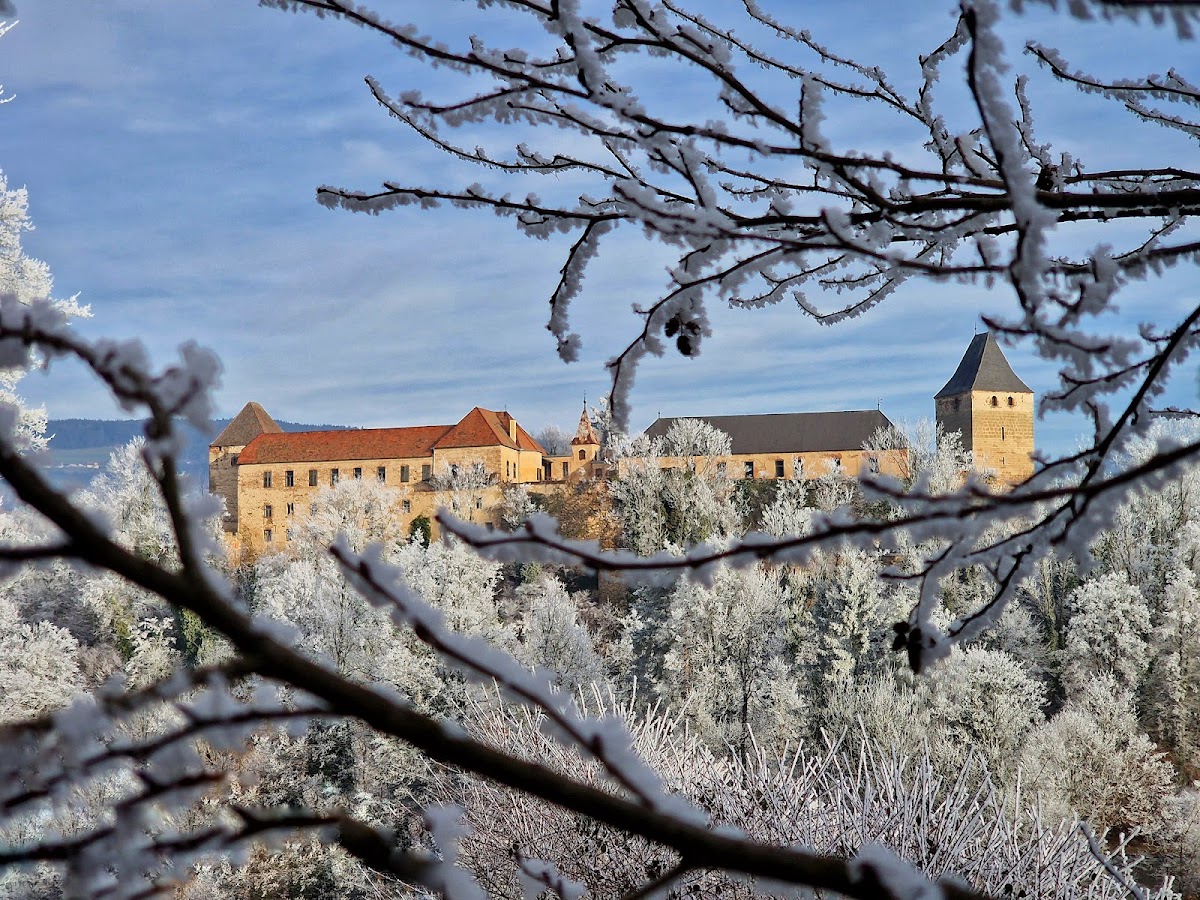
Burg Thalberg occupies a hilltop position and features a lengthy upper castle complex stretching about 90 meters long and 23 meters wide. Much of the original Romanesque stonework survives, showcasing medieval construction techniques combining ashlar blocks (carefully cut stones) and rubble masonry. The fortress is marked by two substantial square towers at each end of this elongated enclosure. The eastern tower, rising approximately 24 meters tall, is a bergfried, or main keep, built to defend the entrance. Its gatehouse is integrated into this tower and includes an elevated round-arched opening about 4.5 meters above ground, framed by two engaged columns topped with preserved ornamental capitals shaped like buds.
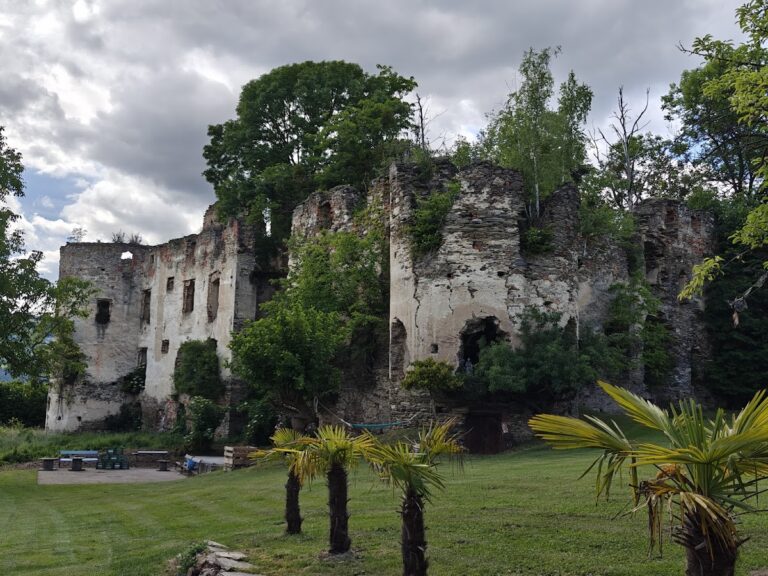
A 12-meter-high wall encircles the main section of the castle, linking the bergfried to a smaller western tower, creating a strong defensive barrier. Nearby, a considerable outer courtyard stretches 50 meters along the complex’s edge. On the courtyard’s northern side stands a three-story residential building with roots in the Romanesque period, later expanded with late Gothic elements. Although the interior ceilings have collapsed over time, this structure remains roofed and recognizable as a ruin.
Within the inner courtyard, the west side is bordered by a three-story palas, the great hall or main living area of medieval castles. This building shows later Gothic and seventeenth-century modifications: its north wing was remodeled in the late Gothic style, while the south wing reflects 17th-century alterations. On the upper floor, a cross-wing separates the inner and outer courtyards and contains the two-bay St. Nicholas Chapel, originating from the late Gothic period. Around 1910, the chapel underwent a neo-Gothic renewal, with its choir projecting outward into the outer courtyard in the form of an oriel, a bay window structure supported from below. Adjacent to the chapel is a small hall notable for a central supporting column and decorative Baroque stucco rib vaulting on its ceiling.
Restoration work in the early 20th century altered parts of the palas interior, removing original coffered ceilings—decorative sunken panels—and replacing formerly ornate courtyard galleries with simple external corridors, changing the castle’s internal circulation.
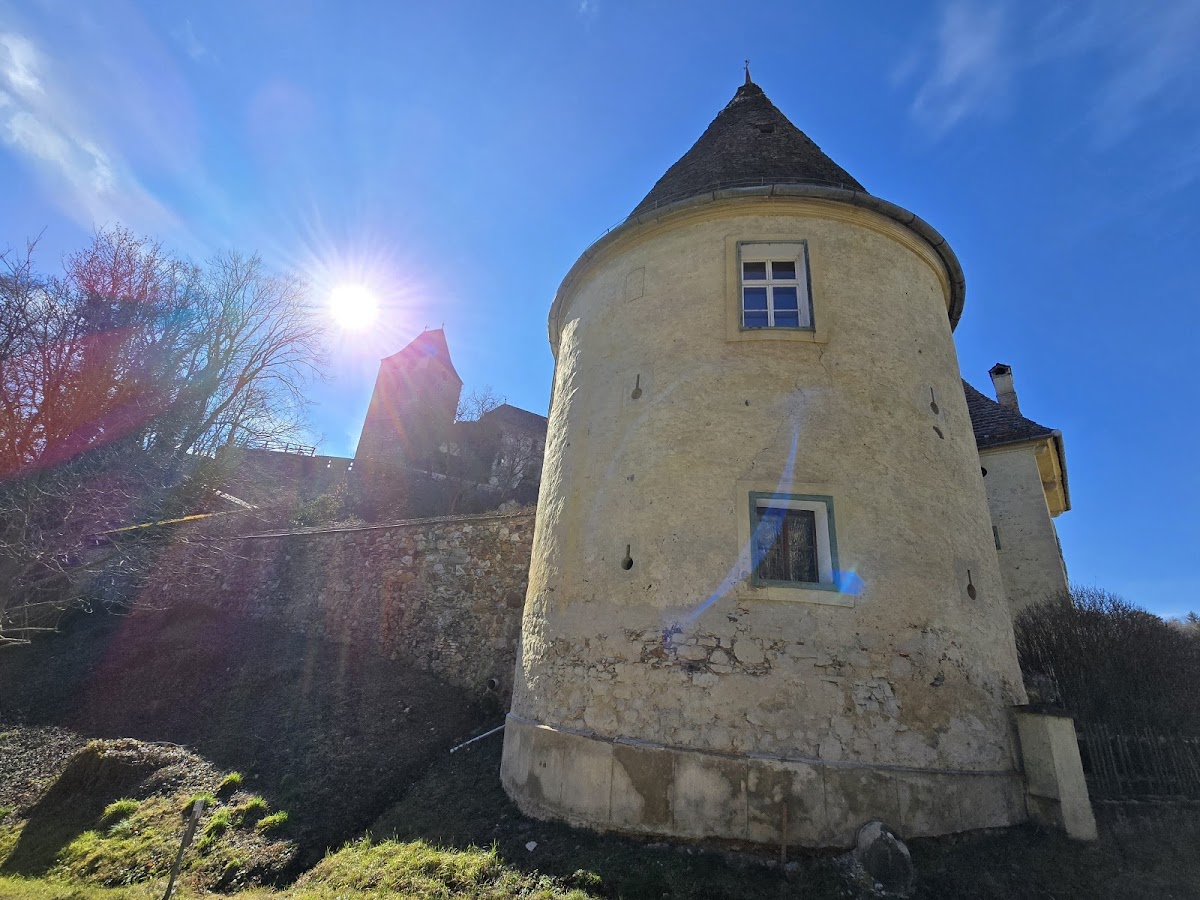
Among the preserved Romanesque details are fragments of an ornamental frieze on the eastern gate, and two bricked-up windows featuring double arches, typical of the period’s architectural style. A low curtain wall dating from the 15th century encloses the entire upper castle, forming a narrow defensive area known as a zwinger, or kill zone. The battlements and protected walkways atop this wall are no longer in existence.
At the base of the hill lies an outer bailey—an enclosed courtyard added in 1499—separated from the main castle by its own curtain wall and featuring a gatehouse that once contained a drawbridge portal. A large granary, three stories high and dating from the 17th century, occupies the southwestern corner of this outer courtyard, indicating the castle’s role in storage and supply during that period. Together, these surviving elements demonstrate Burg Thalberg’s evolution as a fortified residence adapted through centuries of military, religious, and residential functions.
Nearby sites