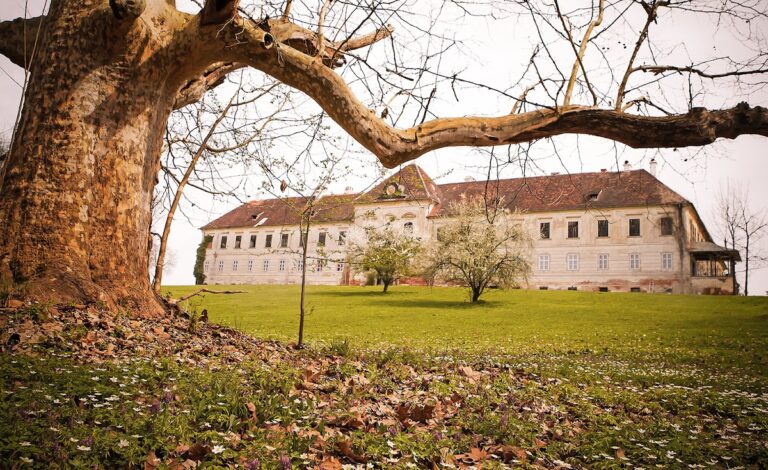
Schlaining Castle: A Medieval Fortress and Peace Centre in Austria


Site at a Glance
- Rating
- 4.6
- Popularity
- Medium
- Country
- Austria
- Primary era
- Medieval
- External website
- Open
- Eras represented
- Medieval, Early Modern, Modern
- Civilizations
- Habsburg, Hungarian
- Site type
- Military
- Remains
- Castle
On this page21 sections
History
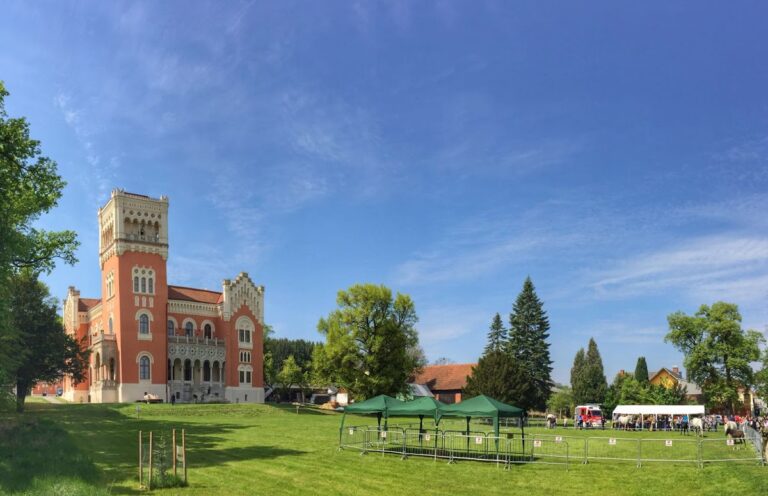
Schlaining Castle is a medieval hilltop fortress in Austria, on the outskirts of Stadtschlaining in Burgenland. Its fortifications appear to have been established by Slavic groups, and the castle was first recorded in 1271 as castrum Zloynuk. It occupied a strategic position on a north-south route across the Bernstein Mountains, while later routes from Steinamanger, Graz, Wiener Neustadt, and Ödenburg met in the surrounding area.
Medieval origins and changing lordships
In 1271, Schlaining belonged to the Counts of Güssing, whose forces were defeated by Charles I Robert of Anjou, king of Hungary. The castle was then granted as a fief to the powerful Kanizsay family. Its name passed through several forms before “Schlaining” became official in 1786.
King Sigismund pledged the castle in 1397 to Nikolaus Zarka of Pecöl and his son-in-law Georg Tompek, also known as Tannpeck, of Oroszvár. In 1401, the property was assigned to Georg Tompek and his brother Johann. These transfers formed part of the castle’s wider medieval history of royal grants, pledges, and changing aristocratic control.
Andreas Baumkircher and the Batthyány family
Emperor Frederick III conquered the Schlaining lordship and castle in 1445, incorporated them into his domain, and soon pledged them to Andreas Baumkircher, a mercenary commander. Baumkircher acquired neighboring estates, and by 1471 the lordship included all or parts of 30 villages. With Frederick III’s permission, a town was founded beside the castle.
Baumkircher shifted his allegiance between Frederick III, Ladislaus V of Bohemia and Hungary, and Matthias Corvinus, the fifteenth-century king of Hungary and Croatia. Corvinus granted him the rank of banneret, a nobleman entitled to lead troops under his own banner. Baumkircher’s dispute with Frederick III, known as the Baumkircher Feud, lasted from 1469 to 1471. It ended with his capture and execution in Graz.
After further changes of ownership, Schlaining was granted to Franz Batthyány in 1471. The Batthyány family, a prominent Hungarian noble house with extensive regional estates, retained the castle for more than 370 years. Their religious tolerance helped Stadtschlaining’s Jewish community expand. By 1865, it numbered 650 people, more than 40 percent of the town’s population.
From confiscation to the twentieth century
Ludwig Batthyány, the last owner from the Batthyány noble line, became Hungary’s first prime minister on 17 March 1848 during the Hungarian Revolution. After the revolution was suppressed, a military tribunal sentenced him to death for treason. Following his execution on 6 October 1849, his property, including Schlaining Castle, was confiscated and transferred to the Hungarian Chamber.
Railroad builder Franz Schmidt purchased the castle in 1849, and his heirs held it until 1911, when ownership passed to Demeter Salesky. After the First World War and the collapse of the Habsburg Empire, Salesky surrendered the castle to the Hungarian Hermesbank.
Transformation into a peace centre
Federal minister Udo Illig acquired Schlaining Castle in 1957 and began efforts to preserve and restore the deteriorated complex. During the Cold War, he developed the idea of turning it into a Friedensburg, or “Peace Castle,” with a peace institute.
With the support of Federal Chancellor Bruno Kreisky, an association devoted to dialogue between East and West was founded in 1982. The castle’s Peace Centre became a place for meetings, discussions, and seminars. In 1983, the association became the Austrian Study Centre for Peace and Conflict Resolution, known as the ÖSFK. United Nations Secretary-General Javier Perez de Cuellar granted the organization the title “Ambassador of Peace” in 1987.
The restored complex became the home of the ÖSFK, the European Peace Museum, Burgenland cultural institutions, and a seminar and conference centre. The Second International Conference of Peace Museums took place there in 1992, and the ÖSFK established the European Peace Museum at the castle in 2000.
Recent restoration and interpretation
A major restoration campaign was decided in 2019 for the 2021 centenary exhibition marking Burgenland’s incorporation into Austria. Work on the facades, masonry, and historic interiors was carried out with the Federal Monuments Office, with attention to authenticity, accessibility, and fire protection. The work revealed original wooden floors and previously unknown wall paintings.
The permanent exhibition “We Are 100. Burgenland Writes History” connects the castle with the centenary of Burgenland’s incorporation into Austria. It explores the region’s political history, identity, economy, environment, emigration, refugee movements, and cultural, linguistic, and religious diversity. Its displays include original peace treaties, including the Treaty of Saint-Germain, the 1919 agreement that reorganized Austria and other parts of Europe after the First World War.
Schlaining is protected as a cultural monument. Its restored historic fabric and its continuing use for peace research, cultural activities, exhibitions, seminars, and conferences define much of its modern identity.
Remains
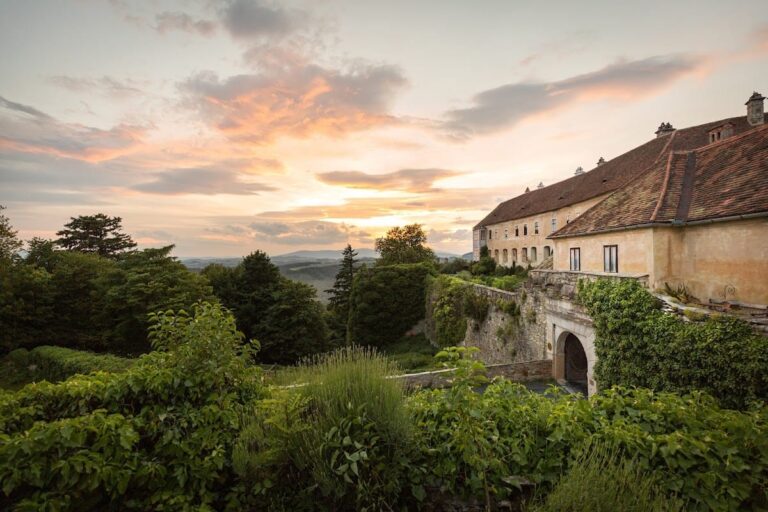
Schlaining Castle is a stone-and-brick fortress on a hill near Stadtschlaining. Its historic approach followed a straight uphill road to the main gate and crossed a drawbridge. The long castle bridge has been completely restored, while the route known as the “Forbidden Way” follows the exterior of the complex and provides access around its walls and towers.
Courts, walls, and defenses
Black Court
The Black Court is regarded as the oldest part of the castle complex. Its name comes from prominent sgraffito decoration, a technique in which contrasting surface layers are scratched through to create patterns, on the stairway and transverse arches. Three cisterns cut into the rock lie within the court. These reservoirs formed part of the castle’s water supply and stored drinking water during a prolonged siege.
Great Castle Courtyard
The Great Castle Courtyard is enclosed by a continuous stone wall. Residential and service rooms once stood against its inner side. Five chestnut trees arranged in the shape of a crown commemorate the coronation of Empress Elisabeth of Bavaria as Queen of Hungary.
Towers and gate area
The principal defensive towers, including the cannon towers, date from the fifteenth century. Two sandstone resting rams from the eighteenth century stand near the bridgehead of the third gate. A Baumkircher memorial stone, also called the Baumkircher Monument, is built into the northern wall.
Interior rooms and religious buildings
Knights’ Hall
By the fifteenth century, during Andreas Baumkircher’s time, the Knights’ Hall served as the principal representative room for feasts and meetings. Above its entrance is a decorative painting dated 1740, combining secular, religious, and ornamental themes. The hall’s frescoes are among the oldest secular interior decorations in Burgenland.
Castle chapel and Granarium
The castle chapel has spacious, light-colored interiors and is still occasionally used for services. A small organ made by Jakob Häcklinger in 1695 remains inside. The Granarium, once the principal granary, now houses the Friedensburg seminar centre, with small seminar rooms and larger halls for conferences and events.
Former Church of Saint Mary
The former Church of Saint Mary stood against the inner side of the defensive wall. The church disappeared after a later chapel was built, but fragments of its masonry indicate its former position. Local tradition says that Baumkircher’s daughter Martha carried her father’s body to Schlaining in a silver coffin and buried him in the church. The associated legend says that his ghost sometimes appears at night carrying his severed head.
Paintings, exhibitions, and associated buildings
Wall paintings and historic fabric
Restoration exposed original wooden floors and wall paintings in the castle. A tower room contains frescoes probably dating from around 1500. Their use of Egyptian Blue, an ancient synthetic pigment made with materials including silica, copper, and calcium, was considered an exceptional discovery because the pigment is said to occur at only two other European locations.
Peace and Burgenland exhibitions
One of the castle halls contains the permanent peace and Burgenland exhibition. Alongside the Treaty of Saint-Germain, it presents other peace treaties connected with the conclusion of wars and conflicts. Open areas within the complex include a stage-and-tribune system used for concerts, ceremonial tournaments, cultural events, and international conferences. The castle arena occupies the event area associated with the former moat.
Former Schlaining Synagogue
The former Schlaining Synagogue stands on the town’s main square immediately beside the Friedensburg. Built in the eighteenth century, it is considered one of the best-preserved synagogues in Burgenland. The adjacent rabbi’s house is also a protected historic building. After the Jewish population was expelled in 1938 and its property confiscated, the synagogue remained vacant for many years after the Second World War. Representatives of the Austrian Study Centre for Peace and Conflict Resolution acquired it in the 1980s.
Peace relic
One of Sadako Sasaki’s folded paper cranes is preserved at the Friedensburg. Sasaki, a Japanese girl who developed leukemia after the atomic bombing of Hiroshima, became internationally associated with folded paper cranes. The preserved crane commemorates the consequences of war and the vulnerability of children, and its outline is also used in the peace institute’s logo.
Former forge and arsenal
The former fifteenth-century forge and arsenal buildings opposite the castle were converted into the Burghotel Schlaining. Conservation-sensitive reconstruction and construction took place from March 2020 until the building’s full opening in late March 2022, giving these former working and military structures a new use within the historic setting.