Burg Reichenbach: A Medieval Castle Ruin in Germany


Visitor Information
Google Rating: 4.6
Popularity: Very Low
Google Maps: View on Google Maps
Official Website: www.burgverein-reichenbach.de
Country: Germany
Civilization: Unclassified
Remains: Military

History
Burg Reichenbach is a medieval castle ruin situated near the town of Hessisch Lichtenau in present-day Germany. It was originally constructed in the mid-11th century by a branch of the Counts Gozmar, a noble family that later took the title Counts of Reichenbach starting in 1089. The earliest recorded member of this lineage is Count Gozmar II., who notably served as the high advocate of the Fulda Abbey from 1117 until 1139.
Located in a border zone between the regions of Hesse and Thuringia, Burg Reichenbach occupied a strategically important position throughout the Middle Ages. This frontier status meant the castle was often involved in territorial disputes, changing hands multiple times through inheritance disagreements, armed sieges, and political deals. The surrounding power struggles involved various influential parties, including the Ludowingians, the Archbishopric of Mainz, and the Landgraves of Hesse.
In 1207, the Counts of Reichenbach made a significant religious endowment by donating a nunnery and its accompanying lands to the Teutonic Order. This marked the first establishment of the Order on German soil. Over the following centuries, the castle’s role shifted to support administrative and leisure functions, serving as both a hunting lodge and the seat of a local government district (Amt) under the Landgraves of Hesse from at least 1315 onwards.
Burg Reichenbach also saw involvement in regional conflicts such as the Sternerkrieg, which took place between 1376 and 1380. It holds historical significance as the place where Landgrave Ludwig II died in 1471. After 1490, the castle’s administrative importance declined as this role was transferred to the nearby town of Lichtenau. Subsequently, the castle was converted for use as a tithe barn, a storage facility for agricultural taxes paid in kind, until approximately 1540.
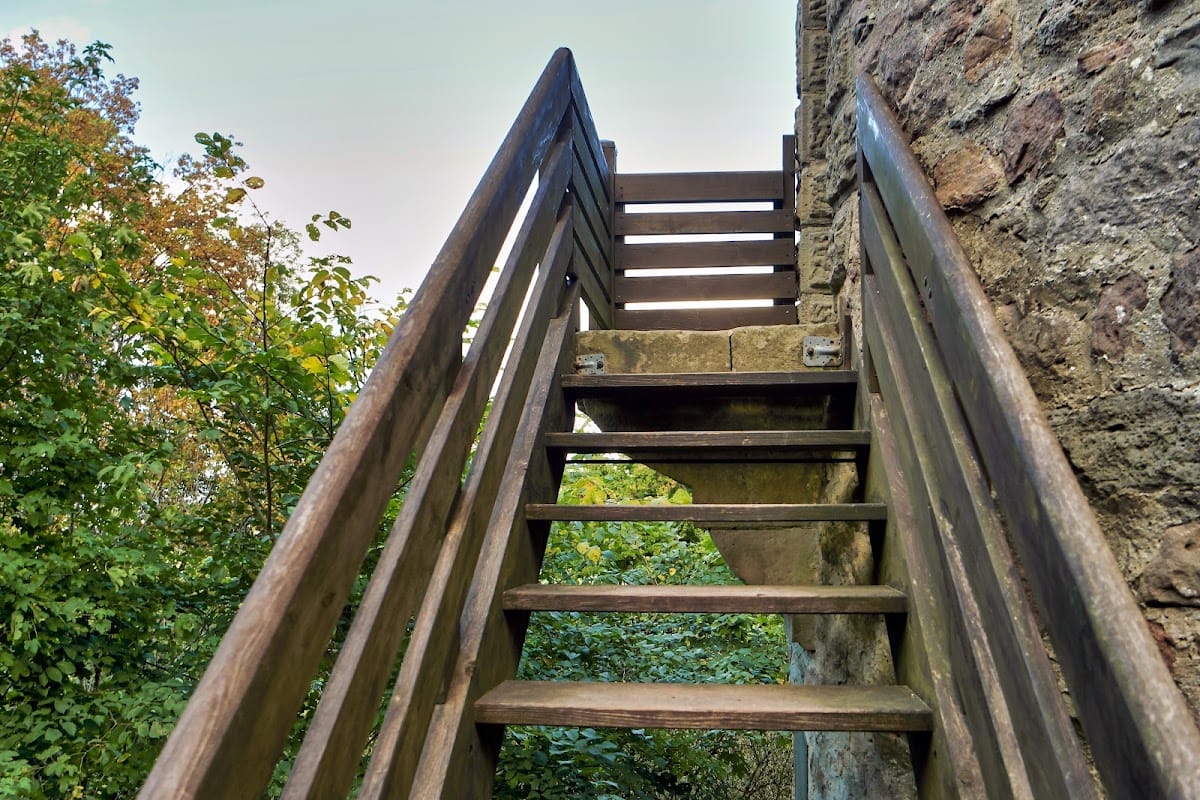
Following the Schmalkaldic War, imperial authorities ordered the castle’s destruction around 1550. Despite this, some of its towers survived into the late 17th century. Over the next centuries, the structure steadily fell into ruin, with parts such as the southeast tower collapsing in 1820. By the late 19th century, archaeological excavations began under the guidance of monument conservators like Gottfried Ganȣauge, marking a renewed effort to preserve and understand the site. Between 1899 and 1901, the main tower, or bergfried, was repurposed as an observation tower. This restoration work continued intermittently throughout the 20th century, accompanied by efforts to maintain the ruins and provide safer access. A local preservation society was founded in 1966 to oversee ongoing care, including installing a new external staircase in 2004.
Remains
Burg Reichenbach is positioned atop the Schlossberg, standing at 522.3 meters above sea level. The castle’s commanding vantage point overlooks several valleys, including those carved by the Losse, Hollsteine, Vockebach, and Essebach streams. This location lies within the Reichenbacher Kalkberge, a protected nature reserve characterized by limestone formations. The castle’s layout reflects typical Romanesque fortress design aimed at controlling the borderlands between Hesse and Thuringia.
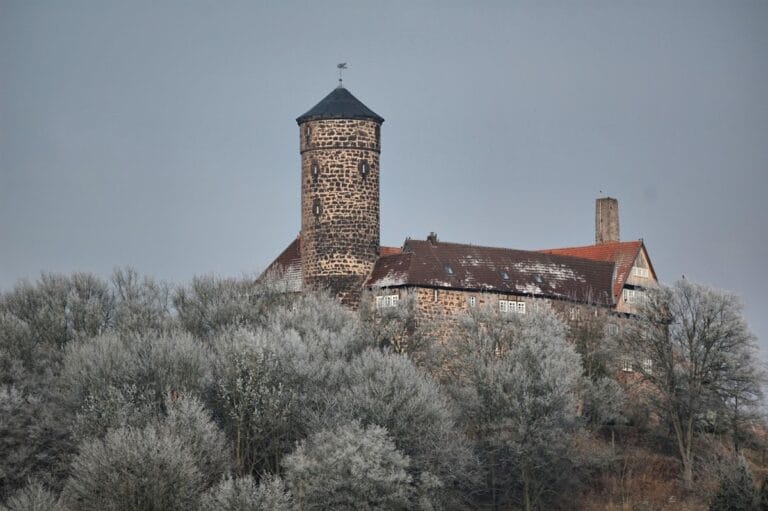
Among the surviving structures, the most prominent is the bergfried, or main tower, which was restored during the late 19th and 20th centuries and converted into an observation point. The bergfried features reinforced masonry and had its battlements sealed to enhance stability and safety. It provides visitors with expansive views of the surrounding landscape, including distant forested regions such as the Kaufunger Wald, as well as hills like the Hohen Meißner and Eisberg within the Stölzinger Gebirge, and the Himmelsberg in the Melsunger Bergland.
Another notable feature is the shield wall (Schildmauer), a defensive barrier designed to protect the castle’s most vulnerable approaches. This massive wall helped strengthen the fortress against sieges and attacks common in the medieval border conflicts. The castle was also secured by two neck ditches, sometimes referred to as small and large Halsgraben. These deep, dry moats cut into the rock formed additional obstacles for potential assailants, severing the castle from the adjoining hill ridge and making direct assaults more difficult.
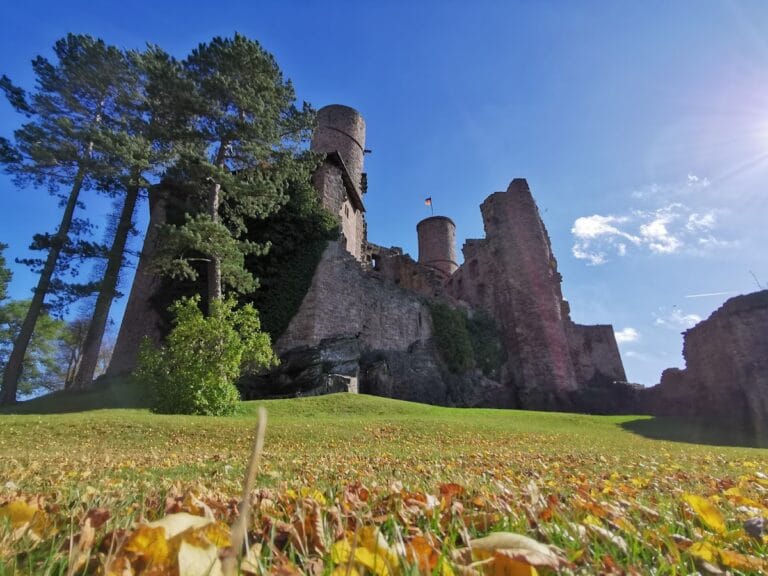
The southeast tower, which once complemented the bergfried, collapsed in 1820, contributing to the castle’s gradual decline. Over centuries, the ruins were quarried by locals, accelerating the degradation of masonry and wall remnants. Archaeological work carried out primarily in the late 19th and early 20th centuries revealed important structural details and unearthed various artifacts, though specific decorative features or inscriptions have not been extensively recorded.
Today, the remains stand as a testament to the castle’s storied past, with carefully maintained ruins that reflect both its military functions and later adaptive uses. The bergfried’s conversion to an observation tower serves as both a preservation effort and a window into the landscape that shaped the castle’s role throughout its history.
Nearby sites