Burg Sensenstein: A Hessian Border Fortress and Youth Education Center


Site at a Glance
- Rating
- 4.3
- Popularity
- Low
- Country
- Germany
- Primary era
- Medieval
- External website
- Open
- Eras represented
- Medieval
- Civilizations
- Holy Roman Empire
- Site type
- Military
- Remains
- Castle
On this page12 sections
History
Burg Sensenstein is a former hilltop border fortress in Germany, built by Hermann of Hesse around 1372 during the late medieval period. It stood on the Gerholdsberg above Sensenstein, opposite the older Burg Sichelnstein, which was substantially enlarged in the same year. The two strongholds guarded the former frontier between Hesse and Brunswick, where raids and attempts to seize grain had made the border region unstable.
Border fortress and local tradition
Hermann, then co-ruler and later Landgrave Hermann II, established Sensenstein to curb raids by Brunswick forces into Hessian territory. A landgrave was a high-ranking territorial ruler in the Holy Roman Empire, broadly comparable to a prince. The castle’s position opposite Sichelnstein gave it a direct role in the military rivalry between the two territories.
A local tradition explains the names of the two castles through this rivalry. According to the story, Brunswick Duke Otto I, known as Otto the Quade, built Sichelnstein to support grain raids into Hesse. Hermann II then founded Sensenstein opposite it, expressing wider defensive aims. The tradition associates both castles with border conflicts and efforts to capture grain, although it belongs to local historical memory rather than the documented sequence of ownership.
Fiefs and changing ownership
In 1438 Landgrave Ludwig I of Hesse granted Sensenstein as a fief to the knight Sittich von Berlepsch, who had previously held Schloss Berlepsch near Witzenhausen. A fief was property granted by a ruler in return for service and loyalty. In 1461 the two estates changed status within the Berlepsch family’s sphere. Schloss Berlepsch became the family’s hereditary seat, while Sensenstein became a Hessian hunting residence associated with the Kaufung Forest, the wooded upland region east of the site.
From 1483 to 1561 Sensenstein and its estates were again held as a Hessian fief by the Counts von Berlepsch. As its feudal lords and owners changed, the castle lost importance and increasingly deteriorated. By 1585, only an estate farm connected with the ruins remained. From 1601 the property was managed by Eberhard von Weyhe, chancellor to Landgrave Moritz of Hesse-Kassel.
Demolition and estate history
The property stood unused from 1626 until 1677. In that year Hessian Privy Councillor Count Dietrich von Kunowitz acquired it, cleared away the decayed buildings, and had the remaining 22-metre-high section of the keep demolished with explosives. A keep was the principal defensive tower of a medieval German castle. This work completed the physical decline of the medieval castle buildings, leaving the site’s earthworks and scattered masonry as its principal archaeological evidence.
In 1699 Amalia of Courland, the wife of Landgrave Karl of Hesse-Kassel, and her son Maximilian acquired the estate together with the neighboring Windhausen estate. In 1767 both properties passed to Major General Martin-Ernst von Schliefen, but they returned to Hessian state ownership after six years. A state property was an estate administered directly by the state rather than held privately as a fief.
From estate to educational center
The last tenant left Sensenstein in 1900. The property then remained uninhabited, while its lands were managed from Windhausen. Shortly after the First World War, a Kassel innkeeper leased the deteriorated estate buildings, repaired the residential house, and converted it into an inn. The establishment operated until the beginning of the Second World War and became a popular excursion destination.
In 1946 the Kassel district youth service held its first youth camping holiday at Sensenstein. The activity became permanent, encouraging the District of Kassel to acquire the entire grounds in 1954. The former timber-framed inn was converted into the district’s first youth center. The foundation stone for the District of Kassel Youth Education Center was laid on 17 September 1960, and the complex opened as Jugendburg Sensenstein on 29 September 1962, with a guesthouse, gymnasium, and swimming hall.
A second guesthouse with an auditorium followed in 1966. In 1996 the Hessian State Sports Association helped finance a large sports hall and the complete renewal of the sports field, becoming a second operator of the complex. The swimming hall was extensively renovated in 2001. The District of Kassel and the Hessian State Sports Association now operate the Sensenstein educational and sports center, which serves sports clubs, school classes, youth groups, and adult education. The former castle site itself is an archaeological monument and a Burgstall, the site of a former castle whose buildings no longer survive but whose earthworks or fragmentary masonry remain.
Remains
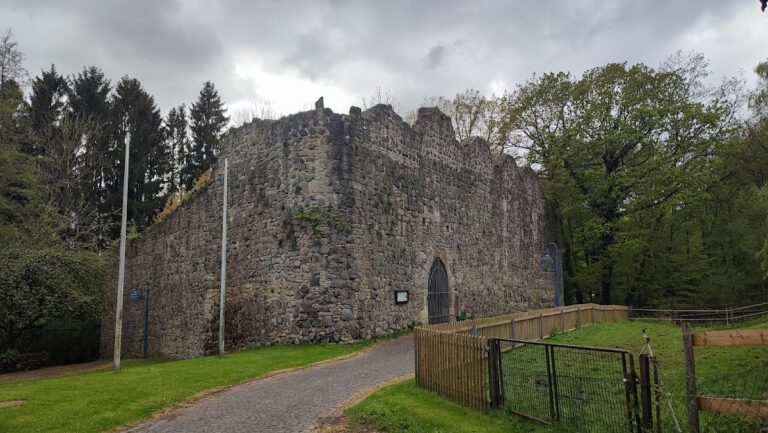
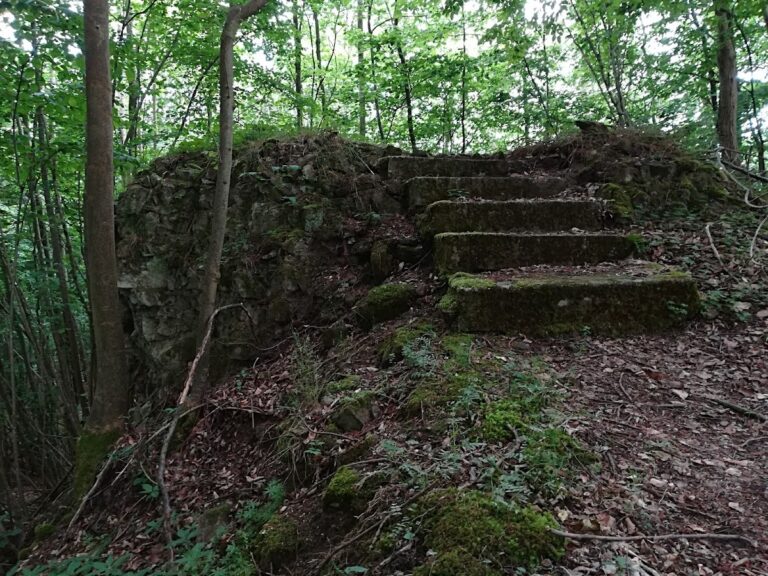
Burg Sensenstein occupied the summit of Gerholdsberg at about 355 metres above sea level. The hill rises south of the Nieste valley in the eastern part of the Kassel Basin, near the western foothills of the Kaufung Forest and north of Kaufungen. As a summit-position castle, it was built from dressed stone blocks and rubble stone. Its surviving archaeological form consists mainly of high ramparts, ditches, and a few wall remnants, while the castle buildings themselves were demolished. The earthworks preserve an indication of the former defensive layout and scale of the stronghold.
Estate building and modern grounds
Timber-framed administration building
The well-preserved timber-framed building that once housed the estate inn and the first district youth center now serves as the administration building of the Sensenstein complex. It is the surviving building most directly connected with the site’s transition from declining estate to modern educational institution.
Education and sports facilities
The adjoining modern complex covers approximately 20 hectares. It contains guesthouses, an auditorium, an education and conference house, a sports hall, a swimming hall, and sports grounds. The later facilities include a large sports hall and a sports field suitable for competitions. These buildings occupy the grounds next to the former castle site rather than reproducing the medieval fortress.
Contemporary artworks at the entrance
The Giant
In front of the Sensenstein portal stands The Giant, a metal sculpture more than four metres high. Austrian artist Robert Colnago created it during the European Art Camp associated with Documenta 2002, the recurring contemporary-art exhibition held in Kassel. The sculpture was installed in 2004 and was intended to welcome visitors rather than threaten them.
Iron entrance gate
In 2006 Colnago created a new entrance to the youth complex from fragments of old agricultural machinery that had been left to decay at Wülmersen Water Castle, a historic moated castle complex in Hesse. The gate incorporates 250 kilograms of iron components and forms part of the modern approach to the educational center.