Banasa: A Roman Colonia in Northern Morocco


Visitor Information
Google Rating: 4.2
Popularity: Very Low
Google Maps: View on Google Maps
Country: Morocco
Civilization: Roman
Remains: City

History
Banasa is located in northern Morocco, near the modern area of Lamaatga Ouled Allal. It was originally a Mauretanian village inhabited since at least the 4th century BC. This early settlement engaged in pottery production influenced by Phoenician, Greek, and Ibero-Punic styles, which were widely traded in the region.
Between 33 and 25 BC, the Roman Emperor Augustus established Banasa as a colonia, a settlement for veterans of the Battle of Actium. The city was then known as Iulia Valentia Banasa. Its position on the southern bank of the Sebou River placed it on the road linking Tingis (modern Tangier) to Sala.
At the beginning of Marcus Aurelius’s reign in the late 2nd century AD, the city was renamed Colonia Aurelia Banasa. During this period, Banasa continued to develop as a Roman urban center with administrative and commercial functions. Military auxiliary troops were stationed there until the early 3rd century AD, although no permanent fortifications have been definitively identified.
Around AD 285, Banasa was abandoned following a reorganization of the provincial boundaries, which were reduced north of the Lixus River. This change led to the city’s decline and eventual desertion. The site remained largely unoccupied after this period.
Banasa is also known for important inscriptions, including the Tabula Banasitana from AD 177. This bronze legal document granted Roman citizenship to a local tribal leader and his family. Another notable inscription is a bronze edict from Emperor Caracalla dated AD 216, which exempted the inhabitants of Banasa from certain taxes.
Remains
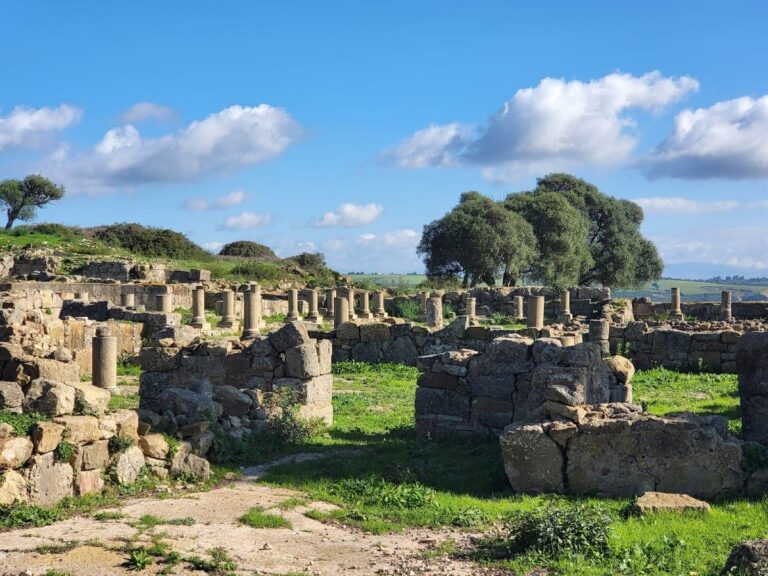
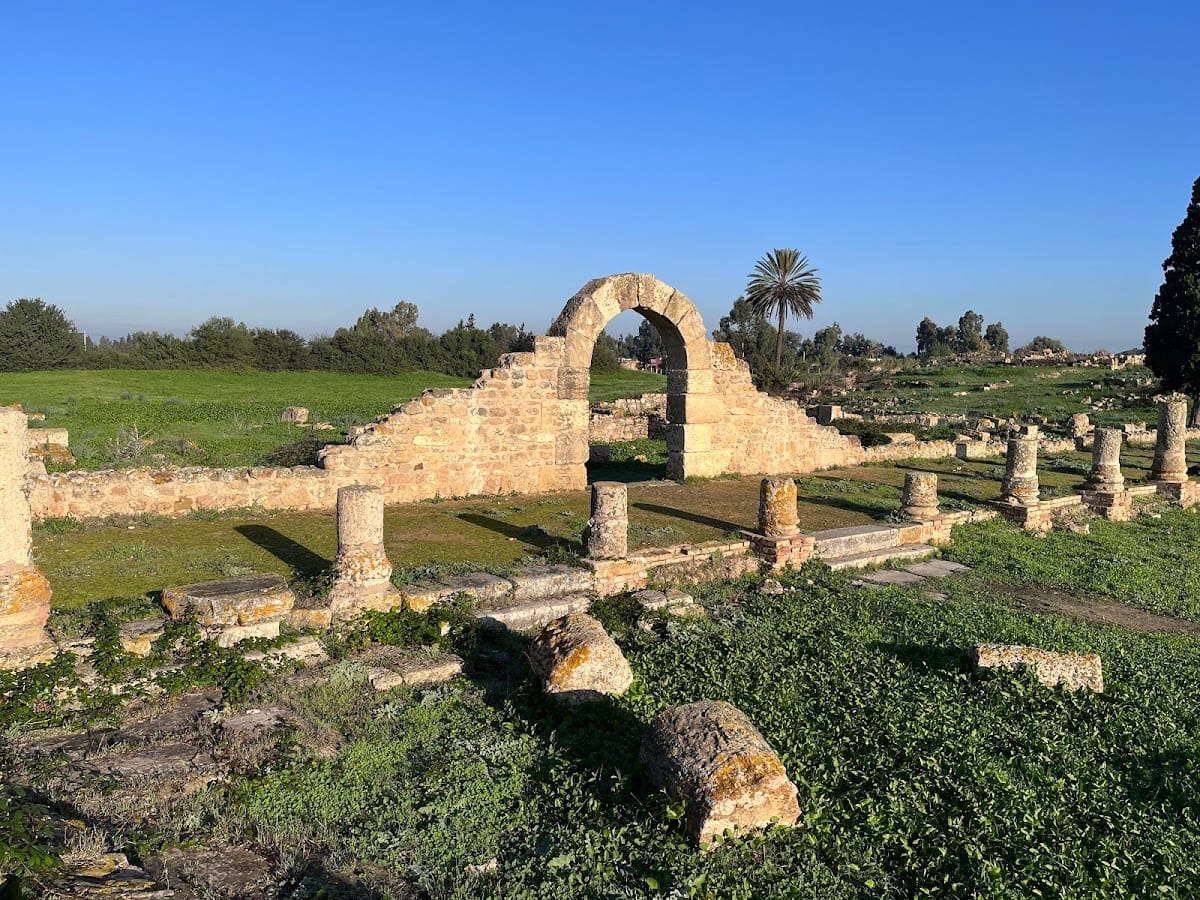
Banasa’s urban layout follows a regular grid pattern centered on a forum, the main public square. Around the forum stood key civic buildings such as a basilica, curia (city council building), and a Capitolium (temple dedicated to the Roman gods). The city also contained commercial structures, public baths, bakeries, oil production facilities, and a macellum, or market hall. A city wall enclosed about 4 hectares, though surveys suggest the internal area was larger.
One of the most studied structures is a large quadrangular warehouse built between the late 1st and early 2nd century AD. This building likely served as a granary for storing and distributing grain within the city’s economy. It measures roughly 307 square meters externally, with thick stone walls supported by external buttresses on three sides. The walls are constructed from layered stones of various sizes, with corners reinforced by alternating stone blocks.
Inside the warehouse, a small room of 17 square meters is located in the southwest corner. The main storage area had no permanent floor but probably featured a raised wooden platform supported by regularly spaced limestone blocks. This design allowed air circulation beneath the stored grain, similar to granaries found in Roman Britain and North Africa. Oak beams supported the wooden floor, which could bear the weight of stored grain and structural elements.
The warehouse’s storage capacity is estimated between 85 and 290 tonnes of grain, depending on how it was stored. The building was partially dismantled and leveled in the 3rd century AD, with its walls reused as foundations for later constructions. Earth was added to raise floor levels in subsequent phases.
Other buildings in Banasa have yielded decorative mosaics, now housed in the Rabat Archaeological Museum. Four bathhouses were discovered in Banasa.