Museum of History and Civilizations in Rabat: Morocco’s National Archaeological Museum


Site at a Glance
- Rating
- 4.3
- Popularity
- Low
- Country
- Morocco
- Primary era
- Classical
- Eras represented
- Stone Age, Iron Age, Classical, Medieval, Early Modern
- Civilizations
- Alaouite, Almoravid, Kingdom of Mauretania, Phoenician, Roman
- Site type
- Museum
On this page15 sections
History
The Museum of History and Civilizations in Rabat is a national archaeological museum in Morocco, established and opened in 1932 during the French Protectorate, the system of French colonial administration that governed Morocco from 1912 to 1956. Originally called the Rabat Archaeological Museum, it presents Moroccan history from prehistory through the Islamic period, with Phoenician, Mauretanian, and Roman history forming its principal pre-Islamic sequence.
Creation under the French Protectorate
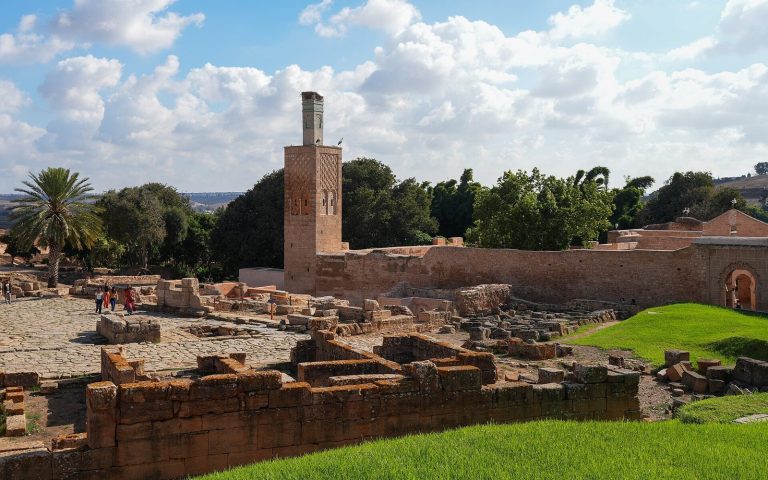
The museum’s core building was constructed during the 1920s to house the Service des Antiquités du Protectorat, the colonial administration responsible for antiquities. In 1930, the building was chosen for conversion into a nationwide archaeological museum. This decision brought numerous artefacts to Rabat, many of them excavated at Volubilis and Chellah.
The transfers followed systematic excavations begun in 1915 by Marshal Hubert Lyautey, the first French Resident-General in Morocco. Between 1930 and 1932, discoveries from Volubilis, Banasa, and Thamusida were placed on exhibition in Rabat. The museum’s architectural form was completed in 1957, when further discoveries also led to a considerable expansion.
From archaeological museum to national collection
After the 1957 expansion, the institution became a national museum. Since 1986, it has served as the repository of the National Museum’s collections. Its holdings come exclusively from archaeological sites in Morocco, including Volubilis, Lixus, Chellah, Banasa, and Thamusida, together with material associated with Fez, the Rif, and the Middle Atlas.
The collections contain approximately 550 items and are arranged chronologically. The prehistoric holdings cover human settlement from the Paleolithic through the Neolithic, the later prehistoric period associated with farming, animal husbandry, and settled communities. They include human remains from the Middle Paleolithic, probably associated with Neanderthals, through the Neolithic, including remains dated to approximately 4000 BC. The museum is described as containing the oldest human remains discovered in Morocco.
The pre-Islamic collections also present evidence of Mediterranean relations, particularly between Morocco and Carthage. The Mauretanian and Roman holdings are especially prominent. Mauretania was an ancient indigenous North African kingdom, while Mauretania Tingitana was the Roman province established in part of its former territory, broadly corresponding to parts of present-day northern Morocco. The Roman collection is the museum’s largest and includes marble and bronze sculpture associated with Roman Morocco.
Islamic collections and recent stewardship
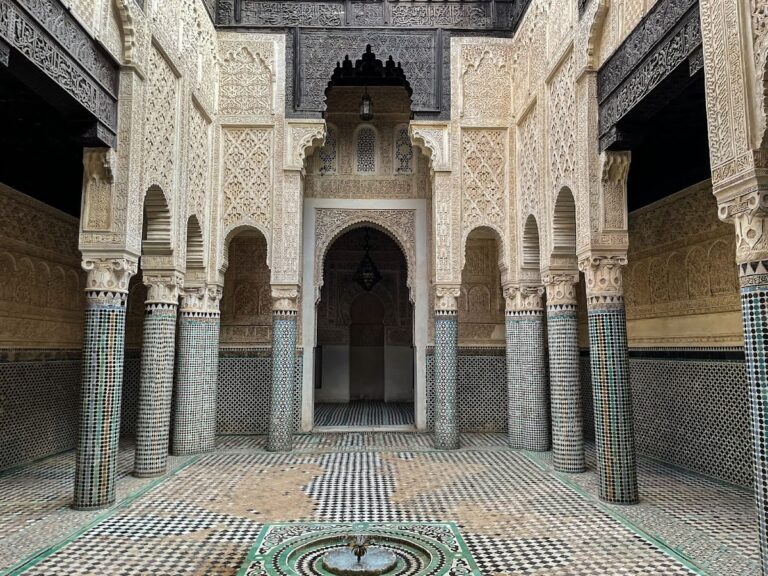
The Islamic collection follows Moroccan Islamic civilization from the Almoravid dynasty, which ruled much of the western Maghreb and al-Andalus in the eleventh and twelfth centuries, to the Alaouite dynasty, which has ruled Morocco since the seventeenth century. It includes Islamic coins, architectural elements, and ceramics made with the cuerda seca technique, in which raised lines separate differently coloured glazes.
Since 2014, the museum has been cared for and protected by the National Foundation of Museums. It closed for about a year for renovation and reopened under its present name on 12 April 2017. Its stated purpose is to preserve ancient art and make earlier, less familiar periods of Moroccan history accessible to the public.
Remains
The museum’s displays occupy three rooms, a patio, and a garden, with a separate pavilion for material from the Islamic period. A map in the entrance hall identifies the Moroccan archaeological sites that supplied the collections. The ground floor also includes space for temporary exhibitions, while the outdoor areas extend the presentation of inscriptions and stone artefacts beyond the main rooms.
Prehistoric and archaeological displays
Stone-tool traditions
The ground floor contains a broad display of prehistoric stone artefacts, including tools, arrowheads, axes, swords, pottery, polished stones, altars, sarcophagi, and inscribed carved stelae. A stele is an upright stone slab that may carry an inscription or commemorative design. The collections represent the Acheulean culture from sites including Sidi Abderrahmane and Daya el-Hamra, the Pebble or Oldowan culture of Arboua, Douar Doum, and Casablanca, the Mousterian industry associated with Neanderthals, and the Aterian culture, dated approximately 38,000 to 10,000 BC.
Neolithic and later material
Material from caves in the Tangier and Tetouan region illustrates agriculture, animal husbandry, developing technologies, and rock art during the Neolithic. The same ground-floor presentation includes fragments of tombs, rock engravings, and a reconstruction of a mosaic discovered at Volubilis.
Roman sculpture and bronze works
Hall of Marbles
The Roman collection is divided between the Hall of Marbles and the Hall of Bronzes. The Hall of Marbles contains white-marble sculptures from Iulia Valentia Banasa, Thamusida, and Chellah. Its notable works include a head of a young Berber dating from the reign of Augustus, the Sleeping Silenus, a sphinx, a marble ephebos crowned with ivy, and a first-century marble statue of Claudius Ptolemy. An ephebos is a representation of an adolescent or young man in ancient Greek and Roman art.
Hall of Bronzes
The oval Hall of Bronzes is devoted to works excavated at Volubilis. Around twenty ancient bronze statues are displayed, most of them found at that site. Their subjects include the Greco-Roman deities Venus, Juno, and Eros, political and historical figures such as Juba II and Cato, full-size figures including an ephebos, and objects connected with public life. Juba II was the Amazigh king of the ancient Kingdom of Mauretania, whose reign was associated with the kingdom’s political and cultural prominence during the early Roman period.
Among the best-known bronzes is the Volubilis Dog, a nude young soldier or trainee holding a lamp in his left hand and wearing an ivy crown. It was discovered in 1916 and dates from the reign of Hadrian in the early second century. The hall also contains a bust of Cato the Younger from the first century and the Tabula Banasitana, a Roman-era bronze inscription found at Banasa in 1957.
Inscriptions and outdoor stone works
Patio inscriptions
The patio presents Libyco-Berber, Latin, and Islamic inscriptions from Marrakesh. Libyco-Berber inscriptions are among the earliest written forms associated with the indigenous peoples of North Africa. The patio also contains the N’khila funerary stele and the Stele of Abu Yaqub Yusuf, both from Chellah.
Garden collection
The garden contains stone stelae, column bases, statues, wheels, altars, sundials, and fragments of stone baths decorated with mosaics. Other displayed works include a plaster statue of a Roman gladiator and a Christian censer from Volubilis, a menorah from Volubilis, and a carved sphinx from Lixus.
Islamic-period pavilion
The dedicated Islamic-period pavilion contains coins, architectural elements, and ceramics representing Moroccan Islamic civilization from the Almoravid to the Alaouite dynasties. Among the ceramic techniques represented is cuerda seca, whose raised separating lines allow differently coloured glazes to be applied within distinct areas.