Durrës Amphitheatre: A Roman Spectacle Venue in Albania


Site at a Glance
- Rating
- 4.1
- Popularity
- Medium
- Country
- Albania
- Primary era
- Classical
- External website
- Open
- Eras represented
- Classical, Medieval
- Civilizations
- Byzantine, Roman
- Site type
- Entertainment
- Remains
- Amphitheatre
On this page10 sections
History
Durrës Amphitheatre is a Roman amphitheatre in Albania, built in the second century AD during the Roman period. It is the largest Roman amphitheatre in the Balkan Peninsula and one of Albania’s most important ancient monuments. Its scale reflects the economic, demographic, and cultural importance of the port city, which had been founded by Greeks as Epidamnos in the seventh century BC and was later known as Dyrrachium under Roman rule.
Greek Foundation and Roman Construction
Durrës became an important Roman settlement, and the establishment of many veterans there under Augustus may have encouraged the construction of an amphitheatre in this part of the empire. Building probably began during the first half of the second century under Emperor Hadrian, although another interpretation places the project somewhat earlier, during the reign of Trajan. Both emperors ruled in the second century AD.
An inscription records gladiatorial games at the amphitheatre’s inauguration. Twelve pairs of gladiators fought in the opening performances, establishing the building’s role as a venue for public spectacles. Gladiatorial combats formed part of the Roman culture of mass entertainment, in which specially built arenas accommodated contests between trained fighters and animal displays.
Late Roman Use and Abandonment
The amphitheatre continued to host gladiatorial performances until the fourth century, although some evidence points to use lasting into the fifth century. Its abandonment may have followed the earthquake of 345–346, an imperial order associated with Theodosius I to close pagan cultural institutions, or a combination of these circumstances. The precise cause is uncertain.
By around AD 500, the abandoned building had been incorporated into Durrës’s defensive system. From approximately the seventh century, the arena and galleries were also used for burials. The monument suffered extensive damage in late antiquity as its stone was quarried and reused as building material. All of the stone seating was removed, and the economic decline that followed the division of the Roman Empire in AD 395 encouraged further reuse of the structure.
Christian and Medieval Reuse
Between the ninth and eleventh centuries, three early Christian chapels were installed in galleries beneath the seating. One is now scarcely preserved. Crosses were erected within the building, and some cells were converted into ossuaries, places where human bones were stored after burial. The principal surviving chapel is generally dated to the sixth century, although an eleventh-century date has also been proposed. Its use may have continued into the early thirteenth century, while archaeological evidence securely places its use through the eleventh century.
After the Ottoman occupation, later construction covered the site during the sixteenth century. Houses incorporated ancient masonry, while nearby lanes followed parts of the amphitheatre’s ground plan. Marin Barleti described the monument in an early-sixteenth-century work. In 1877, Arthur Evans reportedly searched for it without success.
Rediscovery and Conservation
The amphitheatre was accidentally rediscovered during construction work in 1966. Systematic archaeological investigation followed. About one-third of the structure was excavated during the 1960s under Vangjel Toci, and further work took place in the 1980s under Lida Miraj. Later campaigns exposed additional areas, but only part of the monument has been excavated.
Albania declared the amphitheatre a national cultural monument in 1973, and it was placed on the country’s UNESCO World Heritage Tentative List in 1996 under criterion (iv), which concerns an outstanding example of a type of building or architectural ensemble. A restoration and conservation program involving the University of Parma began in 2004.
In 2013, Europa Nostra included the amphitheatre among Europe’s most endangered cultural heritage sites because of water infiltration, erosion, nearby construction, inadequate maintenance, and structural deficiencies. Some nearby houses were later expropriated and demolished, while further removal of buildings was planned to reduce pressure on the monument.
Remains
Layout and Construction
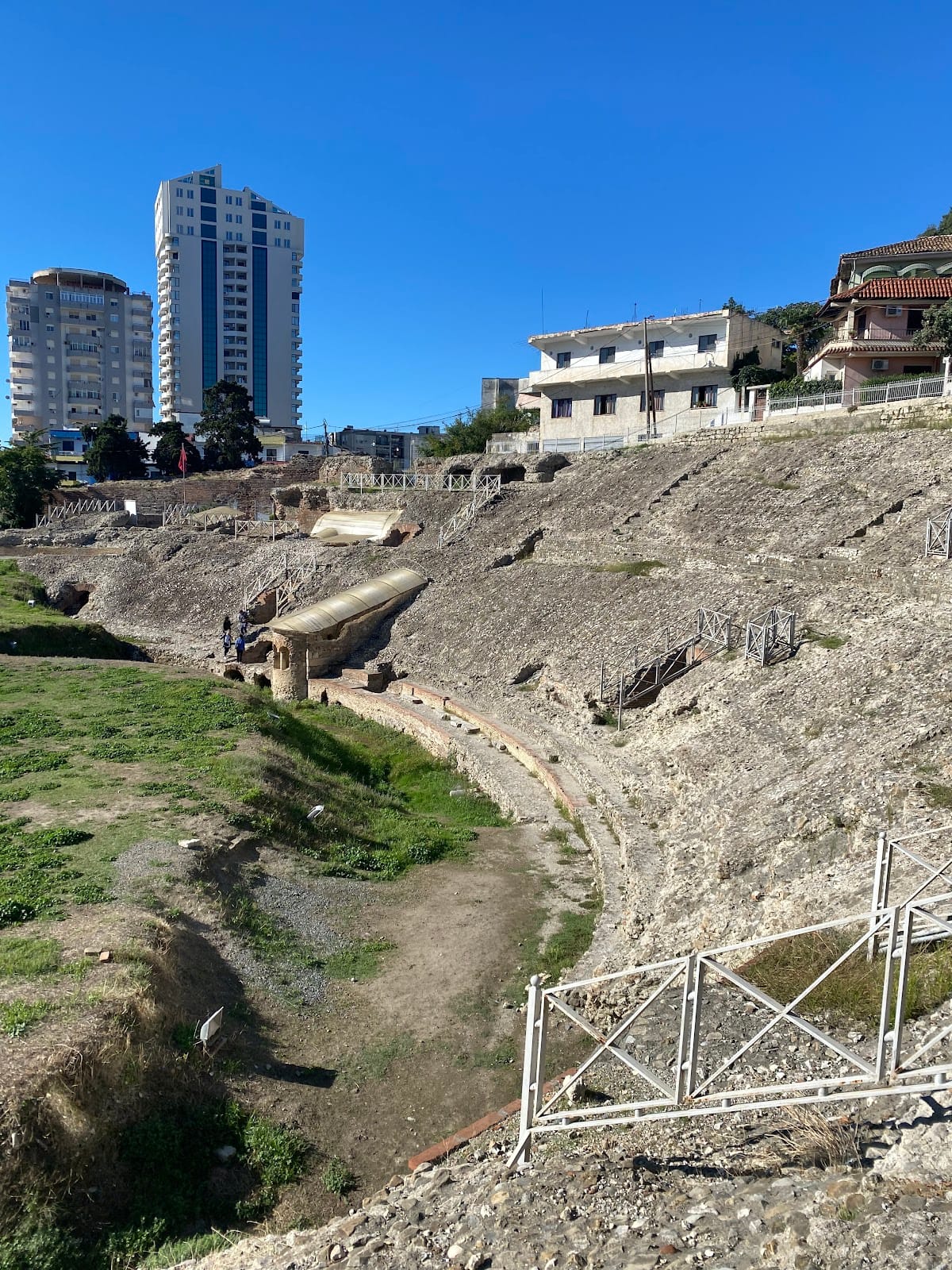
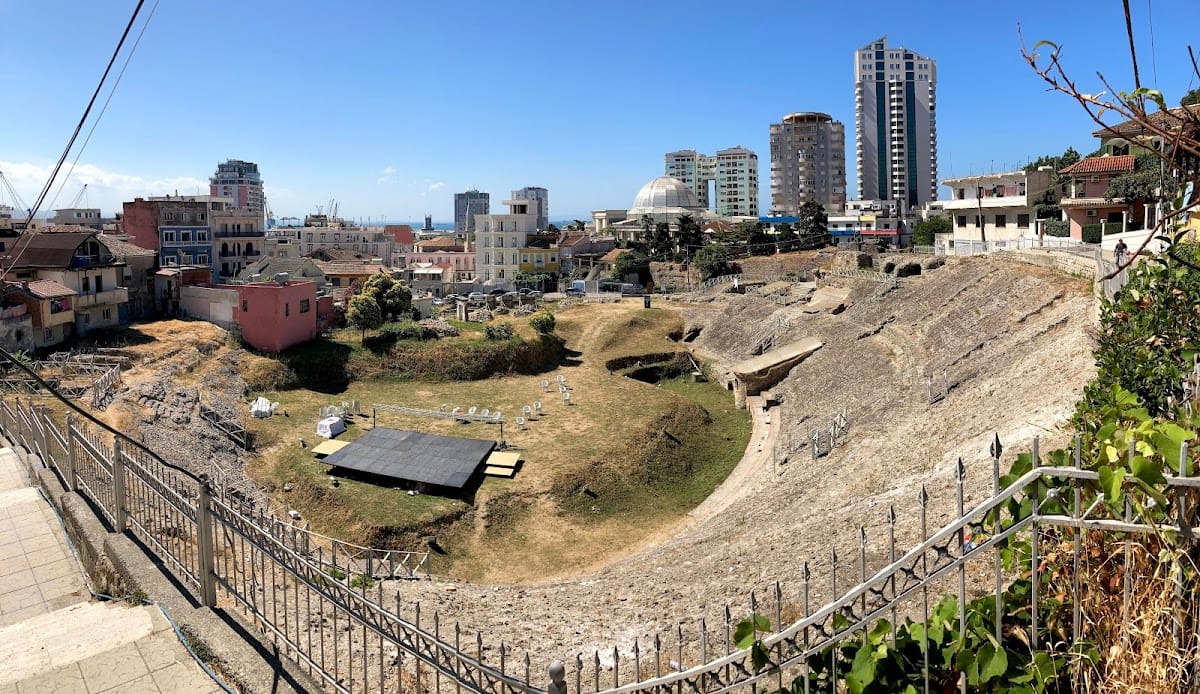
The amphitheatre stands in Durrës’s historic centre, near the southwestern edge of the old city and close to the southwestern end of the peninsula that forms the harbour. It is approximately 350 metres from the Adriatic coast. The building lies within the historic city walls on a hillside rising to the west and north. Its southern and eastern seating areas were instead built on freestanding substructures over level ground.
The structure is elliptical and follows a north-south axis. Its dimensions are given as approximately 118–132 metres by 98–113 metres, with a more precise measurement of 132.4 by 113.2 metres. The seating area, or cavea, rises about 20 metres from its base. It could accommodate approximately 15,000–20,000 spectators, with one higher estimate reaching 23,000.
A system of stone vaults encircled the building and supported the cavea. The amphitheatre had one continuous gallery, known as a maenianum, and its vomitoria, the passages leading to the seating, were irregularly distributed because only the necessary routes were cut into the rock. Unlike many amphitheatres, access from the north descended into the building from above. The original seats were faced with white stone slabs. Their later removal left the mortar-built supporting structure exposed.
Arena and Internal Passages
The arena measures approximately 61–61.4 metres by 40–42.2 metres. Gladiators fought there, and the principal northern passage through the hillside provided access for both gladiators and animals. This route continued into a tunnel that reached about nine metres in height. The southern entrance was positioned slightly away from the main axis.
Arched spaces within the amphitheatre’s walls were used to hold animals for gladiatorial combats. The arena remains partly filled with rubble, and its floor lies below the groundwater level. Later burials occupy parts of the arena and galleries, reflecting the building’s transformation after its period as a performance venue. The monument survives in ruined condition, with only part of its structure excavated. Modern stairs and safety measures have been installed within the excavated areas.
Christian Chapel beneath the Viewing Box
The historically most important surviving chapel was built directly beneath the pulvinar, the elevated viewing box reserved for the emperor or other distinguished spectators, in the amphitheatre’s western section. The room is approximately six metres long and two to three metres wide, narrowing toward the east. An apse, or semicircular sanctuary end, projects eastward into the arena and contains two tall, narrow windows.
The chapel’s added walls and floor used opus mixtum, a Roman building technique combining brickwork with irregular stonework and reused materials. A raised floor and a higher altar were installed later, probably in response to a rise in the groundwater level. A basin in the adjoining northern room may have served as a baptismal font.
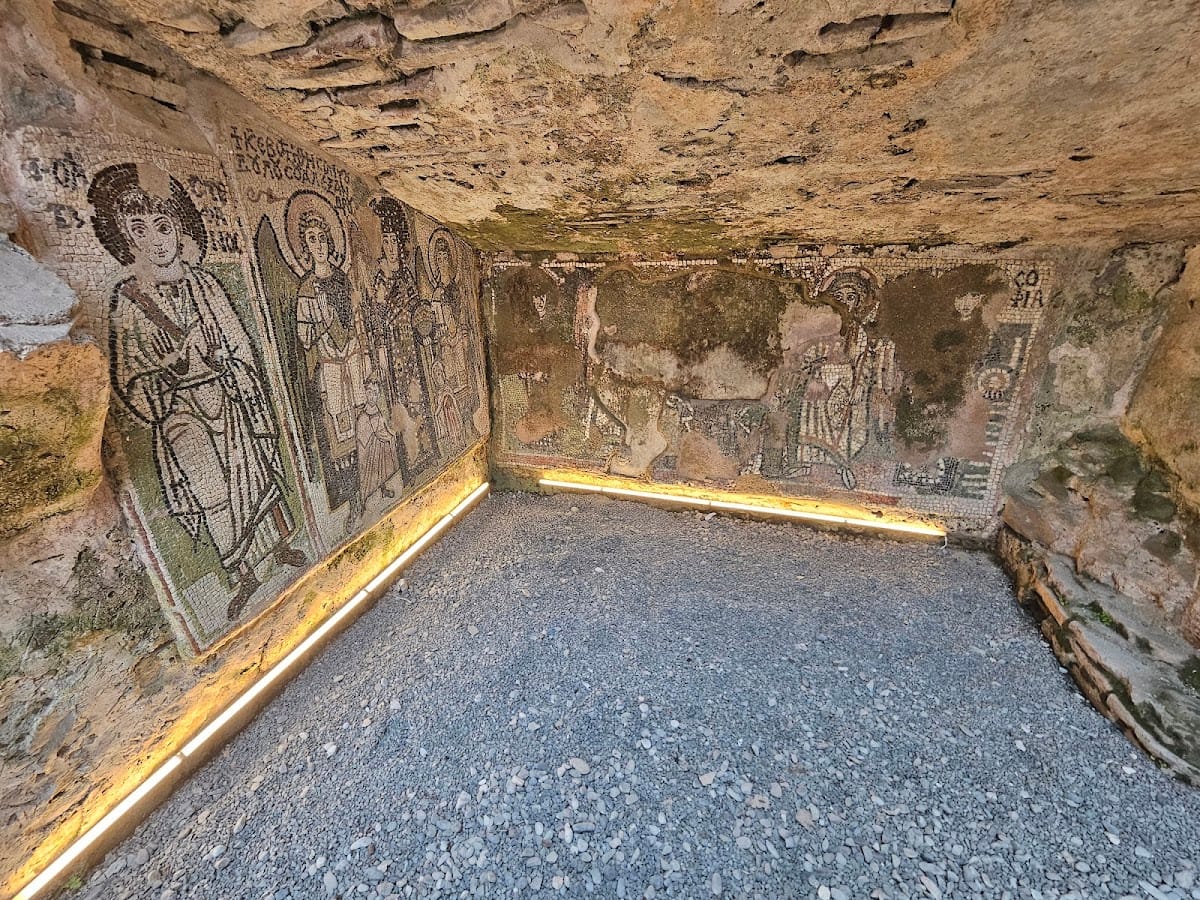
The chapel was reached through the nearest northern vomitorium. Its stone steps show substantially greater wear than the other entrances. The interior was first decorated with frescoes, and mosaics were later laid over earlier wall paintings. Mosaics on the rear wall are badly damaged and include figures identified as Mary, Sophia, and Eirene. Better-preserved mosaics on the southern wall depict angels, saints, Mary, donors, and inscriptions. A ceiling painting represented Christ Pantocrator, an image of Christ as universal ruler. The mosaics and wall paintings are deteriorating.
Urban Encroachment
Modern housing formerly occupied part of the southeastern area and was built over a section of the arena. Some of these houses have been removed, while surrounding urban development continues to place pressure on the monument and its surviving remains.