Egnazia: An Ancient Messapian and Roman Municipium in Apulia, Italy
Table of Contents


Visitor Information
Google Rating: 4.6
Popularity: Medium
Google Maps: View on Google Maps
Official Website: musei.puglia.beniculturali.it
Country: Italy
Civilization: Roman
Remains: Burial, City, Civic, Domestic, Economic, Infrastructure, Military, Religious, Sanitation

Context
Egnazia is situated near the contemporary town of Fasano in the Apulia region of southeastern Italy, occupying a strategic coastal position along the Adriatic Sea. The site rests atop a low limestone plateau that commands views over the adjacent plains and coastline, providing advantageous access to maritime routes and inland territories. Its proximity to the ancient Via Traiana—a Roman road connecting Beneventum (modern Benevento) to Brundisium (modern Brindisi)—further enhanced its regional connectivity and integration within broader trade and communication networks.
Archaeological investigations have established that Egnazia’s earliest occupation dates to the Iron Age, when it was inhabited by the indigenous Messapian people. Over time, the settlement came under Roman control, evolving into a municipium during the Imperial period. The site remained occupied through Late Antiquity, with material evidence indicating the adoption of Christianity. Environmental factors and socio-political disruptions in the region contributed to its gradual abandonment between the 6th and 7th centuries CE.
The extant archaeological remains encompass urban structures, necropolises, and road systems that illustrate the site’s long-term development. Excavations, initiated in the 18th century and intensified in the 20th century, have focused on uncovering and conserving these features. Ongoing research continues to refine understanding of Egnazia’s role within the cultural and historical landscape of Apulia.
History
Egnazia’s historical trajectory exemplifies the complex cultural and political transformations of southeastern Italy from the Iron Age through the early medieval period. Initially established as a settlement of the Messapian people, it later integrated into the Roman provincial framework as a municipium, leveraging its coastal location and proximity to major Roman roads. The site’s occupation reflects regional shifts in governance, economy, and religion, culminating in its decline during Late Antiquity amid broader imperial and environmental challenges.
Archaeological and epigraphic evidence confirms continuous habitation from the Iron Age until the early medieval era. Egnazia’s evolution mirrors the changing dynamics of Apulia within the Roman Empire and its successor states, illustrating the impact of Romanization, Christianization, and eventual urban contraction.
Iron Age and Messapian Period
During the Iron Age, Egnazia was established as a settlement of the Messapians, an indigenous Italic people with origins linked to Balkan migrations. This community formed part of a network of fortified centers across Apulia, characterized by distinctive cultural and linguistic traits. Archaeological data, including extensive necropolises and characteristic pottery styles, attest to sustained occupation throughout this period.
The site’s location on a limestone plateau near the Adriatic coast afforded strategic advantages for controlling maritime routes and access to fertile hinterlands. Defensive walls constructed during this era, measuring approximately two kilometers in length and rising up to seven meters, enclosed the settlement. The necropolises contain tombs adorned with frescoes and ceramic pomegranates, symbols associated with prosperity and the afterlife. Pottery assemblages include “trozzella” vessels with applied roundels and Gnathian ware, a black pottery decorated with white and yellow motifs influenced by Greek artistic traditions. Egnazia functioned as a significant Greek-Messapian center, with its large port facilitating maritime commerce and cultural exchange.
Roman Republican and Imperial Periods
Roman expansion into Apulia during the 3rd and 2nd centuries BCE brought Egnazia under Roman dominion, although the precise date of incorporation remains uncertain. By the Imperial period, epigraphic and architectural evidence confirms Egnazia’s status as a municipium, conferring Roman citizenship and local self-governance. The city’s integration into the Roman provincial system of Regio II Apulia et Calabria was reinforced by its location along the Via Traiana, constructed under Emperor Trajan in the early 2nd century CE, which linked Beneventum to Brundisium and enhanced trade and military mobility.
Roman administration oversaw urban development, including the construction of public buildings, road networks, and port facilities. The harbor was expanded and improved to support increased commercial activity. Civic life included magistracies such as duumviri, attested in inscriptions. The population comprised Roman settlers, veterans, artisans, and Christian clergy. Religious practices reflected syncretism, with statues of Demeter and Attis indicating the persistence of Hellenistic cults alongside emerging Christian worship, evidenced by two basilicas. Public amenities such as baths featured advanced heating systems and decorative mosaics, underscoring the city’s prosperity during this period.
Late Antiquity and Early Byzantine Period
The period from the 3rd to 6th centuries CE was marked by political instability and economic contraction across the Roman Empire, affecting Apulia and Egnazia. Despite these challenges, the site remained inhabited, with archaeological evidence of Christianized burial practices and architectural modifications reflecting ecclesiastical influence. The city likely fell under the late Roman Diocese of Italy and subsequently Byzantine administration following Justinian’s reconquest in the 6th century.
Historical sources document regional turmoil, including Gothic invasions and Saracen raids, which contributed to social fragmentation and economic decline. While no direct records of military engagements at Egnazia exist, the settlement’s diminished role is reflected in reduced urban activity and partial abandonment of public structures. The absence of inscriptions confirming episcopal status suggests a limited ecclesiastical hierarchy. Environmental factors such as coastal erosion and disease may have further undermined the community, leading to its eventual desertion by the 7th century.
Abandonment and Post-Roman Context
By the 7th century CE, Egnazia was abandoned as a residential and administrative center. The combined effects of environmental degradation, shifting trade routes, and political instability—including Lombard and later Norman incursions—precipitated the site’s decline. The population dispersed to more secure inland locations, and the urban fabric ceased to function as a cohesive settlement.
Subsequent centuries saw the region governed by various powers, but Egnazia itself remained uninhabited. Its ruins attracted antiquarian interest from the 18th century onward, with modern archaeological investigations clarifying its historical significance. The site’s history thus concludes as a reflection of Apulia’s transformation from indigenous settlement through Roman municipium to early medieval abandonment.
Daily Life and Importance by Period
Iron Age and Messapian Period
During the Iron Age, Egnazia’s inhabitants were primarily Messapian, an Italic people with cultural ties to the Balkans. The community likely organized around extended family groups within a fortified settlement, as indicated by the substantial defensive walls. Social hierarchy probably included local elites overseeing agricultural production and trade. While direct evidence of gender roles is lacking, regional parallels suggest men engaged in farming, warfare, and craft production, while women managed domestic and religious activities.
The economy centered on agriculture, including cultivation of cereals, olives, and vines, supported by fertile plains and maritime access. Pottery workshops produced distinctive Messapic ceramics such as trozzella vessels with ornamental roundels, reflecting artisanal specialization. The large port facilitated maritime trade across the Adriatic. Dietary remains and ceramic storage vessels indicate consumption of bread, olives, fish, and locally grown fruits. Residential structures were modest, constructed of stone or mudbrick, with interiors decorated in funerary contexts by frescoes and ceramic pomegranates symbolizing prosperity and the afterlife. Religious practices likely involved indigenous cults, though no temples have been excavated.
Roman Republican and Imperial Periods
Following Roman conquest, Egnazia became a municipium, integrating Roman administrative and social structures while retaining local elites. The population diversified to include Roman settlers, veterans, artisans, and Christian clergy. Inscriptions attest to magistracies such as duumviri managing civic affairs. Family units conformed to Roman patriarchal norms, with households comprising nuclear families and possibly slaves or freedmen.
The economy expanded through intensified agriculture, particularly olive oil and wine production for export via the enhanced port. Artisans produced pottery, mosaics, and statuary, including Greek-influenced religious sculptures such as the headless statue of Demeter and the figure of Attis, reflecting syncretic cults. Public baths with sophisticated hypocaust heating and decorative mosaics served as social centers. Urban residences featured mosaic floors and painted walls. The forum and amphitheater functioned as venues for markets, legal proceedings, and entertainment. The Via Traiana facilitated trade and movement by land and sea. Religious life encompassed Roman, Hellenistic, and Christian practices, with two basilicas evidencing the latter. Educational activities likely included public readings and Christian instruction.
Late Antiquity and Early Byzantine Period
In Late Antiquity, Egnazia’s population declined and became more localized, with Christianization evident in burial customs and basilica architecture. Social leadership shifted toward ecclesiastical figures alongside remaining civic officials, though inscriptions are scarce. Family life adapted to Christian rites influencing funerary practices. Economic activity contracted but persisted in agriculture and small-scale crafts, sustaining the reduced community.
Diet and clothing remained consistent with Mediterranean traditions, though diminished urban wealth limited luxury goods. Domestic spaces simplified, and public amenities such as baths and the amphitheater fell into disuse or were repurposed. Trade and transport declined due to regional instability, with local markets serving essential needs. Religious life centered on Christian worship, possibly under episcopal oversight, though no direct evidence confirms a bishopric. The settlement’s administrative role waned under Byzantine control, becoming a minor locality within the provincial system. Pressures from Gothic and Saracen incursions contributed to social fragmentation. Educational activities, if present, were likely confined to Christian instruction within basilicas.
Abandonment and Post-Roman Context
By the 7th century CE, Egnazia was fully abandoned as a residential center. Environmental degradation, including coastal erosion and possible malaria outbreaks, combined with political instability from Lombard and Norman incursions, led to depopulation. The urban fabric ceased to function, and the population relocated to more secure inland settlements.
No evidence indicates continued habitation, market activity, or religious institutions after abandonment. The ruins remained as archaeological vestiges, with the surrounding region transitioning to rural, feudal structures under new rulers. Egnazia’s former role as a municipium and port was supplanted by emerging centers, marking the end of its urban history.
Remains
Architectural Features
Egnazia occupies a limestone plateau overlooking the Adriatic coast, where the urban layout is partially preserved. Construction primarily utilizes local limestone blocks fashioned into ashlar masonry, with Roman concrete (opus caementicium) employed in later phases. The city plan reveals distinct civic, residential, and funerary zones interconnected by a network of paved streets. Urban expansion occurred mainly between the late Republican period and the 2nd century CE, corresponding to its municipium status, before contraction in Late Antiquity.
Surviving elements include sections of defensive walls featuring rectangular towers and gates, enclosing an irregular area adapted to the plateau’s topography. The street system comprises a principal east-west decumanus aligned with the Via Traiana and secondary streets paved with polygonal limestone slabs. Stone-lined drainage channels and terracotta pipes accompany some roadways, indicating water management infrastructure.
Key Buildings and Structures
City Walls and Gates
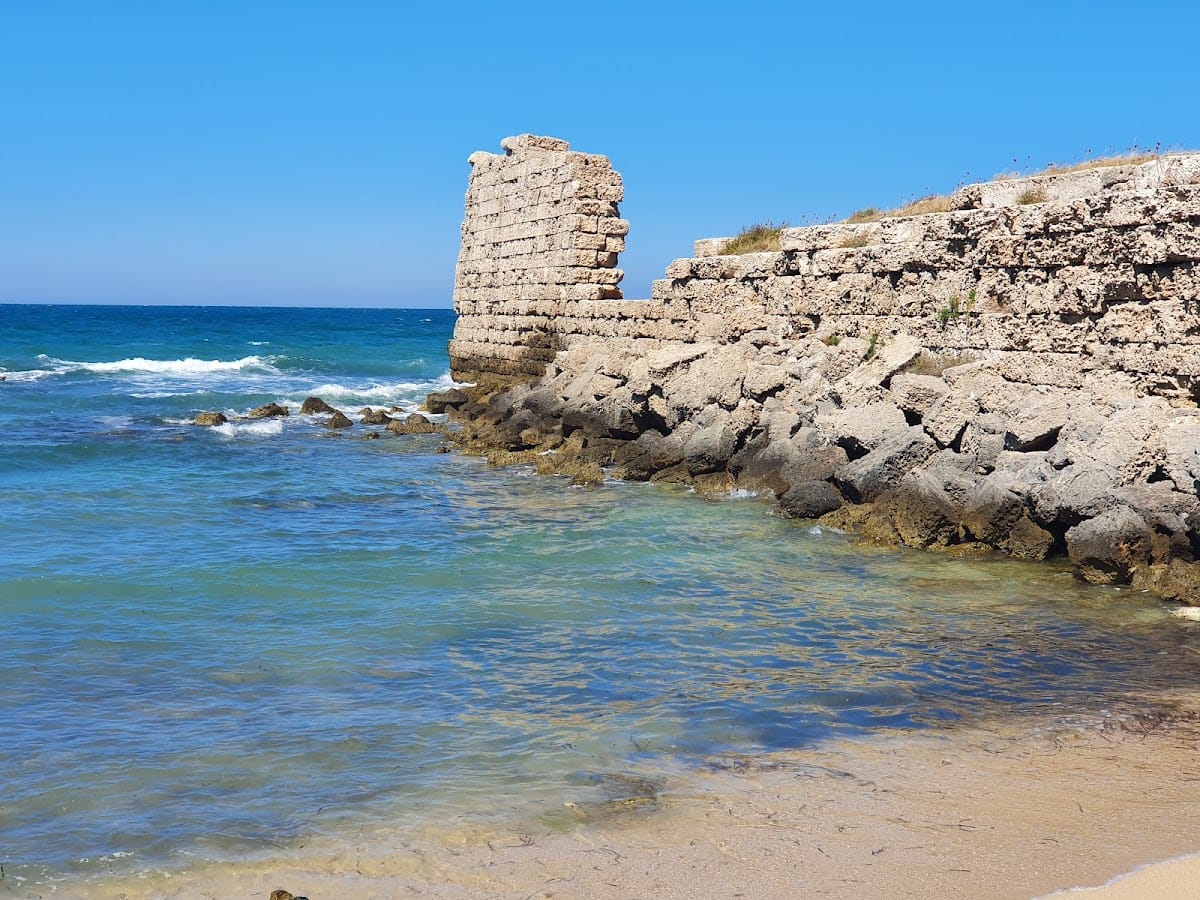
The city’s defensive walls date to the late 1st century BCE or early 1st century CE, constructed of large limestone ashlar blocks. Rectangular towers are spaced at intervals along the walls, which enclose an area of approximately 40 hectares. The main southern gate features a double-arched entrance with preserved threshold stones and remains of a guard chamber. Northern wall sections survive in fragmentary condition, with some reused during the Byzantine period. The walls conform to the plateau’s irregular contours rather than a geometric plan.
Forum Area
The forum complex, erected in the 1st century CE and expanded in the 2nd century, occupies a central location within the settlement. It consists of a rectangular open space surrounded by porticoes supported on limestone columns. Adjacent structures include a basilica with a nave and side aisles, constructed using opus latericium (brickwork) and opus reticulatum techniques. Mosaic floor fragments survive within the basilica. A curia or council building, identified by a rectangular hall with a raised platform, dates to the early 2nd century CE and likely served administrative functions.
Theater
The theater, built around the mid-2nd century CE, is situated on the western edge of the settlement. Its cavea (seating area) is partially preserved, carved into the natural slope of the plateau. The orchestra retains a semicircular limestone slab pavement. Foundations of the scaenae frons (stage building) survive, revealing a multi-level ashlar masonry structure. The theater’s design follows Roman architectural conventions adapted to local topography. No in situ decorative elements have been documented.
Bath Complex
The public baths date from the late 1st century CE, with modifications in the 3rd century. The complex includes a caldarium (hot bath), tepidarium (warm room), and frigidarium (cold bath), arranged around a central courtyard. The hypocaust heating system beneath the caldarium floor consists of brick pilae supporting a suspended floor. Walls are constructed of brick and stone, with surviving plaster fragments. Latrine facilities connected to an external drainage system are also present. The baths feature a laconicum (dry sauna) and an advanced heating system utilizing praefurnia that channeled heat through suspensurae (pipes under the floor) and perforations in hollow perimeter walls, representing a sophisticated engineering achievement.
Necropolises
Multiple necropolises surround Egnazia, primarily dating from the 4th century BCE through the 3rd century CE. Tomb types include chamber tombs built of limestone blocks, rock-cut hypogea, and arcosolia (arched burial recesses). Funerary monuments exhibit diverse architectural forms, such as small temple-like structures and sarcophagi carved from local stone. Some tombs bear inscriptions in the Messapian language and Latin. Grave goods recovered in situ include pottery and personal items. Ceramic pomegranates, symbolic of prosperity and the afterlife, are common both as grave goods and tomb decorations. The necropolis map within the archaeological park is tactile to assist visually impaired visitors.
Residential Quarter
Excavations have revealed domestic buildings dating from the 1st century BCE to the 3rd century CE. Houses feature stone foundations and mixed masonry walls, arranged around internal courtyards. Some residences contain mosaic floors with geometric patterns and painted wall plaster fragments. Water management installations, including cisterns and wells, are present. Later occupation layers indicate partial abandonment and reuse of domestic spaces during Late Antiquity.
Harbor Installations
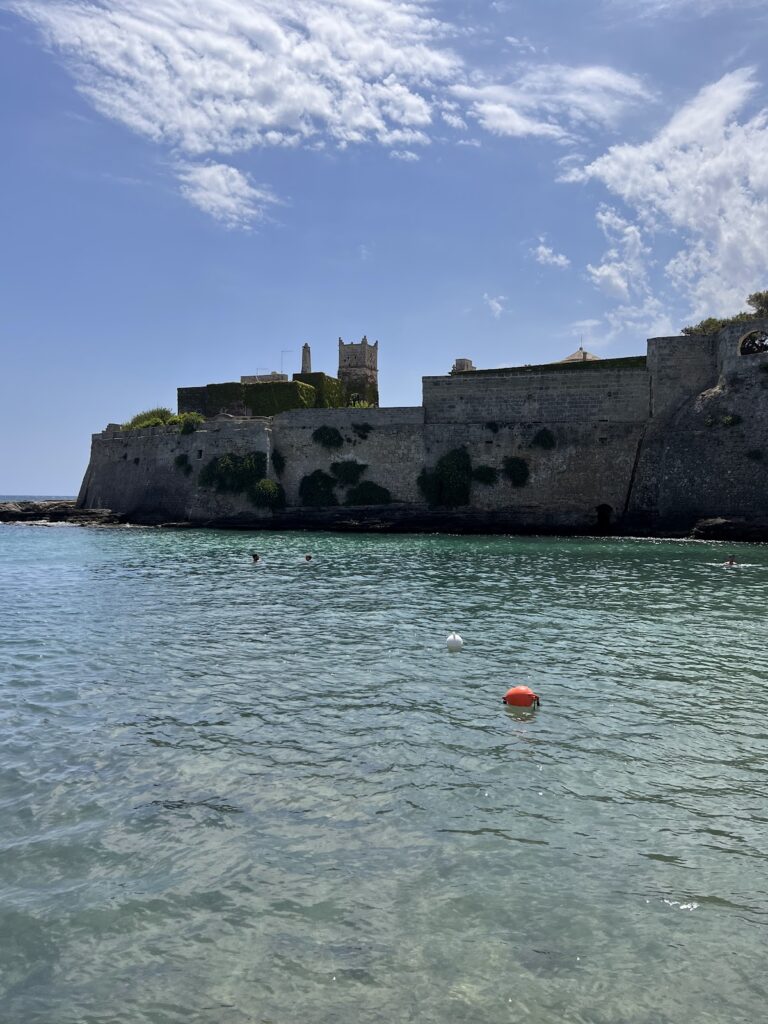
Archaeological surveys have identified harbor structures along the coast near Egnazia, including stone quays and breakwaters constructed in the 1st century CE from large limestone blocks. Underwater investigations have documented submerged remains of mooring posts and anchorage points. The harbor area also contains foundations of warehouses and storage facilities, showing evidence of repair and limited use into the 4th century CE. The port’s remains are currently submerged, with underwater archaeological activities enabling exploration of these features.
Amphitheater
Considerable remains of a Roman amphitheater are present at the site, though detailed measurements and seating capacity have not been fully documented. The structure likely served as a venue for public spectacles and entertainment during the Imperial period.
Christian Basilicas
Two Christian basilicas dating to the Roman period have been identified within the site. Architectural details remain limited, but their presence attests to the Christianization of Egnazia during Late Antiquity.
Archaeological Museum of Egnazia
Located within the archaeological park, the museum houses artifacts spanning from the Bronze Age through the Medieval period. Collections include Messapic trozzella pottery with characteristic roundels, Gnathian black pottery decorated with white and yellow motifs inspired by Greek culture, and numerous ceramic pomegranates symbolizing prosperity and the afterlife. Notable exhibits include the “Banquet” relief depicting funerary traditions, a headless statue of Demeter from the Hadrianic era linked to local legend, and the head of Attis, reflecting religious syncretism during the Roman period.
Archaeological Park and Excavation
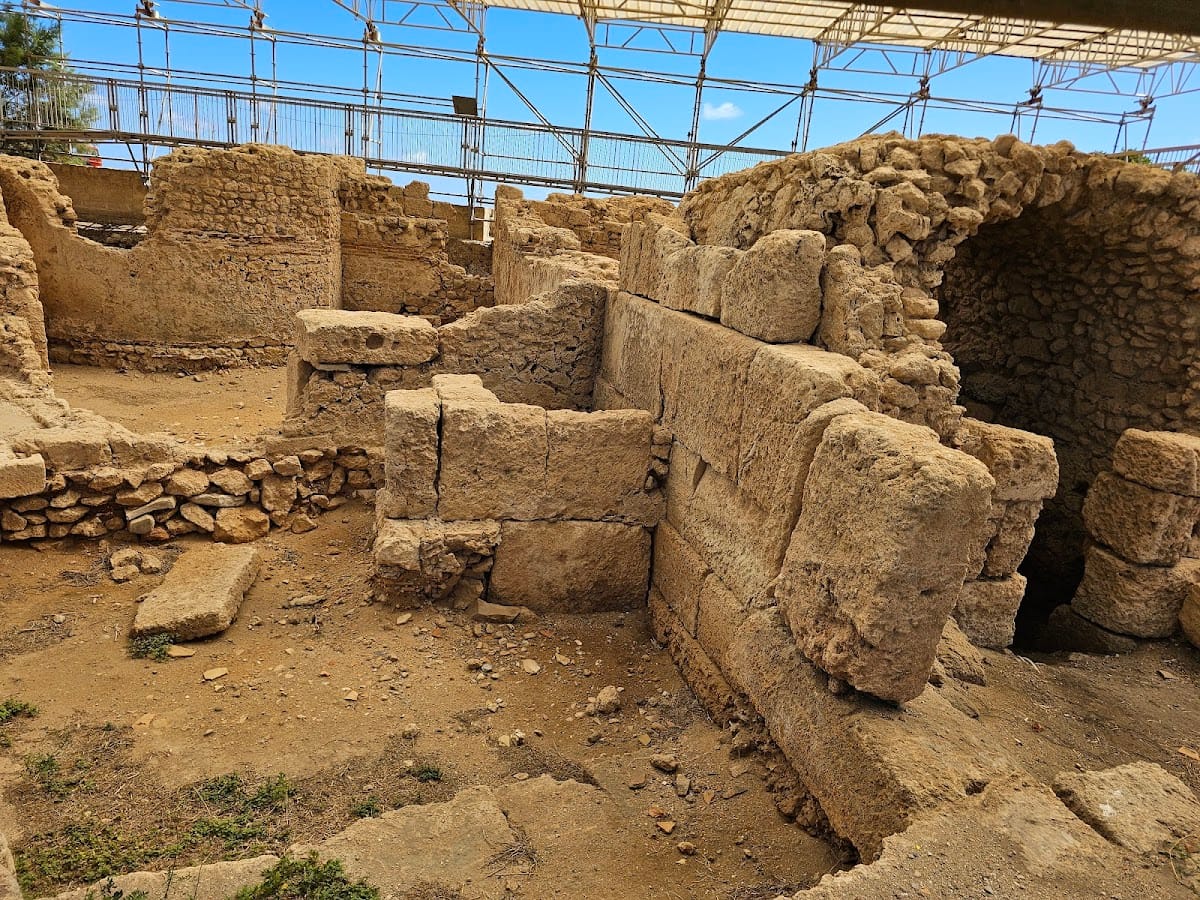
The archaeological park covers approximately 40 hectares, encompassing remains from the Bronze Age, Messapian, Roman, and Medieval periods. It includes foundation stones of houses, roads, necropolises, defensive walls, and public buildings. Excavations began systematically in 1912 and continue today, though only portions of the site have been uncovered. The park is equipped with QR codes linked to an audio guide app and tactile maps to enhance accessibility. Ongoing research and conservation efforts aim to preserve the site and expand knowledge of its historical development.
Preservation and Current Status
Preservation varies across the site. City walls and gates survive partially, with some sections standing several meters high and others reduced to foundations. Forum buildings retain substantial wall segments and column bases, though upper structures are largely lost. The theater’s cavea and stage foundations remain visible but fragmentary. The bath complex is preserved in parts, with hypocaust systems exposed but walls partially collapsed. Necropolises are generally well-preserved, with tombs intact or partially collapsed. Residential remains range from well-defined foundations to scattered fragments. Harbor installations are preserved underwater and along the shoreline but face threats from marine erosion. Restoration has stabilized key areas, employing modern materials distinguishable from original masonry. Vegetation and environmental factors continue to pose challenges, necessitating ongoing maintenance by heritage authorities.
Nearby sites