Hrádek – Museum of Silver: A Gothic Palace and Mining Museum in Kutná Hora

Site at a Glance
- Rating
- 4.6
- Popularity
- Medium
- Country
- Czechia
- Primary era
- Medieval
- External website
- Open
- Eras represented
- Medieval, Early Modern, Modern
- Civilizations
- Holy Roman Empire, Kingdom of Bohemia
- Site type
- Domestic
- Remains
- Elite Residence
On this page18 sections
History
Hrádek – Museum of Silver in Czechia stands in Kutná Hora, where it originated as a small wooden fortress around the turn of the fourteenth century. Built to help protect the developing mining settlement from the west, it was first mentioned in writing in 1312, when Herman de Castro was identified as its owner. The complex later became a high-Gothic fortified residence, a patrician palace in the Jagiellonian Gothic style, and a museum devoted to the region’s silver-mining history.
From Fortress to Fortified Residence
The first Hrádek was a largely wooden tower with an adjoining residential building. Its stone core was created in the mid-fourteenth century, and the small fortification occupied the southwestern edge of the settlement. At the beginning of the fifteenth century, Václav z Donína, a royal reeve responsible for justice and civic administration, rebuilt it as a high-Gothic fortified residence, probably between 1400 and 1420.
The residence changed hands among royal and municipal officials, royal favourites, and prosperous ore merchants. It was damaged during the Hussite Wars, the fifteenth-century religious and political conflicts in Bohemia associated with the followers of the reformer Jan Hus. The damage formed part of a longer transition in the character of the complex, from a defensive stronghold to an urban residence.
The Smíšek Palace
At the end of the fifteenth century, Michal Preklov began expanding Hrádek. He sold the property to Jan Smíšek of Vrchoviště in 1490. Smíšek, an ore-and-copper merchant and mine owner, continued the work and transformed the medieval fortress into a patrician palace. A patrician was a member of the wealthy and politically influential urban elite.
The rebuilding introduced large halls, projecting oriels, a chapel, mining-themed decoration, and early Renaissance painted ceilings. Jagiellonian Gothic, also called Vladislav Gothic in the Czech context, combined elaborate late-Gothic forms with emerging Renaissance features in territories ruled by the Jagiellonian dynasty. Jan Smíšek died in 1501 before the work was complete, and his son Kryštof inherited the property.
Hrádek underwent another major alteration in 1620, when an additional floor was added above the southern wing. In 1684, at the request of the rector of the Jesuit college, the building was sold to the Jesuit order. The Jesuits, a Catholic religious order known for operating schools and seminaries, established a seminary at Hrádek in 1686. They later ran a Jesuit school there until the order was suppressed in 1773.
Schools and Museum
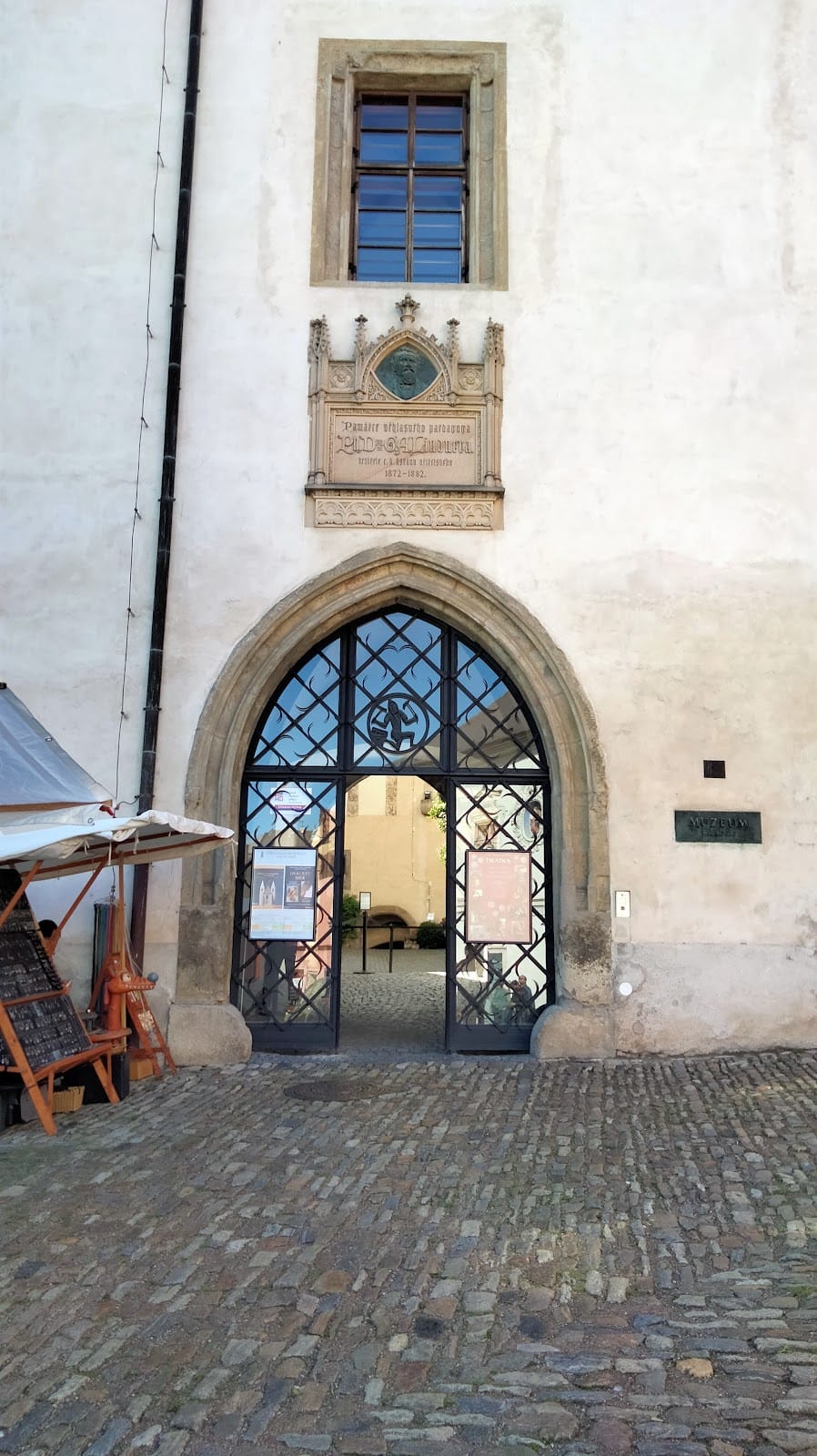
After the suppression of the Jesuits, Hrádek was adapted for use as a main school. Further alterations followed in 1830 and between 1859 and 1861. The building also housed other educational institutions, including a teachers’ institute where the educator Adolf Lindner worked.
In the early twentieth century, Kutná Hora acquired Hrádek with plans to restore it and establish a museum, although the world wars delayed the project. A mining museum opened after major work in the 1950s and early 1960s, then closed while further reconstruction was prepared. The general reconstruction of the 1990s restored stone architectural elements, frescoes, and wooden ceilings. An exhibition of the Czech Museum of Silver opened in 1996.
The museum’s collections include art and craft objects, fine art, ethnographic material, coins and currency collections, geological specimens, and objects connected with mining, metallurgy, and coin production. Metallurgy is the processing of ores and metals, while numismatics concerns the study and collection of coins and currency. The institution also holds a substantial library. Hrádek has been protected as a cultural monument of the Czech Republic since 1966; a museum devoted to related subjects had already been established in 1877.
Remains
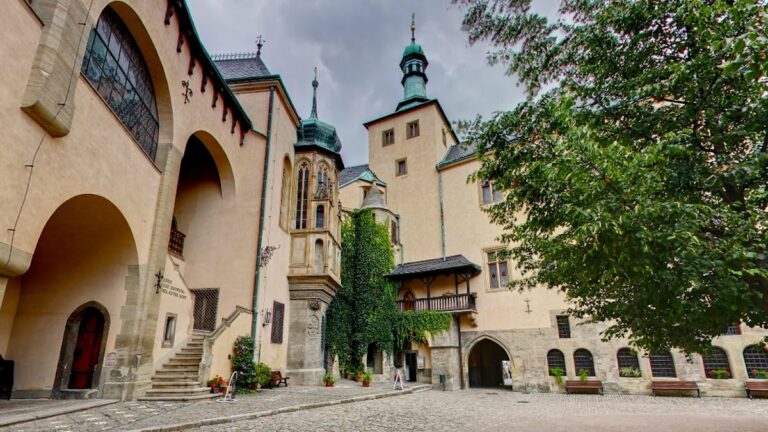
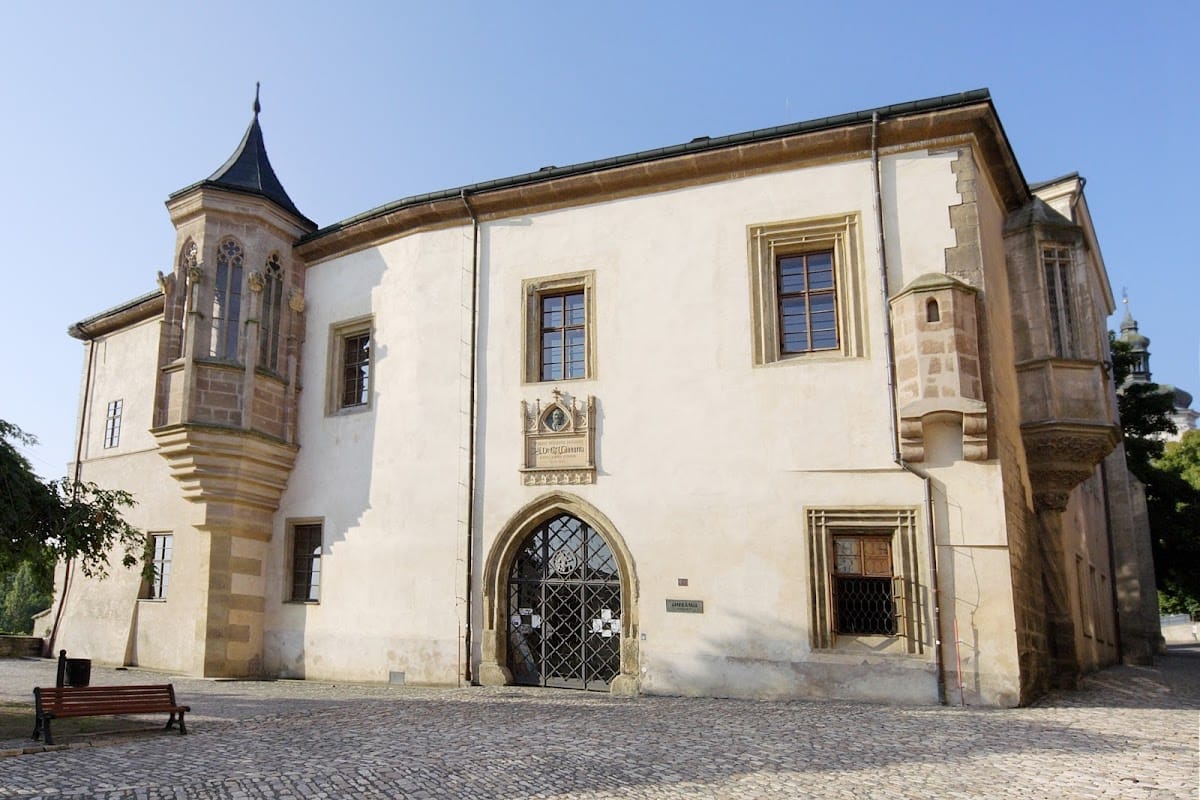
Hrádek occupies a terrace above the Vrchlice valley at the southwestern edge of the historic town. Its southern side was protected by the steep slope toward the valley. On the western side, approach was across a ditch and the town rampart, while the eastern and northern sides along present-day Barborská Street were probably fortified toward the town. The complex combines a tower, opposing residential wings, a courtyard, service buildings, and underground medieval mining workings.
Fortifications and Courtyard
Early Tower
The earliest fortification was a mostly wooden tower, later converted into a stone structure in the mid-fourteenth century. Cellar walls beneath the present two-storey tower belong to this earlier building. A residential structure adjoined the tower on the site of the present western wing, preserving the basic relationship between defensive and domestic parts of the complex.
Fortified Residence
The fifteenth-century residence consisted of two opposing residential wings connected by a curtain wall, with service buildings attached. The older rectangular tower was incorporated into the palace wing. Service facilities stood along the northern wall, while the southern side of the courtyard was initially closed by the fortification wall.
In the arrangement associated with Václav z Donína, the western palace stood directly against the town walls and ended in a tower to the north. Its exposed western side originally contained ventilation openings; the present windows were opened in the eighteenth century, after Hrádek had ceased to serve a defensive purpose. A stairway in an extension at the southeastern corner of the courtyard and wooden galleries around the courtyard provided access to first-floor rooms. Brackets for the galleries survive on the western side.
Palace Grounds
Jan Smíšek’s rebuilding changed the defensive layout. A low wall in front of the eastern entrance formed an entrance court, and a garden was established beside the western residential wing along the town walls. The tower once carried a high hipped roof, while the other buildings had high gabled roofs covered with glazed tiles of different colours. During the conversion to a school, these roofs were replaced by the present low roofing.
Exterior and Interior Architecture
Orials and Tower
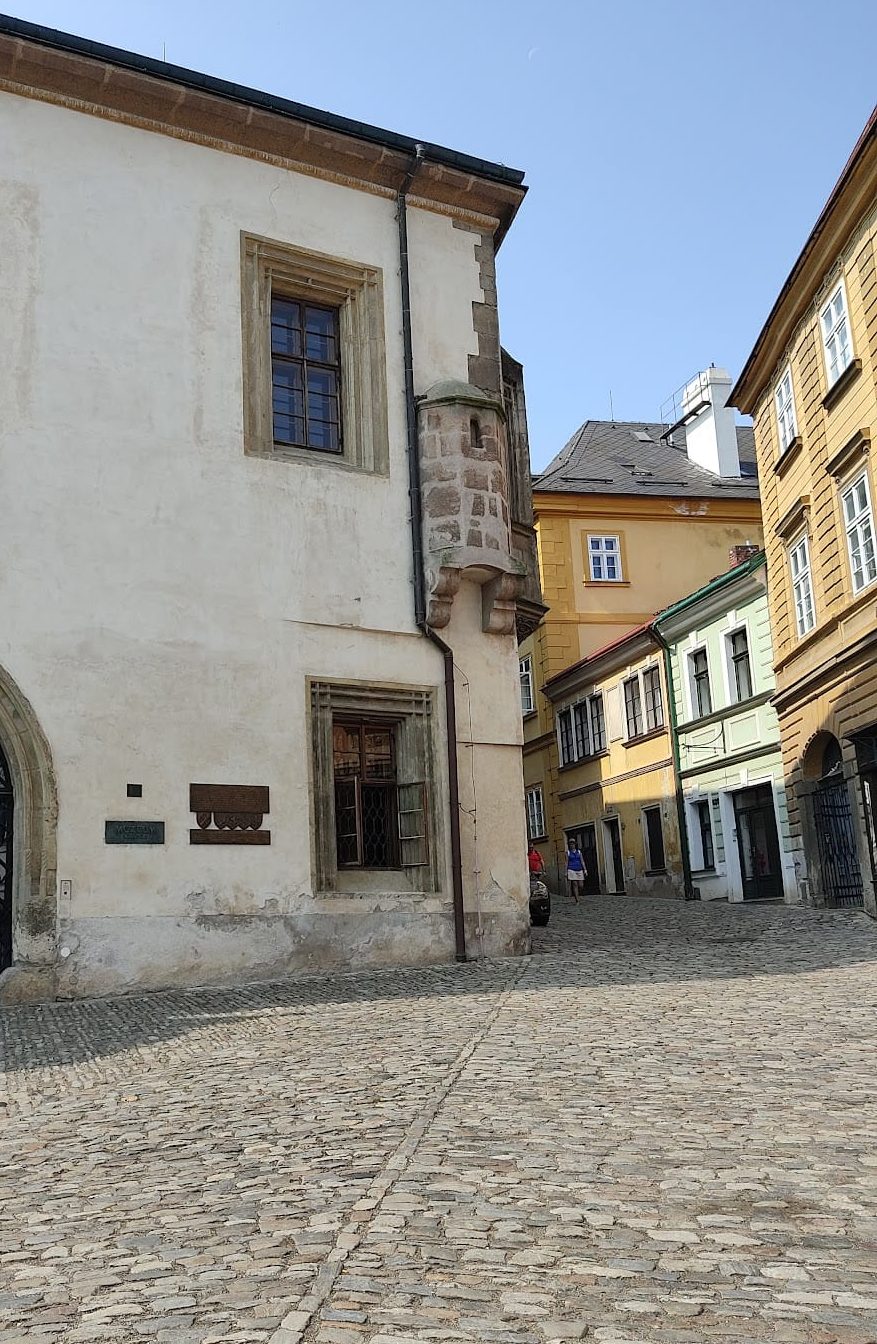
The exterior retains a predominantly Gothic character, while the interiors include Renaissance elements. A tower rises at the southwestern corner. The eastern wing has two oriels, which are enclosed projecting windows supported by a column or other structure. The northeastern oriel belonged to the chapel and rests on a massive column that widens downward. Its five slender Gothic windows contain three types of simple tracery.
The other oriel faces the street on the western side. It rests on a column decorated with twisting rods, and its capital carries animal, floral, and figurative motifs, including a lion, a thistle, and putti linked by bands and interlaced foliage. This oriel served as a lookout and has simple rectangular windows. Its stone roof is original.
Eastern Wing
The eastern wing preserves its perimeter walls from the Donín-period arrangement, while its present vaulting belongs to a later alteration. A corridor on the eastern side of the first floor was walled up during repairs in 1861. Beneath it, a further blocked corridor remains visible through two arches and a solid rough column. Large vaulted rooms once occupied the upper floor, which is now divided by partitions.
Knights’ Hall
The Knights’ Hall occupies the former residential tower and follows its irregular rectangular plan. Four bays of square cross-ribbed vaulting cover the room. A cross-ribbed vault organizes its weight through intersecting ribs, which here are supported by a slender central column with a Gothic base and no capital. Eight ribs spring directly from the shaft, and the vault has smooth circular bosses. Three rectangular windows face the garden and the street. The hall was built as a representational space for Hrádek’s owner.
Great Hall
The large first-floor hall contains a painted early Renaissance coffered ceiling dated 1493. A coffered ceiling is divided into recessed panels, and the design here evokes an elaborate palace hall. Its form suggests a connection with the architecture of the royal castle in Buda. A frieze decorated with plants borders the ceiling.
Chapel of St. Wenceslas
The Chapel of St. Wenceslas has a net-vaulted ceiling whose ribs rise from simple supports ending at the window cornice. The best-preserved vault boss bears Jan Smíšek of Vrchoviště’s coat of arms. Wall paintings with religious subjects date from before 1504, and five Gothic windows light the chapel.
Five heraldic emblems occupy the window corners: those of a hašplíř, a lion, the Smíšek unicorn, a kverk, and a pregéř. The chapel also retains a Gothic altar table. Its wall paintings depict landowners, the symbols of the Evangelists, benefactors, Jan Smíšek, and his wife Anna.
Alterations and Mining Workings
School Adaptations and Conservation
School use altered the historic interior. Some late-Gothic vaults were concealed or removed, the coffered ceiling in the western wing was covered, partitions were added, and the original arrangement of windows was changed. Architectural elements were also removed. The remaining wooden galleries were taken down after 1773, and new internal doorways connected the rooms.
Work in the 1950s and early 1960s removed unsuitable school-period interventions, uncovered original ceilings, conserved architectural elements, and revealed wall paintings. The reconstruction of the 1990s continued this process through the conservation and restoration of stonework, frescoes, and wooden ceilings.
Underground Workings
The museum complex incorporates underground sections and preserved medieval mining workings. These include the fourteenth-century St. George’s mining adit, a generally horizontal passage driven into a mine from the surface. Older mine tunnels in the underground levels were discovered during investigations in the 1960s, adding a mining dimension to the surviving architectural complex.
Nearby sites