Lichnice Castle: A Medieval Royal Fortress in Czechia


Site at a Glance
- Rating
- 4.7
- Popularity
- Medium
- Country
- Czechia
- Primary era
- Medieval
- External website
- Open
- Eras represented
- Medieval, Early Modern
- Civilizations
- Holy Roman Empire, Kingdom of Bohemia
- Site type
- Military
- Remains
- Castle
On this page19 sections
History
Lichnice Castle is a medieval castle in Czechia near Třemošnice, founded around the middle of the thirteenth century in medieval Bohemia and later rebuilt in the late Gothic period. Originally known as Lichtenburk, it became a royal stronghold, a contested noble possession, and the scene of a prolonged Hussite siege before gradually falling into ruin.
Foundation and the Lichtenburks
The castle’s founder remains uncertain. August Sedláček and Dobroslava Menclová attributed its foundation to Smil of Lichtenburk, a member of the prominent Ronov family of Bohemian nobles. Tomáš Durdík’s structural analysis instead identified King Wenceslas I as the builder, with Smil receiving and partly completing a castle that had not yet been finished. The first written reference dates to 1251, in Smil’s byname, although the surviving document is a sixteenth-century copy and may not reproduce the original wording precisely. Smil is directly associated with the castle in 1261 and 1267.
The initial scheme appears to have been ambitious, with buildings arranged around the perimeter. When Smil acquired the castle, the perimeter defenses were still being built and the palace was incomplete. Financial limitations may have resulted in a smaller central stronghold with a modest palace and a round tower. Another possibility is that Smil himself began the construction and reduced the original plan during the building work. After his death, the castle passed to his son Oldřich of Lichtenburk. Oldřich’s son Jindřich later transferred it to King John of Luxembourg, although the nature and date of that transfer are uncertain.
Royal possession and noble pledges
Lichnice was first identified as royal property in 1323. In 1331, Stephen of Tetín served as its vice-castellan, the deputy of the castle’s administrator, and probably held the castle as a pledge, a legal arrangement in which property secured a debt or obligation. Crown Prince Charles IV redeemed it in 1333. The royal chamber retained Lichnice for only a few years before the Lords of Lipé acquired it, and Henry the Younger of Lipé held it from 1346.
Charles IV redeemed the castle from pledge again and included it in the 1350 Majestas Carolina, a legal and constitutional project that regulated the administration and pledging of royal castles. He did not pledge Lichnice during his lifetime and stayed there for a period in 1370. Several royal castellans held office between 1379 and 1394.
At the end of 1394, King Wenceslas IV pledged Lichnice to Stephen of Opočno. In 1396, Stephen promised to open the castle to the king whenever requested. He was murdered at Karlštejn on 11 June 1397 by Duke Hanush of Opava. The identity of Lichnice’s pledge holders in the early fifteenth century is uncertain, but its garrison, commanded by the castellan Ješek of Trojovice, became associated with raiding expeditions. Wenceslas IV redeemed the castle after 1410 with money from an extraordinary provincial tax, and Oneš of Měkovice administered it for the Crown from 1414 to 1418.
Lichnice during the Hussite Wars
After Wenceslas IV died, Queen Sophia received Lichnice and Bradlec as her widow’s dower and appointed Peter of Chlum as castellan. Until the beginning of the Hussite Wars, the religious and political conflicts in Bohemia that followed the execution of the reformer Jan Hus in 1415, the castle garrison supported King Sigismund.
In April 1421, a Hussite army led by Hynek Krušina of Lichtenburk and the priest Jan Želivský besieged Lichnice. Peter of Chlum surrendered the castle without a fight to Hynek Krušina, who handed it to Jan Městecký of Opočno the following year. Hynek Krušina and Jan Městecký soon turned against the Hussites, however, and the garrison commanded by Peter Liška and Oldřich of Kralovice raided supporters of the Hussite movement in the Čáslav region.
After St James’s Day in 1428, an army of the Orphan Union, one of the major Hussite military groupings, attacked Lichnice under the command of Prokop the Younger and Jan Královec. The siege lasted from 29 or 30 July 1428 until 25 November 1429. The besiegers built a camp with bastions, ditches, timber structures, and enclosures. They used neither cannon nor trebuchets and appear to have relied mainly on starving the defenders. Peter Liška and 300 men refused to surrender.
Supply difficulties weakened the besieging army. Its forces made unsuccessful expeditions toward Žitava and later toward Kłodzko and Silesia, while a sortie by the defenders inflicted substantial losses. The siege finally ended after Jan of Opočno promised to join the Orphans. Jan Hertvík of Rušinov, one of the Hussite commanders, was placed in charge of Lichnice, while Jan Městecký was promised the castle’s return if he kept his pledge to support the Hussites.
Late medieval transfers and the Trčkas
After the Hussite Wars, Lichnice was intended to return to the royal chamber. On 11 February 1437, King Sigismund listed it as Queen Barbara’s dower, but she did not redeem it from pledge, and Jan Hertvík still held the castle in 1455. After 1458, King George of Poděbrady redeemed the pledge. In 1469, Lichnice helped resist an invasion by the army of King Matthias Corvinus.
In 1470, George’s opponent Vít of Rzavý captured the castle by stratagem, and his garrison plundered the surrounding area. Provincial forces led by the highest castellan Jan Jenec of Janovice expelled the occupiers in 1473. Until 1475, Lichnice belonged to Queen Joanna. Shortly before her death, she transferred her estates to her sons Hynek and Jaroslav Leo of Rožmitál. Their division of the property on 2 February 1476 assigned Lichnice to Hynek.
Hynek soon pledged the castle for 10,000 gold pieces to William Tetour of Tetov, a supporter of Matthias Corvinus. Unable to redeem the estate, Hynek surrendered it on 6 February 1489 to Matthias and his son John Corvinus, while retaining the right to use the castle for life. King Vladislaus II eventually redeemed Lichnice for the Bohemian Crown and granted it to Nicholas the Younger Trčka of Lípa.
Nicholas Trčka held the castle by December 1490 at the latest. He enlarged the estate, and in 1499 the monarch increased the pledge sum by 1,500 kop of groschen. A kop was a Bohemian monetary unit equal to 60 groschen. In 1503, Nicholas also received authorization to spend another 500 kop on construction at Lichnice.
Under the Trčkas of Lípa, Lichnice underwent a major late Gothic rebuilding that strengthened its defenses and enlarged the residential accommodation. In the 1530s and 1540s, the estate included Podhradí, Ronov, numerous villages, farmsteads, and other dependent properties. In 1533, Lichnice passed with other property to Zdeněk Trčka of Lípa, who transferred it the next year to Jan the Elder Trčka of Lípa. Jan the Elder held it for five years before selling it to Jan the Younger Trčka of Lípa of Opočno.
Robmhap ownership and decline
After Jan the Elder died without heirs around 1549, King Ferdinand I placed the estate under the administration of William Trčka of Lípa. William sold Lichnice and other properties in 1555 to purchasers and guardians representing the Robmhap heirs. Albrecht Robmhap began managing the estate himself in 1557 and enlarged it with four additional villages.
Albrecht and Václav Robmhap divided their property in 1564, with Albrecht retaining Lichnice and several associated villages. In 1578, the provincial assembly approved Albrecht’s request to convert the estate from a pledge into hereditary ownership, and King Rudolf II ordered the change entered in the land registers. Albrecht lived at Třemošnice rather than at Lichnice, and the castle gradually deteriorated. After his death, most of his property passed to his sons, with Zikmund Robmhap inheriting Lichnice.
A fire damaged the castle in 1610. Only several rooms were restored, and the lord of the estate continued to live at Třemošnice. During the Bohemian Revolt of 1618 to 1620, Zikmund Robmhap supported the rebel estates. After their defeat, the Lichnice estate was converted from hereditary tenure into a royal fief as punishment. In 1626, his sons Arnošt and Ferdinand Robmhap accepted it as a fief for themselves and their brothers.
War, demolition, and preservation
On 9 August 1636, King Ferdinand III released the estate from feudal tenure and restored its hereditary status. On 11 May 1637, Ferdinand Robmhap bought it from his remaining brothers and mother. An imperial garrison was subsequently placed in the castle.
In October 1646, about eighty Swedish horsemen entered Podhradí while posing as imperial cavalry. They lured the castle commander into negotiations, but the defenders recognized the danger and prepared to fight. The Swedes withdrew toward Jihlava with the captured commander.
After the Thirty Years’ War, Ferdinand III apparently placed Lichnice among the castles designated for demolition so that it could no longer operate as a fortress. Ferdinand Robmhap, who had meanwhile been raised to the rank of lord, carried out the order. A property division in 1717 described the castle as mostly deserted, with three rooms and basement cellars still in use.
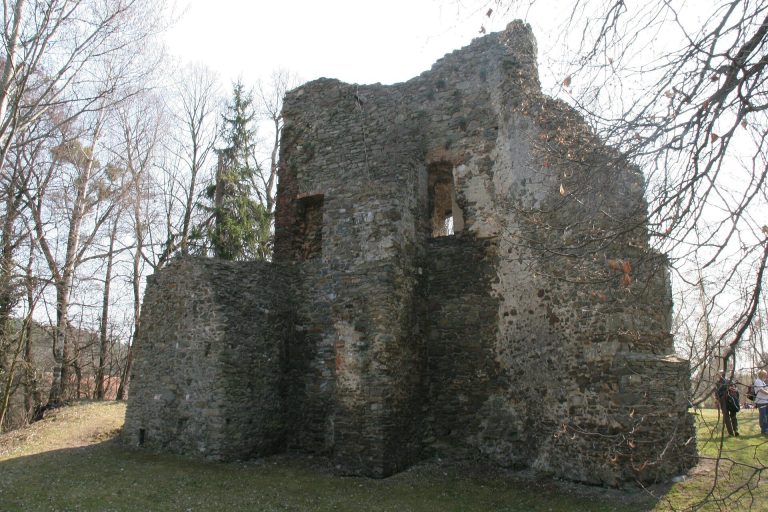
During the eighteenth and nineteenth centuries, inhabitants of nearby villages dismantled castle masonry for building material. Preservation began at the start of the twentieth century. The gate was repaired in 1907, and fragments of architectural elements were incorporated into its masonry. After the land reform, the Czech Tourist Club acquired Lichnice from the Jan Josef Caretto-Millesimo foundation in 1933. During the following decade, extensive excavation exposed the foundations of many buildings and the surviving masonry was conserved. The excavation work also repeatedly damaged the masonry and was later judged unfortunate by Tomáš Durdík.
A lookout and a small museum displaying finds were established in the surviving tower. Conservation continued under the Chrudim District National Committee during the second half of the twentieth century. The town of Třemošnice is the present owner and carries out continuing maintenance and conservation. The ruins are protected as a cultural monument. They lie within the Železné hory Protected Landscape Area and Geopark, while the western slope of the castle hill forms part of the Lichnice National Nature Reserve.
Remains
Lichnice occupies a rocky spur on the edge of the Železné hory. The Lovětín Gorge borders the site to the north, the Peklo Gorge lies to the south, and a steep western slope descends from the spur. A gentler eastern slope rises about 30 metres above the surrounding terrain. Two valleys separate the spur from the main ridge, while a narrow plateau above the Lovětín Gorge connects it with the ridge.
The castle enclosure has a roughly triangular plan, measuring about 79 by 100 by 115 metres and covering approximately 0.46 hectares. A broad ditch and outer rampart surround it except on the northern side. The rampart has a broad crest that was later suitable for artillery. The site’s masonry is built mainly from quarried rubble mixed with lightly dressed blocks of local paragneiss, a metamorphic rock, with smaller quantities of Cretaceous sandstone and granite.
Early castle and inner core
Perimeter defenses and round towers
The earliest building phase included a perimeter wall and a large residential round tower in the northeastern corner. The tower measures about 11.5 metres in diameter. A similar tower, apparently with a projecting beak, probably stood at the southern corner, although only a small fragment survives and its precise form remains disputed. Another probably square building occupied the northwestern corner, and an outer defensive wall was likely part of the first phase as well.
Original palace
The inner core measured approximately 37 by 35 by 32 metres and was separated from the rest of the castle by a wall that has disappeared. The original palace stood along the western wall and measured about 15 by 8 metres. Architectural stone fragments found in this area indicate vaulted spaces and a tracery window. These elements date approximately to the 1260s and help place the early residential work within the castle’s first development.
Late Gothic fortifications and residences
Entrance defenses
The late Gothic rebuilding replaced the original screen gate with a large polygonal barbican, an outer defensive structure protecting the entrance. The rebuilding also probably added an elongated building. At the same time, the ditch and rampart were modified, and the broad top of the rampart provided space for artillery.
Palace and service buildings
The buildings in the northwestern corner were demolished and replaced by a basement palace with a complex plan. The area of the original inner core was also built over. Service buildings were erected along the northern and southwestern walls, while a large two-range building occupied the space between the northern round tower and the gate. These changes expanded the residential and working areas beyond the smaller early core.
Southern shield wall
A shield wall, a particularly strong section of fortification protecting a vulnerable side, strengthened the southern corner. Dendrochronology, the dating of timber through its annual growth rings, places its construction in 1520 to 1522. The wall formed part of the late Gothic defensive improvements associated with the Trčka period.
Hussite siege works
Command post on Kobylí Head
The Hussite siege left earthworks around Lichnice. The best-preserved is the so-called command post on Kobylí Head, on the Štěpnice plateau in the Ohrada locality. It lies about 450 metres from the castle’s southern corner at an elevation of approximately 470 metres. The work has a rectangular plan with seven projections and traces of division into two parts.
Excavation and processing of material from the command post produced 437 fragments of kitchen and table ceramics dating from the first half of the fifteenth century. An archaeological test trench conducted there by Vít Vokolek in 1968 indicated that the position had been occupied only briefly.
Other siege earthworks
Several platforms on the slope above the Lovětín Gorge may have supported siege engines. Early twentieth-century researchers also reported earthworks between Štěpnice Hill and the Lovětín Gorge and interpreted them as remnants of bastions. Their surviving traces could no longer be located at the beginning of the twenty-first century.
Surviving tower and archaeological displays
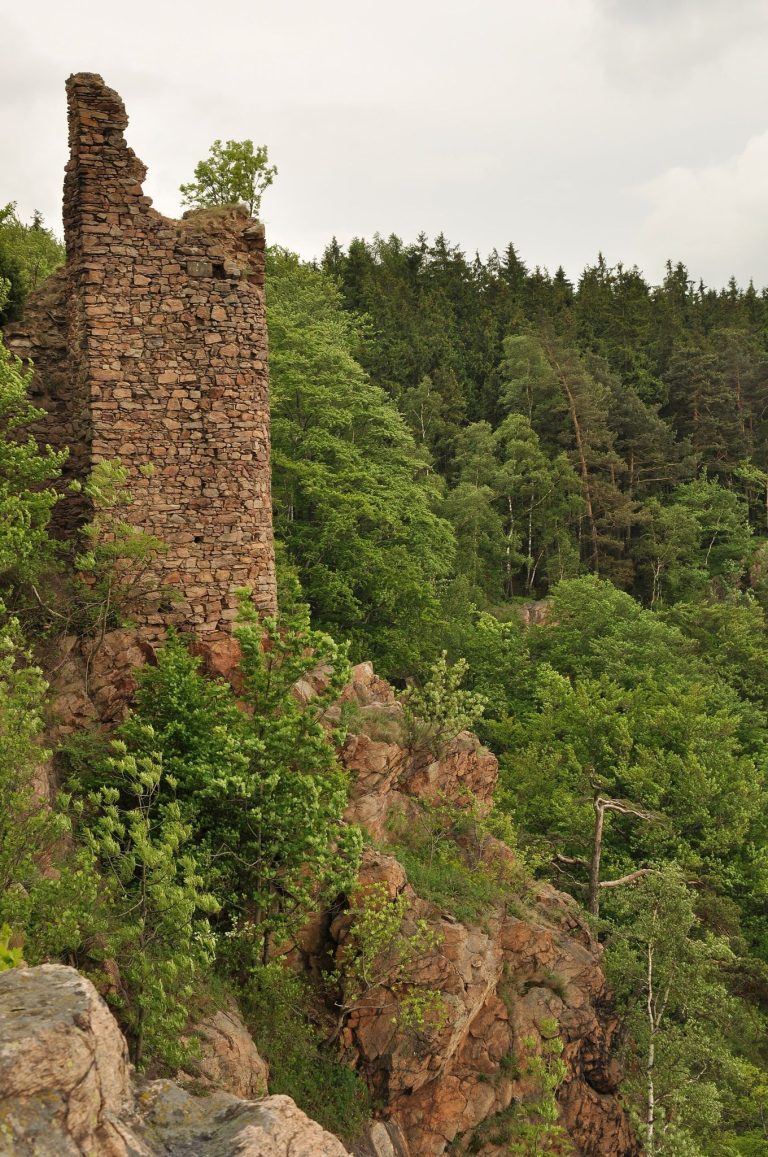
A lookout occupies the surviving part of the tower, and a small museum in the castle displays artefacts recovered during archaeological work. Together with the exposed foundations, conserved masonry, ditches, ramparts, and siege earthworks, these remains show the development of Lichnice from a compact early stronghold into a more extensively fortified late medieval castle.