Pirkštejn: A Gothic Castle at Rataje nad Sázavou


Site at a Glance
- Rating
- 4.4
- Popularity
- Very Low
- Country
- Czechia
- Primary era
- Medieval
- Eras represented
- Medieval, Early Modern
- Civilizations
- Habsburg, Holy Roman Empire, Kingdom of Bohemia
- Site type
- Military
- Remains
- Castle
On this page8 sections
History
Foundation and the Lords of Leipa
Pirkštejn is a Gothic castle in Rataje nad Sázavou, Czechia, founded and built in the first half of the fourteenth century by Henry I of Leipa. It was the lower of two castles at Rataje, while Henry also established the upper castle. The two fortifications are first recorded together in 1346.
The castle remained with the Lords of Leipa until the mid-1360s, when it passed to the Lords of Pirkštejn. This family was a cadet branch of the Lords of Leipa, who themselves belonged to the wider Ronov family. The name Pirkštejn referred to the family’s ancestral castle of Sloup, known in German as Bürgstein.
The Lords of Pirkštejn and Later Holders
Pirkštejn became the principal residential castle of Rataje under the Lords of Pirkštejn, a role it retained until the sixteenth century. Its holders included Jan Ješek of Pirkštejn, his son Jan Ptáček, and Hynce Ptáček of Pirkštejn. When Jan Ptáček was a minor, Hanuš of Leipa acted as his guardian. The property later passed to Viktorin of Poděbrady, the Lords of Švamberk, the Lords of Talmberk, and other noble families.
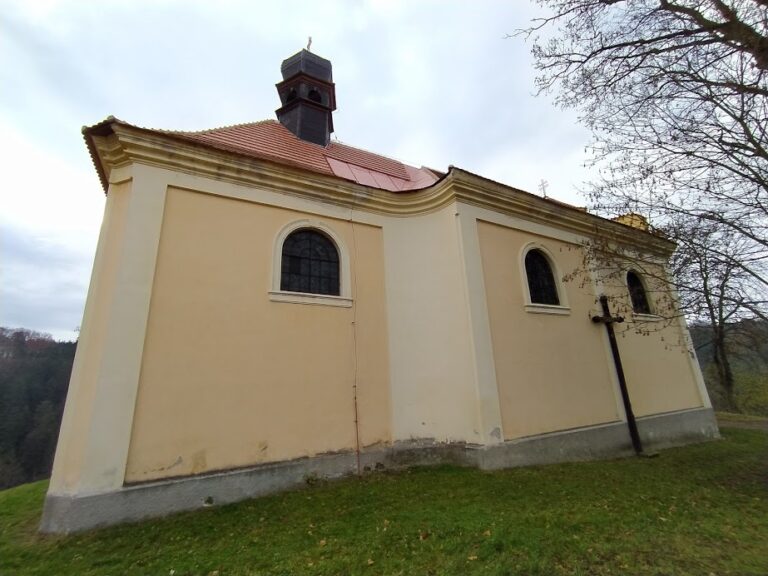
Hynce Ptáček of Pirkštejn was an important political figure in Bohemia after the Hussite Wars, the fifteenth-century religious and political conflicts associated with the followers of Jan Hus. He died at Rataje on 27 August 1444 and was buried in the Church of Saint Matthew there. He had served as tutor and Master of the Mint of the Kingdom of Bohemia, the medieval and early-modern kingdom centered on Bohemia, and had administered several royal towns, including Kutná Hora. He was also guardian of the future King George of Poděbrady.
Transformation and Protection
During the sixteenth century, the Malešický family of Černožice rebuilt the upper castle as a Renaissance chateau. The principal residence then moved there, although Pirkštejn continued to be maintained. The castle was damaged during the peasant revolt of 1627 and was subsequently abandoned.
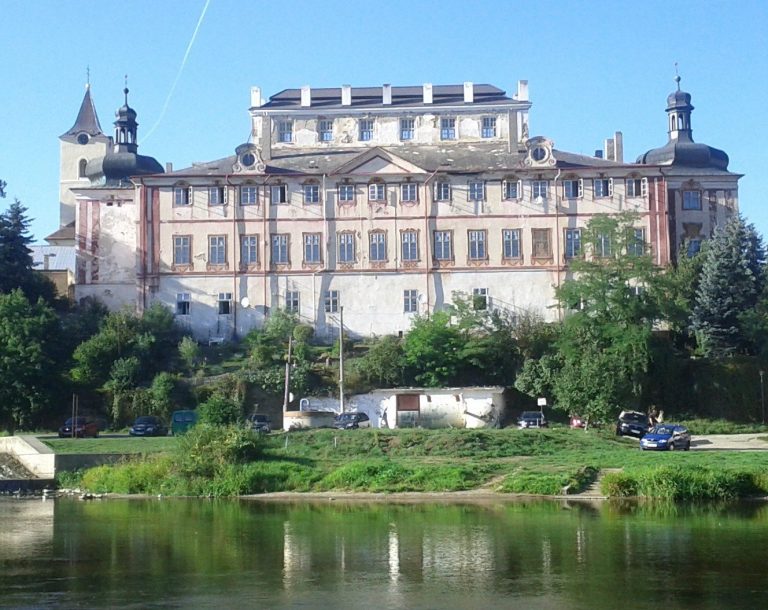
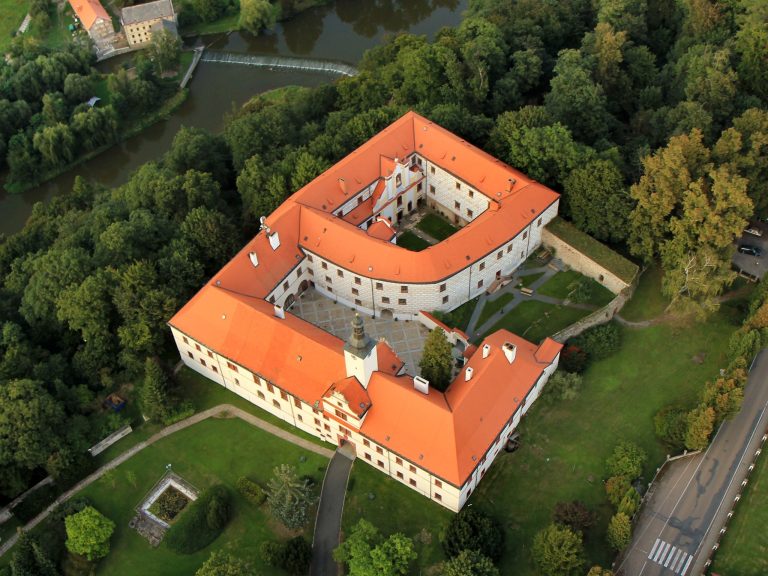
Between 1713 and 1724, the complex was converted into a vicarage and given a bell tower. Pirkštejn is owned by the Church and has been protected as a cultural monument of the Czech Republic since 1958 under registration number 46437/2-1157.
Remains
Defences and Approach
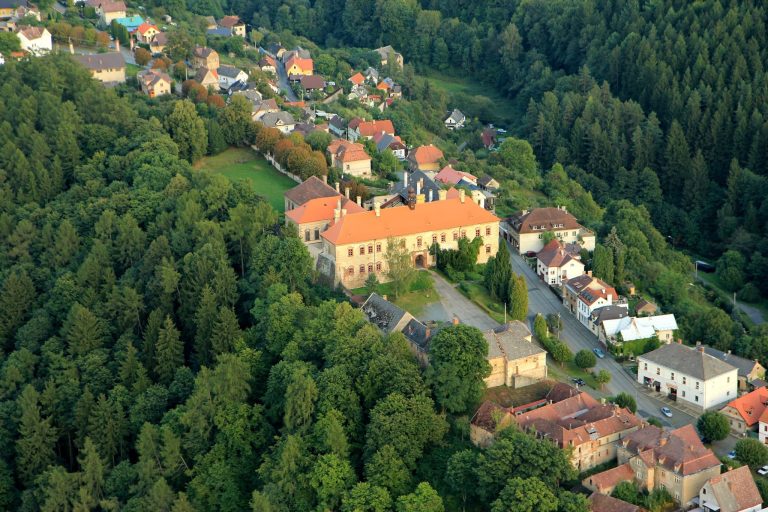
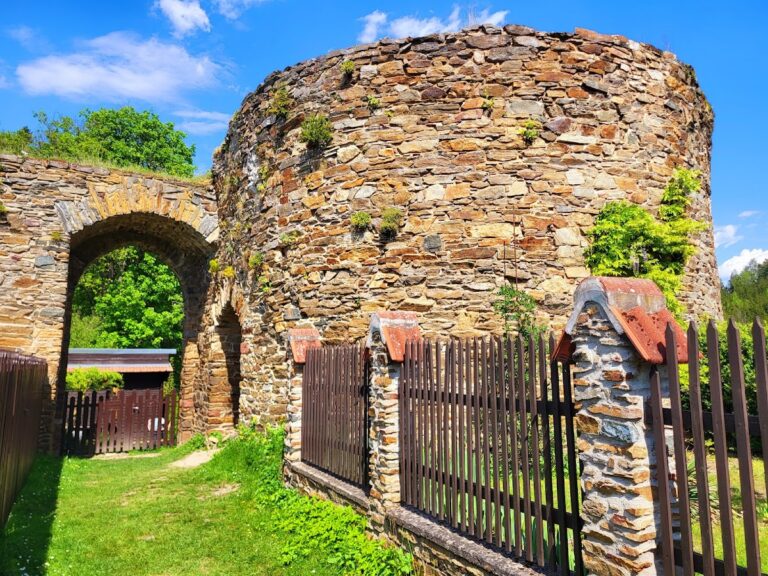
Pirkštejn occupies the southwestern part of the Rataje promontory and is closely connected with the town. Its layout represents an advanced bergfried castle, a medieval complex centered on a strong, usually free-standing defensive and lookout tower. A neck ditch separated the promontory from the town. Beyond the ditch stood the round bergfried, enclosed by a curtain wall. The wall walk controlled a screen gate, linking the defensive system with the approach to the castle.
Palace and Courtyard Buildings
The palace occupied the best-protected rear part of the promontory. It contained three rooms on each floor and was protected on the downslope side by a lower defensive enclosure known as a zwinger, an outer space between a main wall and a lower line of defence. Partially preserved service buildings stood on both sides of the courtyard, completing the surviving arrangement of the castle complex.
Later Alterations
The conversion to a vicarage between 1713 and 1724 altered the complex’s later use and added the bell tower. These changes form part of the surviving architectural history of Pirkštejn, whose medieval defensive and residential elements remain associated with the later ecclesiastical adaptation.