Villa della Palombara: An Ancient Roman Villa near Ostia

Visitor Information
Google Rating: 2.8
Popularity: Very Low
Google Maps: View on Google Maps
Official Website: www.sovraintendenzaroma.it
Country: Italy
Civilization: Roman
Remains: Domestic

History
The Villa della Palombara is situated near Ostia, within the pine forest of Castel Fusano, in the Metropolitan City of Rome, Italy. This ancient Roman villa was constructed in the mid-1st century BC along the Via Severiana, a coastal road that originally ran beside the sea. Over time, natural sand accumulation pushed the shoreline about 600 meters away from the villa.
The villa’s earliest phase likely dates to the mid-1st century BC and is believed to have belonged to the orator Quintus Hortensius, who lived from 114 to 50 BC. Earlier attributions to Pliny the Younger have been revised through archaeological research, which identified Pliny’s residence elsewhere. The villa remained in use and underwent several expansions and renovations through the Roman Imperial period.
During the 2nd century AD, the villa experienced significant development, including the addition of baths and enhancements to the garden area. These changes reflect the Antonine dynasty’s influence, around 130 AD, when a curvilinear fountain was added to the central courtyard. The villa continued to be occupied until at least the early 3rd century AD.
By the 4th and 5th centuries AD, the villa’s function shifted as a Christian basilica was constructed nearby along the Via Severiana. This small church, measuring approximately 16.6 by 9.4 meters, was later modified with a choir area and enclosed porticos. The presence of a child’s tomb and a marble sarcophagus with marine decorations near the basilica’s entrance indicates continued use of the site into late antiquity.
Remains
The Villa della Palombara covers about four hectares and is enclosed by perimeter walls on three sides. Its layout includes a monumental facade facing southwest toward the sea, featuring two polygonal towers rising several floors. Behind this facade lies the residential sector, elevated on a dune platform supported by a cryptoporticus, an underground vaulted corridor that provided panoramic views of the coastline.
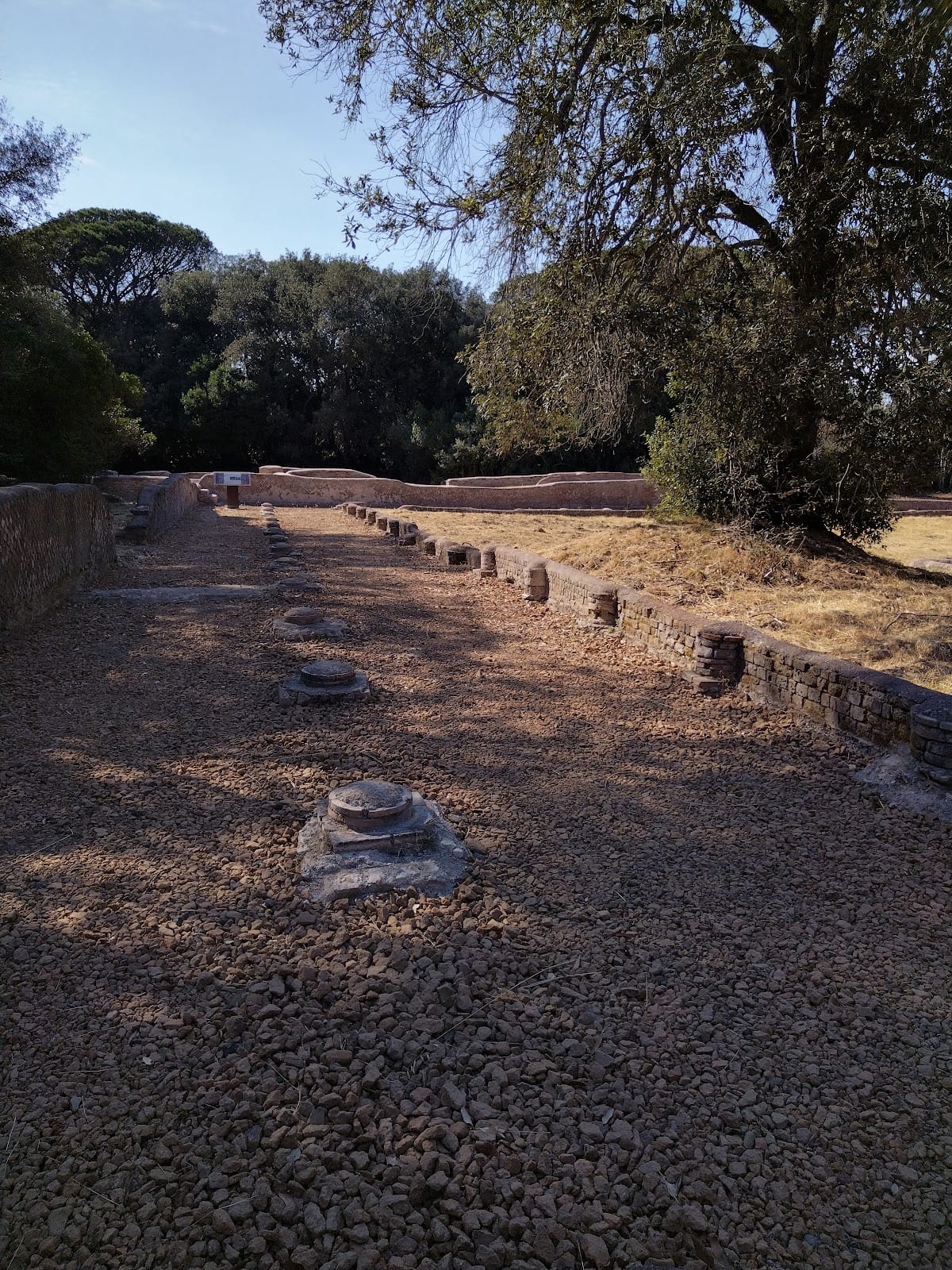
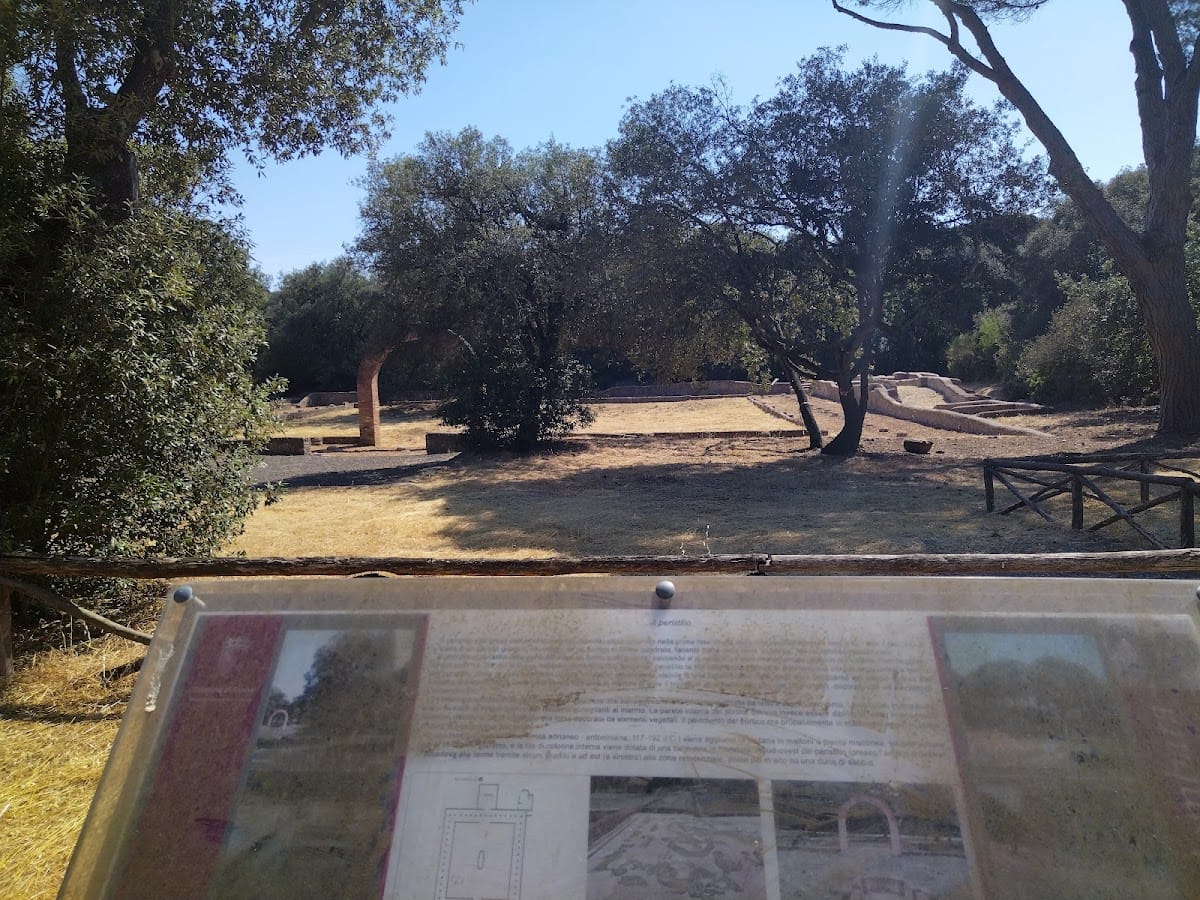
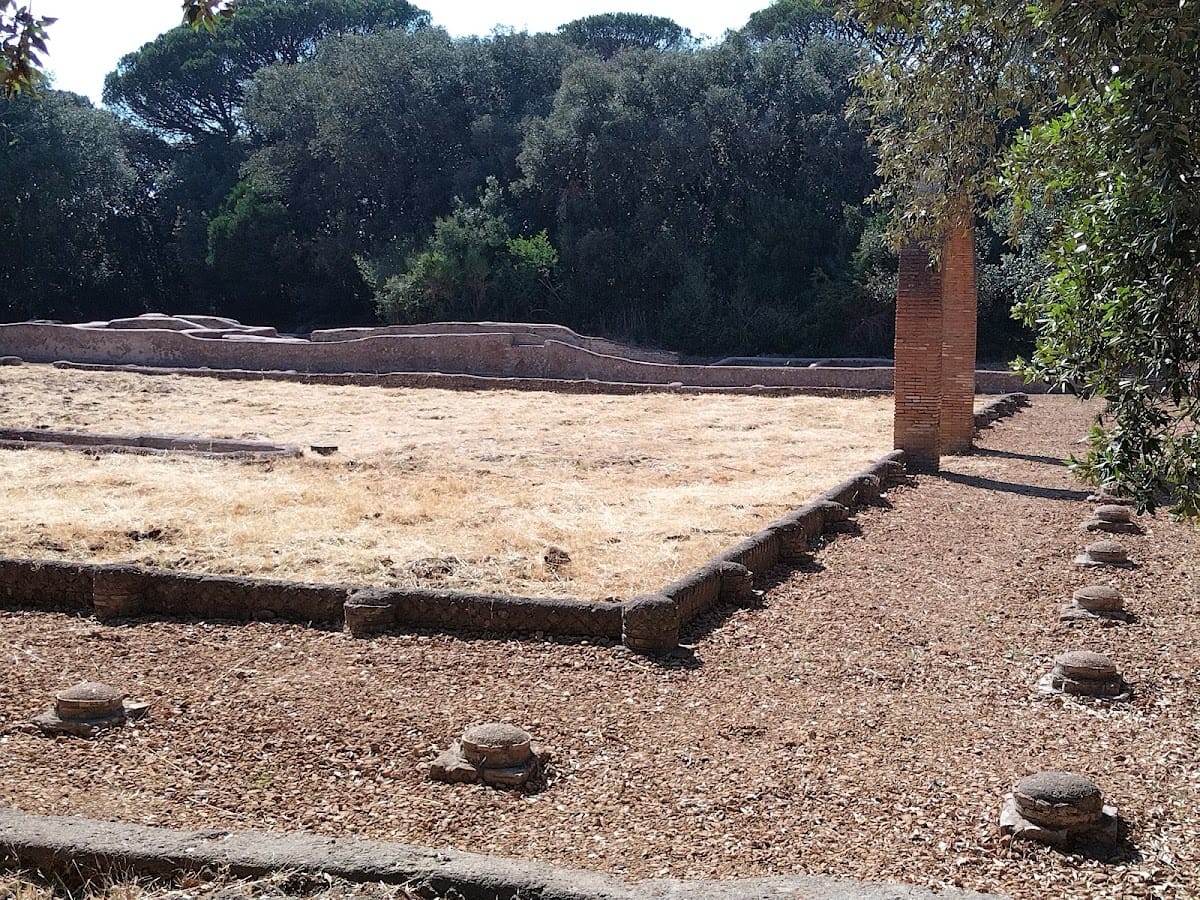
The public area centers on a large porticoed peristyle, a courtyard surrounded by columns arranged in two rows. These columns were made of white-plastered masonry and supported a gabled roof. The inner walls of the portico were decorated with red plaster arranged in a herringbone pattern known as opus spicatum. The entrance once featured a grand arch flanked by columns, now lost. During the Antonine period, a curved brick fountain was added to the courtyard’s center, and a small masonry balustrade was installed along the inner columns of the portico.
The villa’s baths are located at the southwest corner near the peristyle. They include heated rooms and pools, with a notable black-and-white mosaic floor depicting Neptune riding a chariot pulled by seahorses. This mosaic is surrounded by marine figures and attendants. Although the baths were rebuilt during the Antonine dynasty, they may have been part of the villa’s original design.
Residential rooms are arranged around a small colonnaded atrium, while the main entrance to the villa was from the north through another atrium. This northern atrium was later converted into a kitchen featuring a mosaic floor made from reused tesserae, small pieces of stone or glass used in mosaics. Service areas, including a two-level cistern for water storage, are located at the rear of the villa.
Slave housing, known as an ergastulum, was constructed along the northern boundary in the mid-1st century AD. These were two-story modular units built using opus reticulatum, a Roman technique involving diamond-shaped bricks arranged in a net-like pattern.
In the 2nd century AD, the villa’s perimeter walls were expanded to enclose a large garden, or viridarium. This garden included water channels and possibly a fishpond basin, enhancing the villa’s leisure and aesthetic appeal.
Near the villa’s northeast boundary, a paleo-Christian basilica was built in the 4th century AD along the Via Severiana. This church was later modified with a schola cantorum, a choir area, and enclosed portico spaces. Archaeologists discovered a child’s tomb and a marble sarcophagus decorated with marine motifs dating from 150 to 175 AD outside the basilica’s entrance.
Nearby sites