Veste Coburg: A Historic Fortress and Museum in Bavaria


Visitor Information
Google Rating: 4.7
Popularity: Medium
Official Website: www.kunstsammlungen-coburg.de
Country: Germany
Civilization: Medieval European
Site type: Military
Remains: Castle

History
Veste Coburg stands on a hill overlooking the city of Coburg in Upper Franconia, Bavaria, near the border with Thuringia. Archaeological findings show that the site was settled from the Neolithic period through the early Middle Ages. The first written record of Coburg dates to 1056, connected to a donation by Richezza of Lorraine to Archbishop Anno II of Cologne, which led to the founding of Saalfeld Abbey in 1071.
The fortress itself was first mentioned as a “sloss,” meaning palace or castle, in 1225. The oldest surviving structures date from this time. Ownership of the fortress passed through several noble families, including the Dukes of Merania, Counts of Henneberg, and Margraves of Brandenburg. From 1353 until the end of the monarchy in 1918, the House of Wettin held the fortress.
During the Thirty Years’ War, Veste Coburg was never captured by force. However, in 1635, after a five-month siege, it was surrendered due to a forged letter ordering its handover to Imperial forces led by General von Lamboy. This event marked the only time the fortress changed hands through deception rather than battle.
In 1530, Martin Luther stayed at Veste Coburg from April to October while under imperial ban. During his stay, he continued translating the Bible and wrote many letters and sermons. The fortress served as a ducal residence until 1547, after which it was primarily used for military defense.
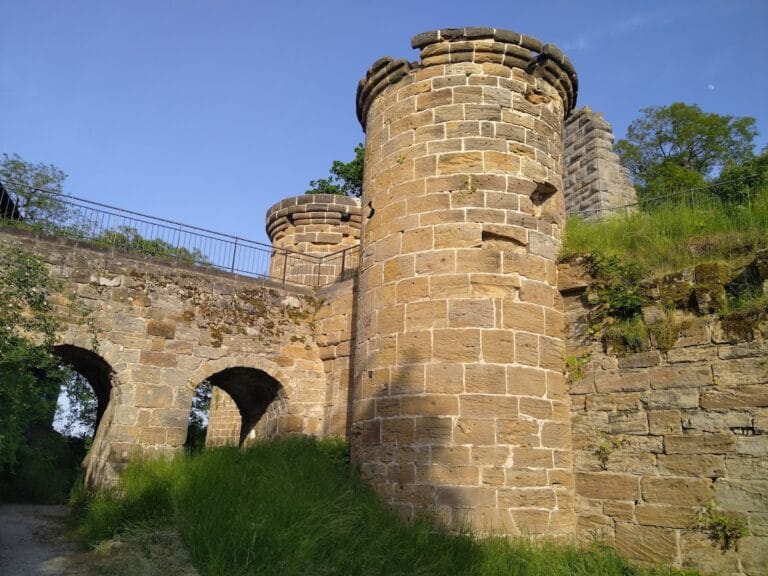
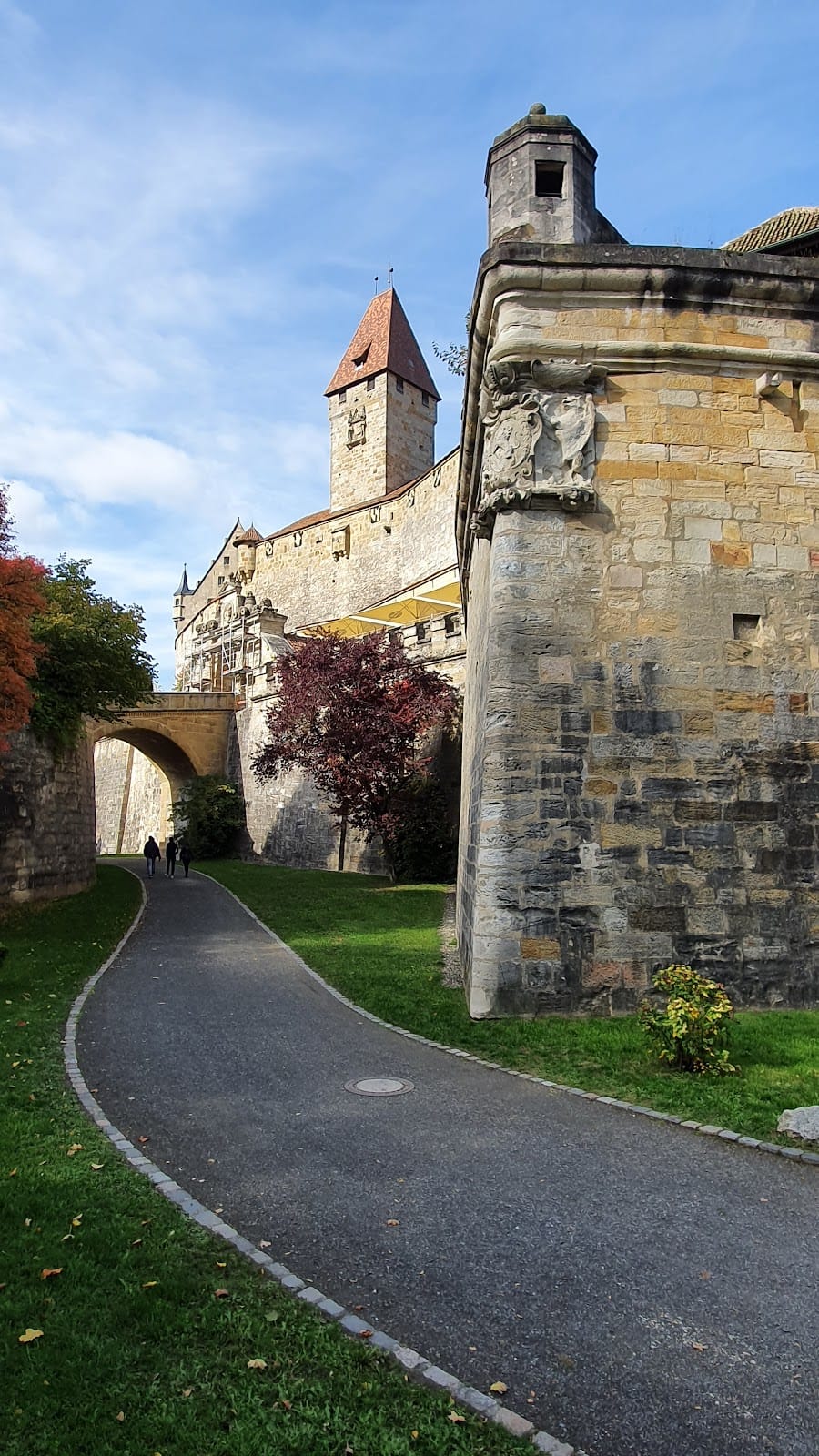
From the 16th century onward, the fortress underwent several expansions and improvements to its defenses. These included the construction of triple defensive walls with nine round towers called rondels, six of which remain today. Large bastions such as the Hohe Bastei, Rautenkranz, Bunter Löwe, and Bärenbastei were added, along with a second entrance on the western side.
In the 19th century, Veste Coburg ceased to serve a military role, officially ending in 1820. Between 1827 and 1838, the outer fortifications were removed, and the fortress was remodeled in a Romantic style to house art collections.
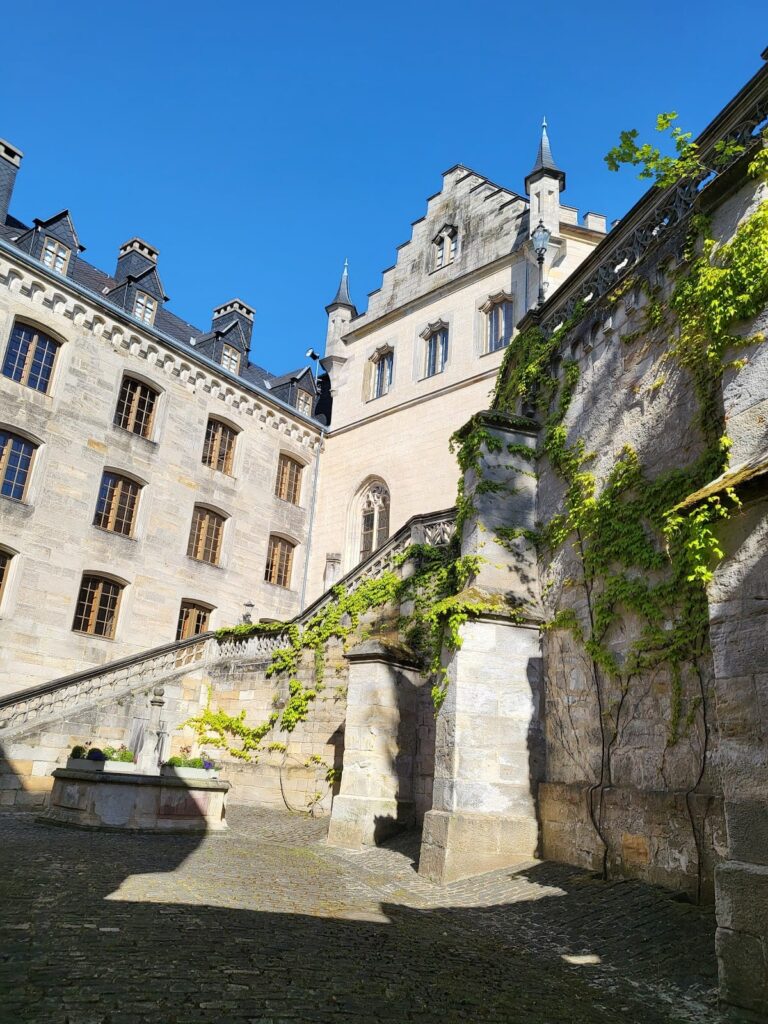
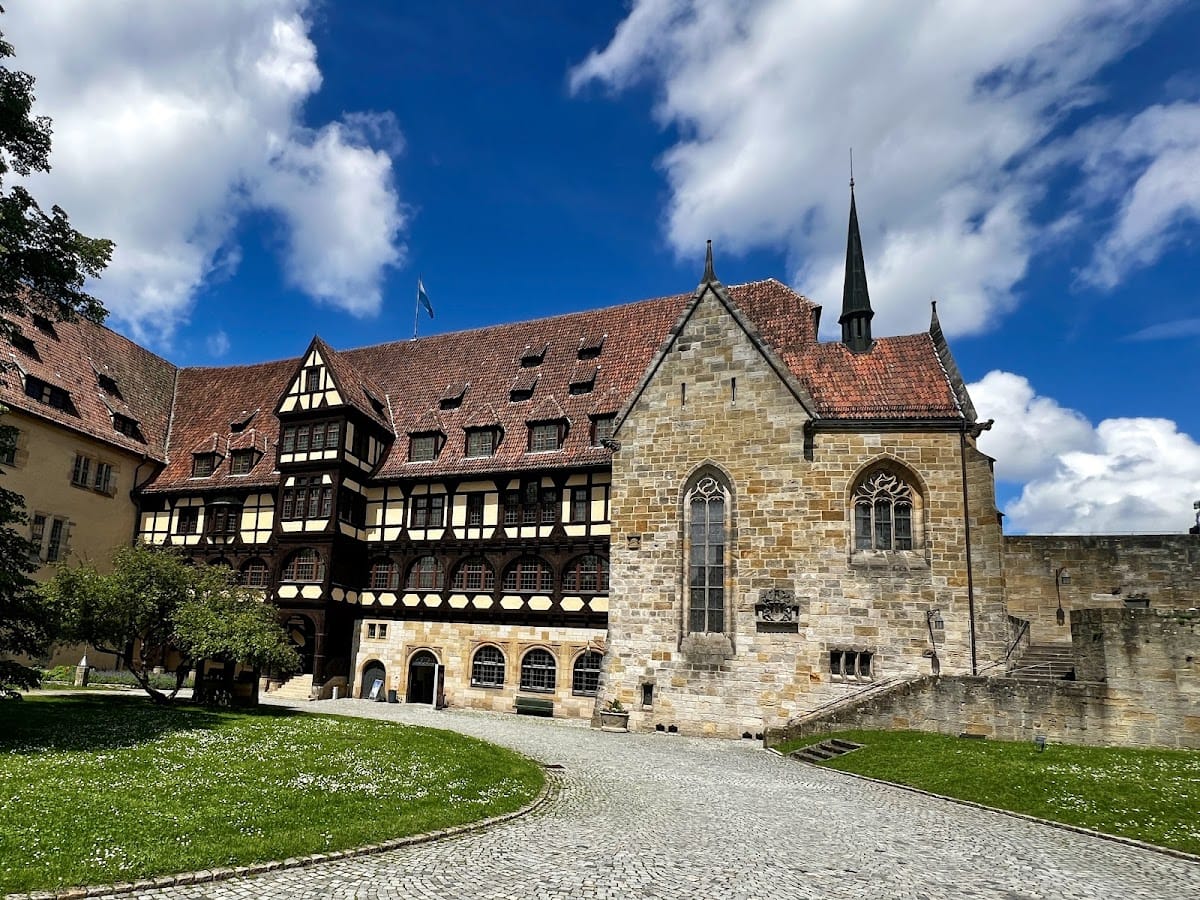
Between 1909 and 1923, architect Bodo Ebhardt led extensive restoration and remodeling efforts. He removed many 19th-century historicist elements and reconstructed key buildings such as the Fürstenbau (princely residence), Luther Chapel, Bulgarenturm (Bulgarian Tower), Herzoginbau (Duchess’s building), and Carl-Eduard-Bau (Congress building). These projects were funded by donations and a lottery, with Duke Carl Eduard playing a significant role in their oversight.
After suffering damage from American artillery in April 1945 during World War II, restoration continued under Bavarian state administration. Major renovations were completed by the late 20th and early 21st centuries. The fortress became state property in 1919 but the ducal family retained residential rights until 1998.
Today, Veste Coburg functions as a museum complex preserving the art and cultural collections of the Coburg dukes. It is managed by the Coburger Landesstiftung and the Bavarian administration.
Remains
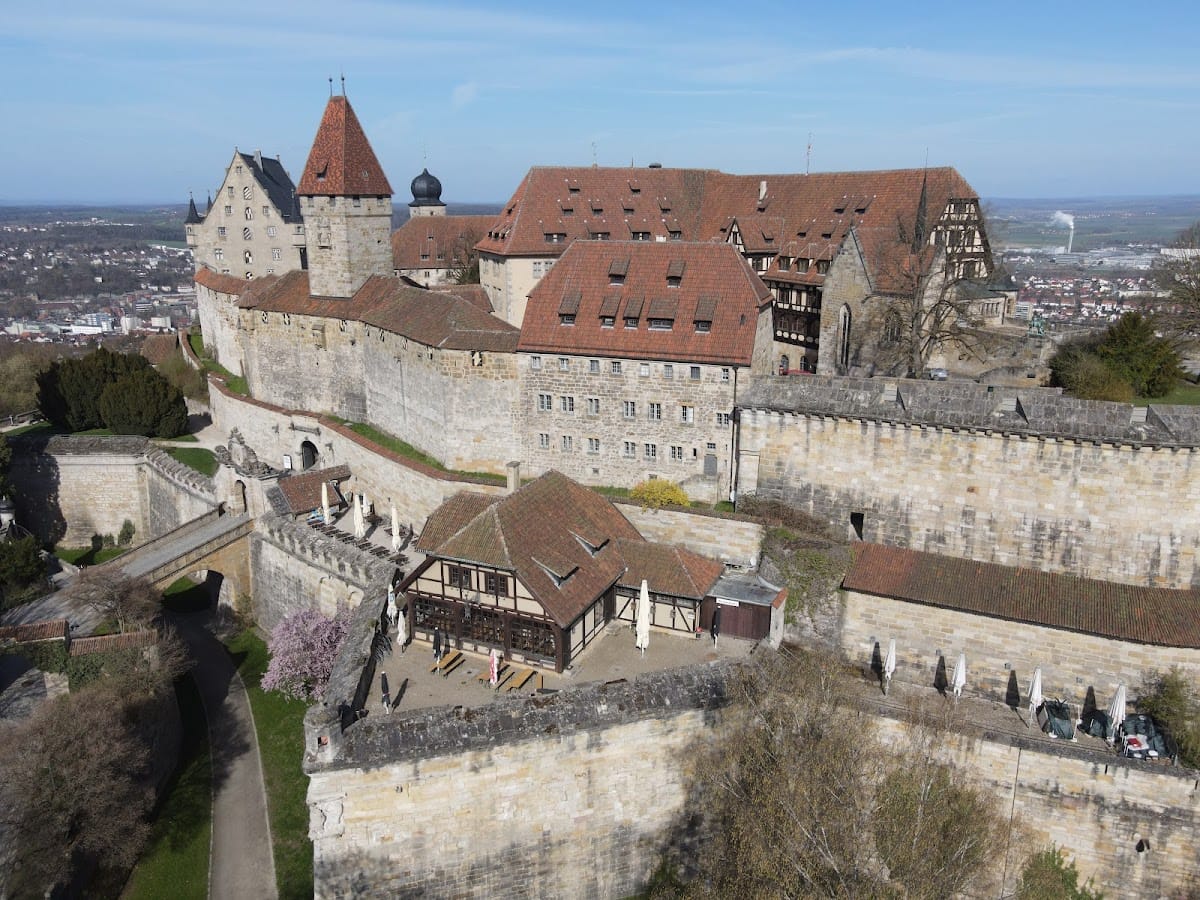
Veste Coburg covers an area approximately 135 by 260 meters and sits about 160 meters above the city center on a hill at 464 meters above sea level. The original layout likely featured an eastern main castle with a bergfried, which is a tall defensive tower or keep, a palas or residential hall, and a chapel. A western outer bailey provided additional space and defense.
Around 1420 to 1430, a triple ring of defensive walls was constructed. The outer wall was strengthened by nine round towers called rondels, six of which survive today. Large bastions were added, including the Löwenbastion, Hohe Bastei, Rautenkranz, Bunter Löwe, and Bärenbastei. The Hohe Bastei, completed in 1553, was designed to defend against cannon fire on the vulnerable eastern side. Deep moats and high bridges further enhanced the fortress’s defenses.
The main entrance features a ten-meter-high portal equipped with iron gates and a portcullis, a heavy grating that could be lowered to block entry. Inside, covered walkways and pitch pits—holes designed to pour boiling substances on attackers—added layers of protection. The fortress’s fortifications have never been breached in combat.
Key buildings within the fortress include the Fürstenbau, which served as the princely residence, and the Luther Chapel. The chapel is a two-aisled structure with rib vaulting, rebuilt in 1851 and remodeled between 1910 and 1923 by Bodo Ebhardt. Its stained glass windows depict Saxon rulers, saints Peter and Paul, and the family of the last Duke Carl Eduard. The chapel organ, originally from Münchberg, was enlarged in 1922 and features thirteen registers on two manuals and a pedal.
The Bulgarenturm, or Bulgarian Tower, was rebuilt in 1913 with financial support from Tsar Ferdinand of Bulgaria. The Herzoginbau houses a notable collection of ceremonial carriages and tournament sleds. The Carl-Eduard-Bau, completed in 1924, served as a congress building. The Hohe Haus, used as an armory or arsenal, was rebuilt after fires.
The fortress grounds include the Coburger Hofgarten, a court garden on the hillside facing the city. A giant sequoia tree planted around 1860 stands over 32 meters tall with a trunk circumference of 6.25 meters.
Interior rooms of note include the Jagdintarsienzimmer, a 17th-century hunting intarsia room decorated with wood inlay, and the Prunkzimmer in the Stone Chamber, which features 60 intarsia panels. The Große Hofstube, or Great Hall, measures 26 by 12 meters.
Veste Coburg houses extensive art collections. These include paintings and sculptures by Lucas Cranach the Elder, Albrecht Dürer, Matthias Grünewald, and Tilman Riemenschneider. The print cabinet contains about 330,000 works, including prints from the Reformation era. The glass collection holds approximately 2,700 pieces, with a focus on Venetian glass. The coin cabinet contains around 20,000 items. The armory includes Gothic wooden shields, firearms and armor from the Thirty Years’ War, richly decorated tournament armor, and a 49-barrel cannon named “Emma.”
Two richly gilded Renaissance wedding carriages are displayed, including the oldest operational carriage of its kind, a dowry gift from Dorothea of Brunswick-Lüneburg.
Outdoor monuments include a 1913 equestrian statue of Martin Luther titled “Light and Power” by Hans Klett and a 1930 relief by Edmund Meusel on the Stone Chamber.
The fortress’s preservation is generally very good. Many original defensive structures remain intact, and several buildings have been restored or reconstructed during the 20th century under Bodo Ebhardt’s direction and later renovations.
Nearby sites