Untere Burg Hardheim: A Medieval Castle in Germany

Visitor Information
Google Rating: 2
Popularity: Very Low
Google Maps: View on Google Maps
Country: Germany
Civilization: Unclassified
Remains: Military

History
Untere Burg Hardheim, also known as the Niederes Schloss, stands at the southern edge of Hardheim’s village center in present-day Germany. This fortified residence was constructed around the year 1200 during the High Middle Ages by the local nobility known as the Hardheim family.
The castle first appears in documentation between 1323 and 1326 as a fortified noble seat enclosed by walls and a moat. Originally, it likely functioned as a water castle, strategically placed to guard the southern approach to the village. By this time, it was closely linked to the Hardheim family, who are recorded as early as 1197 with Heinricus von Hartheim appearing as a witness in a donation deed. Throughout the 14th century, the castle’s ownership was marked by complex feudal relationships. The Hardheim family held it as allodial property—a type of freehold—yet they took it in fief from the Lords of Wertheim. Nearby, the Obere Burg was a separate castle held as a fiefdom of the Archbishopric of Mainz, highlighting a divided territorial control in the area.
In 1444, Untere Burg Hardheim suffered significant damage during a military conflict. Co-owner Horneck von Hornberg initiated raids against the Würzburg bishopric, prompting troops from Würzburg to storm and destroy the castle. Following this event, the castle entered a period of decline. Financial hardship beset Konrad IV. von Hardheim in the mid-15th century, forcing him to pledge parts of the castle. By 1447, Konrad sold the remaining share as a life estate to the Würzburg prince-bishop. This transaction was reversed in 1474, returning the property to the Hardheim family, though their lineage came to an end shortly thereafter in 1482, with Werner V. being the final descendant.
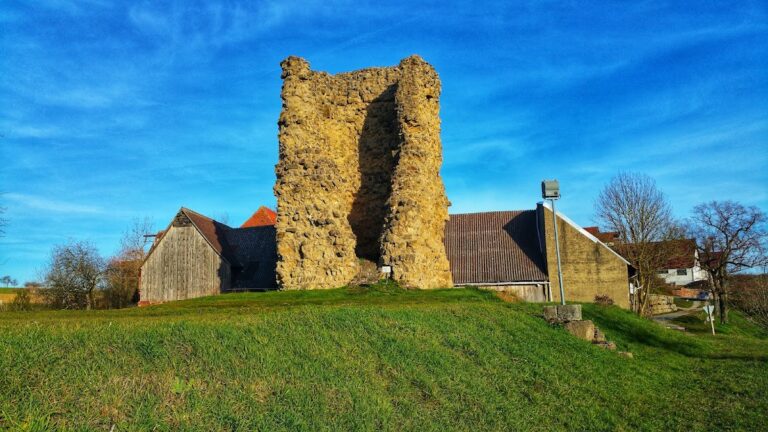
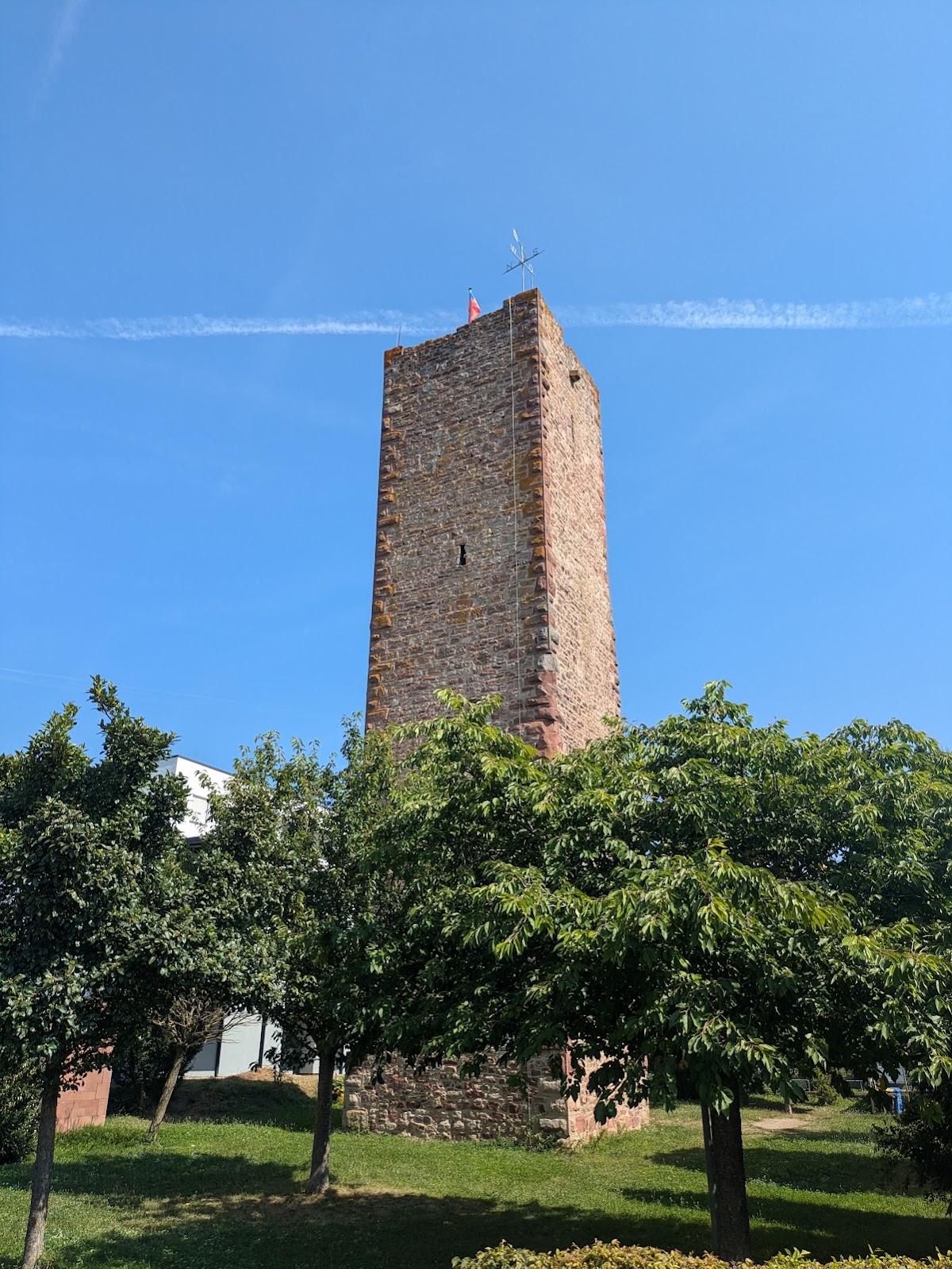
By the late 16th century, specifically 1595, the castle had fallen into ruin and was described as largely deserted. Its remains were divided among local inhabitants by 1711, and while some portions remained visible into the 19th century, the castle never recovered its former stature. An enduring local legend speaks of an underground passage connecting Untere Burg Hardheim to the nearby Obere Burg, though this remains a traditional tale without confirmed evidence. The last surviving part of the castle, a towering stone structure, was uncovered during village renovations in 1987, restored in the mid-1990s, and has since been recognized as a cultural landmark.
Remains
Today, the sole surviving structure of Untere Burg Hardheim is a freestanding stone tower known as a bergfried, which served as a robust defensive tower typical of medieval castles. Built from quarried sandstone around the year 1200, this tower rises approximately 30 meters tall with a square base measuring 6.4 meters on each side. Its massive walls, over two meters thick at the foundation, feature rusticated quoins—blocks with deliberately roughened edges—at each corner. These masonry details provide important clues for dating the tower to the early 13th century.
The tower’s eastern face contains the main entrance at ground level, a round-arched doorway framed by a carefully crafted sandstone portal. Above this, roughly 10 meters from the ground, is a secondary door slightly offset toward the north, which likely provided access to higher defensive levels or a wooden staircase inside. Narrow arrow slits are sparsely distributed on the other sides, designed to allow defenders to shoot while minimizing exposure. A nearly square window opening, believed to have been inserted later, appears a few meters above the current main entrance. This modification suggests adaptation over time to changing needs or living conditions.
Presently, the tower stands surrounded by open meadows and bordered by streets known as Holzgasse and Riedstraße, just east of the modern B27 highway. It is maintained as a protected cultural monument and remains a local landmark. Archaeological investigations at the site have uncovered fragments and artifacts now housed on loan at the Erfatal Museum in collaboration with the Baden-Württemberg State Monument Office. This evidence, together with the tower’s preserved form, offers valuable insight into the region’s medieval past and the strategic role of Untere Burg Hardheim within local noble networks.
Nearby sites