Burg Oberlauda: A Medieval Castle and Administrative Seat in Germany


Site at a Glance
- Rating
- 3.3
- Popularity
- Very Low
- Country
- Germany
- Primary era
- Medieval
- External website
- Open
- Eras represented
- Medieval
- Civilizations
- Holy Roman Empire
- Site type
- Military
- Remains
- Castle
On this page5 sections
History
Burg Oberlauda was a medieval castle in Germany, above Oberlauda, now a district of Lauda-Königshofen. Its exact origin is unknown, although a large refuge fortification probably occupied the Schlossberg before the medieval period and was later expanded into an extensive castle. The medieval complex was probably built after the former castle at Lauda. Known also as the Upper Castle of Lauda and the Mountain Castle of Oberlauda, it served as the seat of the Lauda administrative office until its destruction.
Medieval lordship
In 1169, the noble free lords of Lauda granted part of the castle as a fief to Herold von Höchheim, Bishop of Würzburg. Enfeoffment was a feudal grant made in return for service rather than an outright transfer of ownership. In 1209, the lords divided the castle with their relative Siboto von Zimmern. After their family line ended around 1216, Gerhard von Rieneck was recorded as its holder in 1225.
Lesser nobles of Lauda held the Upper Castle at intervals during the thirteenth and early fourteenth centuries. At least some of these holders also lived partly in the Lower Castle, a separate residential tower at Oberlauda that was later enlarged. The designation Upper Castle distinguished Burg Oberlauda from this lower complex.
Destruction and later investigation
On Good Friday in 1525, rebellious peasants burned the large castle complex above Oberlauda during the German Peasants’ War, a widespread uprising in the German-speaking lands against established political, economic, and ecclesiastical authorities. After the fire, villagers progressively removed the castle’s stones for house construction, a practice that continued extensively until the mid-twentieth century.
Archaeological investigations in 1880 uncovered numerous remains, some of which have since disappeared. In 1949, the local chronicler Stephan Oehmann prepared a reconstruction drawing using topographical knowledge, surviving masonry, and conversations with older residents who had still seen the castle’s outlines around the 1880s. During the construction of an electricity pylon in 1959, ground testing revealed an intact underground dungeon. It was filled with concrete, a loss later condemned by local historians and archaeologists, particularly because Oehmann had called for further research into the castle’s age.
Remains
Castle plateau and surviving earthworks
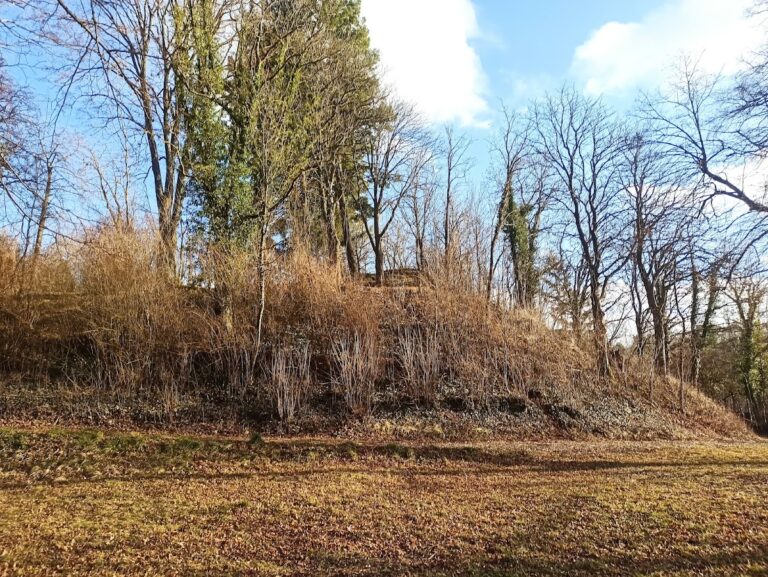
Burg Oberlauda occupied a projecting spur of the Schlossberg at approximately 285 metres above sea level. As a spur castle, it used a projecting ridge and its surrounding slopes as part of its defensive setting. The former complex was large and extensive, with a castle plateau enclosed by a ring ditch. Only scant masonry remains survive, but visible earth banks and underground wall lines allow part of the former ground plan to be traced.
The surviving foundations contain well-cut, high-quality stone and are perceptible in places beneath the earthworks. The underground dungeon found during the 1959 ground testing was intact when discovered but was subsequently filled with concrete. Burg Oberlauda is now a deserted castle site whose physical evidence consists mainly of sparse masonry, buried wall lines, and the remaining earth banks that preserve portions of its layout.