Roman Theater of Lecce: An Ancient Performance Venue in Southern Italy




Visitor Information
Google Rating: 4.3
Popularity: Low
Google Maps: View on Google Maps
Country: Italy
Civilization: Roman
Remains: Entertainment

History
The Roman Theater of Lecce is situated in the historic center of Lecce, a city in the province of Lecce, southern Italy. In ancient times, this area was known as Lupiae, a small town within the Roman world. The theater was built in the early 1st century AD, during the reign of Emperor Augustus. Historical evidence suggests that Augustus may have commissioned the theater before officially becoming emperor, possibly while he was taking refuge in Lupiae.
This theater is closely connected to the Roman amphitheater of Lecce, which is also attributed to Augustus. Both structures were likely part of Augustus’s efforts to honor and repay a debt to the city of Lupiae. The theater served as a venue for public performances, including tragedies and comedies, accommodating an audience estimated to be over 5,000 spectators.
After centuries of use, the theater eventually fell into obscurity and was buried over time. It remained hidden until 1929, when it was accidentally uncovered during excavation work in the gardens of two historic palaces, Palazzo D’Arpe and Palazzo Romano. Since its rediscovery, the site has been studied and partially restored, with artifacts from the theater preserved in nearby museums.
Remains
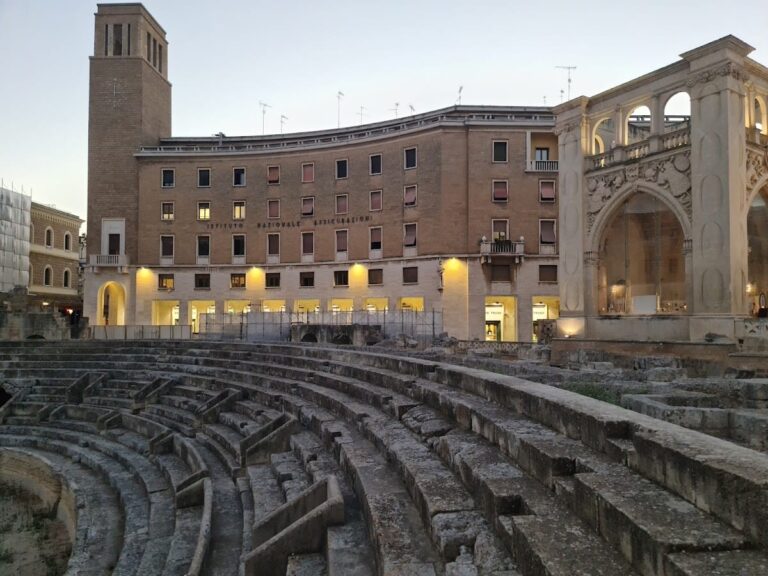
The Roman Theater of Lecce is carved into a rocky slope and features a cavea, or seating area, with an external diameter of 40 meters and an internal diameter of 19 meters. The cavea is constructed using opus quadratum, a technique involving large rectangular stone blocks laid in regular courses. The seating is divided into six wedge-shaped sections by five radial stairways. Each section contains twelve steps, each about 0.35 meters high and 0.75 meters deep, many of which have undergone restoration.
The orchestra, the semicircular space in front of the seating reserved for the chorus, is paved with rectangular white limestone slabs. It was accessible through a narrow covered passage. In front of the orchestra are three large semicircular steps designed to hold movable seats for distinguished spectators. Behind these steps lies a low parapet called the balteus, which bears clay decorative fragments dating back to the Augustan period.
The stage area is located behind the orchestra and includes a channel for the curtain. The stage itself stands 0.70 meters above the orchestra floor, extends 7.70 meters deep, and spans 30 meters in width. While the lower parts of the theater remain visible, the upper seating tiers (media and summa cavea), the peripheral portico (porticus in summa cavea), and the elaborate stage front (frons scaenae) have not survived. Marble statues found at the site are attributed to the Antonine era, indicating later decorative additions.
Artifacts recovered from the theater are housed in the adjacent Roman Theater Museum and the Sigismondo Castromediano Archaeological Museum. The site remains accessible, with occasional performances held inside the theater’s interior.
Nearby sites