Rocca di Offagna: A Medieval Fortress in Italy


Visitor Information
Google Rating: 4.6
Popularity: Medium
Google Maps: View on Google Maps
Official Website: www.visitoffagna.it
Country: Italy
Civilization: Medieval European
Remains: Military

History
The Rocca di Offagna is a medieval fortress situated in the town of Offagna, Italy. It was constructed by the Republic of Ancona, a maritime power in the region, during the mid-15th century.
Building of the fortress occurred between 1454 and 1456 as part of a strategic effort by the Republic of Ancona to defend its mainland territories from the expanding influence of the neighboring city of Osimo. This construction was driven by the need to protect Ancona’s hinterland, which was vital to the republic’s commercial and military interests. The fortress formed one element within a network of defensive structures known as the Castles of Ancona.
Throughout its operational history, the Rocca di Offagna served multiple roles. Initially established as a military stronghold, it later provided refuge for local farmers and their animals during times of conflict. The fortress was managed by a castellan whose residence was located within the keep, offering both administrative control and a defensible position. In 1477, a bell installed at the top of the mastio was inscribed with a dedication to the Madonna and signed by its founder, Iacobus de Istria, indicating continued religious and symbolic significance.
The Rocca di Offagna was declared a national monument in 1902, recognizing its historical importance within Italy. Later restoration work has preserved its structure and adapted the site for cultural and educational purposes.
Remains
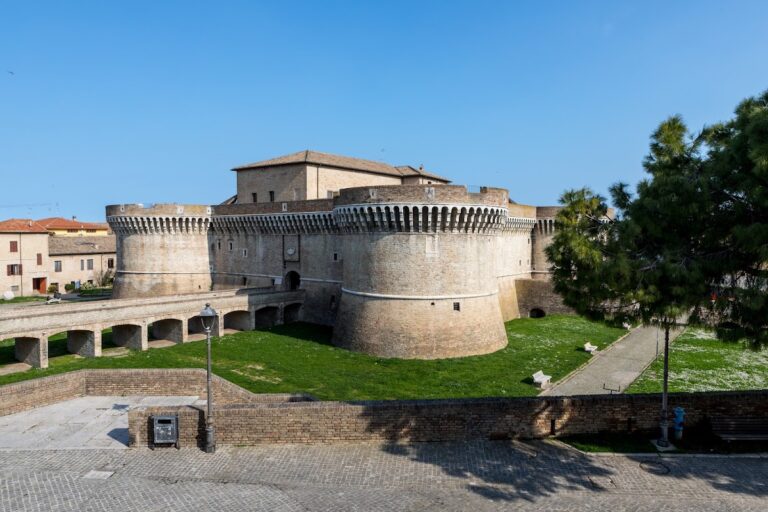
The fortress stands as a large quadrilateral structure built upon a fortified outcrop of tuff rock, a volcanic stone that enhanced its defensive capabilities. The central feature is a towering mastio, or keep, which rises over five levels. This keeps its entrance on the fourth floor to increase security, accessible only by structures designed to be removed or destroyed if attackers breached the outer defenses, allowing the mastio to serve as a final bastion.
The stronghold’s walls are thick and constructed from brick, specifically designed to resist firearms rather than traditional siege engines. This adaptation is evident in the presence of fifty designated positions for bombarde, or early cannons, that were integrated into the battlements. The battlements themselves display swallowtail-shaped merlons, a style associated with the Ghibelline faction, and the surrounding curtain walls include several towers, among which a semicircular tower at the fortress’s northeast end still stands.
Within the walls, the courtyard was originally sheltered by wooden roofing, providing cover for those within. Various internal features such as staircases, walkways, additional drawbridges, and shelters were also wooden, but these elements have not survived the passage of time. Inside the mastio, the ground floor contains a deep well measuring approximately 30 meters, essential for supplying water during sieges. The first floor houses a small cell connected to the upper floors only by ceiling hatches, allowing for secure confinement. The castellan’s living quarters are situated on the third floor, identified by the fortress’s sole fireplace.
A bell atop the mastio dates from 1477 and bears an inscription invoking the Madonna, alongside the signature of Iacobus de Istria, the founder. This element connects the military function of the fortress with religious devotion typical of the period.
Today, restored parts of the fortress include accessible battlements and a terrace at the mastio’s summit. These features offer extensive views over the surrounding countryside, encompassing the Marche hills and nearby historic centers extending from the Apennines mountains to the coastal area known as the Conero Riviera.