Pasargadae: The First Capital of the Achaemenid Empire in Iran


Visitor Information
Google Rating: 4.7
Popularity: Low
Google Maps: View on Google Maps
Official Website: pasargadae.info
Country: Iran
Civilization: Achaemenid
Remains: Civic

History
Pasargadae is located near Madarsoleyman in the Fars Province of modern Iran, situated on a high plain approximately 1900 meters above sea level. It was established by the Persian Achaemenid Empire as its first capital during the mid-6th century BCE. The city was founded by Cyrus the Great, also known as Cyrus II, who belonged to the Pasargadae tribe, a Persian group whose name means “those who wield heavy maces.” This tribe is mentioned by ancient historians such as Herodotus, and the site’s name reflects this heritage.
During the reign of Cyrus the Great, Pasargadae served as both a royal residence and an administrative center. It was here that Cyrus built monumental palaces, gardens, and his own tomb. His son, Cambyses II, continued to use Pasargadae as a royal seat. The city functioned as the heart of the empire until Darius I shifted the capital to Persepolis, marking a new phase in Achaemenid administration and architecture.
After the Achaemenid Empire fell to Alexander the Great in 330 BCE, Pasargadae declined in political importance. Alexander visited the site and ordered restoration of Cyrus’s tomb, showing respect for the founder of the empire. Over time, the site lost its status as a capital and became less central to imperial affairs.
In Islamic times, the tomb of Cyrus was mistakenly identified as the “Tomb of Solomon’s Mother,” reflecting a shift in local religious and cultural interpretations. A mosque was constructed nearby in the 13th century CE (7th century AH), incorporating stones taken from the ancient palaces. This mosque was later dismantled in the 20th century, but its presence marks the continued reverence and reuse of the site through centuries.
Archaeological interest in Pasargadae began in the early 20th century, with significant excavations led by Ernst Herzfeld in 1928. Later, Iranian and British teams under David Stronach conducted further studies between 1961 and 1963. These efforts uncovered the layout and inscriptions of the site, revealing its multicultural influences and historical significance. In 2004, Pasargadae was recognized as a UNESCO World Heritage Site for its outstanding cultural value as the earliest royal complex of the Achaemenid Empire.
Remains
Pasargadae covers about 160 hectares within a larger protected area and includes palaces, gardens, tombs, fortifications, and sacred precincts. The architecture combines influences from Elamite, Mesopotamian, Lydian, Ionian Greek, and Iranian traditions, reflecting the diverse nature of the Achaemenid Empire. Construction materials include white limestone from Mount Sivand, black and blue stones, mud bricks, and cedar and cypress wood for columns. Advanced stone masonry techniques such as Anathyrosis, which allows dry fitting of large blocks without mortar, were employed alongside metal clamps made of iron and lead.
The Tomb of Cyrus the Great is a prominent white limestone structure about 11 meters tall, built around 530–540 BCE. It rests on a six-stepped rectangular base measuring roughly 13.35 by 12.3 meters. The tomb chamber is small, about 5.7 square meters, with thick walls and a gabled roof. Massive stone blocks, some up to 7 meters long, were joined without mortar using metal dovetail clamps, though many clamps have since been removed. The tomb’s entrance faces northwest and was originally sealed by two stone doors, now lost. The stepped base reflects the sacred number seven, with layers of varying heights.
The Tall-e Takht, or Throne Hill, is a large stone platform approximately 98 by 79 meters, originally about 15 meters high. Built in four phases from Cyrus’s time through the Seleucid and Sassanian periods, it features dry-stone masonry with Anathyrosis and had two broad staircases on its northern side. This platform served defensive and ceremonial purposes and includes fortifications with stone and mudbrick walls.
Gate R, also known as Palace R, is a rectangular hypostyle hall measuring 28.5 by 25.5 meters. It contains eight rows of square column bases, each about 2 meters wide, and originally rose over 16 meters high. The gate was decorated with a now-lost relief of a four-winged figure and inscriptions in Old Persian, Elamite, and Akkadian cuneiform, including a trilingual inscription.
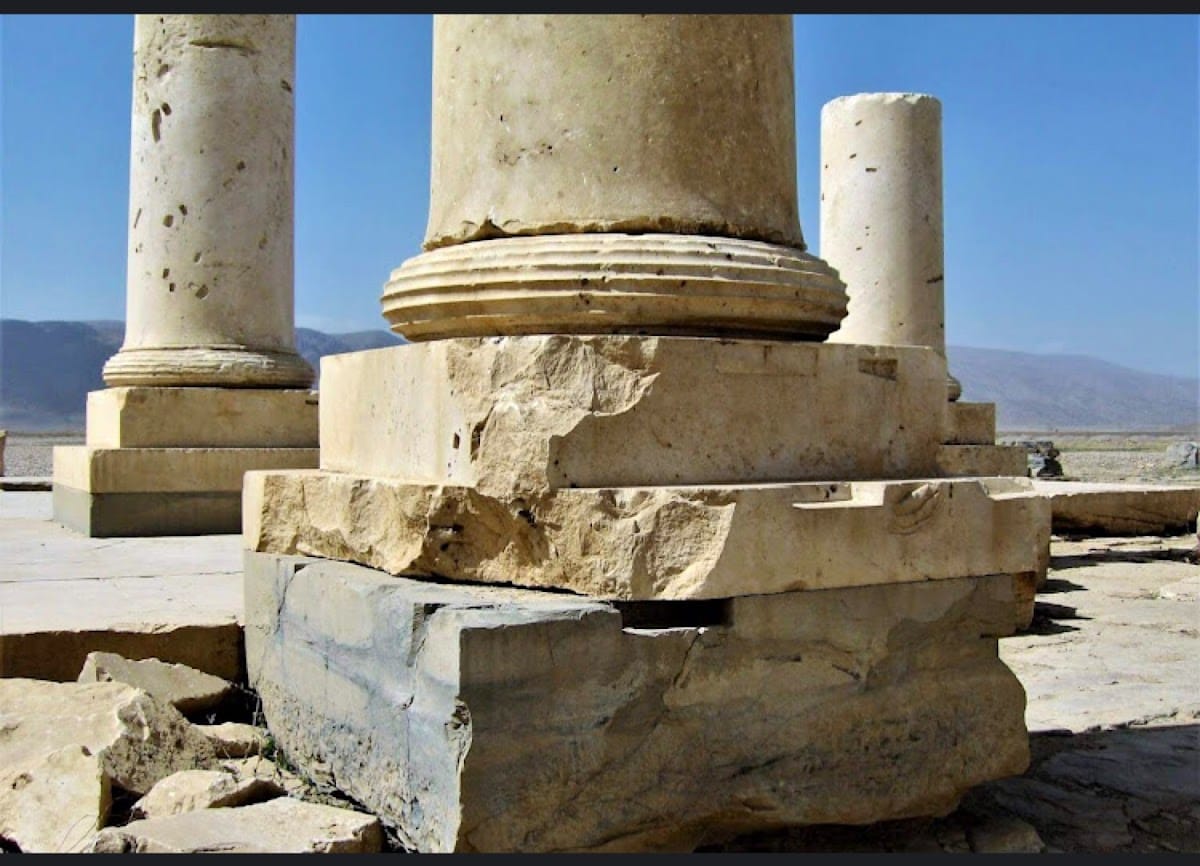
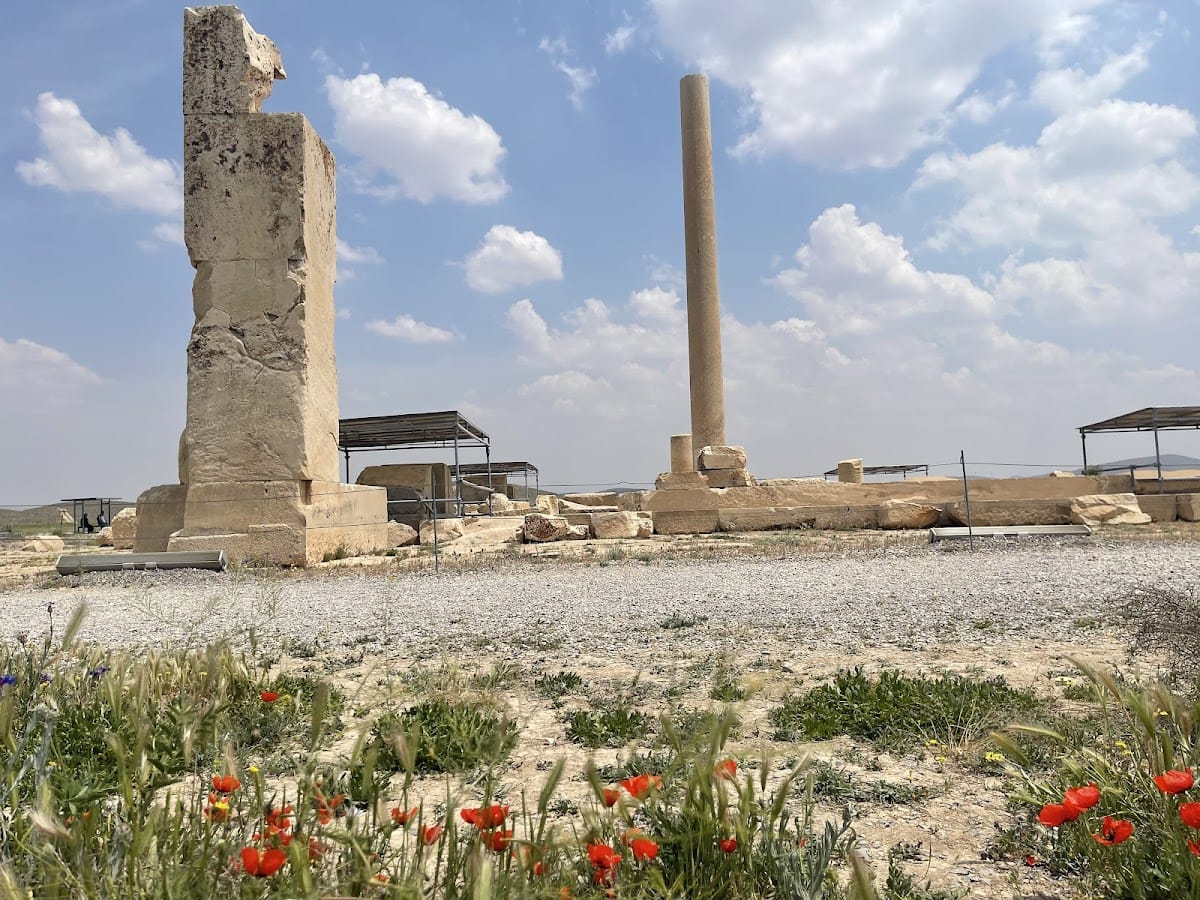
The Audience Hall, or Palace S, measures about 32.35 by 22.14 meters and features two rows of four columns. Only one column remains standing, over 13 meters tall, made of four stone drums joined by wooden dowels and Anathyrosis. The Residential Palace, Palace P, is larger at approximately 76 by 46 meters, with a hypostyle hall supported by five rows of six columns. Its column bases combine black and white limestone with horizontal fluting, showing Ionian Greek influence.
The Royal Garden, known as Chahar Bagh, covers about 145 by 112.5 meters and includes stone-lined water channels and two pavilions. Irrigation was supplied by a canal from the nearby Pulvar River. Archaeological excavations uncovered over 1100 meters of stone aqueducts with basins spaced regularly, demonstrating sophisticated water management. The garden represents an early example of the Persian garden design.
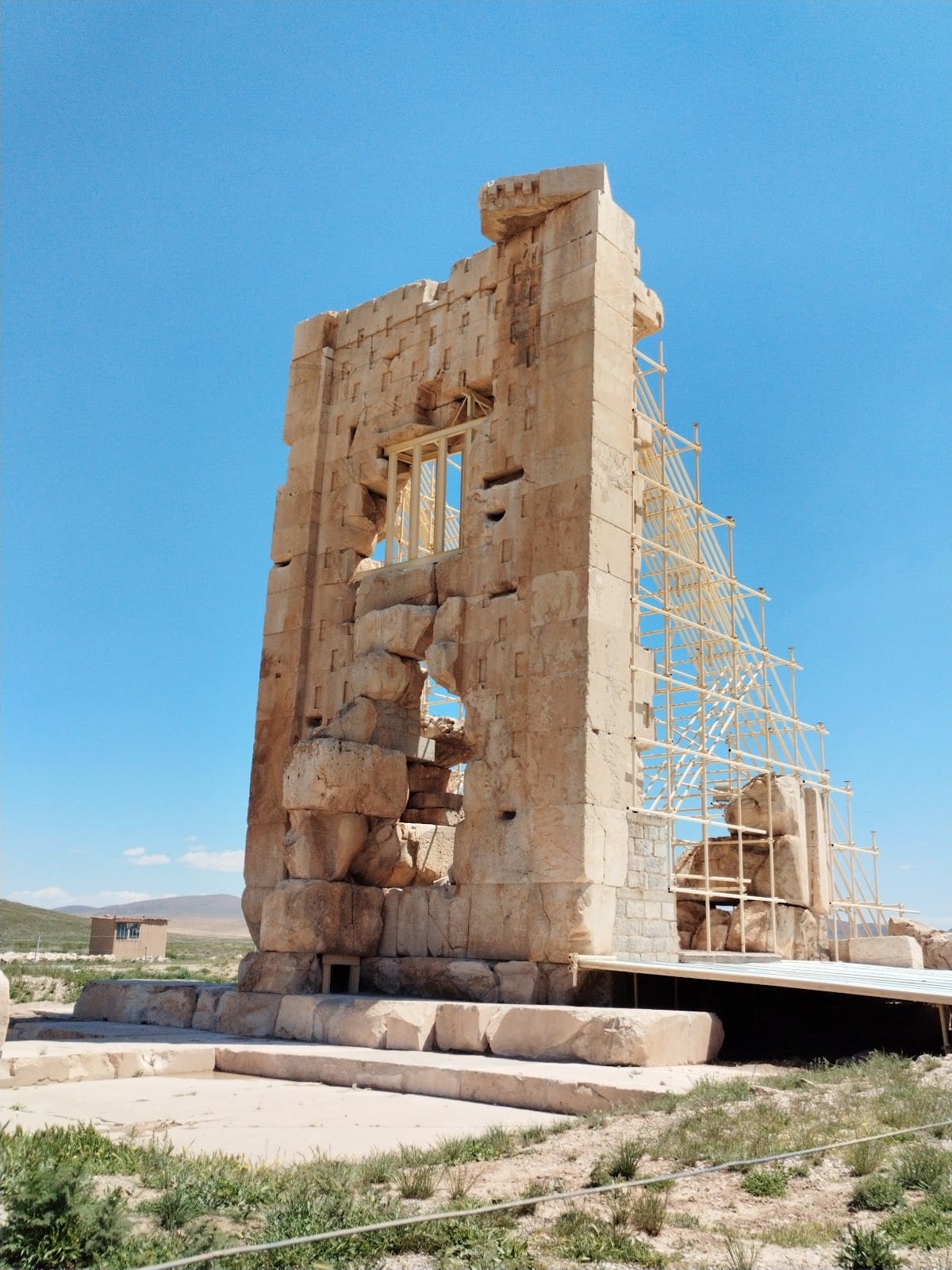
A stone bridge spans a main canal within the site, measuring about 15.6 meters long and 16 meters wide. It is supported by three rows of stone columns approximately 2 meters high and 90 centimeters in diameter. The Zendan-e Soleyman, or “Prison of Solomon,” is a tower over 14 meters tall, nearly square in plan, standing on a three-tiered platform. Its walls have fifteen rows of rectangular recesses. Its exact function is uncertain but may have been religious or for royal storage.
The Sacred Precinct contains two white stone platforms with steps and a large stepped rectangular mound likely used for ritual fire altars. These features emphasize the ceremonial role of the site. Defensive structures include fortifications on Tall-e Takht with walls, staircases, and a courtyard featuring an eight-columned hall.
Later reuse of the site is evident in the remains of a 14th-century caravanserai built with stones taken from the ancient palaces. This structure includes a courtyard about 208 square meters and a large iwan (a vaulted hall) 30.3 meters wide. The 13th-century mosque near Cyrus’s tomb, constructed with repurposed palace stones, had a mihrab with Quranic inscriptions but was dismantled in the 1970s, with its stones relocated.
Pasargadae preserves inscriptions in multiple ancient languages, including Old Persian, Elamite, and Akkadian, highlighting its role as a multicultural center. The site’s layout and construction techniques reveal a blend of cultural influences and advanced engineering for its time.

