Nora Archaeological Park: A Phoenician and Roman Settlement in Sardinia
Table of Contents

Visitor Information
Google Rating: 4.6
Popularity: Medium
Google Maps: View on Google Maps
Official Website: www.fondazionepulacultura.it
Country: Italy
Civilization: Byzantine, Phoenician, Roman
Remains: Burial, City, Civic, Domestic, Economic, Entertainment, Infrastructure, Military, Religious, Sanitation

Context
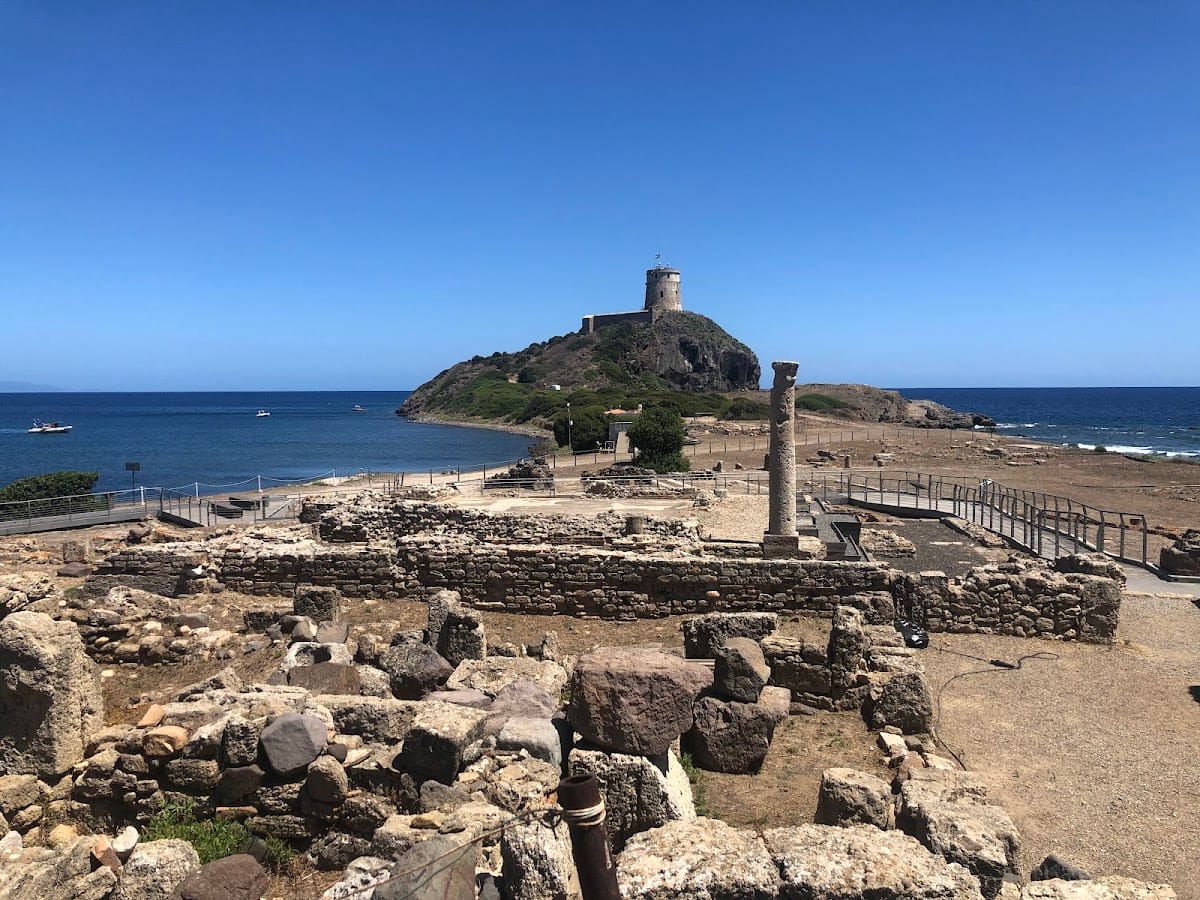
Nora Archaeological Park is situated on the southern coast of Sardinia, near the contemporary town of Pula in the province of Cagliari, Italy. The site occupies a prominent promontory overlooking the Mediterranean Sea, strategically positioned on the isthmus of Capo Pula. This location provided natural harbors and sheltered anchorage, facilitating maritime navigation and trade across the western Mediterranean basin. The surrounding terrain comprises gentle hills and fertile plains, which supported agricultural activities and resource exploitation throughout the site’s occupation.
Archaeological evidence indicates continuous human presence at Nora from the late Bronze Age through the Roman period. Initially associated with the indigenous Nuragic culture, the site later developed into a Phoenician trading settlement in the 8th century BCE. Subsequently, it came under Carthaginian influence before incorporation into the Roman Empire in the 3rd century BCE. Stratigraphic and environmental studies suggest that Nora experienced gradual decline during late antiquity, influenced by coastal erosion and shifting economic conditions, leading to its abandonment by the early medieval era.
Systematic archaeological investigations began in the 18th century and intensified during the 20th century, revealing substantial urban remains including public buildings, fortifications, and residential quarters. Despite some damage from natural and modern factors, conservation efforts by Italian heritage authorities aim to safeguard the site. Nora remains a key locus for understanding settlement dynamics, cultural interactions, and maritime networks in ancient Sardinia and the broader Mediterranean region.
History
Nora Archaeological Park encapsulates a multifaceted historical trajectory that reflects broader political, cultural, and economic transformations in Sardinia and the central Mediterranean. Originating as a Nuragic settlement, the site evolved into Sardinia’s earliest Phoenician colony, later becoming a Carthaginian stronghold before its integration into the Roman provincial system. Nora’s development and decline correspond closely with regional shifts in power, trade, and environmental conditions, culminating in its reduction to a fortified site during the early medieval period.
The city’s coastal position on the Capo Pula isthmus rendered it a significant maritime node, facilitating commercial exchange and military control. Its history illustrates Sardinia’s transition from a Bronze Age cultural landscape to a Roman municipium and, ultimately, to a diminished fortress settlement in late antiquity.
Nuragic and Pre-Phoenician Period (Late Bronze Age)
During the late Bronze Age, the area encompassing Nora was inhabited by the Nuragic civilization, characterized by distinctive stone towers (nuraghi) and complex social organization. Archaeological discoveries include a Nuragic well located near the coastal thermal baths and imported Mycenaean IIIb ceramics, indicating participation in Mediterranean trade networks. Nearby Nuragic sites such as Sa Guardia Mongiasa and Nuraghe Antigori in Sarroch further attest to the region’s cultural vitality and external contacts during this period.
Although no extensive urban settlement from the Nuragic era survives at Nora, these findings demonstrate the site’s role as a local center within the Nuragic cultural sphere prior to Phoenician colonization. The presence of imported Aegean ceramics suggests early engagement with wider Mediterranean exchange systems.
Phoenician Foundation and Expansion (8th–4th century BCE)
In the 8th century BCE, Nora was established as the first Phoenician city on Sardinia, likely founded on or adjacent to preexisting Nuragic settlements. Its location on the Capo Pula isthmus provided a naturally sheltered harbor, enabling the city to develop as a fortified commercial emporium within the western Mediterranean maritime network. The Nora Stele, an 8th-century BCE inscription written in a script akin to Phoenician, contains the earliest known reference to the name Sardinia (Shrdn), underscoring Nora’s early regional prominence.
Archaeological evidence from this period includes a tophet—a sacred precinct containing urn burials and sandstone stelae bearing symbolic motifs such as the betyl stone and the sign of the goddess Tanit—reflecting Punic religious practices. Fortifications and artisanal workshops near the shoreline indicate organized urban functions supporting trade and craft production. The necropolis with chamber tombs and quarrying activities at Is Fradis Minoris further illustrate Nora’s economic and funerary landscape during the Punic era, which persisted until the early Roman conquest.
Roman Conquest and Republican Period (238 BCE – 1st century CE)
Following Rome’s annexation of Sardinia and Corsica in 238 BCE, Nora was designated the initial capital of the new Roman province, marking a significant administrative transformation. By the 1st century CE, the city had attained municipium status, reflecting its full integration into Roman civic and legal frameworks. Inscriptions attest to local magistracies such as duumviri, indicating the adoption of Roman municipal governance.
Roman urban development reshaped Nora’s cityscape, with the construction of a forum situated between the Colle di Tanit and the Coltellazzo promontory. This monumental center replaced earlier Phoenician-Punic warehouse districts, symbolizing Roman political authority. Public buildings including baths and a theater were erected, often superimposed upon or covering Punic remains. Archaeological finds demonstrate that Nora maintained active maritime trade throughout this period, linking it to broader Mediterranean commercial networks under Roman rule.
Imperial Roman Period (2nd–4th century CE)
The 2nd through 4th centuries CE represent Nora’s apogee under Roman imperial administration, coinciding with Sardinia’s integration into the empire’s economic and cultural systems. The Severan dynasty and subsequent decades witnessed extensive urban renewal, including the paving of streets with underlying sewer systems and the enlargement of the forum, which featured two monumental entrance arches. Inscriptions document magistrates and religious officials overseeing civic and cultic activities.
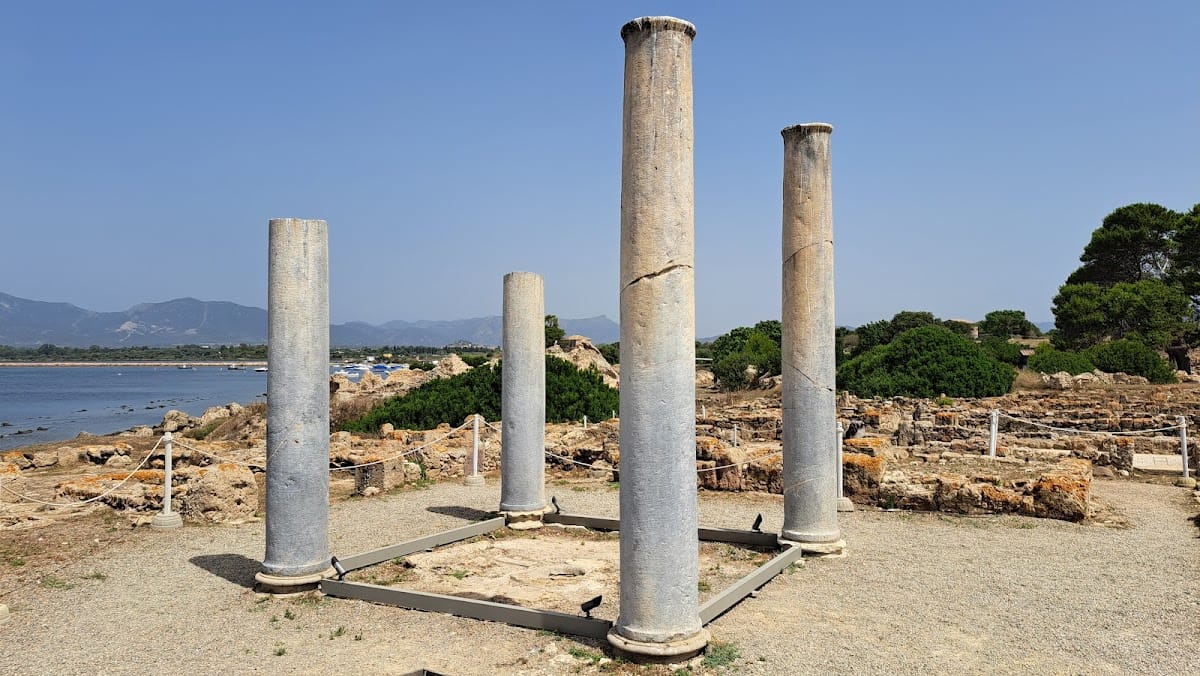
A six-columned hexastyle temple, commonly referred to as the Roman Temple, was constructed on the southeastern slopes of the Colle di Tanit, reflecting continued religious investment. Public amenities expanded with three thermal bath complexes, including the large Terme a Mare, indicative of the city’s prosperity and social diversification. Luxurious private residences, such as the Casa dell’atrio tetrastilo with its mosaic floors depicting marine motifs, attest to elite habitation. Commercial and residential complexes developed in the northwestern sector, alongside modifications to shop-house neighborhoods.
The sanctuary of Aesculapius (Esculapius), featuring mosaic-lined terraces, suggests the presence of healing cults and ritual incubation practices. A public aqueduct supplied water to baths, fountains, and other amenities, with restoration activities documented into the early 5th century. Nora continued to flourish into the 4th century, with new or renovated baths and expanded commercial facilities. The construction of a three-nave Christian basilica during the 4th or 5th century marks the introduction and establishment of Christianity within the city. Public building activity, including forum restorations and aqueduct repairs, persisted into the early 5th century.
Late Antiquity and Vandal Period (5th–7th century CE)
The 5th century CE witnessed Nora’s gradual decline amid the Vandal conquest of Sardinia and disruptions to Mediterranean trade routes. The city’s population progressively retreated from the vulnerable coastal zone to more defensible inland locations, resulting in contraction of urban space and functions. Archaeological evidence indicates that some residential districts in the central and northwestern sectors remained occupied, albeit with altered uses and structural modifications.
Material culture, including African sigillata ceramics, attests to limited economic activity and port functionality persisting into the early 6th century. By the 7th century, the Ravenna Cosmography refers to Nora as a praesidium, signifying its transformation into a military fortress rather than a thriving urban center. The site’s later historical significance is linked to the martyrdom of Saint Efisio, commemorated by a small church erected near the ruins in 1089, marking the transition from antiquity to the medieval period.
Medieval to Modern Rediscovery and Excavation
Although the ruins of Nora were identified by Renaissance scholars such as Giovanni Francesco Fara and noted by 19th-century travelers, systematic archaeological investigation commenced only in the late 19th century. The discovery of the Phoenician-Punic tophet in 1889 initiated formal excavations conducted by Giovanni Spano, Filippo Vivanet, and Filippo Nissardi. Extensive campaigns in the mid-20th century, led by Gennaro Pesce, uncovered substantial remains of the city’s public and private buildings spanning Phoenician, Punic, and Roman periods.
Today, the archaeological park preserves key monuments including the forum, baths, theater, amphitheater, residential houses with mosaics, and religious structures such as the sanctuary of Aesculapius and the church of Saint Efisio. Ongoing conservation and research efforts continue to enhance understanding of Nora’s historical development and its role within Mediterranean antiquity.
Daily Life and Importance by Period
Phoenician Foundation and Expansion (8th–4th century BCE)
During its Phoenician phase, Nora functioned as a cosmopolitan trading emporium inhabited by merchants, artisans, and religious officials. The population included a mercantile elite overseeing trade and craft production, supported by a working class engaged in artisanal activities and quarrying at nearby Is Fradis Minoris. The city’s sheltered harbor facilitated exchange of goods such as ceramics, metals, and textiles across the western Mediterranean.
Religious life centered on Punic cults, notably the worship of the goddess Tanit, as evidenced by the tophet containing urn burials and symbolic stelae. Residential structures were modest, with limited evidence of large-scale urban planning, but fortifications and public religious precincts indicate organized civic functions. Dietary staples likely included cereals, olives, and fish, consistent with regional Mediterranean practices. Clothing styles presumably reflected Phoenician traditions, though direct textile evidence is limited.
Roman Conquest and Republican Period (238 BCE – 1st century CE)
Following Roman annexation, Nora’s population diversified to include Roman settlers alongside Punic inhabitants. Civic officials such as duumviri are attested epigraphically, reflecting Roman municipal governance. Family and social structures aligned with Roman norms, with elites residing in elaborated domus and a broader citizenry engaged in trade, agriculture, and artisanal production.
Economic activities expanded, supported by intensified maritime commerce and local agriculture. The construction of the forum and public baths signaled a shift toward Roman urbanism, with civic life centered on administration, legal affairs, and social gatherings. Domestic interiors began featuring mosaic floors and painted walls, enhancing comfort and status display. Markets supplied a range of goods from foodstuffs to imported luxuries, while transport relied on coastal shipping and local roads.
Religious practices transitioned from Punic deities to Roman gods, with temples and shrines dedicated to imperial cults and traditional pantheons. Civic festivals and public entertainments, including theatrical performances in the newly built theater, fostered communal identity. Nora’s evolution into a municipium reflects its integration into Roman political and economic networks.
Imperial Roman Period (2nd–4th century CE)
At its height, Nora’s population comprised Roman citizens, local Sardinians, freedmen, and slaves, organized within a stratified society of elites, merchants, artisans, and laborers. Inscriptions document magistrates overseeing urban administration and religious officials managing cults dedicated to deities such as Aesculapius and the imperial family.
Economic life was multifaceted, encompassing maritime trade connecting Nora to Mediterranean markets, local agriculture producing grains, olives, and grapes, and artisanal workshops manufacturing ceramics and textiles. Public infrastructure improvements—including paved streets with sewers, aqueducts, and thermal baths—enhanced urban living standards. Residential architecture featured richly decorated domus such as the Casa dell’atrio tetrastilo, with mosaic floors depicting marine themes and frescoed walls.
Diet was varied, incorporating bread, olives, fish, and imported delicacies, reflecting local production and trade. Clothing adhered to Roman fashions, with social distinctions marked by quality and decoration. Commercial complexes and shop-houses indicate active marketplaces supplying food, household goods, and luxury items. Transport combined maritime vessels and well-maintained roads facilitating movement of people and goods.
Religious life was diverse: pagan temples coexisted with an emerging Christian community, evidenced by the construction of a three-nave basilica in the 4th or 5th century. Rituals included healing cults at the sanctuary of Aesculapius, public festivals, and imperial ceremonies. Educational and cultural activities likely involved Christian catechesis and public readings, reflecting the city’s evolving spiritual landscape. Nora functioned as a prosperous municipium and regional center within the Roman Empire.
Late Antiquity and Vandal Period (5th–7th century CE)
During the 5th century, Nora experienced demographic and economic contraction amid Vandal incursions and disrupted trade. The population diminished and shifted toward defensive inland locations. Remaining inhabitants included a reduced civic elite, military personnel, and rural settlers. Social structures adapted to insecurity, with diminished public services and altered domestic uses.
Economic activities persisted at a reduced scale; archaeological finds of African sigillata ceramics attest to continued, though limited, maritime commerce. Local agriculture and artisanal production supported subsistence needs. Residential areas in the central and northwestern districts remained occupied, though with simpler layouts and modifications reflecting changing circumstances.
Diet likely became more localized, relying on staple foods and preserved goods. Clothing and household decoration simplified in line with economic constraints. Transport focused on defensive mobility and essential supply routes rather than extensive trade. Religious life saw consolidation of Christianity, with the three-nave basilica serving as a focal point for worship and community cohesion. Nora’s designation as a praesidium in the Ravenna Cosmography underscores its military role during this period. Civic administration was minimal, oriented toward defense and survival rather than urban governance. The martyrdom of Saint Efisio and the later erection of a commemorative church highlight the city’s enduring religious significance despite its diminished status.
Medieval to Modern Rediscovery and Excavation
While outside the scope of ancient daily life, it is notable that Nora’s ruins were recognized from the Renaissance onward, with scholarly interest culminating in systematic archaeological excavations beginning in the late 19th century. These investigations have illuminated the city’s complex urban fabric, revealing insights into the daily lives, economic roles, and cultural practices of its diverse inhabitants across periods. The preservation of monumental structures and artifacts continues to inform understanding of Nora’s regional importance from Phoenician foundation through Roman prosperity to late antique decline.
Remains
Architectural Features
The archaeological remains at Nora encompass a broad chronological range from the late Bronze Age through late antiquity, illustrating the site’s urban evolution. The city’s layout includes a central forum, residential quarters, commercial complexes, and public buildings arranged along paved streets equipped with underground drainage systems. Construction primarily employed local stone masonry, with Roman concrete (opus caementicium) used in later phases. Roman Republican and Imperial periods saw extensive replacement of earlier Phoenician-Punic structures with monumental architecture. By late antiquity, urban contraction and fortification became prominent as the city’s function shifted toward military defense.
Surviving structures include civic, religious, domestic, and economic buildings, as well as infrastructure such as an aqueduct and water distribution system. Nuragic features persist in the form of a well near the coastal baths, while Punic and Roman phases are represented by temples, baths, a theater, and an amphitheater. Funerary monuments and necropolises from both Punic and Roman periods are present. Preservation varies, with some buildings well conserved and others surviving only as foundations or fragmentary walls, partly due to coastal erosion and modern impacts.
Key Buildings and Structures
Forum
Constructed during the Roman Republican period, likely in the 2nd century BCE, the forum occupies a central urban sector between the Colle di Tanit and the Coltellazzo promontory. Its erection involved the systematic destruction and burial of an earlier archaic warehouse district. Although the southern portion has suffered erosion, the remaining rectangular open space is surrounded by monumental architecture. The forum functioned as the city’s political and administrative center, with adjacent buildings defining its spatial organization. Its layout influenced the urban character of this sector for several centuries.
Roman Temple (Hexastyle Temple)
This large hexastyle temple, dating to the late 2nd or early 3rd century CE during the Severan period or shortly thereafter, is situated on the southeastern slopes of the Colle di Tanit. Featuring six columns across its façade, it is among the most imposing monuments from the Imperial phase. Constructed of ashlar masonry, the temple occupies an elevated position overlooking the urban area. No secure evidence of an earlier Punic temple beneath this structure has been identified.
Temple of Eshmun-Esculapius
The sanctuary dedicated to the healing god Eshmun-Esculapius is a large sacred complex with multiple construction phases spanning from the Roman Republican period into the Imperial era. The temple is arranged on several terraces and includes mosaic-decorated rooms dated to the Imperial period. A distinctive architectural feature is the duplicated pronaos (entrance hall) separated by a partition wall, characteristic of Punic sacred architecture, suggesting a Punic antecedent. Excavations uncovered six ceramic statuettes from the 2nd century BCE, including two larger figures depicting devotees, one wrapped by a serpent, symbolizing the god’s healing cult. An apse opens on the southern side of the complex. A fragmentary inscription from the early 3rd century CE was found, though its original location remains uncertain.
Thermal Baths
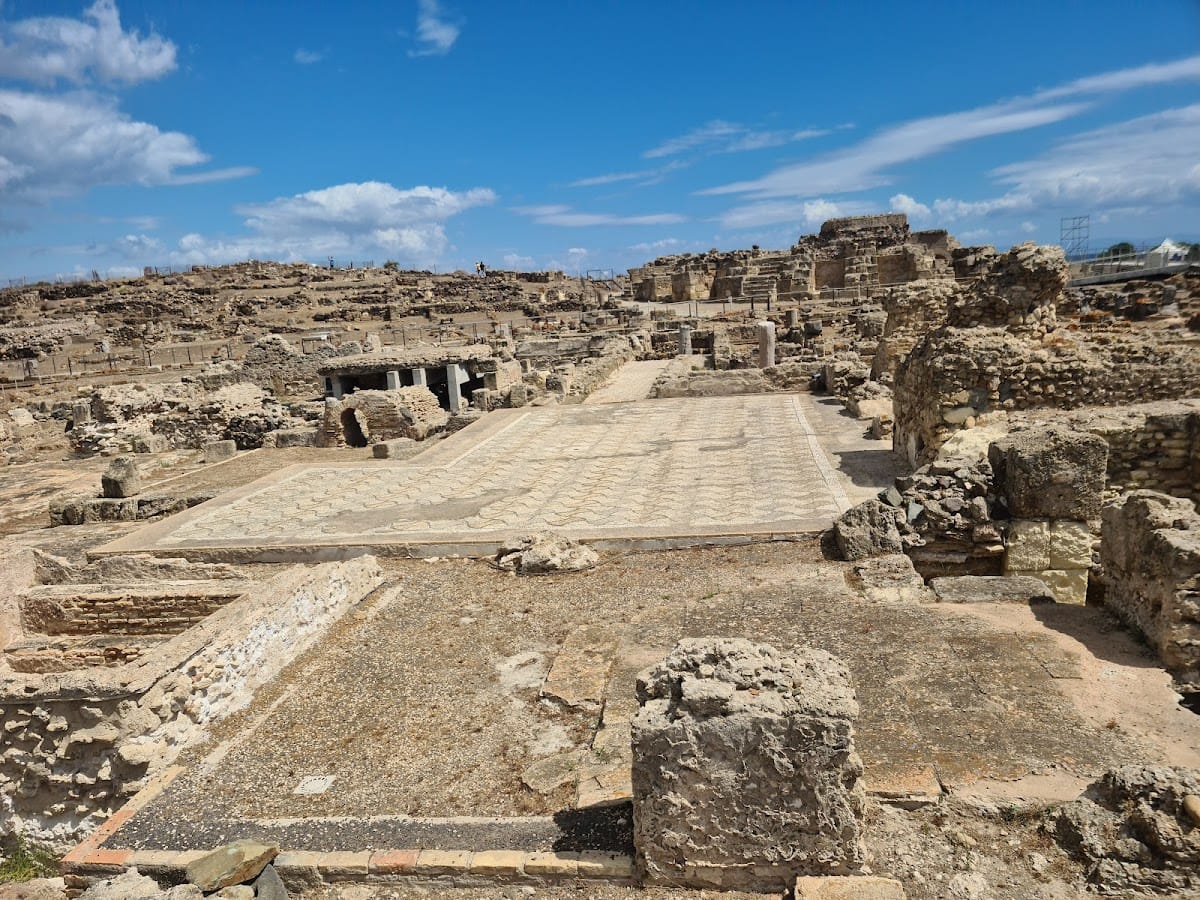
Several thermal bath complexes are preserved, primarily constructed or renovated during the Severan period and subsequent decades (late 2nd to early 3rd century CE). The largest, known as the Baths by the Sea (Terme a Mare), is located in the northwestern sector and features multiple rooms arranged along a central axis. The Central Baths and smaller baths, possibly of private use (Piccole terme), are also present within the urban fabric. These complexes include hot rooms (caldaria), cold rooms (frigidaria), and hypocaust heating systems. The Baths of Levante, built or restored in the 4th century CE in the eastern sector, represent later additions. The baths are integrated with paved streets and an underground drainage system, contributing to the spatial division of the city into functional quarters.
Amphitheatre
The Roman amphitheatre, dating to the Imperial period, originally featured marble lining and twenty terraces for seating, accommodating approximately 1,000 spectators. The structure remains partially excavated and has not been fully studied or restored. It is located within the archaeological park and currently serves as a venue for cultural events.
House of the Tetrastyle Atrium
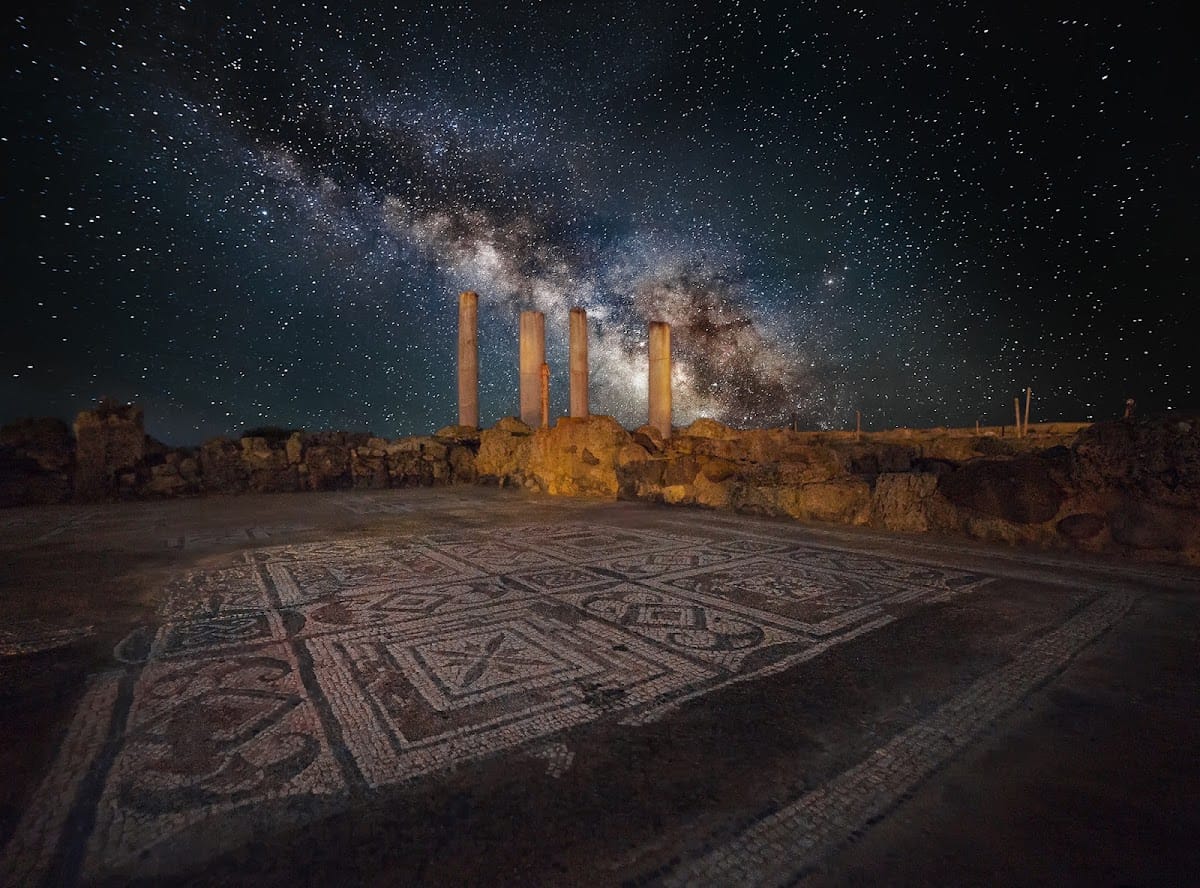
This noble residence, dating to the 3rd century CE, is situated along the coast within the park. It is characterized by a four-column portico (tetrastyle atrium) opening onto interior rooms. Several rooms contain mosaic floors, including a notable mosaic depicting a Nereid riding a marine centaur. The house’s layout reflects Roman domestic architecture of the period, emphasizing reception and private spaces.
Basilica (Christian)
A three-nave Christian basilica was constructed in the 4th or 5th century CE in the northwestern sector of the city, near the expanded small baths and the enlarged commercial-residential complex. The basilica’s plan includes a central nave flanked by aisles separated by columns or piers. This structure marks the Christianization phase of the city during late antiquity.
Commercial-Residential Complex (“Macellum / Horreum” or “Insula A”)
This large multifunctional complex combines commercial and residential functions and was constructed and expanded during the Imperial period, especially in the late 2nd and early 3rd centuries CE. Located in the northwestern sector near the Baths by the Sea and the quarter of house-shops, the complex was doubled in size during 4th-century renovations. It includes shop spaces, storage areas, and living quarters arranged around internal courtyards.
Aqueduct and Castellum Aquae
A public aqueduct built during the Imperial period supplied water to the city’s baths, fountains, and other public amenities. The aqueduct fed a castellum aquae (water distribution basin), which connected to three thermal bath complexes and a fountain. An inscription documents restoration of the aqueduct in the first half of the 5th century CE. The water infrastructure remained functional into the early Byzantine period.
Necropolises
Punic chamber tomb necropolises developed contemporaneously with the tophet in the isthmus area and suburban sector. These necropolises include chamber tombs carved into rock and funerary monuments. Intensive quarrying activity at the nearby Is Fradis Minoris peninsula during the Punic period is documented. A Roman necropolis is located north of the forum area, containing burial structures consistent with Roman funerary practices.
Tophet
Discovered in 1889 following a coastal storm, the tophet is a sacred burial ground dated between the 5th and 3rd centuries BCE. It contains numerous sandstone stelae with symbolic representations within small shrines, including architectural elements. The stelae bear symbols such as the betyl stone (a sacred stone seat) and the sign of the goddess Tanit, depicted as a triangle surmounted by a circle with astral motifs like the solar disk and crescent moon. Human figure representations are less common. The stelae vary in size from small to over one meter tall. The tophet is located in the suburban sector near the Romanesque church dedicated to Saint Efisio.
Other Religious Structures
Remains of a sacred structure dedicated to the goddess Tanit are associated with the tophet area. The small Romanesque church of Saint Efisio, erected in 1089 near the tophet, marks the site of the saint’s martyrdom. This church is a medieval addition built atop or adjacent to earlier sacred remains.
City Walls and Fortifications
Few remains survive of the original city fortifications, including sections of Punic walls. By the 7th century CE, Nora is documented as a praesidium (fortress), indicating a military function after urban decline. The surviving fortification fragments are limited and partially eroded.
Roads and Urban Layout
Nora was the starting point (caput viae) of all roads on Sardinia during Roman times. The city streets were paved with stone slabs and equipped with underground drainage systems, especially during the Imperial period. The urban layout includes a central forum, residential quarters, commercial complexes, and public buildings arranged along main axes, reflecting planned urban development.
Other Domestic Buildings
Several private houses with rich mosaic decorations have been excavated, including the House of the Director Tronchetti and other late antique residences in the central quarter. The quarter of house-shops (domus-bottega) shows mixed residential and commercial use, with integrated living and working spaces.
Other Remains
Surface traces and architectural fragments indicate the presence of additional Punic and Roman buildings not yet fully excavated or identified. Nuragic remains include a well near the Baths by the Sea and imported Mycenaean artifacts from the Bronze Age. A 16th-century Spanish tower stands at Punta del Coltellazzo, overlooking the isthmus, representing a post-antique military structure.
Archaeological Discoveries
Excavations at Nora have uncovered a variety of artifacts spanning the Nuragic, Phoenician-Punic, and Roman periods. Pottery includes locally produced and imported amphorae and tableware, with Mycenaean ceramics found in the Nuragic context. Numerous inscriptions have been documented, including the Nora Stone, the earliest known inscription mentioning Sardinia, and a fragmentary 3rd-century CE epigraph from the Temple of Esculapius.
Coins from various Roman emperors have been recovered, indicating continued economic activity into late antiquity. Tools related to agriculture and crafts have been found in domestic and workshop areas. Domestic objects such as lamps and cooking vessels are common in residential contexts. Religious artifacts include ceramic statuettes from the Temple of Eshmun-Esculapius, altars, and ritual vessels associated with the tophet and other sacred sites.
Preservation and Current Status
The preservation of Nora’s ruins varies by structure. The forum and Roman temple retain substantial masonry but suffer from erosion, especially along the southern edges. The thermal baths and House of the Tetrastyle Atrium preserve mosaic floors and architectural elements, though some walls are fragmentary. The amphitheatre remains partially excavated and uncompleted. The tophet’s sandstone stelae are well preserved in situ.
Restoration efforts have stabilized many structures, with some reconstructions using modern materials to support fragile walls. Coastal erosion and vegetation growth pose ongoing threats to exposed ruins. Conservation is managed by Italian heritage authorities, with ongoing excavation and research projects aimed at documenting and protecting the site. Some areas are stabilized but left unrestored to preserve archaeological integrity.
Unexcavated Areas
Several sectors of Nora remain unexcavated or only partially studied. The amphitheatre is not fully explored, and surface surveys suggest additional Punic and Roman buildings await excavation. Some urban quarters, especially peripheral residential and commercial zones, have limited archaeological investigation. Modern development and environmental factors restrict excavation in certain areas. Future research is planned but constrained by conservation policies and site preservation priorities.
Nearby sites