Umm Qays: The Ruins of the Ancient City of Gadara
Site at a Glance
- Rating
- 4.5
- Popularity
- Medium
- Country
- Jordan
- Primary era
- Classical
- External website
- Open
- Eras represented
- Classical
- Civilizations
- Ancient Greek, Roman
- Site type
- City
On this page11 sections
History
Umm Qays in Jordan preserves the ruins of ancient Gadara, a Hellenistic city founded by the third century BC that became a major center of Greek culture during the Hellenistic and Roman periods. Regarded as one of the most strongly Hellenized cities of Syria, Gadara held special political and religious status and later formed part of the Roman Decapolis, a league of ten largely Greek-influenced cities that retained a degree of municipal autonomy under Roman rule.
Hellenistic foundations and rival kingdoms
In 218 BC, the Greek historian Polybius described Gadara as “the strongest of all places in the region.” The city soon surrendered when it was besieged by the Seleucid king Antiochus III. The Seleucids, a dynasty ruling much of Alexander the Great’s former Asian territories, also used the names Antiochia, Antiochia Semiramis, and Seleucia for the city. Control of the surrounding region shifted between the Seleucids and the Ptolemies, the Greek dynasty that ruled Egypt after Alexander’s death.
Gadara was later captured and damaged by the Hasmonean king Alexander Jannaeus. The Hasmoneans were a Jewish ruling dynasty that controlled parts of the southern Levant before Roman domination. These changes placed the city within the political struggles that shaped the southern Levant before Rome established its authority.
Roman rule and the Decapolis
In 63 BC, the Roman general Pompey brought the region under Roman control, rebuilt Gadara, and incorporated it into the Decapolis. The city also served as a bulwark against Nabataean expansion. In 30 BC, Augustus placed Gadara under the authority of the Jewish king Herod. After Herod’s death in 4 BC, the city became part of the Roman province of Syria.
Gadara continued to function as a cultural, political, and religious center during the Roman period. Its intellectual reputation earned it the ancient description “city of philosophers.” Menippus of Gadara, a third-century BC Cynic philosopher and satirist, was born there. His lost works combined prose and verse and later influenced Varro and Lucian. Meleager of Gadara, born in the early first century BC, was a major Greek poet whose collection of other poets helped form the basis of the Greek Anthology.
Other figures associated with Gadara included Philodemus, a first-century BC Epicurean philosopher and poet who studied under Zeno of Sidon in Athens and taught at the Villa of the Pisos in Herculaneum. Manuscripts from that library provide important evidence for Roman Epicureanism. The city was also associated with the orator Theodorus, the freedman Demetrius, the mathematician Philo, the Cynic philosopher Oenomaus, and the rhetorician Apsines.
In AD 66, during the Jewish revolt against Rome, the lands around Gadara were devastated. Some inhabitants captured Jewish prisoners, executing some and imprisoning others, while many townspeople later surrendered to the Roman commander Vespasian. He stationed a garrison at Gadara, reinforcing its position within the Roman military system.
Christian and Islamic periods
Gadara retained regional importance in the Eastern Roman Empire and for a long period served as the seat of a Christian bishop. It became a suffragan bishopric, meaning a diocese subordinate to a metropolitan archbishopric, under the archbishopric of Scythopolis, the capital of the province of Palestina Secunda. Its ecclesiastical importance declined after the Muslim conquest. By the fifteenth century, the diocese had been nominally restored as a Latin titular bishopric, an ecclesiastical title for a diocese that no longer functions as an ordinary territorial district. The titular see is currently vacant.
Following the Battle of Yarmouk in 636, Gadara came under Muslim rule. An earthquake around 749 largely destroyed the city and led its inhabitants to abandon it. The site was identified with ancient Gadara in 1806 by the German traveler Ulrich Jasper Seetzen. Umm Qays lies in Jordan’s Umm Qais area near the borders with Israel and Syria. Ancient Gadara is distinguished from the separate Gadara or Gadora of Peraea, identified with Tell el-Jadur near Salt.
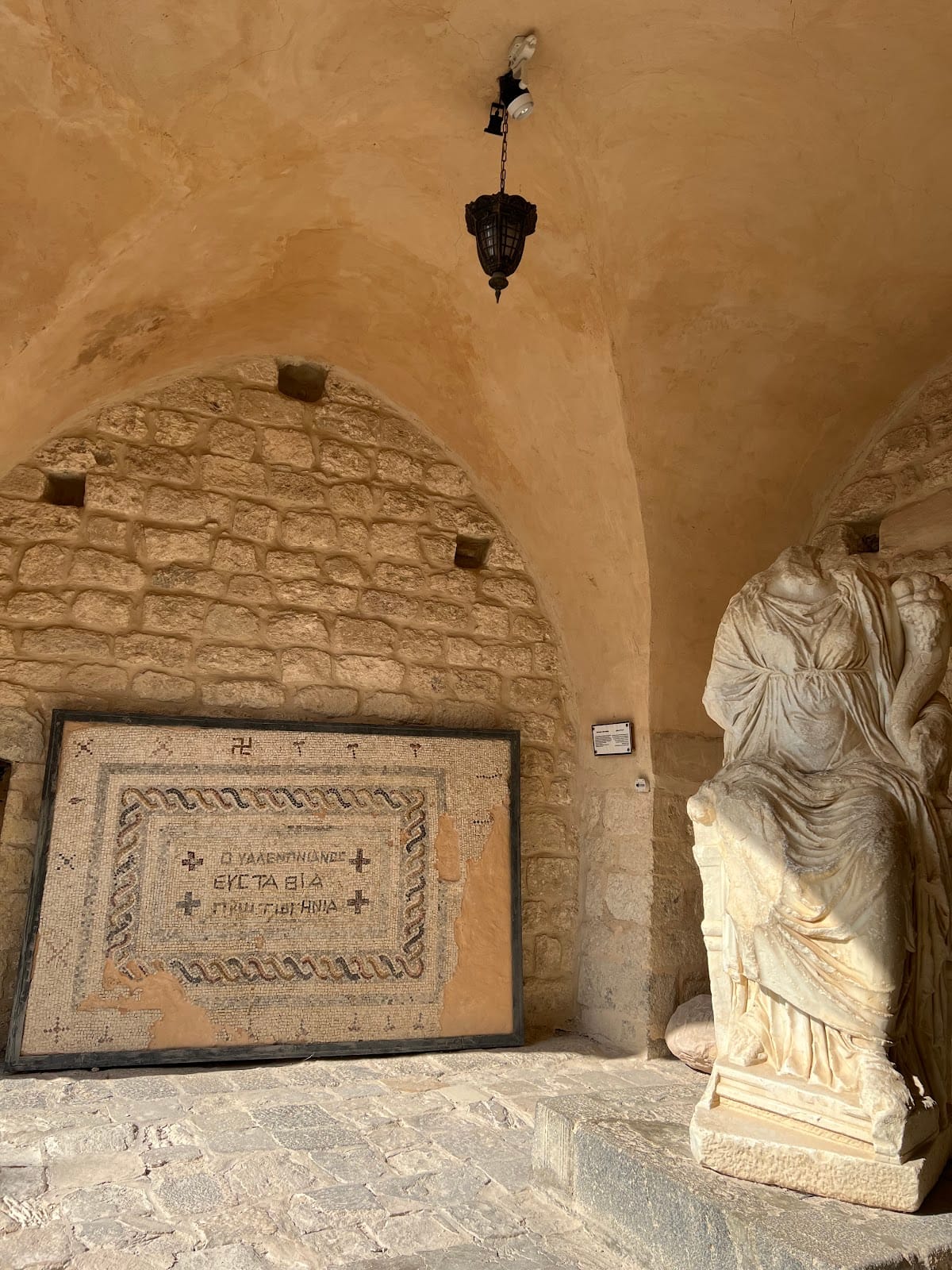
The Synoptic Gospels tell of the exorcism of the Gerasene demoniac, although some ancient manuscripts call the location Gadarene or Gergesene rather than Gerasene. The association with Gadara is therefore a textual tradition rather than a certain identification. The former residence of the Ottoman governor, Beit al-Rousan, now houses the Umm Qais Museum and preserves discoveries from the ancient city.
Remains
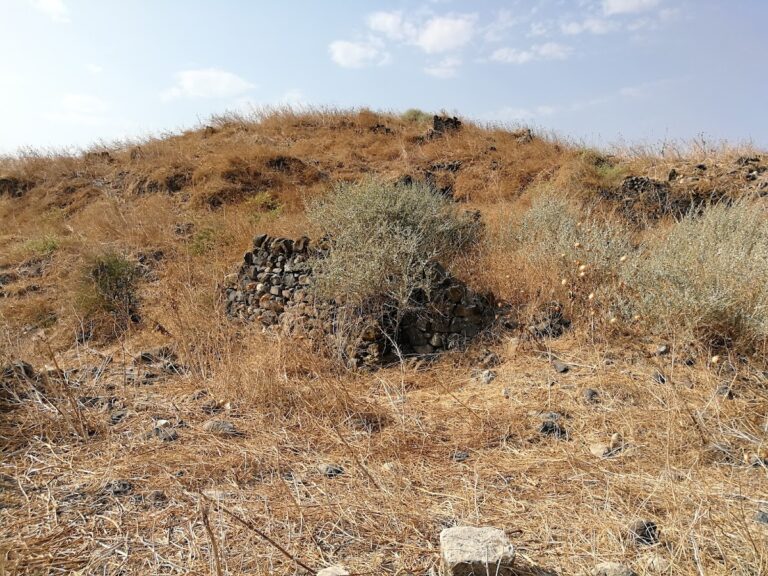
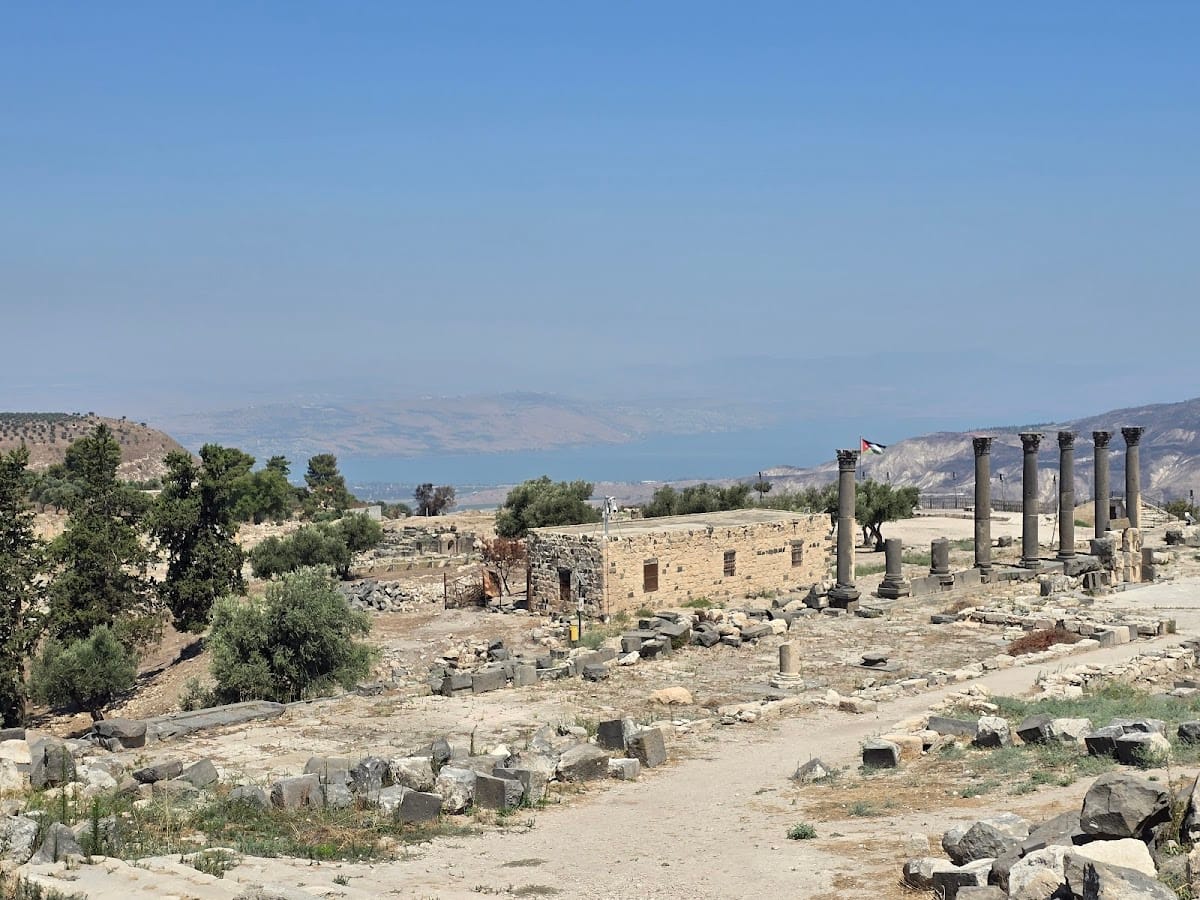
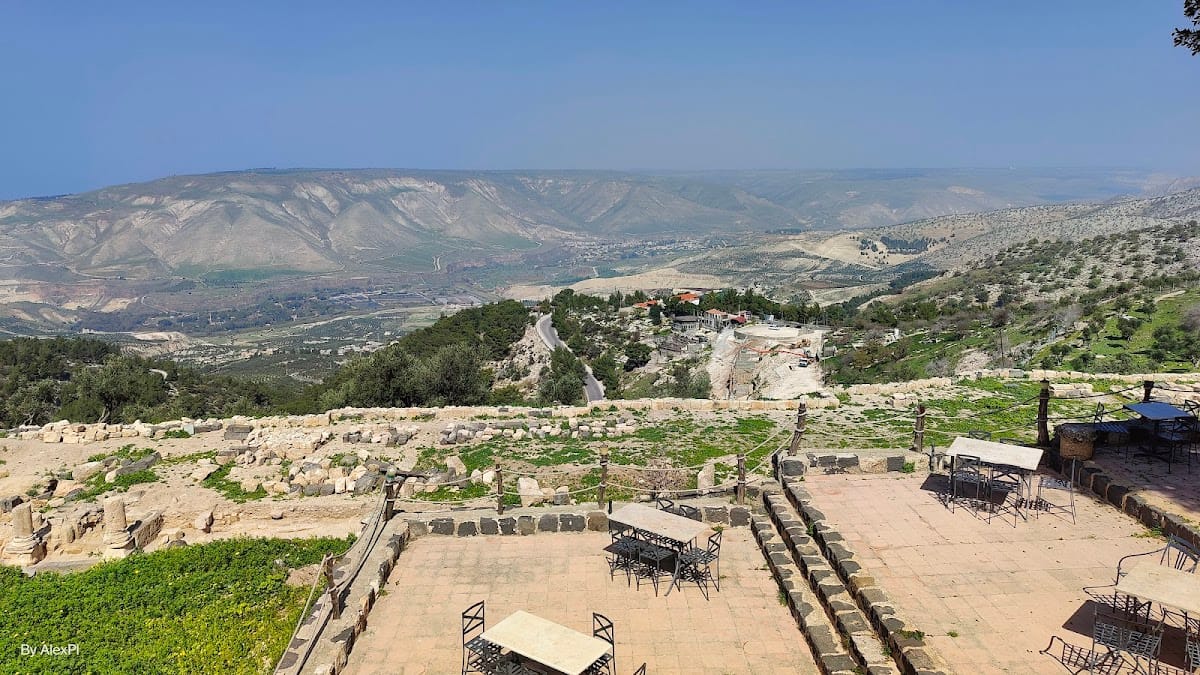
Gadara occupied a ridge 378 metres above sea level. The ridge was accessible from the east, while steep slopes protected its other three sides. From this position, the city overlooked the gorge of the Yarmouk River, the Golan Heights, and the Sea of Galilee to the north and northwest. Its ancient defensive walls can be traced around almost the entire circuit for approximately 3 kilometres.
Urban circuit and public buildings
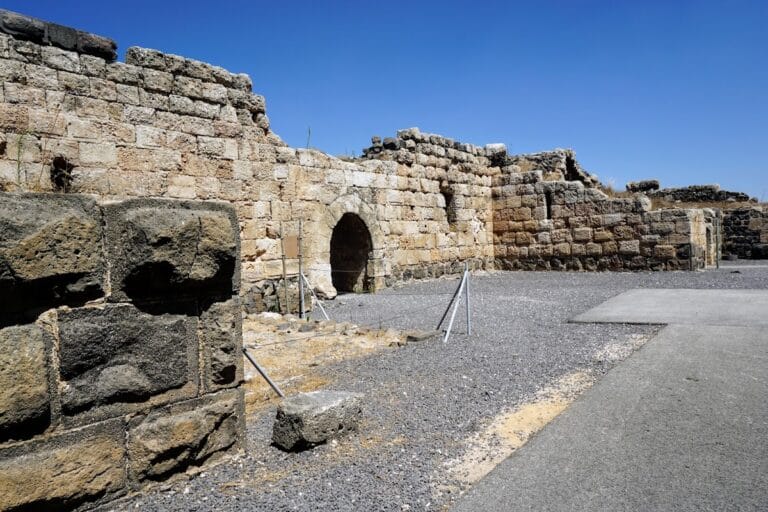
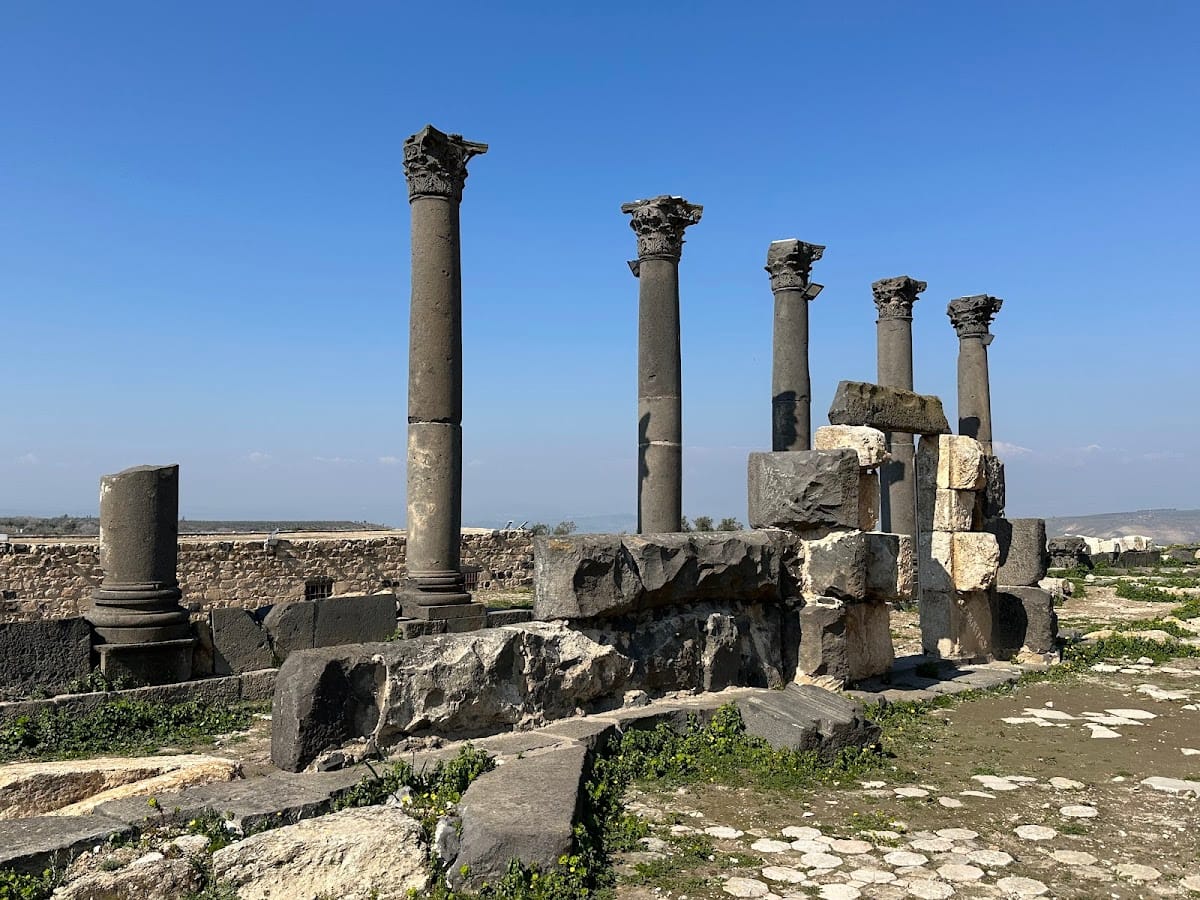
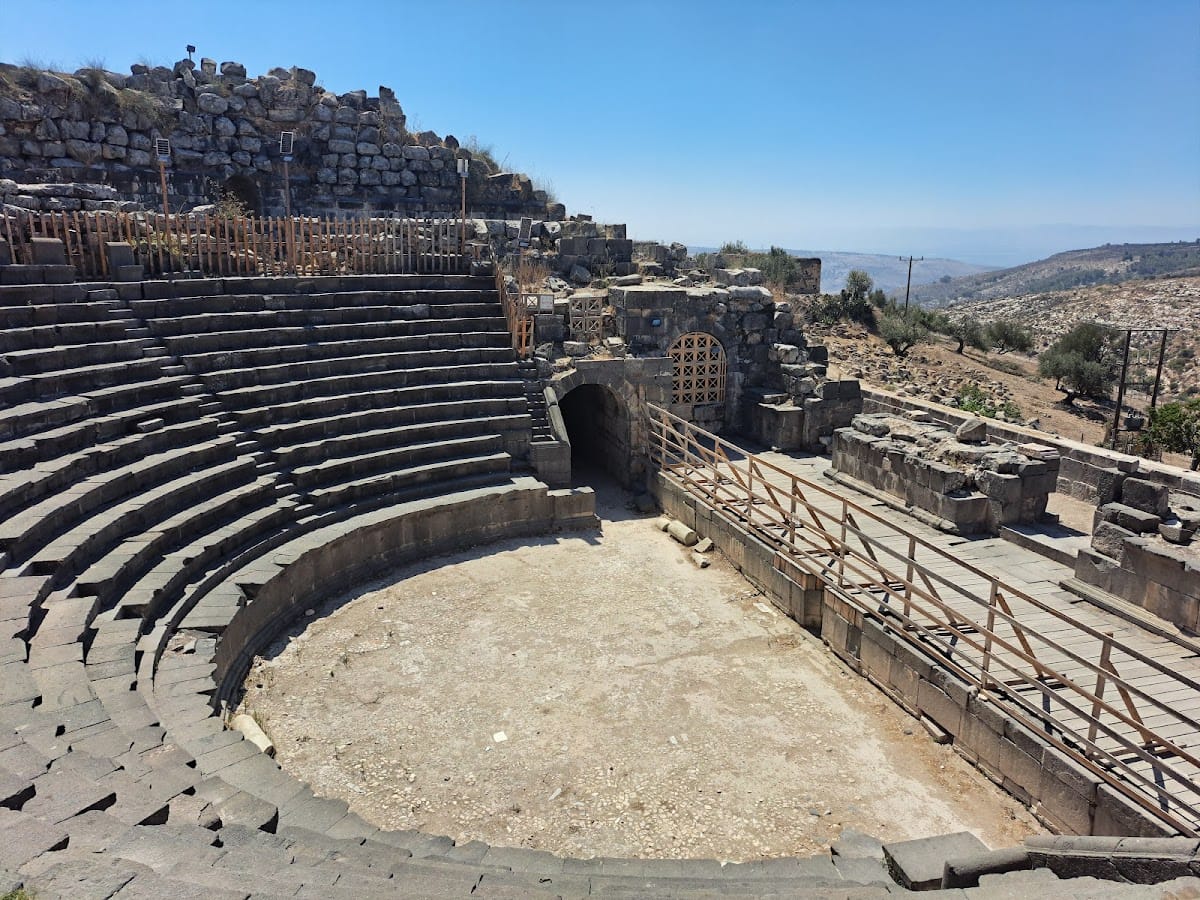
The surviving ruins include baths, two theatres, a hippodrome, colonnaded streets, a temple, a basilica, and other urban buildings. Together with the walls, these remains mark the extent and public character of the ancient settlement. The city was supplied by the Ain Qais spring and by cisterns, which supported its buildings and inhabitants.
Streets and water systems
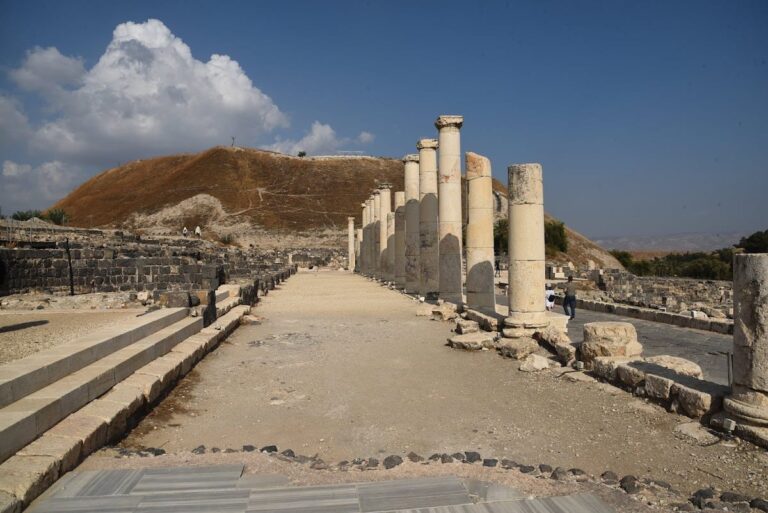
Colonnaded street
A paved street crossed the ancient city from east to west. Its double colonnade formed a principal urban route, and the paving still carries ruts made by the wheels of ancient vehicles. A Roman road also ran eastward from Gadara toward Daraa.
Aqueducts and underground channels
The Roman aqueduct that supplied drinking water to Gadara was constructed in the second century AD. It extended for approximately 170 kilometres, including a 94-kilometre underground section described as the longest known tunnel from antiquity. Another aqueduct has been traced to the Khab pool, approximately 20 miles north of Daraa in Syria.
Archaeologists have also found a network of water tunnels beneath the centre of the ancient town. This system is separate from an external tunnel discovered in the area decades earlier. The Gadara Nymphaeum, a large fountain associated with water nymphs, survives in partly ruined form.
Hellenistic temple
A temple dating to the third century BC was discovered in 2017. It is believed to have been dedicated to Poseidon, the Greek god associated especially with the sea, earthquakes, and horses. The building follows the distyle-in-antis arrangement, with two columns between projecting side walls at the front. Its parts include a pronaos, or entrance porch, a podium, and a naos, the principal sacred chamber. Hellenistic pottery was also found at the site.
Umm Qais Museum
The Umm Qais Museum occupies Beit al-Rousan, the former residence of the Ottoman governor. Its collections include archaeological discoveries from Gadara, providing a place for finds from the ancient city to be preserved and interpreted.