Neu-Ems Castle: A Medieval Fortress near Hohenems, Austria
Visitor Information
Google Rating: 4.4
Popularity: Low
Official Website: www.rentacastle.at
Country: Austria
Civilization: Medieval European
Site type: Military
Remains: Castle

History
Neu-Ems Castle is located near the town of Hohenems in present-day Austria. It was constructed in the 14th century by the medieval noble family known as the Ems, a lineage connected to local feudal power.
The castle’s origins trace back to 1343 when Ritter Ulrich I von Ems received permission from Emperor Ludwig IV of Bavaria to build a new fortress. This site was chosen close to the older Alt-Ems Castle to serve as a secure home for the expanding Ems family during a period marked by unrest. The first written record mentioning Neu-Ems Castle dates to 1401.
Only a few years later, in 1407, the castle became a military target during the Appenzell Wars, a conflict involving regional forces in what is now southwestern Austria and Switzerland. After a nearly two-month siege, Neu-Ems was forced to surrender once its food and supplies were exhausted. The castle was then completely destroyed.
Reconstruction began soon after, led by Hans Ulrich I von Ems. This rebuilding effort was carried out with determination, and by around 1430 the castle had been restored. In the early 17th century, specifically in 1603, a chapel was added to the castle’s ground floor, serving the spiritual needs of its inhabitants. Although the chapel itself no longer stands, its altar, crafted by a skilled artisan from Antwerp around 1515–1520, remains preserved and is now held in the Tyrolean State Museum.
Following the extinction of the Hohenems family line in 1759, the castle’s ownership reverted to the Austrian imperial authorities under feudal law. In the 19th century, the property changed hands twice: first bought in 1834 by Josef Peter, and later acquired in 1843 by Maximilian, Count of Waldburg-Zeil-Hohenems. Since then, Neu-Ems Castle has remained in this family’s private possession, who continue to use it seasonally during summer months.
Remains
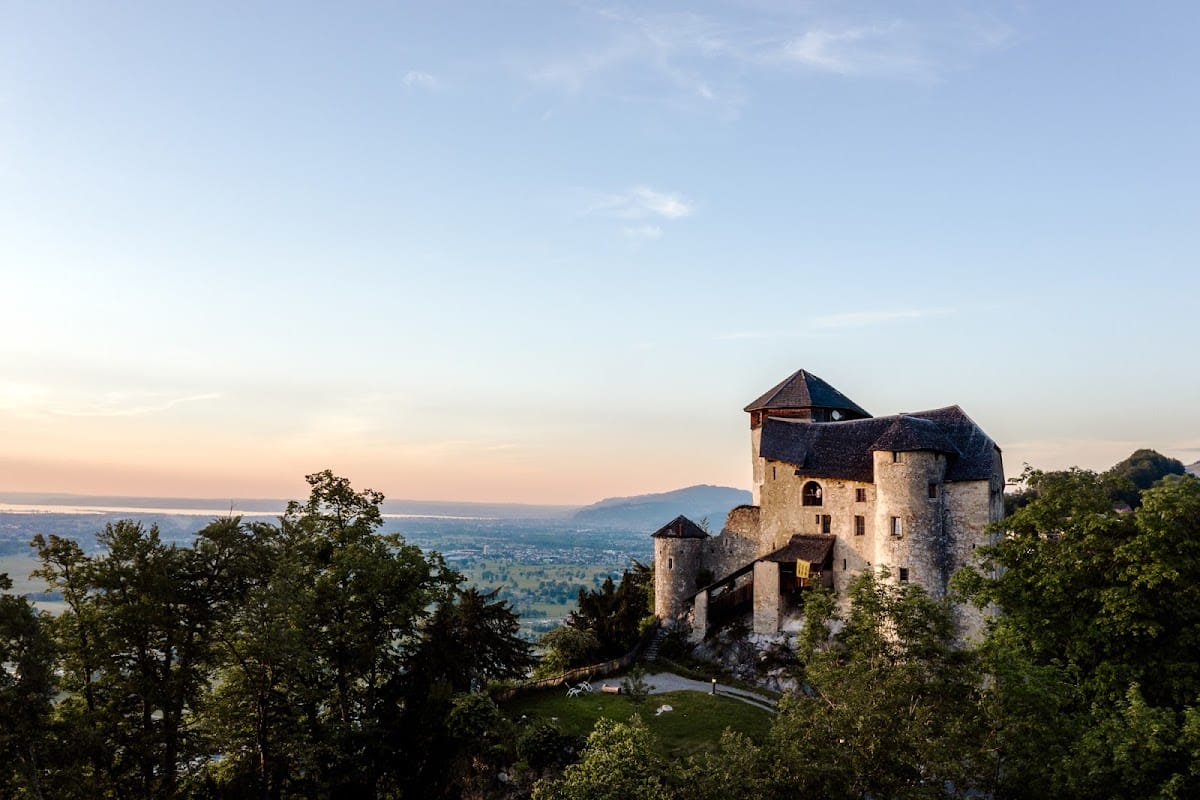
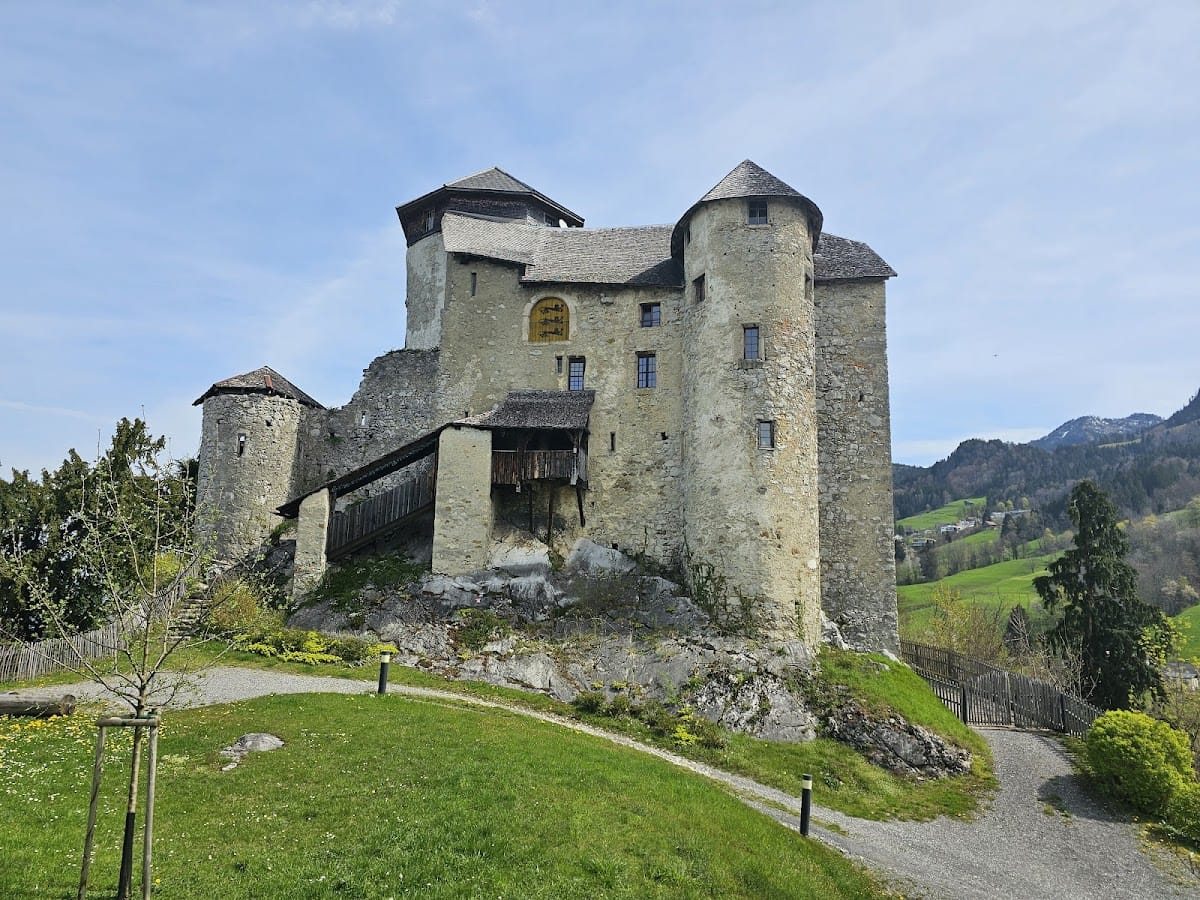
Neu-Ems Castle occupies a compact hilltop that commands views over the Rhine valley. Its layout reflects a carefully planned fortress designed for defense and residence. The original complex included an octagonal tower where the family lived, a water cistern for supply, and a circular defensive wall enclosing an inner courtyard. These features together formed a stronghold typical of medieval fortifications in the region.
One of the central elements is a substantial tower resembling a bergfried, a tall defensive structure common in central European castles. Attached to this tower is the palas, the main residential building, while an outer bailey, or lower courtyard, lies nearby, providing additional space for activities and protection.
The chapel, built in the early 1600s on the castle’s first floor, has mostly disappeared. Only two windows with pointed arches remain on the northern exterior wall as traces of this sacred space. The altar from this chapel, notable for being crafted around 1515–1520 by a master from Antwerp, survives in museum care but no longer exists on site.
Stone is the primary building material throughout the fortress, reflecting the robust construction methods of the medieval period. Despite Neu-Ems Castle’s relatively small size, its architectural components form a remarkably cohesive ensemble, demonstrating careful design and craftsmanship. Key structures such as the octagonal tower and surrounding curtain wall are still standing today, preserving the castle’s distinctive historic character.
Nearby sites