Narin Castle: An Ancient Mud-Adobes Fortress in Meybod, Iran



Visitor Information
Google Rating: 4.5
Popularity: Low
Google Maps: View on Google Maps
Country: Iran
Civilization: Unclassified
Remains: Military

History
Narin Castle is located in the city of Meybod in present-day Iran and stands as one of the oldest known mud-adobe fortresses constructed by ancient civilizations in central Iran. While the exact original builders remain uncertain, archaeological evidence points to multiple construction phases spanning several historic eras, including the Median, Achaemenid, and Sassanid periods.
The earliest foundations of the fortress likely date back as far as 4,000 BCE, based on the discovery of pottery fragments resembling motifs from the Elamite civilization, which flourished in the third millennium BCE. Over time, successive layers of building indicate the site maintained continual occupation and strategic use through ancient times. The presence of bricks of different sizes and styles, along with inscribed seals in the Pahlavi script, link the complex firmly to late pre-Islamic Iranian empires.
Local folklore has long connected the castle to the prophet Solomon (Suleiman Nabi), attributing its origins to his legendary time. However, this tradition is recognized by scholars as a myth without historical support. Instead, the fortress functioned as a governmental citadel and seat of authority during the era before the advent of Islam in the region, reflecting the organized political society of ancient central Iran.
Following the Islamic conquest, Narin Castle retained its military and residential importance. It underwent repairs and structural expansions, notably during the rule of the Muzaffarid dynasty in the medieval period. However, some of these later restoration efforts were carried out rapidly and without strict adherence to the original architectural methods, impacting the fortress’s structural cohesion.
Throughout its long history, the castle managed to withstand numerous military threats, aided in part by a subterranean network designed to sustain its inhabitants with essential supplies such as water and food. Its enduring legacy was formally recognized when it was designated a national heritage site of Iran on August 8, 1975, cementing its significance in the country’s cultural and historical landscape.
Remains
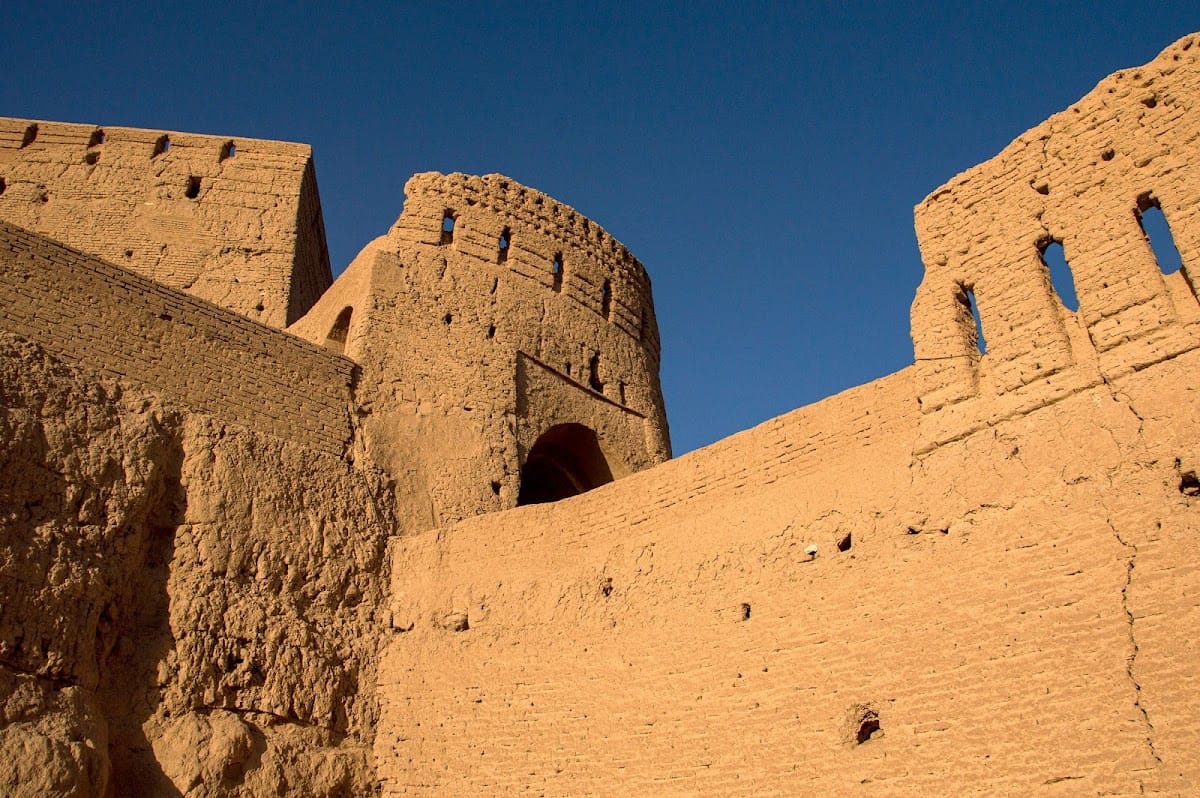
Narin Castle occupies a raised hill overlooking Meybod, covering an area of approximately three hectares. Its massive structure reaches around 40 meters in height and consists primarily of sun-dried mud bricks and adobe. The fortress is composed of seven stories, with four large circular towers positioned around its perimeter, adding to its defensive capability. The outer walls include multiple layers of fortification, with the lowest defensive wall remarkably thick in places, reaching up to 20 meters wide.
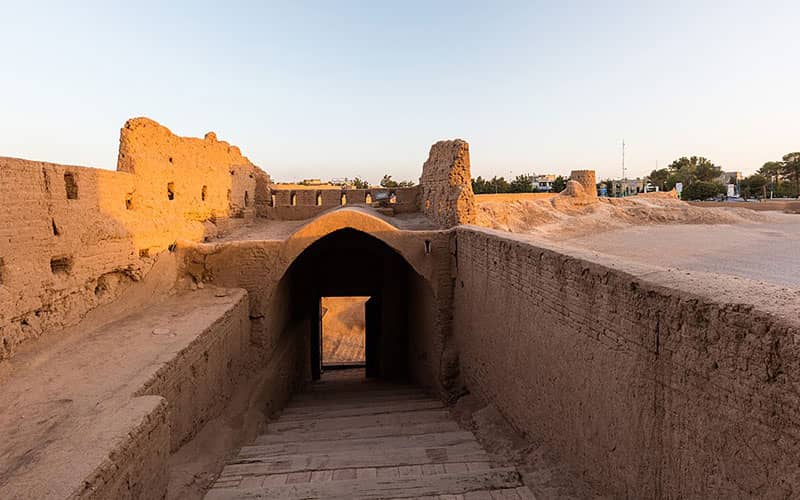
The castle’s main entrance opens into a broad courtyard, from which residents and officials accessed the rest of the complex. At the summit lies a terrace, once accessed by two helical staircases. These spiral staircases, however, have collapsed and are no longer passable. Within the structure itself, small interconnected rooms and spiral corridors create complex access routes leading toward the upper royal quarters. Ventilation was achieved through small openings near the upper walls, allowing air circulation through the thick mud walls.
Internally, the fortress was divided into three main floors, reflecting a social hierarchy. The lower level, known as the shahrstan, housed a mosque, a bathhouse, and narrow passageways, though much of this area is now ruined. Above this lay the citadel or hakim-nishin, which traditionally included three floors used for royal or administrative purposes.
Embedded within the castle’s walls is a primitive plumbing system utilizing sarooj, a traditional water-resistant mortar, demonstrating advanced engineering to provide water supply and manage moisture. Below ground, a sizeable chamber thought to have served as a prison has been identified, although it is currently filled with debris. In addition, extensive underground tunnels linked parts of the fortress, designed to ensure sustained provision of food and water during sieges, and are said to have remained unconquered by invading forces.
The fortress’s construction reveals signs of multiple building phases, indicated by bricks of varying dimensions. Some bricks measuring about 10 by 24 by 40 centimeters are attributed to the Median period, while others measuring roughly 12 by 28 by 42 centimeters have been linked to the Sassanid era, with a supporting discovery of Pahlavi inscriptions as evidence of this timeline.
Despite suffering damage from earthquakes and subsequent unskilled repairs using mud and clay bricks, substantial portions of the central fort remain intact, including key exterior walls and towers. In local tradition, the castle is also called “Narenj Qal’eh,” or Orange Castle, a folk name that connects it to a wider tradition of “Narin” or “Narenj” castles across Iran, some believed to descend historically from Zoroastrian fire temples. The fortress’s overall design bears resemblance to the Arg-e Bam fortress, reflecting architectural conventions for grand defensive structures in the region.