Burg Rothenfels: A Medieval Hilltop Castle and Christian Education Centre in Germany



Site at a Glance
- Rating
- 4.3
- Popularity
- Low
- Country
- Germany
- Primary era
- Medieval
- External website
- Open
- Eras represented
- Medieval, Modern
- Civilizations
- German, Holy Roman Empire
- Site type
- Military
- Remains
- Castle
On this page12 sections
History
Burg Rothenfels is a hilltop castle in Germany, above the Main Valley at Rothenfels in Lower Franconia, Bavaria. Its construction dates to around 1148, and its oldest surviving parts date from about 1150. Founded by Markward II von Grumbach, the medieval castle later passed through noble and ecclesiastical ownership before becoming a centre for Christian education and youth work in the twentieth century.
Grumbach and Rieneck ownership
Markward II von Grumbach, documented from about 1120 until his death on 9 February 1171, founded Burg Rothenfels. The Grumbach line ended in 1243 with Albert von Grumbach, Lord of Rothenfels. Through Albert’s daughter Adelheid, who married Count Ludwig of Rieneck, the castle passed to the Counts of Rieneck.
The Counts of Rieneck sold Burg Rothenfels to the Wolfskeel ministerial family in 1328. The Wolfskeels transferred it to the Bishopric of Würzburg in 1333 and moved to Burggrumbach Castle. The resident branch thereafter used the names Wolfskeel von Grumbach and, later, Herren von Grumbach.
From ecclesiastical territory to princely estate
Until the early nineteenth century, Rothenfels belonged to the territory of the Bishopric of Würzburg, an ecclesiastical principality governed by a bishop as both religious leader and territorial ruler. During the secularization of 1803, the territory passed to the House of Löwenstein-Wertheim-Rosenberg. In 1806, mediatization, the absorption of smaller territories into larger states, transferred it to the Principality of Aschaffenburg. In 1813, it became part of the Kingdom of Bavaria.
The castle remained with the prince but was used mainly for agricultural purposes. Its rooms served as cattle stables and storage areas for crops and wine, rather than as a centre of noble residence.
Quickborn and the youth-castle movement
The Verein der Quickbornfreunde became the legal body of Quickborn on 20 November 1917. Quickborn was a Catholic youth movement whose religious and educational work shaped Burg Rothenfels after 1919. The association bought the castle from the Prince of Löwenstein on 21 February 1919, making it the first youth castle to emerge from the German youth movement.
Klemens Neumann and many volunteers prepared the complex for the first German Quickborn gathering in August 1919. Annual gatherings then made Burg Rothenfels a place where young people developed Christian forms of worship, scripture reading, communal life, music, dance, and other educational activities together.
In 1933, the association changed its name to the Vereinigung der Freunde von Burg Rothenfels. The new name expressed the intention that the castle should welcome all open-minded Christians, not only Quickborn members. The Reichsführer-SS and Chief of the German Police dissolved the association by circular decree on 24 July 1939, and the castle was seized on 7 August. This forcibly ended its educational work and interrupted its involvement with the Liturgical Movement and the peace movement.
Romano Guardini and the Liturgical Movement
Romano Guardini directed Burg Rothenfels from 1927 to 1939 and helped make it known beyond Bavaria. A theologian, Guardini supported the Liturgical Movement, a twentieth-century Christian reform movement seeking fuller participation and renewed forms of worship. Under his direction, the castle chapel became a centre for these ideas, some of which were later associated with reforms connected with the Second Vatican Council.
Rudolf Schwarz served as castle architect from 1924 to 1940. His direction also shaped the chapel furnishings, produced through collaboration between teachers and students of the Aachen School of Arts and Crafts.
Post-war education and modern use
After the Second World War, educational work resumed under Heinrich Kahlefeld, a Munich Oratorian. Oratorians are members of a Catholic community of secular priests devoted to pastoral, educational, and scholarly work. Easter and Pentecost conferences, youth workshops open to people from all social backgrounds, and other programmes again brought participants to the castle. The association reopened on 16 April 1948 under Josef Seipel.
Later educational leadership included Heinrich Fleckenstein, Bernhard Casper, and Bruno Leuschner from 1959. A nine-member voluntary castle council responsible for educational work was established in the 1960s. Full-time educational directors included Hanna-Barbara Gerl-Falkovitz from 1975 to 1984, Ludger Bradenbrink from 1986 to 1995, Joachim Hake from 1995 to 2006, Achim Budde from 2007 to 2018, and Philip Fuhrmann from 2019. Voluntary castle chaplains included Rolf Zerfaß from 1983 to 1991, Gotthard Fuchs from 1996 to 2018, and Joachim Negel from Pentecost 2018.
Since the early 1970s, Burg Rothenfels has been thoroughly renovated and adapted as a youth and adult education centre. It operates as an independent Christian educational and conference house under the Vereinigung der Freunde von Burg Rothenfels, which is affiliated with the Bavarian Adult Education Association. The association organizes about 50 events each year, including the Rothenfels Easter Conference and the Quickborn working week at New Year. The castle also accommodates educational and cultural events, youth groups, school classes, choirs, and study conferences.
Burg Rothenfels is recognized as an architectural heritage monument in Bavaria. In November 2022, the Free State of Bavaria pledged more than 3.3 million euros for comprehensive restoration carried out under heritage-conservation requirements. The completed restoration of the East Palace, the largest building in the complex, was celebrated on 8 June 2025.
Remains
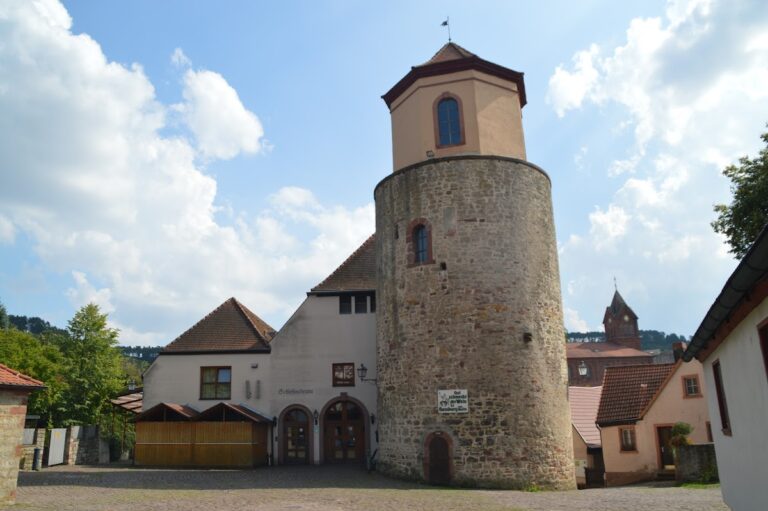
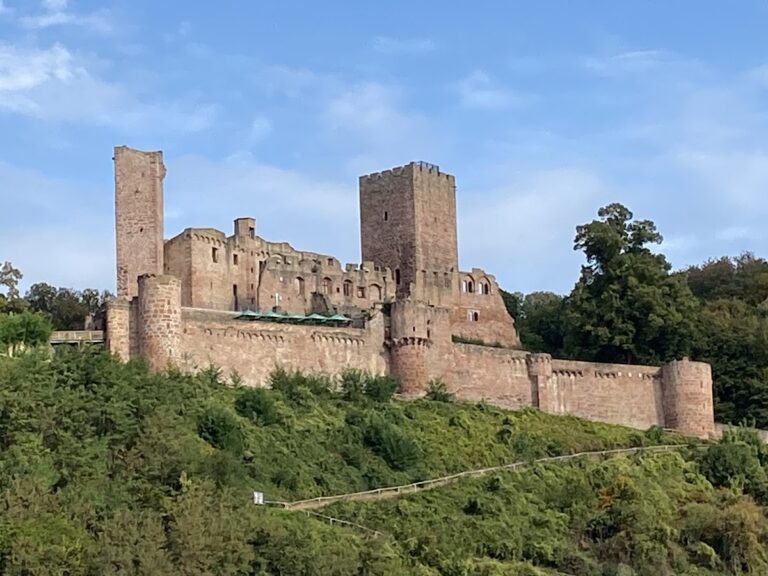
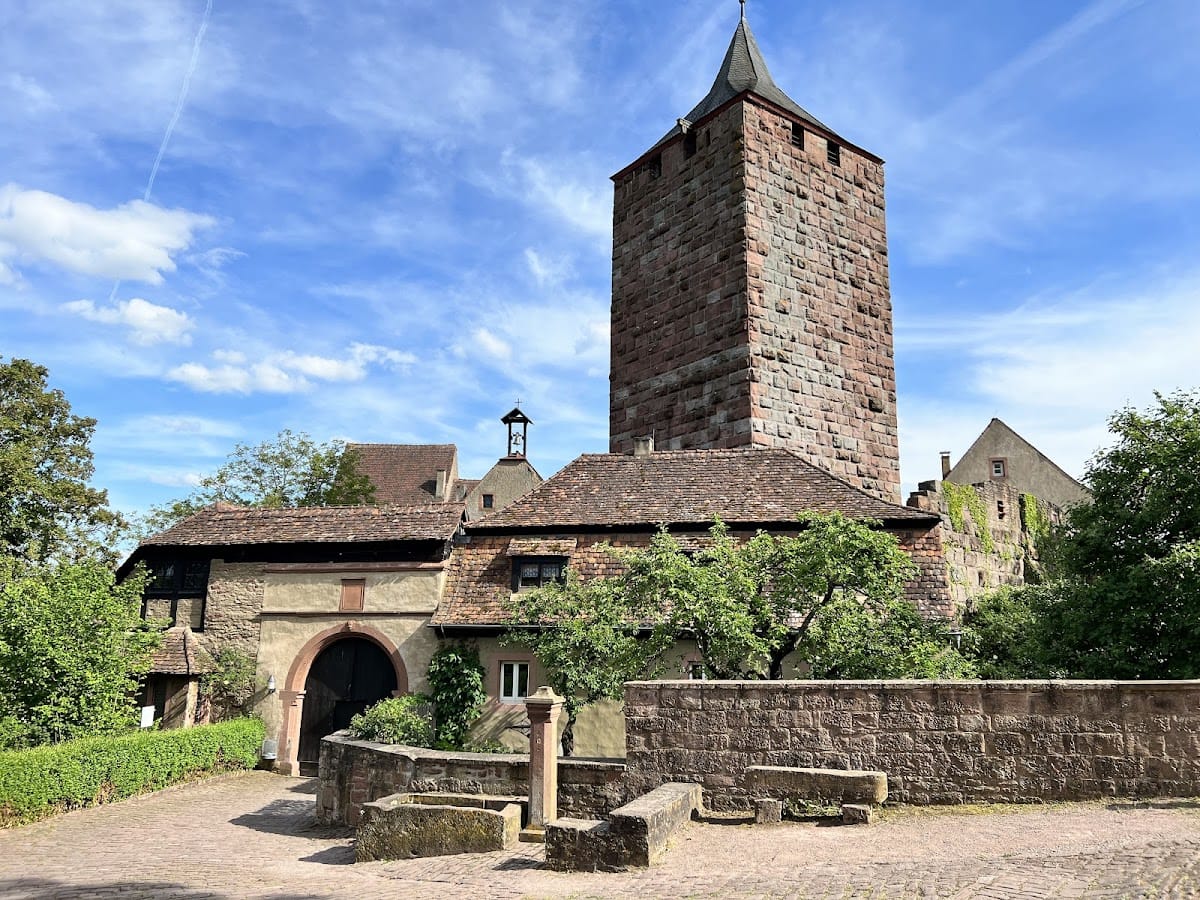
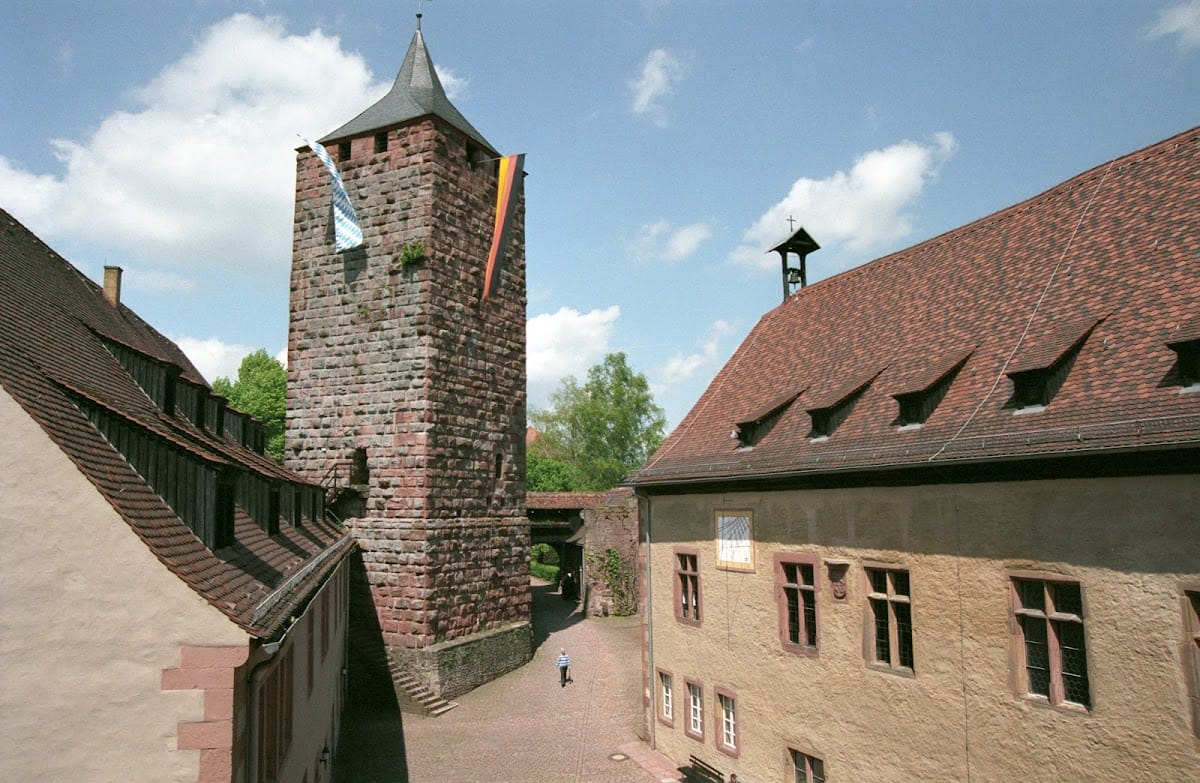
Burg Rothenfels is a substantially preserved hill castle standing at about 225 metres above sea level, high above the Main. The deeply incised Main Valley and the old town of Rothenfels lie immediately behind it toward the east and southeast. The complex consists of an inner castle and an outer castle in front of it, with the East Palace, South Palace, and West Palace forming its principal palace buildings. A massive keep is also among its defining medieval structures.
Castle buildings and educational spaces
East Palace
The East Palace is the largest building in the complex. It was among the buildings initially renovated from the early 1970s, and its comprehensive restoration was completed in 2025. The building forms part of the preserved group of principal castle structures now used within the educational institution.
South and West Palaces
The South Palace was initially renovated from the early 1970s, and its chambers were refurbished in 2014. From 1979, work extended to the West Palace and the outer castle. A wood-chip heating system was installed from 2008 as part of the modern adaptation of the complex.
Conference and residential facilities
The complex contains a chapel, three dining rooms, and ten work and group rooms designed for groups of between 20 and 70 people. A great hall provides seating for 300 and is particularly suitable for theatre and musical groups. Youth-hostel and conference facilities provide about 280 beds, allowing the medieval buildings to support the castle’s continuing educational use.
Chapel furnishings
The chapel retains sacred furnishings created during Rudolf Schwarz’s direction through the collaboration of teachers and students from the Aachen School of Arts and Crafts. Fritz Schwerdt made the large eternal-light lamp. Anton Schickel and Fritz Schwerdt produced the small crucifix, whose ivory corpus was made by Hein Minkenberg.
Schwarz designed the altar, altar candlesticks, and tabernacle. These pieces were executed mainly in silver sheet with nail decoration, with Anton Schickel carrying out the execution. Together, the surviving furnishings preserve the chapel’s connection with the artistic and liturgical work developed at Burg Rothenfels during the interwar period.