National Museum of Bardo: Tunisia’s Premier Museum of History and Art




Visitor Information
Google Rating: 4.6
Popularity: Medium
Google Maps: View on Google Maps
Official Website: www.bardomuseum.tn
Country: Tunisia
Civilization: Roman
Remains: Museum

History
The National Museum of Bardo is situated in Tunis, Tunisia, within the historic Bardo Palace complex. The palace itself originated in the 15th century and was initially constructed as a residence for the Beys of Tunis. Over the centuries, it underwent significant expansions, particularly during the 17th to 19th centuries under the Muradid and Husainid dynasties. These rulers enhanced the palace’s structure and decorative elements, establishing it as a central seat of power in the region.
Following the French protectorate establishment in 1882, the palace’s function shifted. A decree that year founded the first museum institution in North Africa, which officially opened in 1888 within the former Beylical palace. Initially named Musée Alaoui after the reigning Bey Ali III, the museum utilized parts of the palace, including the former harem, to house its collections. This marked a transformation from a royal residence to a cultural institution.
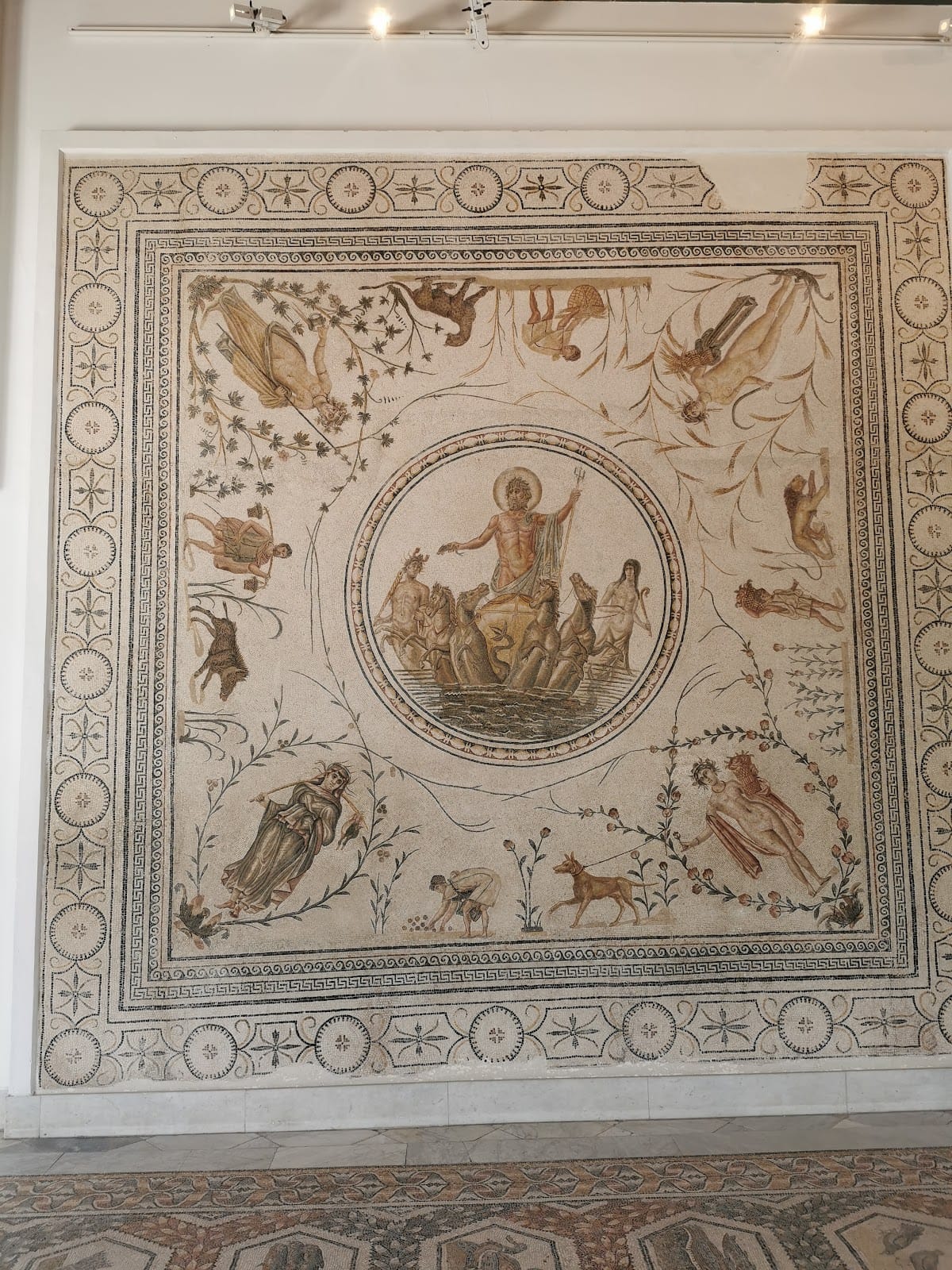
Throughout the early 20th century, the museum’s collections expanded rapidly due to archaeological excavations at prominent ancient sites such as Carthage, Dougga, Hadrumetum, and Utica. Underwater excavations near Mahdia also contributed significant artifacts. These efforts resulted in the museum acquiring one of the world’s most extensive assemblages of Roman mosaics and Punic relics. After Tunisia gained independence, the museum was renamed the National Museum of Bardo, a title in use since the late 1950s.
A new wing opened in 2012, increasing exhibition space and allowing the museum to accommodate up to one million visitors annually.
Remains
The museum occupies the Grand and Petit Palaces of the Bardo complex, structures originally erected in the 15th century and extensively modified during the 18th and 19th centuries. The architectural style reflects a blend of Maghrebi, Turkish, Andalusian, Italian, and European influences. The layout includes a main entrance on the eastern façade, featuring a gallery with seven arcades supported by pink marble colonnettes and a large copper-plated door adorned with bronze studs and knockers.
The ground floor, once used as stables and storage, contains a vaulted vestibule decorated with polychrome faience and a carved wooden door leading to the upper levels. The first floor hosts the principal exhibition halls, including the Carthage Hall, which was originally the palace patio. This hall is rectangular and surrounded by a double arcade of white marble columns with composite capitals. It is decorated with gilded plaster cornices and motifs, and its floor is paved with white marble tiles. Four chandeliers hang from the ceiling.
Notable rooms within the museum include the Sousse Hall, distinguished by a sixteen-sided wooden dome painted with geometric and floral designs on a gold background. The dome culminates in an inverted stalactite apex with a central chandelier. The Virgile Hall is shaped like a Greek cross and features vaulted ceilings, semicircular windows, polychrome faience panels, and intricate white plaster stucco with interlacing and floral motifs extending to the ceiling.
The Althiburos Hall is rectangular and contains two elaborately decorated wooden tribunes supported by slender white marble colonnettes inlaid with red marble strips and metal railings. Its ceiling consists of three separate wooden panels adorned with geometric and floral patterns. The Oudna Hall, also rectangular, is notable for its fully carved and painted wooden ceiling.
Access to the Petit Palais is possible from the first floor via the Carthage Hall or from the ground floor through a vaulted vestibule featuring marble benches and a niche. The Petit Palais includes a marble-floored patio with black and white voussoirs on arches supported by white marble columns with composite capitals. A marble fountain is centered in this patio. Surrounding rooms have marble door and window frames, richly decorated plaster ceilings, and polychrome ceramic wall panels.
The museum’s underwater archaeology section contains a reconstructed marble garden inspired by artifacts recovered from the Mahdia shipwreck. This garden includes restored marble craters, sculptures depicting children playing with water, and various architectural fragments. The entire architectural ensemble has been classified as a historic monument since 1985, maintaining its original character despite adaptations for museum use.
Supporting facilities within the museum include three restoration workshops specializing in mosaics, textiles and wood painting, and general maintenance. Additionally, there is a photographic laboratory and an architectural office. The museum also houses a library with approximately 5,000 volumes and a photographic archive containing around 44,500 images. Since 2014, a multilingual digital guide has been available, providing audio commentary, photo slideshows, and historical context through a free smartphone application or loaned devices.


