Lenzburg Castle: A Historic Fortress and Museum in Switzerland


Visitor Information
Google Rating: 4.6
Popularity: Medium
Google Maps: View on Google Maps
Official Website: www.museumaargau.ch
Country: Switzerland
Civilization: Medieval European
Remains: Military

History
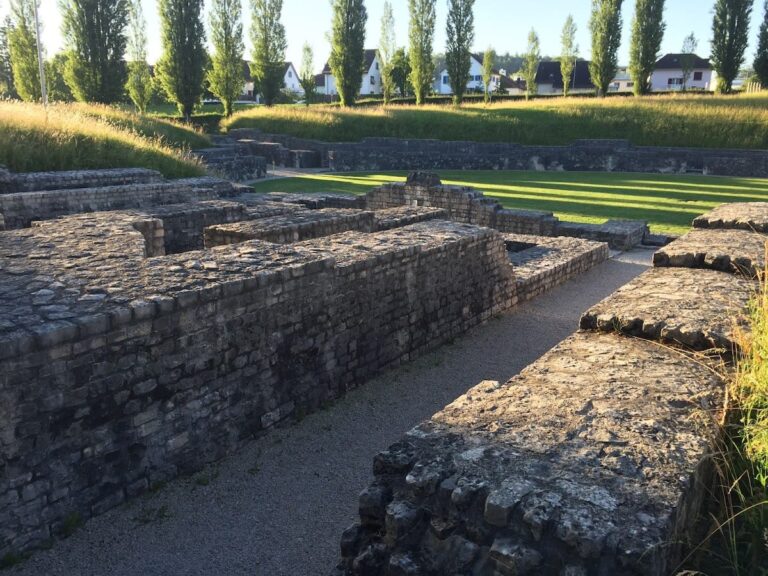
Lenzburg Castle stands on a hill in what is now Lenzburg, Switzerland, a site occupied since prehistoric times. Archaeological finds reveal Neolithic settlements around 3000 BCE and a large burial ground from that era. Bronze Age remains and Roman artifacts from the 1st and 2nd centuries CE connect the site to the nearby Roman settlement Vicus Lindfeld. There is also evidence suggesting a sanctuary may have existed here during Roman times.
The castle’s name originates from the Counts of Lenzburg, who likely established their residence here in the early 11th century. The first written record dates to 1077, mentioning Ulrich III, a count involved in the Investiture Controversy, a major conflict between church and state. The Lenzburg family line ended in 1173 when Ulrich IV left the castle to Emperor Frederick Barbarossa. The emperor personally managed the inheritance, granting much land to his son Otto I of Burgundy. After Otto’s death in 1200, the ruling Staufer family was expelled from the region of Argovia.
Around 1230, the castle passed by marriage to the Kyburg family, who founded the fortified market town of Lenzburg at the castle’s western base. The Kyburg line ended in 1264, and Rudolf I of Habsburg became guardian of the heiress Anna von Kyburg. He acquired the castle in 1273, marking the start of Habsburg control. Under the Habsburgs, the castle served as a regional administrative center. Duke Frederick II lived there from 1339 and began building the Ritterhaus for his planned marriage to an English princess, but he died in 1344 before its completion.
From 1369, the Ribi-Schultheiss family held the castle as a fief. In 1375, the castle successfully resisted a siege by the Gugler, a group of mercenaries. In 1415, the city of Bern conquered western Argovia. After negotiations, Bern fully acquired Lenzburg Castle by 1442. Starting in 1444, it became the seat of the Bernese bailiff, who managed military, judicial, and tax affairs in the region.
The castle’s military importance grew after Bern adopted the Reformation in 1528. It served as a frontier fortress during the Kappel Wars of 1529 and 1531, controlling crossings over the nearby Reuss River. In the 17th century, the castle underwent major fortifications, including a double gate with a defensive courtyard (zwinger) built in 1625 and an 11-meter-high bastion constructed between 1642 and 1646. Moisture problems caused by the bastion’s earth mound led to the construction of a new bailiff’s residence between 1672 and 1674.
During the 18th century, the castle was converted into a large granary, expanded to store over 5,000 tons of grain. The last Bernese bailiff surrendered the castle to French troops in 1798, after which it briefly served as a military hospital. The canton of Argovia acquired the castle in 1804 but left it mostly unused until 1823. That year, educator Johann Karl Christian Lippe opened a boys’ boarding school there, which operated until 1853.
In 1860, the castle entered private ownership, passing through several hands including Konrad Pestalozzi-Scotchburn, Friedrich Wilhelm Wedekind (father of playwright Frank Wedekind), Augustus Edward Jessup, and American industrialist James William Ellsworth, who bought it in 1911. His son Lincoln Ellsworth inherited the castle in 1925 and used it occasionally while planning polar expeditions.
After Lincoln Ellsworth’s death in 1951, his widow sold the castle in 1956 to a foundation created by the canton and city of Lenzburg. The castle was opened to the public and underwent a major restoration from 1978 to 1986, led by architect Dieter Boller. This restoration adapted the castle for museum use and included archaeological excavations that uncovered many historical artifacts. Since 1987, the castle has housed the Historical Museum of Argovia, renamed Museum Aargau in 2007, showcasing the castle’s history and regional collections.
Remains
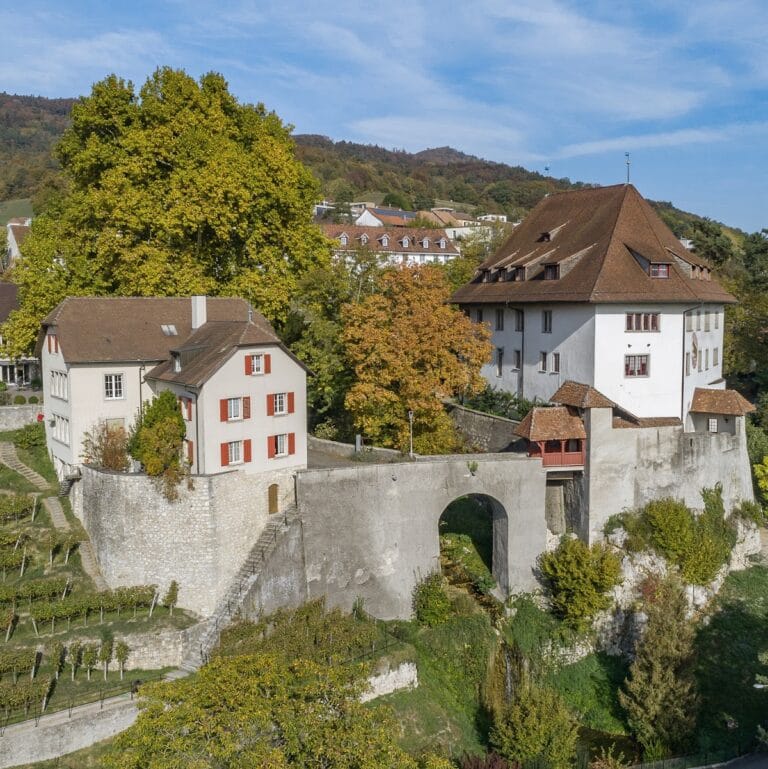
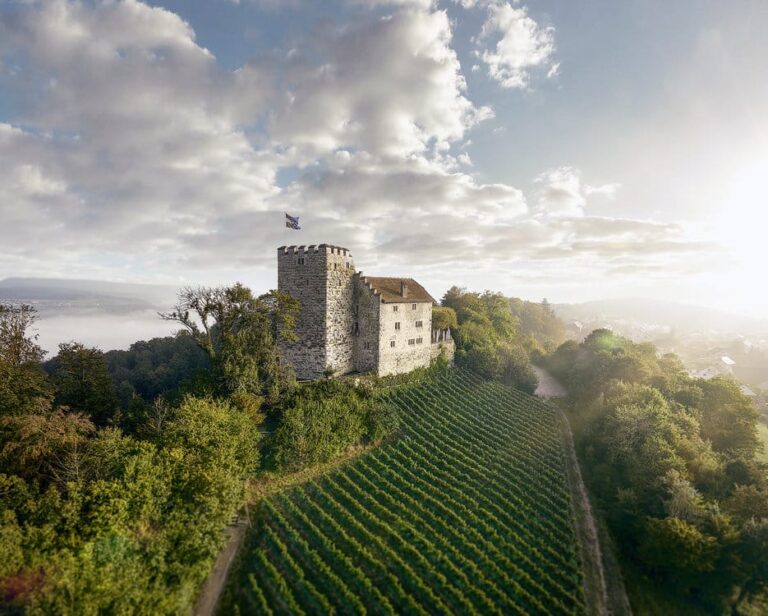
Lenzburg Castle occupies a nearly circular hill about 250 meters wide and 100 meters above the surrounding plain. The site is enclosed by a ring wall built in the late 15th century, constructed directly on the rock with varying height and partly crenellated with sloped merlons covered by tiles. The castle’s seven main buildings form a horseshoe shape around a courtyard open to the southwest, featuring Gothic and Baroque architectural styles from the 12th to early 18th centuries.
The main entrance lies on the northwest side, reached by a stairway or old path leading to the lower gatehouse built in 1625. This gatehouse has a round arch framed by rough bossage stones and a relief showing the coats of arms of Bern, the Holy Roman Empire, and bailiff Peter Bucher, flanked by lions holding an orb and sword. Beyond this gate, a defensive courtyard called a zwinger leads to the intermediate gatehouse, also from 1625 and expanded in the 1760s. This one-story building features a hipped roof, bossed masonry, round-arched portal, embrasures for defense, and an oriel window supported by decorated consoles.
The path then turns sharply to a drawbridge and the upper gatehouse, the only entrance to the inner courtyard. The courtyard’s southwest end contains a French-style garden first recorded in 1560 and redesigned in the 18th century. It has intersecting paths dividing the lawn into four parts, a pavilion attached to the wall, and a limestone fountain made from local Mägenwiler Muschelkalk stone.
The north wing includes the upper gatehouse, remains of the northern bergfried (a tall defensive tower), and the bailiff’s residence built between 1672 and 1674. This three-story late Gothic building has a stepped gable, steep hipped roof, and a small round tower added in 1626 replacing a wooden latrine oriel. A pentagonal stair tower was added in 1630, with its roof changed from an onion dome to a hipped style in 1760.
The eastern bastion, constructed between 1642 and 1646, replaced an older bulwark and closed the gap between the bailiff’s house and the palas (main residential building). It was designed to protect against cannon fire from a nearby hill. The bastion’s 11-meter-high wall has crenellations, a round-arched portal with decorative lesenes (vertical strips), and a pediment adorned with spheres. A clock tower was added in 1659, later topped with an onion dome in 1760. The earth mound behind the bastion caused moisture problems in the bailiff’s house, leading to its lowering in the early 20th century and further reduction during the 1978–1986 restoration, which also uncovered a basement now used by the museum.
The palas dates to around 1100 and is built of layered stone blocks and rubble. It is rectangular, four stories tall, and originally had its entrance on the second floor via an external wooden staircase. The main floor contained a fireplace, the upper floor served as sleeping quarters, and the lower floors were for storage. During Bernese rule, a torture chamber was located here. Between 1592 and 1599, a ground-floor arched entrance was added. The 1978–1986 restoration reorganized interior floors and stairs for museum use.
Attached to the palas’s west side is the donjon, a square tower measuring 10 by 10 meters with walls three meters thick. Built around 1150, construction stopped after Ulrich IV’s death and remained unfinished for over 170 years. It was completed in 1344 with two additional floors of thinner walls. From the early 17th century, the first floor served as a prison. In 1728–1729, the donjon was connected to the Ritterhaus and the well between them by a functional building, requiring removal of the north facade. The granary built nearby was demolished in 1896, restoring the donjon’s original appearance and uncovering the well first mentioned in 1369. The 1978–1986 restoration reorganized floors and stairs.
The Ritterhaus, or Knights’ House, began construction in 1339 for Duke Frederick II of Habsburg’s planned marriage but remained unfinished after his death in 1344. The western part was demolished and rebuilt in 1509, while the eastern walls remained but interiors were completely redone. By about 1590, it was used as a barn with grain storage and a wine press, with added embrasures for defense. In 1758, the interior was remodeled with extra floors to increase grain storage. The 1893 restoration removed these floors and restored the upper hall’s pointed-arch windows. The two-story rectangular building measures 28 by 17 meters and has a massive half-hipped roof covered with Alsatian tiles. A small chapel dedicated to Saint Fortunatus stood nearby from 1369 until its demolition in 1762–1763 due to decay.
The Bernerhaus, also known as the Stapferhaus or Hintere Haus, was built around 1600 by combining a stable and mill under one roof. It was expanded eastward between 1705 and 1707 to increase grain storage. Part of its south facade was rebuilt in 1761–1762 due to moisture damage. The 1893 extension was demolished and replaced by a reconstructed battlement walkway leading to the upper gatehouse. This three-story building has a hipped roof with Alsatian tiles and regularly spaced simple windows. Three loggias on the east side include one masonry on the ground floor and two wooden above. It housed the Stapferhaus foundation from 1960 to 2018 and now contains a restaurant and conference rooms.
The castle is accessible from a parking area at the hill’s base by a pedestrian path or an elevator located between the donjon and Ritterhaus, providing disabled access. Today, the castle functions as a museum with four main sectors: the bailiff’s residence as a residential museum, permanent exhibitions in the palas and donjon, historical workshops and temporary exhibitions in the eastern bastion, and a children’s museum in the bailiff’s attic. The courtyard garden was restored in the 1980s to its 18th-century French style, replacing gravel with lawn and featuring a limestone fountain at the path intersection.
Nearby sites