Isert Kelly Castle: A 15th-Century Tower House in County Galway, Ireland

Visitor Information
Google Rating: 4.5
Popularity: Very Low
Google Maps: View on Google Maps
Country: Ireland
Civilization: Unclassified
Remains: Military

History
Isert Kelly Castle is situated in the municipality of Kilchreest, in County Galway, Ireland. The tower house was constructed in the 15th century by the MacHubert Burkes, a family descended from Hubert, the son of Richard Óg de Burgh, a prominent Hiberno-Norman knight of the 13th century. This connection places the castle within the context of the Norman influence that shaped much of medieval Ireland.
The MacHubert Burkes originally controlled the castle, but ownership later passed to the MacRedmonds, another branch of the wider Burke family. In 1596, the castle suffered an assault by the Ó Doḏnnaill (O’Donnells), during which it was set on fire. Despite this damage, evidence from a fireplace dated 1604 indicates the castle remained occupied or underwent refurbishment shortly afterward. This suggests the site retained its importance into the early 17th century.
Following the turbulent mid-17th century period in Ireland, particularly after the Cromwellian conquest, the estate changed hands, passing into the possession of Dudley Persse. By the 19th century, ownership belonged to William Persse, reflecting broader patterns of land redistribution during this period. Archaeological work carried out between 2014 and 2016 has since explored the castle’s long history, uncovering details of its past occupation and structural development.
Remains
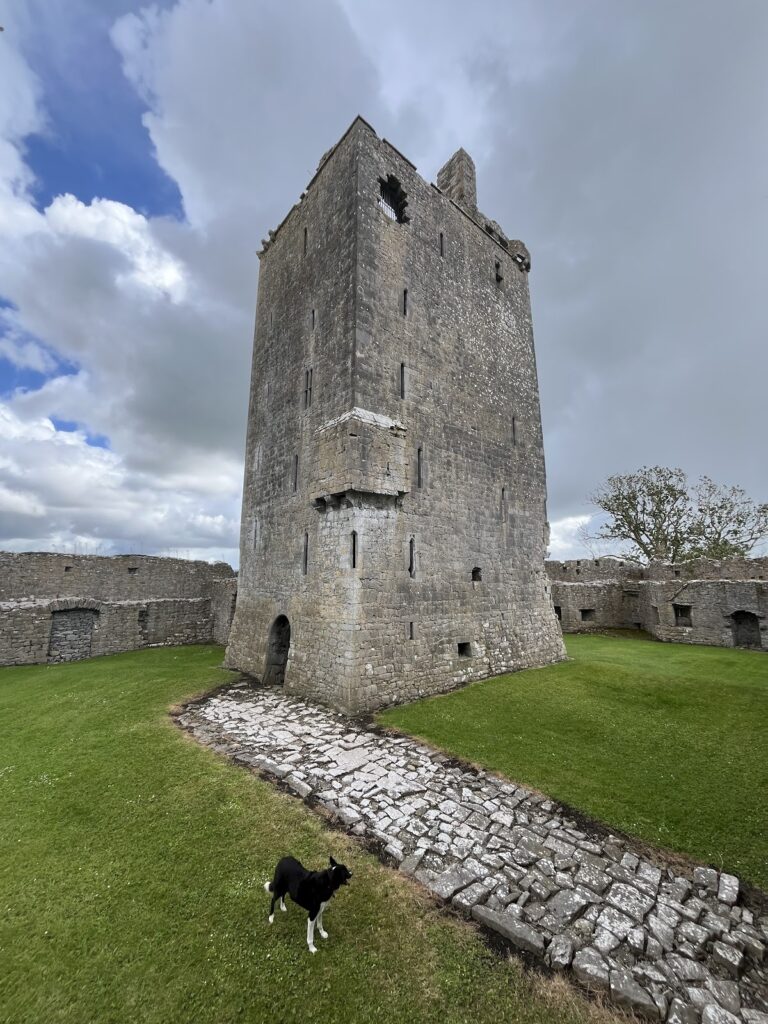
Isert Kelly Castle stands as a well-preserved example of a 15th-century Irish tower house. The main structure rises to a height of 21 meters (69 feet) and is contained within a square enclosure called a bawn, measuring 60 meters (about 200 feet) on each side. This enclosed courtyard likely served defensive and domestic purposes. Surrounding the castle, within the area known as Castlepark townland, covering roughly 20.5 hectares (51 acres), once stood additional buildings, which may have included a hall, stables, cottages, and barns linked to the castle’s operation.
Inside, the tower house’s first floor features a vaulted ceiling, a construction method that uses arches to support the roof and distribute weight evenly, demonstrating medieval building techniques aimed at durability and fire resistance. This floor also contains a fireplace, suggesting it was used for warmth and cooking. On the second floor, arcades—rows of arches supported by columns or piers—are present, likely contributing both to structural support and interior design.
The principal chamber is found on the third storey where another fireplace remains. This hearth bears an inscription including the initials W.H. and the date 1604, marking the period shortly after the castle’s burning in 1596, and indicating refurbishment or continued habitation. Throughout the tower, these elements illustrate a combination of functionality and status within the tower house. The preservation of these features provides valuable insight into the castle’s medieval and early modern architecture.
Nearby sites