Gradačac Castle: An Ottoman Fortress in Bosnia and Herzegovina



Visitor Information
Google Rating: 4.6
Popularity: Medium
Google Maps: View on Google Maps
Country: Bosnia and Herzegovina
Civilization: Unclassified
Remains: Military

History
Gradačac Castle is located in the municipality of Gradačac in Bosnia and Herzegovina. It was constructed by the Ottoman Empire and functioned as a military and administrative center from the early 18th century onwards.
The origins of the fortress date back to around 1710, when the kapetanija—or captaincy—of Gradačac was established. This captaincy was responsible for defending the northeastern frontier of the Ottoman territory, overseeing at least 300 soldiers and commanding neighboring fortifications such as Srebrenik and Soko. By the time of the Treaty of Belgrade in 1739, which fixed the Ottoman border along the Sava River, the fortress had become a key military site. Between 1718 and 1739, the complex was fortified with defensive moats and batteries equipped with heavy artillery, reflecting its strategic importance near the empire’s border.
Significant expansions and renovations took place from the mid-18th to early 19th centuries under the leadership of successive kapetans—Mehmed, Osman, and Murat Gradašćević. The most notable construction phase culminated in 1824 with the completion of the White Tower (Bijela kula). While this tower is commonly linked to Husein-kapetan Gradašćević due to its name, historical accounts do not definitively confirm his direct involvement in its construction. Throughout this period, the fortress served as a fortified military headquarters and administrative base for the local captaincy, which managed defense and governance without being a family residence.
After the abolition of the captaincy system, the castle’s role evolved toward civilian administrative functions and later military use as barracks. The fortress and its key structures, including the White Tower and nearby clock tower (sahat-kula), suffered damage from bombardment in June 1992 during the Bosnian War. Since 1962, the White Tower has enjoyed state protection, and in 2004 the entire castle complex was officially designated a national monument of Bosnia and Herzegovina. A restoration completed in 2003 helped preserve the site for its historical legacy.
Remains
The Gradačac Castle complex occupies approximately 3,500 square meters and is comprised of two main sections: the Lower Town and the Upper Town. These are enclosed by widely spread ramparts featuring three access points, each guarded by small defensive towers known as kapi-kule. The surrounding fortifications display careful masonry and a design aimed at both defense and surveillance.
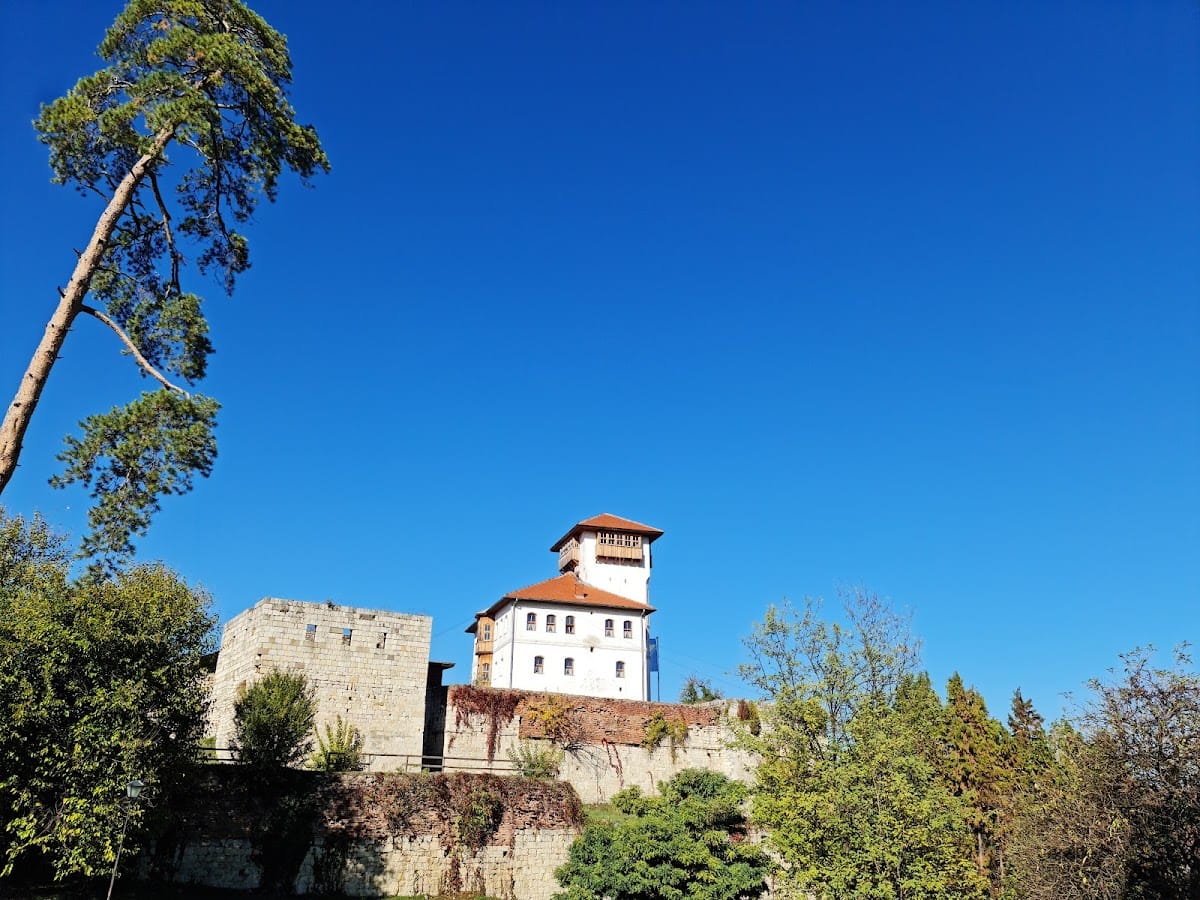
At the heart of the castle stands the White Tower, a prominent three-story brick structure topped by an additional tower reaching about 18 meters in height. Its base covers roughly 7.4 by 7.3 meters, while the entire building including an attached konak, or residence, spans 15.5 by 12.5 meters. The tower’s walls are nearly one meter thick, constructed mainly of brick, which contrasts with parts of the fortress walls made from precisely cut stone, indicating a higher level of craftsmanship uncommon among contemporary local fortifications.
Architecturally, the tower and konak are integrated yet distinct, with the tower rising above its adjoining building by an extra floor. The presence of a projecting watchroom called a čakma at the top adds an observation point and suggests the tower was built before the konak was added. Inside, the tower contains three vaulted rooms on the ground floor, while the first and second floors each hold five rooms arranged symmetrically around a central staircase and an antechamber. Originally, all four sides of the tower’s top floor featured wooden balconies known as doksat, likely triangular in shape, as well as one above the entrance, though these elements no longer survive.
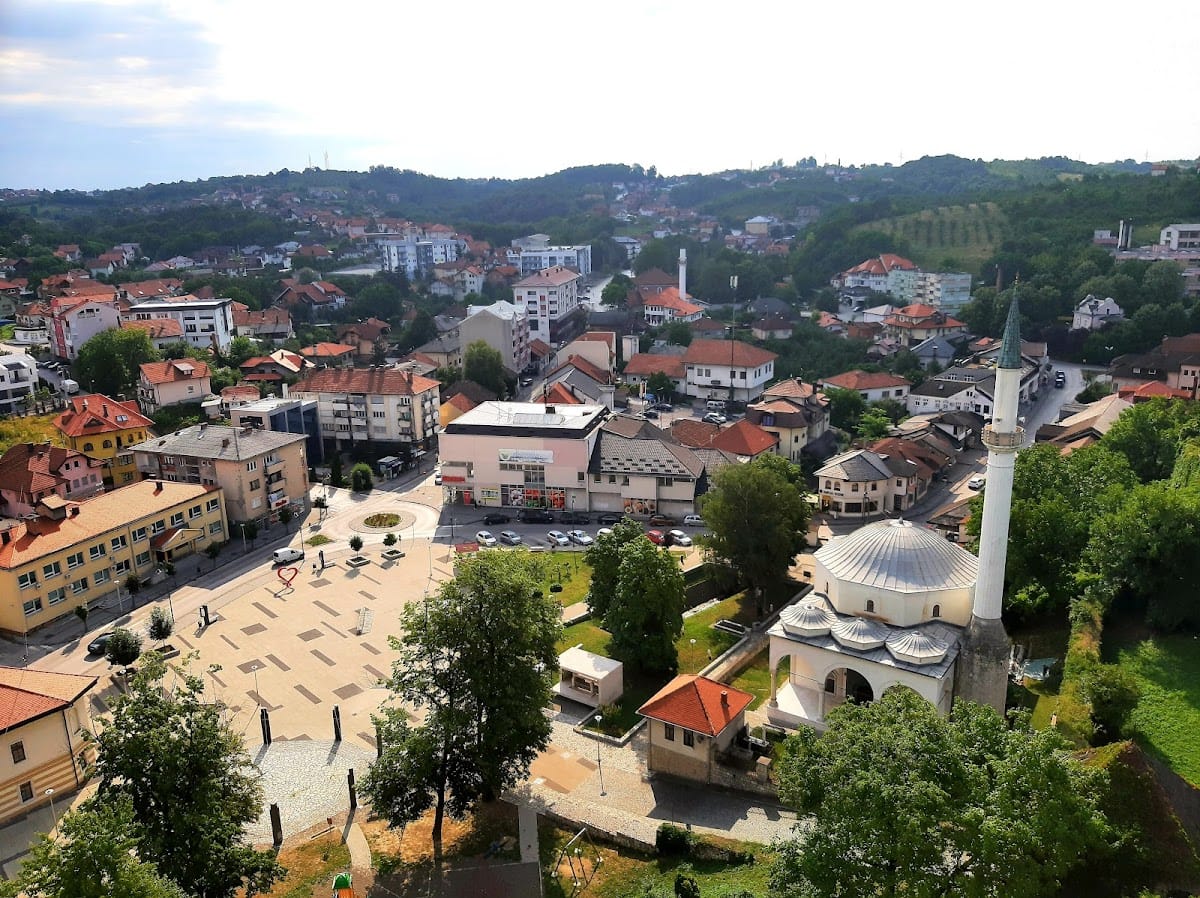
Within the fortress precincts are additional noteworthy structures, including the clock tower or sahat-kula and the Husejnija mosque, both integral to the site’s military and religious functions. During recent restoration and adaptation efforts to support modern uses, concrete and reinforced concrete components were introduced to reinforce the historic fabric without compromising the overall form.
Today, the uppermost part of the White Tower accommodates a restaurant offering expansive views over the town of Gradačac and its environs, utilizing the tower’s original role as a vantage point to observe the surrounding landscape and nearby settlements.
Nearby sites