Kyzikos: An Ancient City on the Kapıdağ Peninsula in Türkiye
Table of Contents

Visitor Information
Google Rating: 3.7
Popularity: Medium
Google Maps: View on Google Maps
Official Website: www.kulturportali.gov.tr
Country: Turkey
Civilization: Byzantine, Greek, Roman
Remains: City

Context
Kyzikos is situated on the Kapıdağ Peninsula along the southern coastline of the Sea of Marmara, near the modern town of Erdek in Balıkesir Province, Türkiye. The ancient settlement originally occupied an island on the Arctonnesus peninsula, which was later connected to the mainland by a narrow isthmus or canal. This location provided sheltered harbors and access to fertile plains, facilitating maritime trade and agricultural production. The site’s position controlled key sea routes linking the Aegean and Black Seas, underscoring its strategic importance in regional navigation and commerce.
Archaeological evidence indicates continuous occupation from the Archaic Greek period through the Byzantine era. The city’s long history is marked by the production of distinctive coinage beginning in the sixth century BCE, reflecting sustained economic activity. Over time, natural processes such as harbor silting contributed to the contraction of urban space and eventual abandonment. The site has attracted scholarly interest since the nineteenth century, with systematic archaeological investigations conducted by Turkish and international teams in the twentieth century. Excavations and surveys have yielded inscriptions, coins, and architectural fragments now curated in regional museums. Although many ruins lie buried beneath alluvial deposits and modern cultivation, Kyzikos remains a protected cultural heritage site under Turkish authorities and continues to be a subject of archaeological research.
History
Archaic and Classical Periods (7th–4th centuries BCE)
Kyzikos was founded as an Ionian Greek colony, traditionally dated to the 8th or 7th century BCE, though archaeological data support a foundation in the mid-6th century BCE. The settlement occupied an island on the Arctonnesus peninsula, strategically positioned to oversee maritime routes between the Aegean and Black Seas. Prior to Greek colonization, the area was inhabited by indigenous groups identified in ancient sources as the Doliones or Pelasgians. Mythological traditions associate the city’s name with Kyzikos, a figure linked to Apollo. Early in its history, Kyzikos gained renown for minting gold staters—coins of high purity and value—that circulated widely across the Greek world, featuring iconography such as a female head, likely representing the goddess Cybele, and a lion’s head.
During the 6th century BCE, Kyzikos came under the dominion of the Lydian kingdom and subsequently the Persian Empire, becoming part of the satrapy administered from Daskyleion. Around 514 BCE, the city was governed by tyrants, reflecting the political instability of the period. Kyzikos participated in the Ionian Revolt against Persian rule in 499 BCE but capitulated following the fall of Miletus. In the 5th century BCE, the city joined the Delian League under Athenian leadership, paying tribute between approximately 452 and 418 BCE. Its political organization included democratic institutions such as a council (boulē) and assembly (dēmos), with magistrates serving in rotating offices including prytanes and a prytanarch.
Throughout the Peloponnesian War, control of Kyzikos oscillated between Athens and Sparta. The city rebelled against Athenian authority in 411 BCE but was retaken and subjected to heavy taxation after the Athenian naval victory at the Battle of Cyzicus in 410 BCE, where Alcibiades defeated the Spartan fleet. At this time, Kyzikos lacked defensive walls, indicating a relatively modest urban status. Following the war, it came under Spartan influence and later reverted to Persian control after the Peace of Antalcidas in 387/386 BCE. The city briefly allied with Athens again in the mid-4th century BCE but withdrew during the Social War (357–355 BCE). It maintained political ties with neighboring cities such as Chalcedon and its mother city Miletus through citizenship agreements (isopoliteia). Bronze coinage continued to be issued during this period. During Alexander the Great’s campaign, the satrap Memnon unsuccessfully besieged Kyzikos, and some sources credit Alexander with connecting the island to the mainland, though this remains uncertain.
Hellenistic and Early Roman Period (3rd–1st centuries BCE)
After Alexander’s death, Kyzikos briefly regained autonomy before falling under Seleucid control around 281 BCE. By the early 2nd century BCE, it became part of the Attalid kingdom of Pergamon. The city maintained close dynastic and political ties with Pergamon’s ruling family, exemplified by the marriage of Attalos I to Apollonis, a woman from Kyzikos. The city contributed naval forces to regional conflicts under Attalid leadership, reflecting its maritime capabilities.
In 133 BCE, Kyzikos was incorporated into the Roman Republic’s provincial system along with much of western Asia Minor. The city endured a significant siege by King Mithridates VI of Pontus in 74 BCE but successfully resisted due to its fortified walls and ample food supplies. Roman general Lucullus relieved the siege by severing Mithridates’ supply lines. In recognition, Rome granted Kyzikos the status of a free city (civitas libera), expanding its territory and privileges. Under Roman administration, the city’s domain reached its greatest extent, encompassing several neighboring cities and islands. Kyzikos emerged as a key commercial center, facilitating trade between the interior Rhyndakos River valley and maritime routes.
Imperial Roman Period (1st–3rd centuries CE)
During the early Roman Empire, Kyzikos initially retained its free city status but lost it in 25 CE under Emperor Tiberius due to offenses against imperial authority, including disrespect toward Augustus and mistreatment of Roman citizens. The city was then placed under direct provincial administration. Despite this setback, Kyzikos remained prosperous throughout the imperial period, though it suffered damage from earthquakes during the reign of Marcus Aurelius.
Under Emperor Caracalla, Kyzikos was elevated to the rank of metropolis, reflecting its administrative and ecclesiastical prominence. The city became an early Christian episcopal see, with a bishopric established by the 1st century CE. Kyzikos was noted for producing a distinctive perfume or ointment derived from local plants such as Cyzicena amaracus or possibly iris species, as described by Pliny and Athenaeus. Its gold staters, known as Kyzikēnoi, continued to circulate widely. The city also housed notable artworks, including paintings of mythological figures Ajax and Medea, mentioned by Cicero, and a renowned statue of the goddess Cybele crafted from gold, ivory, and hippopotamus teeth, originally brought from the nearby island of Prokonnesos.
Late Antiquity and Byzantine Period (4th–14th centuries CE)
In late antiquity, Kyzikos served as the metropolitan see of the Roman province of Hellespontus, overseeing twelve suffragan bishoprics such as Abydus, Dardanus, and Lampsacus, as well as two autocephalous archbishoprics, Parium and Proconnesus. The city produced prominent ecclesiastical figures, including the Arian theologian Eunomius, the historian Gelasius, and several bishops who later became Patriarchs of Constantinople. The Orthodox Church venerates nine martyrs from Kyzikos and the patron saint Tryphaena.
The city endured a series of destructive earthquakes from the 5th through the 11th centuries CE, contributing to gradual decline and demographic shifts. In 675 CE, Arab forces under Muawiyah I briefly captured Kyzikos during their raids in the region. By the 13th century, much of the population had relocated to the nearby city of Artake. Despite this decline, Kyzikos maintained some ecclesiastical importance, providing subsidies to the Patriarchate of Constantinople in 1324. The metropolitan see experienced vacancies likely due to economic hardship but later expanded its jurisdiction to include neighboring sees and patriarchal estates in Bithynia and the Hellespont.
Medieval and Ottoman Periods (14th century–20th century)
During the late medieval and Ottoman periods, Kyzikos fell under Ottoman administration as part of the Erdek district within the Bursa province. The ancient city site was largely abandoned between the late 14th century and early Ottoman era, though the surrounding lands remained cultivated. The metropolitan see persisted nominally until the early 20th century, despite the diminished local population.
Significant monuments survive, including 4th-century city walls, the foundations of the Temple of Hadrian—the largest Greco-Roman temple ever constructed—and a large Roman amphitheater, one of the largest known, with a diameter of approximately 150 meters. Byzantine Emperor Justinian repurposed building materials from Kyzikos for construction projects in Constantinople, including the Hagia Sophia, and the Ottomans continued quarrying the ruins. The Greek Orthodox metropolitan see existed until 1923, ending with the population exchange between Greece and Turkey; the last metropolitan died in 1932. Since 1885, the Catholic Church has listed Kyzikos as a titular metropolitan see, though it has been vacant since 1974. The site remains protected by Turkish cultural heritage authorities and continues to be a focus for archaeological research.
Daily Life and Importance by Period
Archaic and Classical Periods (7th–4th centuries BCE)
The population of Kyzikos during the Archaic and Classical periods was predominantly Greek, organized into six tribes (fylai) named Geleontes, Aigikoreis, Argadeis, Hopletes, Boreis, and Oinopes, each led by a tribal leader (fylarkhos). Citizens, known as Kyzikēnoi, participated in a democratic political system featuring a council (boulē) and assembly (dēmos), with magistrates such as prytanes, prytanarch, epistatēs, and grammateus serving in rotating offices. Elite families likely controlled landholdings and trade networks, while artisans, merchants, and religious officials formed distinct social groups.
Economic life centered on maritime commerce, agriculture, and coin minting. The city’s island location enabled control over key sea routes, facilitating trade in commodities such as olive oil, wine, and luxury goods. The production of highly valued gold staters (Kyzikēnoi) indicates a sophisticated monetary economy. Workshops for metalworking and pottery likely operated at household or small-scale levels, supporting local needs and export. Domestic architecture probably included homes with mosaic floors and painted walls arranged around courtyards, as suggested by parallels in Ionian settlements. The diet comprised bread, olives, fish, and locally grown produce, reflecting the fertile plains and access to sheltered harbors. The agora functioned as a commercial and social center, while transportation relied on boats for maritime trade and animal-drawn carts for inland movement.
Religious life was marked by temples dedicated to deities such as Cybele, Athena, and Apollo, alongside cults like the Dolon women’s group devoted to Artemis. Public festivals and rituals reinforced civic identity and social cohesion. Kyzikos operated as a modest but strategically important polis, integrated into wider Greek political networks such as the Delian League and navigating shifting allegiances during the Peloponnesian War.
Hellenistic and Early Roman Period (3rd–1st centuries BCE)
During the Hellenistic and early Roman periods, Kyzikos experienced political realignments under Seleucid and Attalid rule, while maintaining Greek cultural traditions. Aristocratic families consolidated power through dynastic marriages, including the union of Apollonis to Attalos I. Civic institutions adapted to monarchic overlordship but retained elements of tribal and democratic organization. The city expanded its maritime and commercial activities, contributing naval forces to regional conflicts and benefiting from its strategic port position.
Fortifications were enhanced during this period, enabling the city to withstand the siege by Mithridates VI in 74 BCE. Agricultural production remained vital, exploiting fertile lands on the peninsula and adjacent mainland. Workshops and markets flourished, with increased trade in luxury goods and raw materials. Residences likely grew in scale and decoration, incorporating Hellenistic artistic motifs. The diet continued to emphasize Mediterranean staples, supplemented by imported delicacies. The agora remained the focal point for commerce and social interaction, while transportation integrated riverine and maritime routes, facilitating connections with Pergamon and other centers.
Religious practices blended traditional Greek cults with Hellenistic influences. Temples such as the Apollonikon reflected dynastic patronage. The city’s status evolved into a free city under Roman rule, granting privileges and territorial expansion. Kyzikos functioned as a significant regional hub, balancing local autonomy with allegiance to larger Hellenistic and Roman powers.
Imperial Roman Period (1st–3rd centuries CE)
Under Roman imperial administration, Kyzikos’ population comprised Greek inhabitants alongside Roman officials and settlers, as evidenced by inscriptions naming magistrates and civic leaders. The city’s elevation to metropolis under Caracalla signified its administrative and ecclesiastical prominence. Social hierarchy included a municipal elite, clergy of the early Christian church, merchants, artisans, and laborers.
Economic activities diversified, encompassing maritime trade, agriculture, and specialized production such as the renowned Cyzicena perfume derived from local plants. Archaeological evidence of aqueducts and public baths indicates advanced urban infrastructure. Domestic architecture featured mosaic floors and frescoed walls, with household layouts including courtyards and reception rooms. The diet remained Mediterranean, with fish, cereals, olives, and wine predominant.
The agora and associated markets offered a variety of goods, including imported luxury items from across the empire. Transportation relied heavily on sea routes, with well-protected harbors facilitating commerce. Religious life transformed with the establishment of a Christian bishopric; churches and ecclesiastical institutions gained importance alongside traditional cults. The city hosted festivals and maintained civic rituals blending pagan and Christian elements. Kyzikos’ role shifted from a free city to a provincial metropolis, serving as a commercial and ecclesiastical center. Its territorial jurisdiction expanded, integrating neighboring communities and enhancing regional influence. Despite setbacks from earthquakes, the city sustained economic vitality and cultural significance within the Roman imperial framework.
Late Antiquity and Byzantine Period (4th–14th centuries CE)
During the Byzantine period, Kyzikos maintained a predominantly Greek Christian population governed by metropolitan bishops overseeing a broad ecclesiastical province. Civic administration was closely linked with church authority, with bishops often acting as key local leaders. Social structure emphasized clergy, landowners, artisans, and a diminishing urban populace due to repeated earthquakes and external pressures.
Economic activity contracted but persisted through agriculture, local crafts, and limited trade. The city’s infrastructure suffered damage, with many public buildings repurposed or abandoned. Domestic life adapted to smaller, more modest dwellings, with less evidence of elaborate decoration. Diet remained consistent with Mediterranean staples, though archaeological data suggest a decline in urban consumption patterns. Markets and transportation networks contracted, focusing on sustaining local needs. Religious practices centered on Orthodox Christianity, venerating local saints and martyrs such as Tryphaena. The city retained ecclesiastical prestige, producing notable theologians and maintaining metropolitan status despite demographic decline. Kyzikos’ regional role shifted from a commercial hub to a primarily religious center within the Byzantine provincial system. Its gradual depopulation led to population relocation to nearby Artake, reflecting broader urban contraction trends in late antiquity.
Medieval and Ottoman Periods (14th century–20th century)
By the medieval and Ottoman periods, Kyzikos’ population had largely dispersed, with the ancient city site abandoned but surrounding lands cultivated. The social fabric transformed from urban civic life to rural agrarian communities under Ottoman administration. The metropolitan see persisted nominally until the early 20th century, though with diminished local presence.
Economic activities focused on agriculture and small-scale resource extraction, with quarrying of ancient ruins for building materials continuing under Byzantine and Ottoman authorities. The monumental remains, including the Temple of Hadrian and the large amphitheater, attest to the city’s former scale but no longer served active civic functions. Daily life centered on rural village patterns typical of the region, with limited evidence of urban-style domestic decoration or complex social organization. Transportation relied on local roads and maritime routes supporting small-scale trade. Religious life was dominated by the Orthodox Christian community until the population exchange of 1923 ended Greek presence. The Catholic Church maintained titular recognition of the metropolitan see, though it remained vacant after 1974. Kyzikos’ role had diminished from a vibrant urban center to a historical site within Ottoman provincial structures, its importance preserved primarily through ecclesiastical titles and archaeological heritage. The site today reflects layers of historical occupation and decline, with ongoing research illuminating its complex past.
Remains
Architectural Features
The ancient city of Kyzikos was enclosed by defensive walls, initially constructed around 410 BCE following Athenian capture during the Peloponnesian War. Surviving fragments and surface traces confirm the extent of these fortifications, which played a critical role during the 74 BCE siege by Mithridates VI, enabling the city to withstand the assault. Additional city walls dating to the 4th century CE are also visible and traceable for much of their length, indicating continued urban defense efforts into late antiquity.
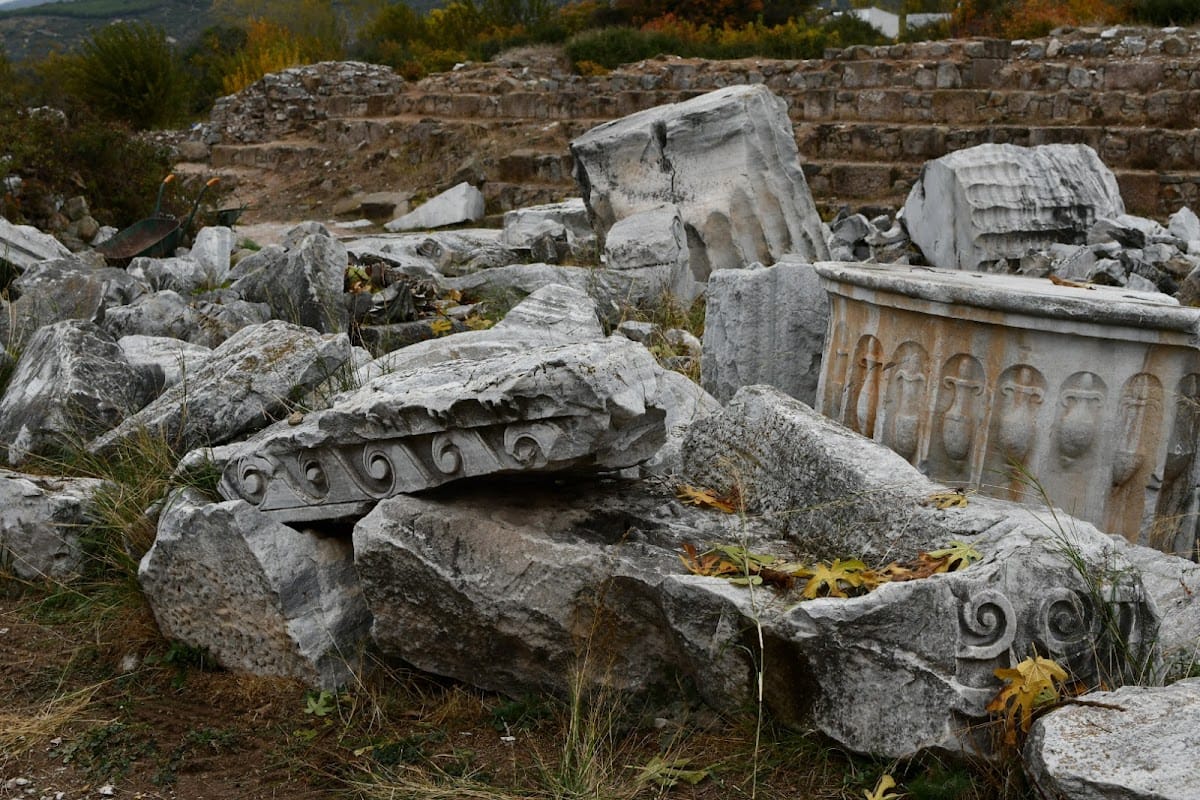
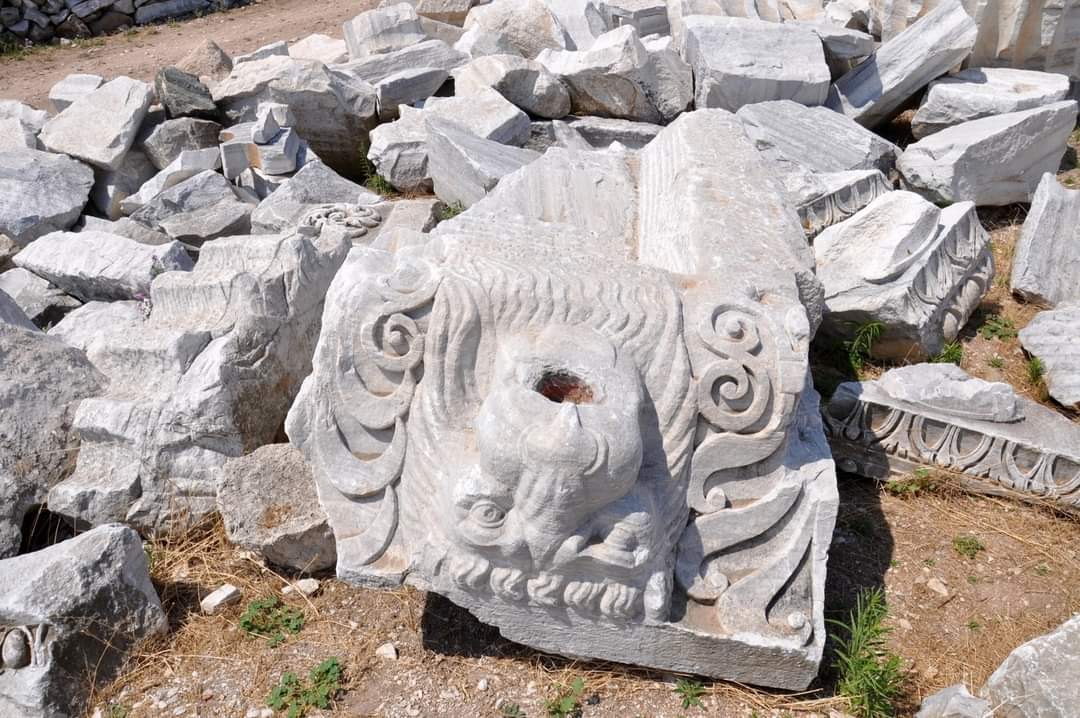
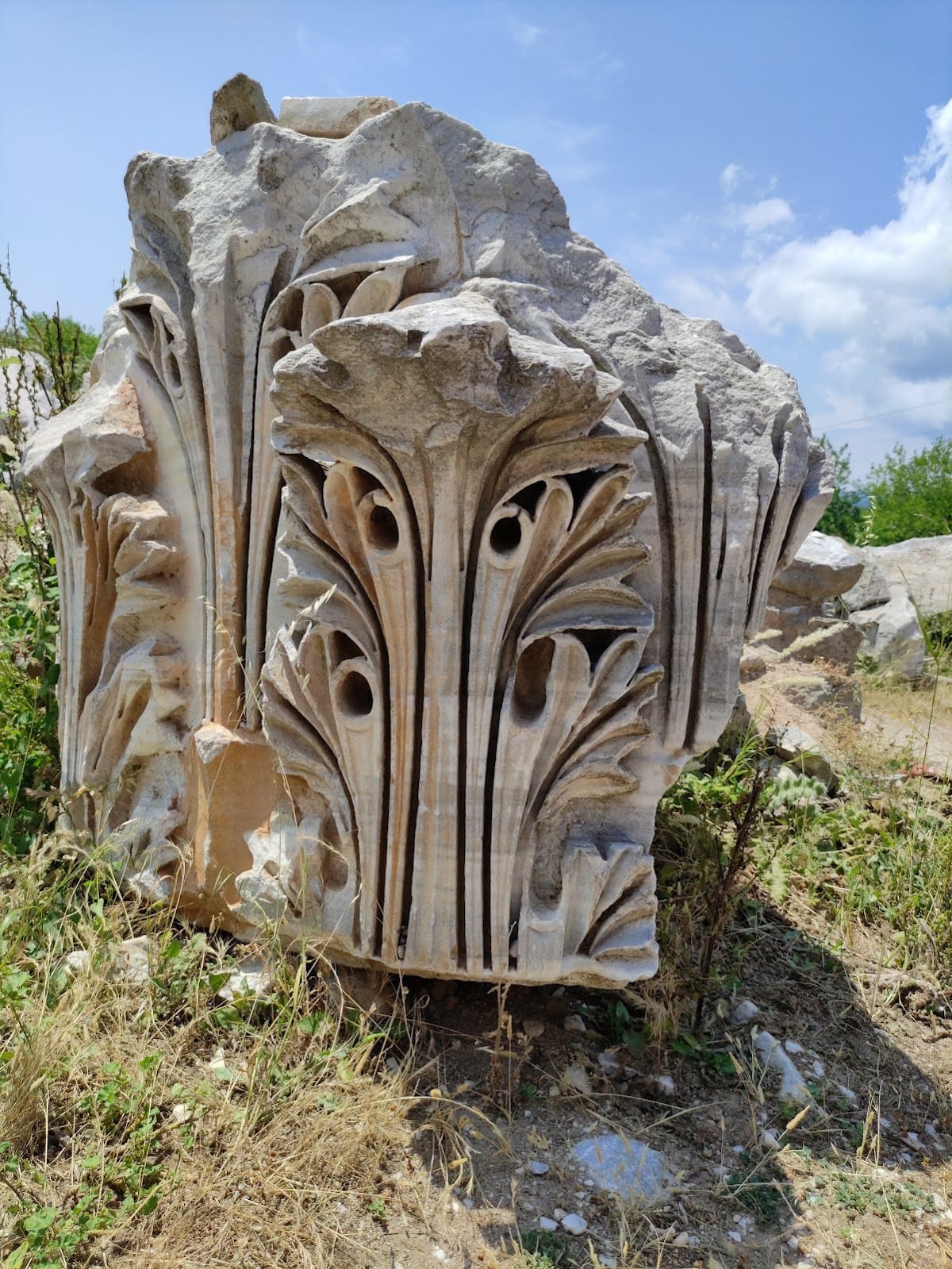
Kyzikos’ architecture prominently features extensive use of white marble sourced from the nearby island of Prokonnesos, alongside local granite of a friable variety. Over centuries, much of the marble was removed and repurposed in other construction projects, including Byzantine and Ottoman buildings. The surviving remains are scattered and fragmentary, reflecting the city’s historical expansion and contraction. The site includes civic, religious, and entertainment structures, many of which were quarried for building materials during later periods.
Key Buildings and Structures
Hadrian’s Temple
Constructed in the 2nd century CE near the city’s agora, the Temple of Hadrian was dedicated to Emperor Hadrian, honored as the 13th Olympian god. It was the largest Greco-Roman temple ever built, with columns approximately 21.35 meters (70 feet) tall, surpassing those of the Baalbek temple in Lebanon. In 1431, the Renaissance traveler Cyriacus of Ancona documented 33 standing columns and produced detailed drawings. Today, only the vaulted foundation supporting the temple remains visible, representing the most substantial ancient ruins at Kyzikos.
Temple of Athena
Kyzikos housed a temple dedicated to Athena, recognized as one of the earliest in Asia Minor. While literary sources attest to its existence, physical remains are limited, and no substantial structural fragments have been conclusively identified at the site.
Temple of Dindymene Meter (Cybele)
Located on the nearby Dindymon hill, this temple was devoted to Dindymene Meter, identified with the goddess Cybele. Tradition attributes its foundation to the Argonauts. Archaeological remains on the hill include foundations consistent with a religious structure, though detailed excavation reports are limited.
Temple with Golden Bands
Pliny the Elder describes a temple in Kyzikos where the joints between marble stones were inlaid with golden bands, creating a striking visual effect. No surviving architectural remains definitively correspond to this temple, but literary testimony confirms its historical existence.
Temple of Apollonikis
This temple, dedicated to Apollonikis, wife of Attalos I, is known from inscriptions collectively called the “Cyzicene epigrams.” Physical remains have not been conclusively identified, but epigraphic evidence confirms its presence within the city.
Roman Theatre
The Roman theatre, dating to the 1st century CE, is situated on the southwestern slope of a hill (approximate coordinates 40°23′32.1″N, 27°53′17.4″E). Its semicircular seating area remains partially preserved, revealing the typical layout of Roman theatres. The structure incorporates local stone and marble elements, though much of the superstructure has been lost.
Amphitheatre
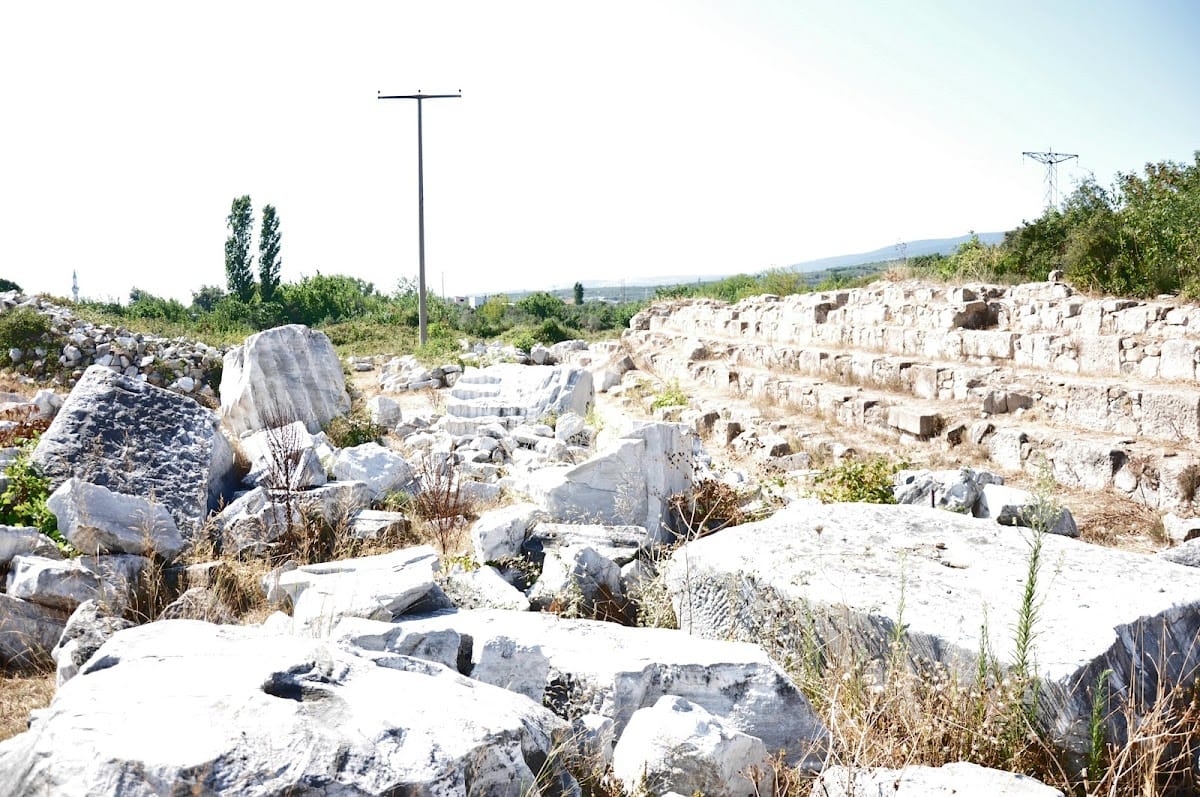
Located northwest of the theatre in a north-south oriented valley (approximate coordinates 40°23′53.7″N, 27°53′04.3″E), the amphitheatre was constructed beginning in the mid-1st century CE and continued until the late 3rd century CE. It is one of the largest known ancient amphitheatres, with a diameter near 150 meters (about 500 feet). The valley’s slopes facilitated seating construction along the long sides. Some relatively tall wall sections survive. A stream runs through the valley floor, suggesting possible use for mock naval battles (naumachiae), similar to the amphitheatre at Pergamon. By 1444, 31 massive columns still stood, but these were gradually removed for building materials.
Roman Aqueduct
Ruins of a Roman aqueduct are present at the site, though detailed descriptions and structural remains are limited. The aqueduct likely supplied water to the city during the imperial period, supporting urban infrastructure such as baths and fountains.
Agora and Associated Structures
Literary sources attest to an agora serving as the city’s central public space. Associated civic buildings included a prytaneion (council house) and a Doric-style stoa (columned hall). The prytaneion reportedly housed the “fugitivus lapis,” a stone said to be the anchor of the Argonauts’ ship Argo, fixed in place with a lead weight. Although no substantial architectural remains of these structures have been excavated, their historical presence is well documented in ancient texts.
City Walls
As noted, the city walls date primarily to around 410 BCE, constructed after Athenian capture. Later 4th-century CE walls are also traceable. Surviving fragments confirm the walls’ extent and defensive function. The walls were integral during the Mithridatic siege in 74 BCE, contributing to the city’s successful defense.
Other Remains
Additional architectural remains include scattered foundations and fragments of various buildings, many quarried for materials during Byzantine and Ottoman times. Surface traces of 4th-century CE city walls extend nearly their entire length. The site contains remains of a Roman aqueduct and a theatre. Marble and granite fragments are dispersed across the site, reflecting extensive reuse. The amphitheatre and Hadrian’s temple ruins were sources of building materials for Constantinople’s Hagia Sophia and other structures.
Archaeological Discoveries
Artifacts from Kyzikos span from the Orientalizing period (600–500 BCE) onward. Numerous funerary stelai with inscriptions, inscribed stones, and sculptures have been recovered. These finds are housed primarily in the Istanbul Archaeological Museum and the Erdek Museum. The inscriptions include dedicatory texts such as the “Cyzicene epigrams,” which reference local temples and notable figures.
Coins minted by Kyzikos, including its renowned gold staters (Kyzikēnoi), have been found, illustrating the city’s long-standing economic activity from the 6th century BCE through the Roman imperial period. These coins circulated widely across the Greek world. Other finds include ceramics, some dating to the Orientalizing period, and various domestic and religious objects, though detailed inventories are limited.
Preservation and Current Status
The ruins of Kyzikos are generally fragmentary and scattered over a broad area. The vaulted foundations of Hadrian’s temple remain the most substantial visible structure. The amphitheatre retains some tall wall sections, while the theatre’s semicircular seating area is partially preserved. City wall fragments survive but are incomplete. Many marble elements have been removed or repurposed over centuries, including for Byzantine and Ottoman construction projects.
The site is protected by the Turkish Ministry of Culture. Archaeological excavations have been limited relative to the city’s historical size and importance. Some areas have been stabilized but not fully restored. Environmental and human impacts, such as modern land use and quarrying, have affected preservation. The amphitheatre and theatre remain visible in the landscape and have been subject to surface study.
Unexcavated Areas
Large portions of Kyzikos remain unexcavated or poorly studied. Surface surveys and historical documentation indicate buried remains beneath alluvial deposits and modern agricultural land. No comprehensive geophysical surveys or extensive excavations have been reported. The site’s size and partial burial under alluvium limit excavation scope. Ongoing research continues under Turkish cultural heritage authorities, but detailed plans for future excavations have not been publicly disclosed.