Castle of Villarejo de Salvanés: A Historic Fortress in Spain



Visitor Information
Google Rating: 4.5
Popularity: Low
Official Website: turismovillarejodesalvanes.com
Country: Spain
Civilization: Unclassified
Site type: Military
Remains: Castle

History
The Castle of Villarejo de Salvanés stands in the town of Villarejo de Salvanés, Spain. While the exact date of its foundation remains unclear, the fortress is traditionally linked to Christian builders who likely erected it during the 13th century. This initiative aimed to reinforce control over the Tagus river basin after Christian advances in the region, replacing an earlier Muslim stronghold known as Alfariella or Alarilla, which had existed nearby in Fuentidueña de Tajo and was eventually destroyed.
Some studies suggest the castle may have even older roots, possibly occupying the site of a former Roman fortress, which points to a layered historical presence at this strategic location. Its position was critical, as it formed part of a defensive network that guarded key routes such as the medieval Toledo Road and the ancient Senda Galiana, a Roman road connecting Gaul and Hispania still used in the Middle Ages.
Throughout its history, the castle played various roles beyond military defense. It served as the seat for the Special Tribunal of the Military Orders, institutions charged with judicial and military authority during the medieval period. In the 19th century, the fortress gained renewed significance when it provided refuge to the guerrilla fighter known as El Empecinado, a figure notable for his resistance during the Peninsular War against Napoleonic forces. Additionally, it was the starting place of one of Juan Prim’s uprisings, though this attempt did not succeed.
Remains
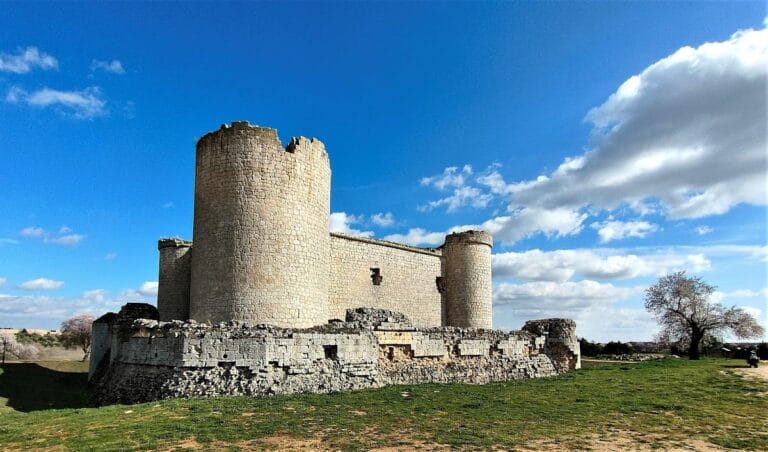
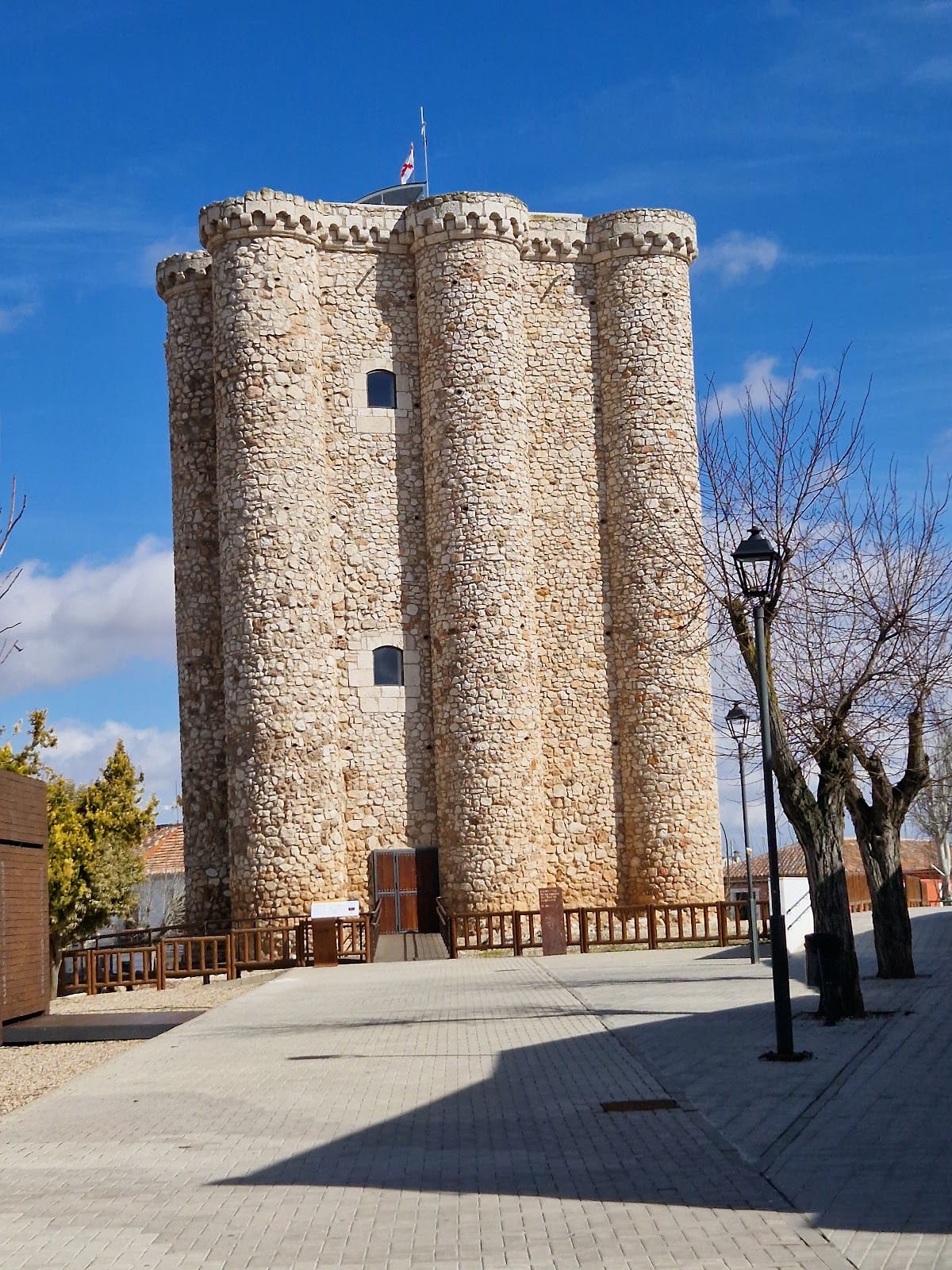
Today, only the castle’s main tower, known as the keep or tower of homage, survives. This structure offers a unique example of local medieval military architecture. It is built primarily of roughly hewn stone blocks, called sillarejo, held together with lime mortar, a traditional bonding material used in the region around Madrid and Toledo. The tower rises across four floors and features simulated machicolations—openings near the top once designed to allow defenders to drop projectiles on attackers—that frame the battlements.
One distinctive architectural detail is the arrangement of cylindrical turrets, or cubillos, along the sides of the tower. Unlike typical Spanish castles where turrets appear at the corners, here three turrets run along each side flanking the main structure, marking a rare and notable design choice in local castle construction. The tower’s limited openings include a few windows framed with carefully cut stone blocks, called ashlar, which provide structural strength and refined finishing.
A written description from 1575 highlighted the castle’s notable qualities for that era. It mentioned well-appointed living quarters featuring arches fashioned from cut stone and the presence of Genoese marble, suggesting both comfort and prestige within the fortress. The text also emphasized the tower’s impressive height, its defensive walkway known as an adarve, and the turrets built from a combination of lime mortar and rubble, reinforcing its robust military character.
Presently, the castle remains under municipal ownership and is part of the town’s designated Historic-Artistic Ensemble, along with the nearby Church of San Andrés and the Casa de la Tercia, reflecting its enduring cultural importance within Villarejo de Salvanés.
Nearby sites