Castle of la Muela: A Historic Fortress in Consuegra, Spain



Visitor Information
Google Rating: 4.6
Popularity: Medium
Google Maps: View on Google Maps
Official Website: www.consuegra.es
Country: Spain
Civilization: Unclassified
Remains: Military

History
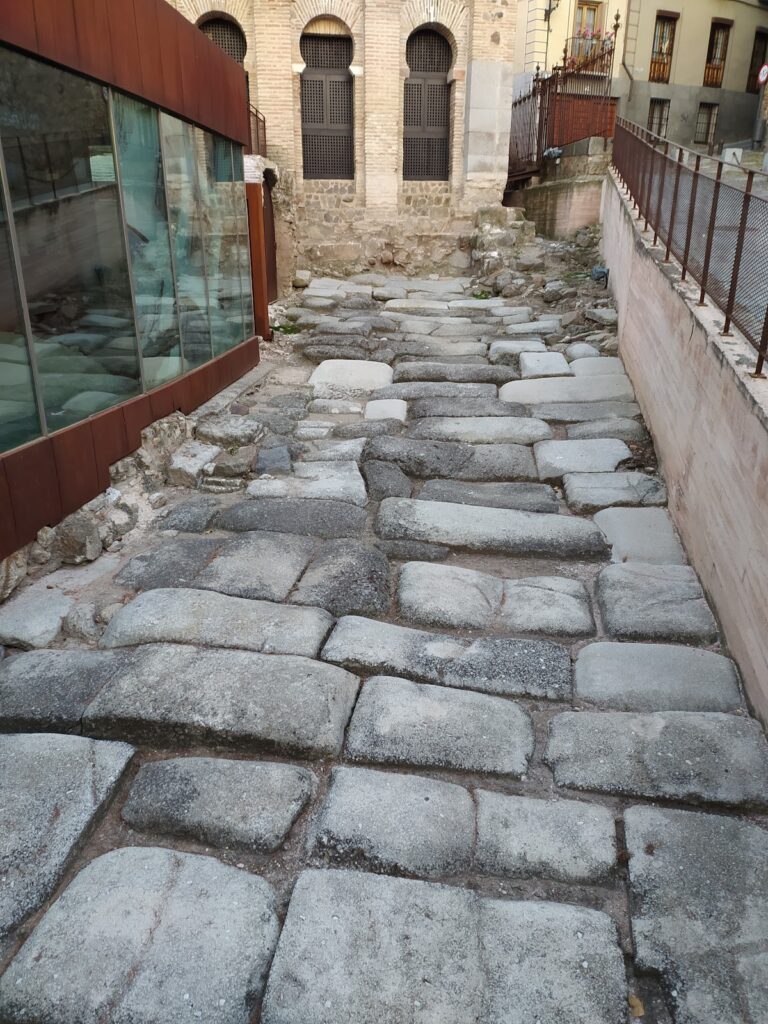
The Castle of la Muela stands on Cerro Calderico hill in the town of Consuegra, Spain. Its origins trace back to human settlement in the area as early as the 5th century BCE, evolving from an ancient site that later became the Roman town of Consabura in the 2nd century BCE. Under Roman influence, Consabura developed infrastructure including baths, defensive walls, an aqueduct, and a circus, demonstrating the area’s importance during that period.
During the 10th century, under the Caliphate of Córdoba, the initial fortification was likely established by Almanzor. This small castle served as a military stronghold within the region controlled by Muslim rulers. In 1097, the castle changed hands through a marriage alliance when the Muslim ruler al-Mu’tamid granted it as a gift to Alfonso VI of León. However, that same year the castle was lost following the Battle of Consuegra, where Almoravid forces defeated the Christian army and Diego Rodríguez, the son of the legendary El Cid, was killed.
Christian forces regained control of the castle in the 12th century. Under King Alfonso VII, the Knights Hospitaller, known as the Order of Saint John of Jerusalem, rebuilt and fortified the structure, making it their regional headquarters in 1183. Their influence shaped the castle into its medieval European form, reflecting the military and religious functions of the Order. By the 14th century, figures like Fernando Rodríguez de Valbuena served as prior, and the castle gained mention in contemporary romances that highlighted its strength and significance.
Following the completion of the Reconquista, the castle experienced a period of decline. Nevertheless, it regained political prominence in the 17th century when Juan José de Austria, serving as Grand Prior of the Order in Castile and later prime minister under King Carlos II, used the site in a leadership capacity. In the early 19th century, during the Napoleonic Wars, French forces occupied the castle between 1809 and 1813, inflicting severe damage upon their retreat.
The castle’s fortunes waned after the Mendizábal confiscations of 1836, a series of secular reforms that led to its abandonment. It suffered from neglect and destructive fires, gradually falling into ruin. In 1962, the local municipality purchased the property and began efforts to restore and preserve this historic fortress.
Remains
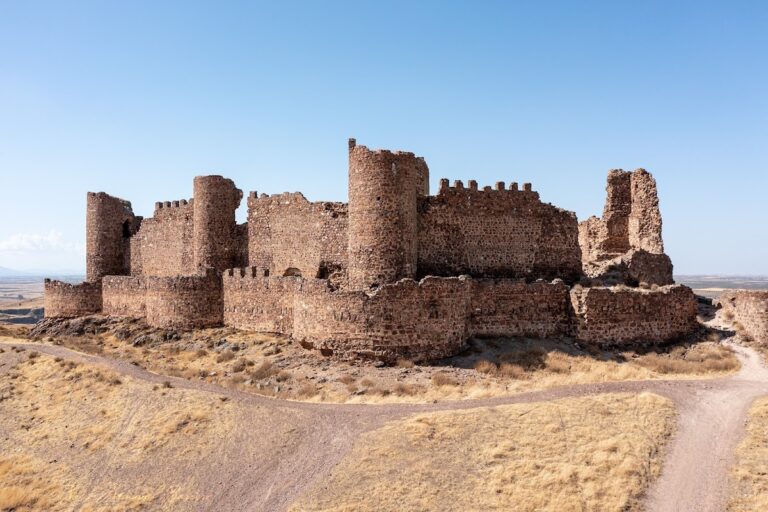
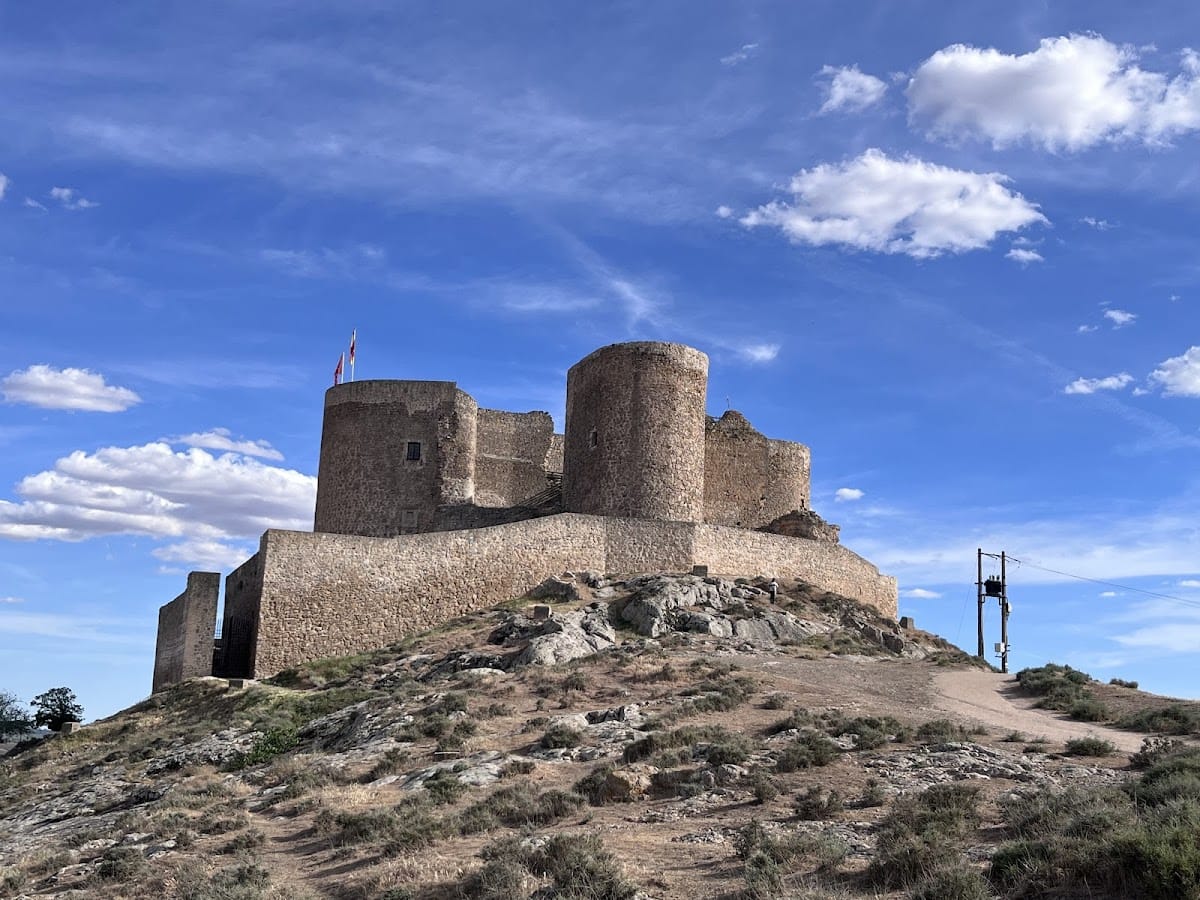
The Castle of la Muela presents an unusual architectural arrangement centered around a square core, with large cylindrical towers positioned at the midpoint of each side. This central body is enclosed by an irregular defensive wall, fragments of which survive mainly near the inner courtyard, offering glimpses into the castle’s original defensive design. The walls are primarily built from roughly hewn local stone using a masonry technique, incorporating an early form of concrete distinct from modern varieties.
Access to the castle occurs through a first defensive wall opening into a spacious area known as the “Centinela,” or sentinel’s courtyard. From here, one reaches the main gate, guarded by two cubic structures and adorned with the coats of arms belonging to Prior Juan José de Austria and the Álvarez de Toledo family, reflecting the site’s historical leadership ties.
Inside, visitors can find a vaulted cistern (aljibe) from the Arab period, approximately 8 meters long, 4.8 meters wide, and 5.4 meters high. This water reservoir was coated with a waterproof mixture combining red zinc and tin, allowing it to hold about 207,360 liters. The cistern’s preservation highlights its critical role in sustaining the castle’s inhabitants during sieges or dry seasons.
The castle’s interior stretches across three floors and contains rooms that served various functions, including kitchens, a chapter house where members of the Order met, and a chapel that was later deconsecrated. The chapel held significance as the place where knights of the Order of Saint John were formally invested. The castle once housed the Order’s archives, which were destroyed by French troops in 1813 during their occupation.
A distinctive defensive feature is the albarrana tower, a circular watchtower separated from the main walls on the southern side but linked by a raised walkway called an adarve, or chemin de ronde. Standing four stories tall, this tower was devised during the Arab period to launch attacks on besiegers and, if necessary, to be isolated to prevent enemy use.
Ongoing restoration has opened various parts of the castle for study and appreciation, including the restored chapel, cistern, battlements, chapter house, albarrana tower, terraces, and barbican. These efforts have gradually revived the castle’s austere medieval character, allowing the structure’s layered history to be observed in its architectural form.
Nearby sites