Castelo de Palmela: A Historic Castle in Portugal


Visitor Information
Google Rating: 4.7
Popularity: Medium
Google Maps: View on Google Maps
Official Website: www.cm-palmela.pt
Country: Portugal
Civilization: Medieval European
Remains: Military

History
The site of Castelo de Palmela, located in Palmela, Portugal, has been occupied since prehistoric times, with evidence of human presence dating back to the Neolithic period. Around 310 BCE, a fortified settlement was established here, marking the beginning of its strategic importance. In 106 CE, the Romans fortified the site under the direction of a Lusitanian praetor named Áulio Cornélio or Áulio Cornélio Palma, whose name is linked to the early development of the castle.
Between the 8th and 9th centuries, Muslim forces built the initial fortifications on the site. These were expanded significantly from the 10th to the 12th centuries, reflecting the castle’s role in controlling the surrounding territory. During the Christian Reconquista, Portuguese forces captured Palmela in 1147. The castle changed hands several times before being permanently taken in 1165. From 1186, the castle and its lands were granted to the Order of Santiago, which established its headquarters there before 1210.
The castle endured damage during Almohad attacks around 1190-1191 but was repaired and strengthened by Portuguese kings. Alfonso III confirmed the Order’s domains in 1255, and King Denis, reigning from 1279 to 1325, likely constructed the Gothic keep tower. During the 1383-1385 crisis, the castle served as a signaling point during the 1384 siege of Lisbon. King John I expanded and reinforced the castle in 1423 and founded a church and convent for the Order of Santiago, which settled there permanently from 1443.
In 1484, the castle was the site of a political conspiracy when Garcia de Meneses, bishop of Évora, was imprisoned and died in the castle’s cistern. King Manuel I granted a new charter to the town in 1512, reflecting its continued importance. During the War of Spanish Succession, King Peter II modernized the castle’s defenses with bastioned fortifications adapted for artillery use.
The 1755 earthquake caused serious damage to the castle, but it remained occupied by the Order of Santiago until their dissolution in 1834. Afterward, the castle housed a Portuguese Army garrison. Notably, the explorer Brito Capelo was born there in 1841. The castle was declared a National Monument in 1910 and underwent restoration and archaeological work during the 20th century. From 1945, the former convent buildings were converted into a pousada, a historic inn, and joined the Pousadas de Portugal network in the 1970s. The castle has also been used as a filming location for movies and television series in recent decades.
Remains
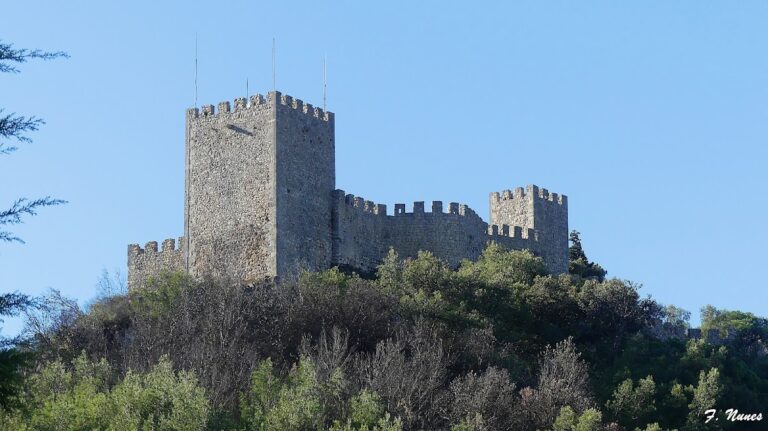
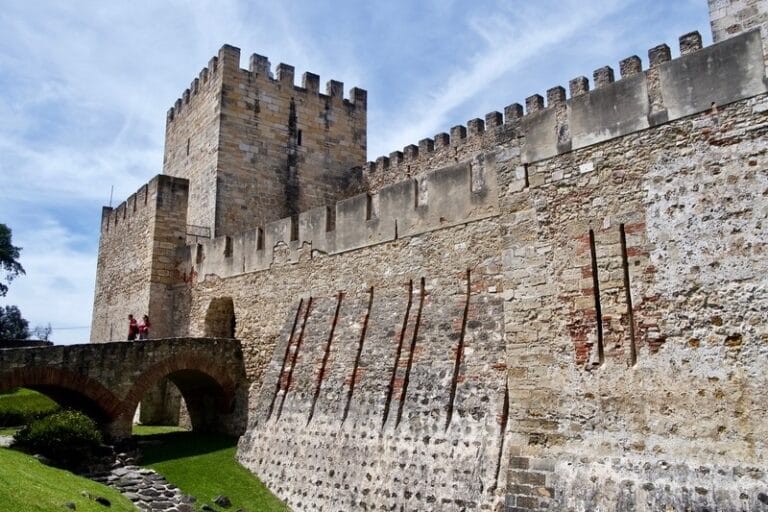
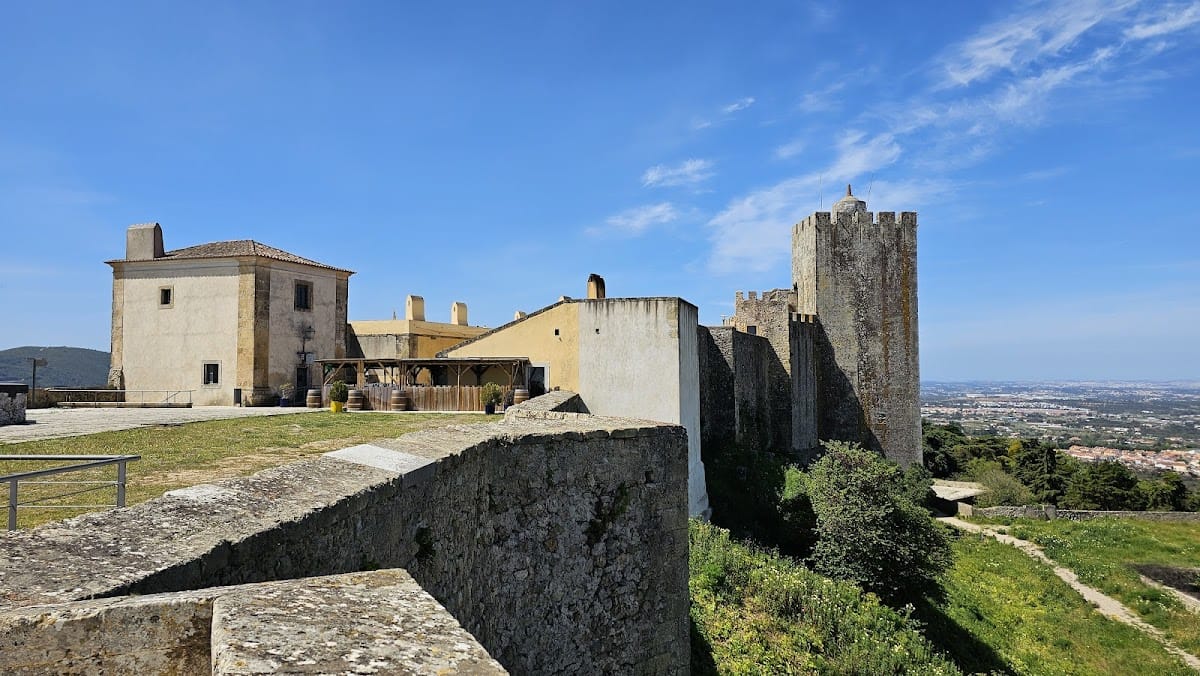
Castelo de Palmela occupies a hill at 240 meters above sea level on the eastern foothills of the Arrábida mountain range. Its layout follows an irregular polygonal plan that adapts to the natural terrain. The defensive walls are reinforced by both square and circular towers, forming three successive lines of fortification without moats.
The innermost line dates from the 12th and 13th centuries and includes the oldest walls supported by two cylindrical towers. The keep tower, part of this line, contains a cistern and was remodeled in the 14th century. This remodeling raised its height, added crenellations bearing initials, and included a stone staircase connecting multiple floors.
The middle line of walls was built in the 15th century and encloses the castle’s main square. Within this area stand the Church of Santa Maria, originally from the 12th century but rebuilt during the Renaissance, the convent, and the Gothic Church of Santiago de Palmela.
The outermost line dates from the 17th century and features bastions, ravelins, and tenailles—defensive structures designed to resist artillery attacks. These additions reflect the castle’s adaptation to evolving military technology.
Archaeological excavations in the late 20th century have uncovered parts of the castle that now serve as museum spaces, service areas, and commercial zones. The former convent buildings have been preserved and repurposed as a pousada since 1945, contributing to the site’s conservation. The castle’s walls, towers, and internal structures remain largely intact, showcasing centuries of architectural evolution.
Nearby sites