Archaeological Park Carranque: A Late Roman Villa Rustica in Spain


Visitor Information
Google Rating: 4.4
Popularity: Medium
Google Maps: View on Google Maps
Official Website: cultura.castillalamancha.es
Country: Spain
Civilization: Roman
Remains: City

History
The Archaeological Park Carranque is located in the municipality of Carranque, Spain. It preserves the remains of a late Roman villa rustica, a countryside estate reflecting the lifestyle and status of wealthy landowners during the declining years of the Western Roman Empire.
The site’s origins date back to around 400 CE when the villa was likely built by Materno Cinegio, believed to be the uncle of Emperor Theodosius I. This connection is supported by the presence of luxurious marble columns quarried from the eastern Mediterranean, suggesting imperial gifts and close ties between the owner and the emperor. The villa complex served both residential and administrative purposes, combining noble living quarters with spaces for civil representation. A small mausoleum served as the family burial place, underscoring the estate’s private and elite character.
With the fall of Roman authority and the establishment of the Visigothic Kingdom in the region, the palatial component of the villa underwent a significant transformation. The building was adapted for Christian worship, becoming a church that housed religious artifacts and became a burial site during this period. This change aligns with the broader Christianization of formerly Roman sites as well as the lasting use of the estate as a center of local importance.
Following the Christian conquest of Toledo, the complex entered a new phase in the Middle Ages. In 1142, King Alfonso VII granted the site monastery status. Over subsequent centuries, the property changed hands among various religious groups, including Benedictine monks, possibly the Knights Templar, and later the Clarissan order. By the 18th century, the monastic buildings had fallen into decline and ruin, marking the end of their active use.
Excavations beginning in 1985 have revealed extensive Roman structures and artifacts, confirming the villa’s richness and complexity. Beyond the main villa, the discovery of additional Roman remains such as mills, water conduits, and another nearby villa suggests that Carranque was part of a larger rural settlement or estate system along the Guadarrama River.
Remains
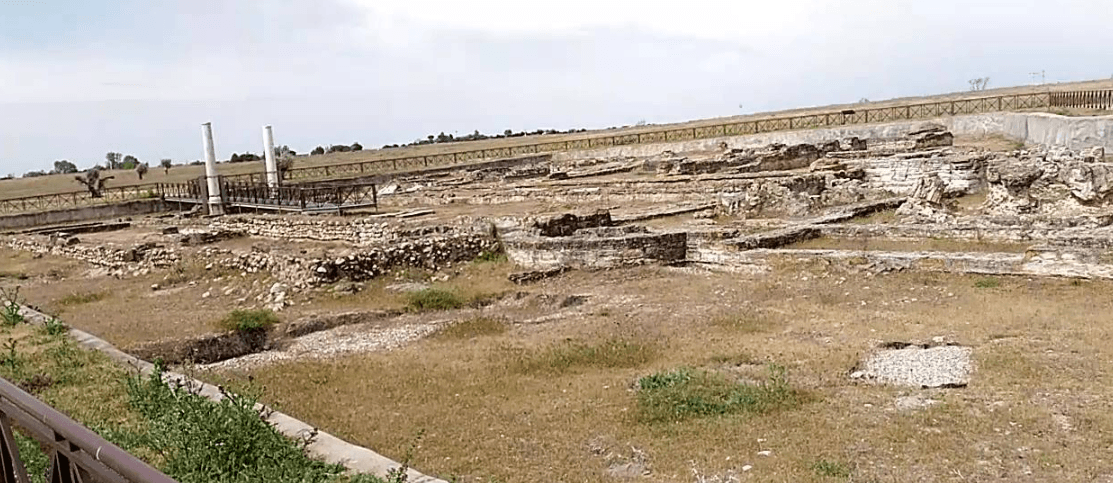
The Archaeological Park Carranque encompasses a remarkably well-preserved group of structures centered on a late Roman villa complex with distinctive Mediterranean architectural influences. The complex includes three main elements: a palatial building, a large residential villa, and a small funerary mausoleum, all constructed using advanced Roman techniques.
The palatial building, built around 400 CE, follows an unusual floor plan similar to southern Gallic governor palaces. Its walls and floors display exceptional decoration with 39 different types of marble sourced from across the Mediterranean, including Greece, Turkey, Egypt, and an Iberian stone from Estremoz. Four-meter-high marble columns from Greece and Turkey are among its most striking features. The vaulted ceilings were adorned with mosaics made from lightweight glass paste tesserae, while floors feature opus sectile—a decorative technique using fitted pieces of marble to create geometric and floral designs. Later, during the Visigothic period, this palatial building was converted into a Christian church, evidenced by numerous burials and religious artifacts found in the excavations. Today, visitors can observe the original floor plan, surviving columns, and tombs ranging from the Visigothic era through the Middle Ages.
The mausoleum is a small square structure attached to the villa complex, constructed using opus caementicium (a Roman concrete) and opus testaceum (brickwork). It features thick walls, approximately two meters wide, supported externally by granite columns affixed to the surface. Inside, niches likely housed statues or funeral urns, and a fragment of a mosaic floor remains visible. The roof combined a barrel vault over the main square section with a quarter dome over the semicircular apse, where the marble sarcophagus of the villa owner was placed.
The Villa of Materno stands as a large residential building roughly 40 meters on each side, enclosing about 1,600 square meters. Accessed through a portico supported by brick columns and flanked by two square towers, it contains approximately twenty rooms with diverse functions. Highlights include a circular entrance hall, a central courtyard or peristyle surrounded by brick columns, a hexagonal oecus or reception room with a semicircular apse and fountain, and octagonal chambers thought to have served as libraries. The dining room, or triclinium, is rectangular and includes an exedra, a semicircular recess on a raised platform. Private quarters feature multiple bedrooms, including Materno’s cubiculum (bedroom) with an antechamber. Service areas and a cellar supported the villa’s operations. The noble portions were heated by a hypocaust system, where hot air circulated beneath floors and exited through ceramic pipes. The villa also included running water and a drainage network.
Interior decoration was rich and varied, with floors covered by mosaics depicting geometric shapes, flowers, and figurative scenes, while walls were finished with painted stucco in geometric and vegetation motifs. Among the painted decorations is an image of a small bird.
To the agricultural east of the residential compound lay facilities for processing olive oil and wine. A square room with a pressing installation, likely a beam press, adjoined a paved chamber with two basins for decanting olive oil. Nearby, a separate building had a grape treading floor (called a calcatoria) and basins (lacus) to collect grape must. Later in the 4th century, viniculture ceased, and some wine-making structures were converted to olive pressing tools called trapeta, featuring a floor of fired clay tiles (tabulatum) to facilitate olive grinding.
Situated near the villa on the left bank of the Guadarrama River within the La Sacristana stream, remains from a much later period include hydraulic mills. These structures comprised mill wheels, a dam, and an aqueduct supplying water to power the mills, which remained operational until the mid-19th century.
Today, the site is partially protected by a large metal canopy designed to shield the fragile archaeological remains from weathering. The preserved ruins allow visitors and scholars to explore the remains of one of the most sumptuous rural estates of late Roman Hispania, reflecting the region’s transition through Roman, Visigothic, and medieval Christian phases.
Nearby sites