Stobi: An Ancient Urban and Religious Center in North Macedonia
Table of Contents



Visitor Information
Google Rating: 4.7
Popularity: Low
Google Maps: View on Google Maps
Official Website: www.stobi.mk
Country: North Macedonia
Civilization: Byzantine, Greek, Roman
Remains: City

Context
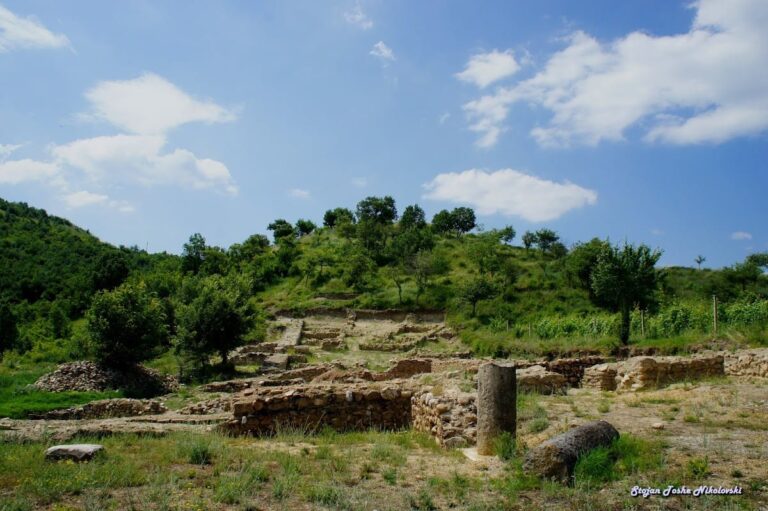
The archaeological site of Stobi is situated near the contemporary village of Gracka in North Macedonia, positioned at the strategic confluence of the Crna (Erigon) and Vardar (Axios) rivers. This location on a low alluvial plain connects several central Macedonian valleys, facilitating communication and movement across the central Balkans.
Archaeological stratigraphy at Stobi reveals continuous occupation from the Iron Age through Late Antiquity. Initial settlement layers correspond to a Paeonian community, succeeded by material culture reflecting Hellenistic influence. Roman urban development is evident from the late Republic through the Imperial period, with substantial expansion in Late Antiquity. The site also served as an episcopal center during the early Christian era. Excavations have documented destruction layers and diminished habitation in the seventh century, correlating with historical accounts of Slavic and Avar incursions in the region.
Systematic archaeological investigations commenced in the early twentieth century, with major campaigns led by Yugoslav institutions during the mid-century. These efforts uncovered extensive mosaics, inscriptions, and stratified occupation sequences. Conservation initiatives have established Stobi as an open-air archaeological park with an on-site museum. The site remains protected under national heritage legislation, and ongoing research continues to refine its chronological framework and historical interpretation.
History
Stobi’s historical trajectory reflects its strategic position at the confluence of two major rivers and the intersection of significant Roman roads. Originating as a Paeonian settlement, it evolved through Hellenistic influence into a prominent city under Roman administration. Elevated to municipium status and later serving as the capital of the province Macedonia Salutaris, Stobi flourished during the Roman Imperial and Late Antique periods as a religious and administrative hub. Its decline resulted from successive invasions, seismic events, and shifting political dynamics, culminating in abandonment by the early medieval era.
Paeonian and Hellenistic Period (Archaic period – 2nd century BCE)
Stobi was initially established as a Paeonian settlement during the Archaic period, occupying a terrace overlooking the confluence of the Erigon (Crna) and Axios (Vardar) rivers. The surrounding fertile alluvial soils and proximity to Mount Klepa, a source of high-quality marble, supported agricultural production and artisanal activities. The original Paeonian inhabitants were later joined by immigrant groups, particularly following the Macedonian expansion under Philip V in the late 3rd century BCE. In 217 BCE, Philip V annexed Paionia, incorporating Stobi into the Macedonian realm during campaigns against the Dardani. The earliest literary reference to Stobi appears in Livy’s account of a battle near the town in 197 BCE, confirming its regional strategic importance.
Archaeological evidence from this period includes cremation burials beneath later Roman structures, with ashes contained in various grave forms, and bronze statuettes dating to archaic and classical phases. These findings indicate continuous occupation and cultural development, reflecting a community engaged in established funerary customs and artisanal production. While no formal marketplace or monumental architecture from this period survives, the settlement functioned as a local agricultural and resource center within the broader Paeonian and Macedonian spheres.
Roman Conquest and Administration (2nd century BCE – 3rd century AD)
Following Rome’s decisive victory over King Perseus in 168 BCE, Macedonia was initially divided into four republics before being unified as a Roman province in 148 BCE. Under Roman rule, Stobi experienced significant growth, attaining municipium status by 69 BCE, as attested by coinage inscribed “Municipium Stobensium.” Its inhabitants were granted Roman citizenship with Ius Italicum privileges and were enrolled primarily in the Roman tribes Aemilia and Tromentina, reflecting formal integration into imperial administrative structures. Stobi functioned as the capital of the province Macedonia Salutaris.
Strategically located at the crossroads of the Via Egnatia and Via Militaris, Stobi became a vital node for trade and communication linking the Danube frontier with the Aegean coast. The city minted its own coins from the reign of Emperor Vespasian (69–79 CE) through Emperor Elagabalus (218–222 CE), indicating sustained economic vitality. Architectural developments from this period include a large theatre, constructed in phases from the late 1st century CE and completed by the mid-2nd century CE, with a seating capacity estimated at 7,600. Defensive walls, water supply infrastructure, a synagogue, the Casa Romana residence, and the monumental “Building with Arches” (Roman Forum) further attest to urban sophistication. The city suffered destruction in the late 3rd century CE, likely due to Gothic and Heruli incursions around 267–269 CE, possibly compounded by seismic activity.
Imperial Roman and Late Antique Period (4th – 6th centuries AD)
During the 4th and 5th centuries CE, Stobi underwent extensive reconstruction and expansion, reaching its maximum urban extent with fortifications enclosing approximately 27 hectares. A new eastern defensive wall was erected around the turn of the 5th century CE, incorporating earlier structures such as the Building with Arches and reusing marble seats from the theatre within its towers. The fortifications included fourteen rectangular towers and at least two gates, notably the Porta Heraclea (also known as Porta Sacra), which integrated theatre seating into its defensive architecture.
Stobi emerged as a significant Christian center during this period. Its first known bishop, Budius, participated in the Council of Nicaea in 325 CE. The Old Episcopal Basilica, dating to the 4th century CE and possibly commissioned by Budius, represents the earliest known Christian church in the region. Under Bishop Philip in the late 4th and early 5th centuries CE, the basilica was expanded into a monumental two-story structure adorned with mosaics, frescoes, and a baptistery featuring symbolic iconography such as peacock mosaics referencing Psalm 42. Emperor Theodosius I resided in Stobi in 388 CE, issuing edicts against heretical groups; his residence, the so-called Palace of Theodosius, featured luxurious marble floors and mosaics.
Additional Late Antique structures include large residential complexes with mosaic floors and baths equipped with hypocaust heating systems, such as the House of Peristeria and the House of Polycharmos. The Jewish community maintained a synagogue dating from the 3rd or 4th century CE, built atop an earlier 2nd-century synagogue founded by Tiberius Claudius Polycharmos, a prominent Jewish citizen. The city’s street network connected civic, religious, and residential zones, supported by fountains and drainage systems. Stobi functioned as a bishopric and possibly a metropolitan center, with its clergy participating in ecclesiastical councils until the 7th century CE.
Decline and Destruction (5th – 6th centuries AD)
Stobi’s decline commenced with the Hunnic invasions of 447 CE, evidenced archaeologically by layers of fire damage and weaponry. The city was subsequently sacked by Theodoric and the Ostrogoths in 479 CE but underwent partial reconstruction. A major earthquake in 518 CE inflicted further damage on the urban infrastructure. The 6th century CE saw devastating Avaro-Slavic incursions that severely disrupted Stobi’s economy and urban fabric, leading to the cessation of its urban functions.
By the medieval period, many basilicas and public buildings lay in ruins or were repurposed, with some serving as cemeteries containing graves dating from the 9th to 14th centuries CE. These graves include Slavic burials accompanied by artifacts such as silver coins from Serbian and Venetian rulers, indicating continuity of local populations in a ruralized context. The theatre was abandoned by the late 4th century CE and later quarried for building materials used in fortifications and ecclesiastical structures.
Modern Rediscovery and Excavation (20th century – present)
Systematic archaeological exploration of Stobi began in 1924 under the auspices of the Museum of Belgrade, revealing public and private buildings, the theatre, and religious artifacts. Excavations proceeded intermittently until 1940, uncovering late Hellenistic graves and Slavic burials. Major campaigns from 1970 to 1980, conducted by Yugoslav and American teams, exposed mosaics, the Episcopal Basilica, aqueduct networks, and numerous residential and public structures. The theatre has been subject to ongoing excavation since 1924, with renewed efforts from 2009 focusing on comprehensive excavation, conservation, and partial reconstruction.
The Episcopal Basilica underwent multiple excavation phases, revealing two construction stages and rich decorative programs including mosaics and frescoes. Other significant discoveries include the Domus Fulonica, the Palace of Theodosius, the House of Peristeria, the synagogue basilica, and extensive fortification walls. Epigraphic finds include a funerary inscription from the 2nd or 3rd century CE mentioning the ethnonym “Albanos,” and a well-preserved marble head of Emperor Augustus discovered in 2009. These findings contribute to a nuanced understanding of Stobi’s religious, cultural, and administrative history. The site remains protected under national heritage legislation, with ongoing research refining its chronology and historical narrative.
Remains
Architectural Features
Stobi’s archaeological remains encompass approximately 27 hectares, enclosed by city walls initially constructed in the 1st century CE. The fortifications include an eastern wall roughly 450 meters in length, situated near the Crna River, and later defensive walls erected in the late 4th or early 5th century CE. These later fortifications incorporated earlier structures such as the Building with Arches and reused marble seats from the theatre within their towers. The walls feature rectangular towers and gates, including the southern Porta Heraclea, with evidence of multiple construction phases and repairs. The urban layout reveals distinct civic, religious, residential, and economic zones interconnected by paved streets such as the Via Sacra and Via Principalis Superior and Inferior.
Construction techniques at Stobi include ashlar masonry combining tile and stone, opus sectile floors composed of colored marble slabs, and hypocaust heating systems within bath complexes. Many buildings exhibit mosaic and fresco decoration, with some walls painted in geometric and figurative motifs. The urban fabric reflects phases of expansion and contraction, with Late Antique fortifications enclosing the city’s largest extent. Post-6th century, many structures fell into ruin or were repurposed, with some areas converted into cemeteries during the medieval period.
Key Buildings and Structures
Theatre
Located at the southern edge of Stobi, the theatre was constructed in three principal phases spanning from the late 1st century CE to the late 3rd century CE. The initial phase remained unfinished, while the second phase in the mid-2nd century CE introduced a revised architectural design. Following earthquake damage at the end of the 3rd century CE, repairs included the addition of walls flanking the scene-building, which rose approximately 13 meters and was adorned with pink marble columns arranged on two levels.
The cavea (seating area) comprises 33 to 35 rows divided by a central walkway (diazoma) into two zones. Marble seats bear inscriptions naming families and individuals who frequented the theatre. Originally, front-row spectators were protected by a net barrier, later replaced by a wall that obscured the first rows. The parodoi (side entrances) were gated, separating the orchestra from the entrances. A wall erected before the scene-building enclosed a central room converted into a shrine dedicated to Nemesis. The theatre was abandoned by the late 4th century CE and subsequently used as a quarry and dumping ground. By the 6th century CE, modest houses were constructed atop the theatre’s remains. Excavations began in 1924 and have continued intermittently, with systematic efforts since 2009 focusing on excavation, conservation, and partial reconstruction.
Episcopal Basilica
Situated west of the theatre, the Episcopal Basilica is the most prominent Christian edifice at Stobi. It was constructed in two main phases: the original basilica dates to the first half or middle of the 4th century CE, possibly commissioned by Bishop Budius, a participant in the Council of Nicaea in 325 CE. The basilica features a three-aisled plan with a central nave separated by colonnades. In the late 4th century CE, the building was expanded eastward with reconstructed walls.
The basilica’s mosaic floors are divided into three zones, including an inscription naming Bishop Eusthatius as commissioner of a reconstruction phase. Frescoes on the north and south walls depict geometric patterns, animals, and saints, representing some of the best-preserved early Christian wall paintings in Macedonia. The second phase, constructed in the first half of the 5th century CE under Bishop Philip, added a monumental two-story basilica incorporating many marble seats and columns recycled from the theatre. The atrium, accessed from the Via Sacra, leads to a narthex divided into three zones by pairs of columns, with frescoed walls and mosaic floors featuring animal and geometric motifs.
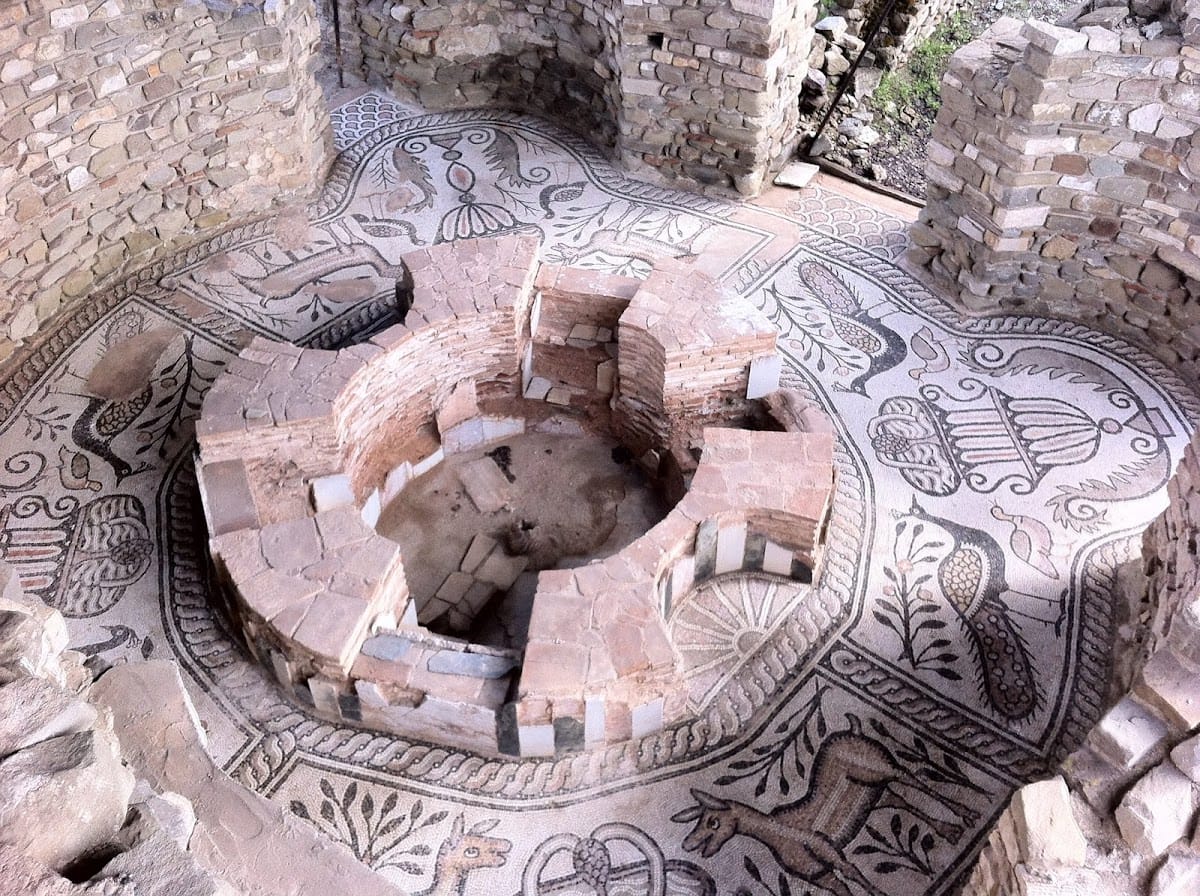
The nave combines marble tile floors with mosaics and sandstone slabs. The altar screen is decorated with relief crosses, and the eastern end has a double apse with a crypt beneath the inner apse. The southern and eastern aisles contain frescoed walls, with the southern aisle featuring two mosaic floors, one interrupted by a tomb foundation, possibly that of a bishop. South of the basilica lies a baptistery with a quatrefoil plan and dome. It contains a central piscina with steps and a mosaic floor depicting peacocks and deer flanking kantharoi, referencing Psalm 42. The baptistery walls bear frescoes of saints, and a marble kantharos was added atop the piscina in the early 6th century CE. The basilica was destroyed after 569–570 CE, as indicated by a coin found beneath its ruins.
Via Sacra
The Via Sacra is a sacred street approximately 75 meters in length, extending from the Porta Heraclea gate to the Episcopal Basilica. It is paved with sandstone slabs and flanked on both sides by colonnades with arcades. The columns rest on a stylobate constructed from marble seats repurposed from the theatre. The street terminates in a semicircular court surrounded by columns and small rooms interpreted as workshops. Within this court stands a pedestal for an equestrian statue, possibly representing Emperor Theodosius I. Although the street is not fully excavated, archaeological evidence indicates it was reconstructed at the beginning of the 5th century CE.
Domus Fulonica (House of GR)
Located on Via Principalis Superior opposite the Episcopal Residence, this building was initially identified as a textile workshop due to the discovery of shells and spindle whorls in 1934. Subsequent research reinterpreted it as a private residence with two construction phases dating to the late 3rd and late 4th centuries CE. The 4th-century structure features a peristyle surrounded by twelve columns with a central well and an apsidal hall containing four niches that once held sculptures. Beneath the house, Hellenistic graves with cremated remains were uncovered. The building was destroyed in the 5th century CE, possibly during Hunnic attacks, as indicated by nomadic weapons found on site. Some scholars propose renaming the building “House of GR” based on a ring inscription discovered there.
Episcopal Residence (Casino)
The Episcopal Residence, known as the Casino, lies north of the theatre and was excavated in several campaigns between 1939 and 2009. Constructed toward the end of the 4th century CE, it contains numerous rooms with mosaic and marble tile floors. The residence includes a bath with a hypocaust heating system and two small pools, as well as a unique latrine toilet seat. The western end features a peristyle with a pool. Christian symbols and frescoes of saints found within suggest it served as the bishops’ residence. The building is connected to the Episcopal Basilica by the Via Episcopalis, a street paved with marble seats from the theatre. In the 6th century CE, the residence was rearranged with new dwellings incorporating older walls.
Theodosian Palace
Located centrally between Via Principalis Inferior and Via Principalis Superior, the Theodosian Palace is named after Emperor Theodosius I, who stayed there in 388 CE. The complex is divided into two parts: the southern section, called the House of Parthenius after a seal inscription, and the northern section, which contains mosaic-floored rooms arranged around an open peristyle courtyard. The peristyle and corridors have mosaic floors, and the eastern end includes a pool fenced with pink marble parapet blocks, niches, and marble bases that once supported sculptures.
Bronze statues of satyrs, Apollo, Aphrodite, and Lar, along with a marble head of Serapis dating to the 2nd century BCE, were found in the pool. The southern part contains a smaller peristyle with mosaic-floored rooms, including a storage room with ten large storage jars (pithoi). Two vaulted chambers southeast of the palace, called the “Prison” due to human remains found there, likely served as cellars or economic facilities. The palace was destroyed in the 5th century CE, and its walls were later incorporated into poorer houses built in the 6th century.
House of Peristeria
This large residential and economic complex is situated centrally within Stobi and is surrounded by streets on all sides. Excavations mainly conducted in 1933–34, with additional work in later decades, revealed a building with multiple rooms serving both residential and economic functions. The southeast half is residential, featuring a peristyle with sandstone slab flooring and columns, two triclinia (dining rooms), a bath, and an open courtyard. The peristyle includes a pool fenced with slabs, into which a grave stela from the 2nd or 3rd century CE with a family relief is embedded.
The western triclinium has a sandstone slab floor, while the eastern triclinium contains a mosaic floor with Christian symbolism and an inscription naming members of the Peristeria family. The complex dates primarily to the early 5th century CE, based on mosaic styles. The northwest half served economic purposes, with numerous small rooms arranged around two courtyards, including a pottery kiln and large quantities of pottery debris. Beneath the open courtyard, walls from the 1st–2nd centuries CE and graves from the 3rd–2nd centuries BCE were discovered.
Public Fountain
The Public Fountain is located at the southeast corner of the House of Peristeria and was constructed in Late Antiquity using spolia from earlier buildings. Water was supplied through a covered channel beneath Via Principalis Inferior, which also fed the Large Bath. The fountain’s water was collected in a long reservoir with several pipes before flowing into troughs for public use.
Large Bath (Magnae Thermae)
Opposite the House of Peristeria and across Via Principalis Inferior lies the Large Bath complex, excavated in 1931–32 and conserved in 1960. The main entrance is from Via Axia. The largest room is the apoditerium (dressing room) on the western side, lined with stone benches and divided by an arcade. Beneath its floor, a colonnade and two early 3rd-century sculptures were found, including one of Venus with a dolphin and another depicting an honorable citizen.
The bath includes a frigidarium (cold water room) and a caldarium (hot air room) with an apse and five fireplaces (praefurnia). Inside the caldarium are smaller baths with hot or warm water, heated by a preserved hypocaust system (underfloor heating). Water was supplied to the caldarium via a water line supported by an arcade. North of the caldarium are an open courtyard and a latrine with a drainage channel. Another frigidarium with semicircular pools lies east of the caldarium but lacks heating. The bath complex was built at the end of the 3rd century CE.
Via Axia
Via Axia is an east-west oriented street running between the Large Bath and the Palace of Polycharmos. It passes near the House of Peristeria and extends westward toward the defensive wall. A drainage channel covered with sandstone slabs runs near the House of Peristeria along this street.
House of Polycharmos (House of Psalms)
Adjacent to the Synagogue Basilica and sharing its south wall, the House of Polycharmos was excavated mainly in 1931–33 and conserved in the 1960s and 1970s. The main entrance is via a porticus on the south side, leading to rooms arranged around a central peristyle with eight columns, containing a pool and a well. Mosaic floors in the corridors display geometric motifs. An apsidal room or triclinium includes a fountain and a mosaic floor illustrating Psalm 42, depicting two fawns separated by a kantharos with flowing water.
The western side of the house has stairs indicating a second floor. Named after Tiberius Claudius Polycharmos, a prominent Jewish citizen who built the synagogue and his house in the 2nd century CE, the building was used by Christians in the 5th century CE when mosaics were added. In the 6th century CE, modest houses were constructed atop the site, reusing older walls. Floors from this period were made of beaten earth, and storage vessels were dug into the western floor.
Synagogue Basilica
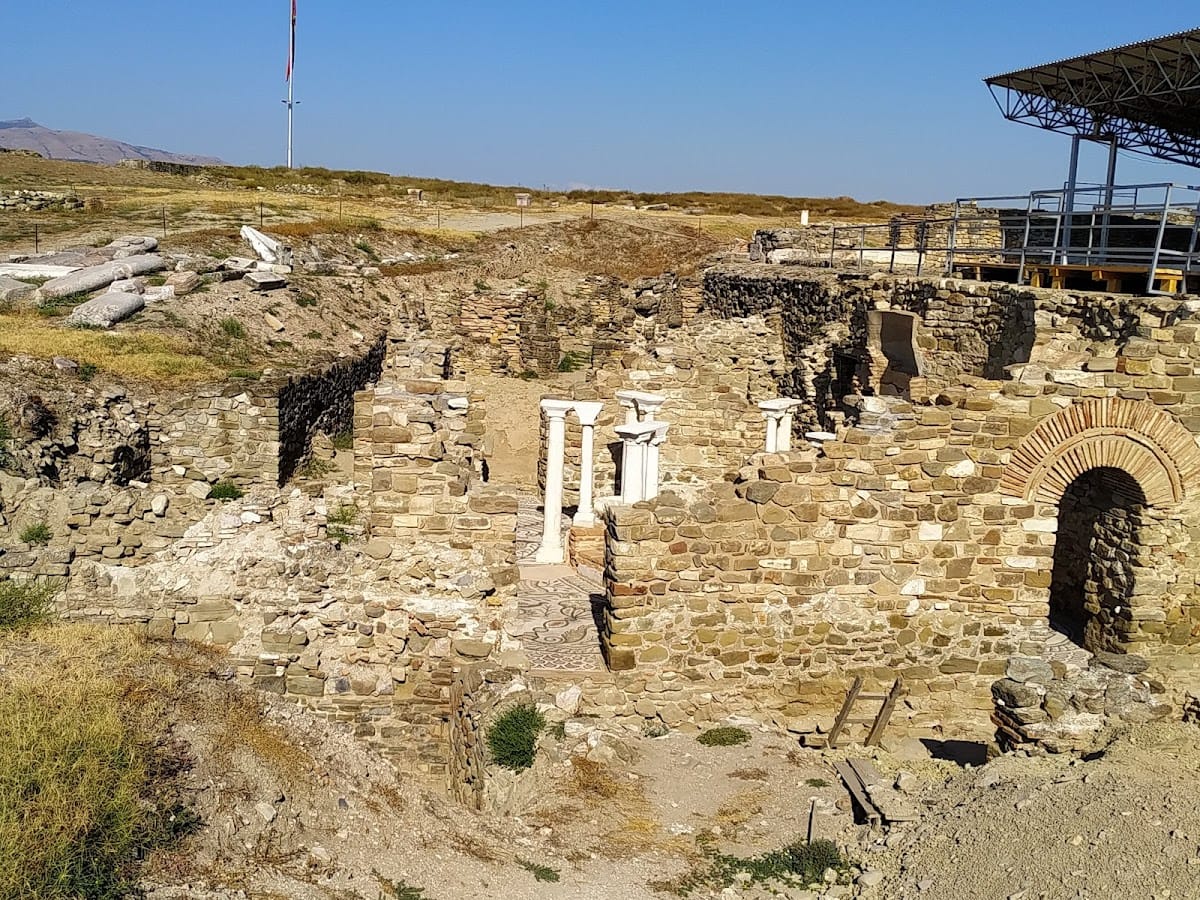
The Synagogue Basilica, located south of the Civil Basilica, was built over two earlier synagogues and excavated in 1931 and 1970–74. It is an early Christian basilica with three aisles separated by colonnades. The western atrium is accessed from Via Principalis Inferior, and the narthex lies to the east of the atrium. Southern rooms connect the basilica to the House of Polycharmos. The floor consists of tiles and sandstone slabs, and the altar contained a reliquary with a cross-shaped opening. The basilica was constructed at the end of the 4th or beginning of the 5th century CE.
Excavations uncovered an inscribed column revealing that Claudius Tiberius Polycharmos donated parts of his house for the synagogue. Beneath the basilica floor lie two earlier synagogues: Synagogue II, dating to the late 3rd or early 4th century CE, with mosaic floors featuring geometric motifs; and Synagogue I, from the 2nd century CE, with walls bearing inscriptions dedicated to Polycharmos. A marble plate credits Alexander phrontistes with rebuilding the porch at the end of the 3rd or early 4th century CE. Hellenistic building remains and a coin hoard dated 211–125 BCE were found beneath the narthex.
Small Bath
Near the apse of the Synagogue Basilica lies the Small Bath, excavated in 1931 and 1963 with limited documentation. The eastern part of the bath is lower than the western side due to disturbed soil, likely from an earthquake. The north half contains a large room with a sandstone slab floor identified as the apoditerium (dressing room). To the west of the apoditerium is an apsidal room, probably the frigidarium (cold water room). The south side includes three apsidal rooms: a tepidarium (warm room) with a small pool and two heated rooms with hypocaust heating systems. A fireplace lies beneath the third apsidal room, accessible from the apoditerium. Two rooms east of the dressing room include one with a drainage channel, likely a latrine. The bath dates broadly from the 4th to 6th centuries CE.
Civil Basilica
The Civil Basilica is located between the North Basilica and the Synagogue Basilica. It has a three-aisled architectural layout but lacks Christian elements. Excavations conducted in several campaigns from 1937 to 2005 identified seven building phases, with the latest phase being non-sacred. Bronze objects from the 5th century BCE were found below the apse, and a wall with a painted wild duck from the 1st century CE was uncovered beneath the central aisle. Hellenistic layers from the 3rd and 2nd centuries BCE were also documented. A medieval cemetery from the North Basilica area extended into the Civil Basilica, with 18 graves dated to the 11th–13th centuries CE.
North Basilica
Discovered in 1937 and excavated again in 1955, the North Basilica is one of three Early Christian churches in Stobi featuring a baptistery. Located in the northern part of the town, it has three aisles and an open atrium on the western side, accessed from Via Principalis Inferior by steps. The atrium floor is paved with sandstone slabs and contains a small marble pool with a three-partite niche above. The nave floor is tiled, and the aisles are separated by colonnades founded on a stylobate made from theatre marble seats. The baptistery on the north side has a hexagonal piscina and is accessed from a small rectangular room with a mosaic floor (catechumenion) connected to the atrium. The mosaic is divided into eight squares depicting birds and a kantharos. The basilica was built in the late 5th or early 6th century CE and was later used as a cemetery during the Middle Ages, with 23 graves dated to the 9th–12th centuries CE and one from the 14th century CE. The last grave contained 80 silver coins from Serbian kings and the Venetian Republic, along with a silver plate with relief decoration.
Building with Arches
The Building with Arches is a monumental public structure located inside the Inner Defensive Wall area on an eastern terrace. Excavations began in 1972 and continued intermittently until 2009. The building has a rectangular plan with two apsidal halls on the western side. Its walls are constructed of tile and stone, featuring massive pilasters connected by arches. The upper floor walls follow a similar design. The lower wall zones are decorated with green and pink marble reliefs, while the upper parts have fresco and stucco decoration. The floors of the apsidal halls are made of opus sectile, using pink and green marble slabs. Gilded sculptures once stood in fresco-decorated niches. The entrance is located between the two apsidal halls.
The building went out of use by the early 4th century CE, when a cistern was installed in a large rectangular room. A drainage channel connected the cistern to the Small Bath. The passage to the apsidal halls was closed, and a small pagan temple with massive steps was built over the entrance. The building was abandoned by the late 4th century CE and the area was used as a cemetery. The upper floor walls collapsed over graves in the first half of the 6th century CE, with evidence of flooding. The building is not fully excavated but is considered a significant public structure near the forum.
Casa Romana (Roman House)
The Casa Romana is a partially excavated Roman house located in the northeastern part of the town near the eastern defensive wall, separated by a small street. Excavations in 1970, 1972, and 1974 uncovered one fully excavated room and nine partially excavated rooms. The walls are decorated with frescoes featuring Ionian pilasters and human figures. The house was built in the mid-1st century CE, with frescoes repainted in the 2nd century CE. It was destroyed by flooding at the end of the 3rd or beginning of the 4th century CE. Excavations were limited by flooding from the nearby Crna River, and the floor level is close to the river level.
Fortification of Stobi
The city walls of Stobi, enclosing approximately 27 hectares, were initially constructed in the 1st century CE. The eastern wall, about 450 meters long and located near the Crna River, was partially documented during excavations of the Casa Romana in 1972. This wall remained functional until flooding in the 4th century CE. Subsequently, a new wall was built in the late 4th or early 5th century CE west of the old wall, with foundations resting on older buildings, including the Building with Arches. Marble seats from the theatre were incorporated into the defensive walls, aiding in dating their construction.
Excavations in 2008 and 2009 uncovered a southeast section preserved up to four meters above the foundations, showing tile lines and stone layers. A corner bonding the old and new walls with an inner tower was also discovered. The southern, western, and northern walls remained consistent, with repairs and doubling over time. The walls average 2.5 meters in width and include 14 rectangular towers. The only known gate on the southern segment is the Porta Heraclea (or Porta Sacra), featuring an indrawn gate with an arched ante-gate and two towers added in the late 4th or early 5th century CE. Theatre seats were built into these towers. Some scholars interpret these towers as a dypilon gate or a propylon of a proteichisma (outer defensive wall). A new gate was discovered in 2010 in the southeastern fortification sector, which was closed in the 6th century CE. Excavations in 2009 also revealed 326 meters of the western wall with two construction phases. Older buildings were found beneath the fortification walls. The area outside the walls near the fortifications was used as a cemetery in Late Antiquity.
Casino (Episcopal Residence)
The Casino, a luxurious residence north of the theatre, was excavated in multiple campaigns from 1939 to 2009. Built toward the end of the 4th century CE, it contains numerous rooms with mosaic and marble tile floors. The residence includes a bath with a hypocaust heating system and two small pools, as well as a unique latrine toilet seat. The western end features a peristyle with a pool. Christian symbols and frescoes of saints suggest it served as the bishops’ residence. The building is connected to the Episcopal Basilica by the Via Episcopalis, a street paved with marble seats from the theatre. In the 6th century CE, the residence was rearranged with new dwellings incorporating older walls.
Extra Muros Basilica
Located approximately 120 meters southwest of the city wall, outside the fortifications, the Extra Muros Basilica was discovered in 1992 and excavated until 2001. It is the second largest church in Stobi, featuring three aisles separated by colonnades, some of which reuse columns and capitals from older buildings. The central nave has a mosaic floor divided into rectangular zones depicting Early Christian motifs. The south side contains three rooms, with the central room serving as a baptistery with a circular piscina. The basilica was built in a suburban context and dates to the late 5th to 6th centuries CE. A small medieval church was later constructed inside the altar area of the ruined basilica.
Cemetery Basilica
The Cemetery Basilica is situated about 250 meters southwest of Porta Heraclea, within the Western Necropolis. Discovered by German soldiers in 1917 and excavated in 1924, 1936, and 1982, it has three aisles separated by colonnades and a western narthex with attached rooms. The central nave floor is decorated with mosaics dating to the first half of the 5th century CE. Approximately 50 tombs are located inside and around the church, including ten vaulted tombs built of tiles with walls covered in mortar and frescoes, and others constructed as sandstone slab cists. The south side contains a large cross-vaulted chamber with steps and three arcosolia (arched recesses). The basilica served as a burial place for wealthy Christians of Stobi.
Palikura Basilica
Located about 2 kilometers southwest of Stobi near the village of Palikura, the Palikura Basilica was discovered and excavated by German soldiers in 1916, with further excavations in 1954, 1970, and 1980. The basilica has three aisles and a narthex, with aisles separated by colonnades featuring five columns. Columns and capitals were reused from older buildings. Four connected rooms lie to the east, including one with an octagonal plan, possibly serving as a baptistery or martirium. The basilica was built along the road to Heraclea Lyncestis and its isolated position and eastern rooms suggest it functioned as a monastery. Its chronology is uncertain but dates to the late 5th to early 6th centuries CE. A Late Antique and medieval cemetery surrounds the church.
Other Remains
Additional urban features include Via Principalis Superior (Main Upper Street), which runs north from Via Sacra and is flanked by the Domus Fulonica on the west and the Episcopal Residence, Theodosian Palace, and House of Peristeria on the east. This street remains only partially excavated. Via Theodosia connects Via Principalis Superior and Inferior, running between the Theodosian Palace and House of Peristeria. Via Principalis Inferior (Main Lower Street) runs parallel to Via Principalis Superior and is known to contain a waterline supplying the Large Bath and Public Fountain, though it remains unexcavated.
Via Axia (Axios Street) runs east-west between the Large Bath and the Palace of Polycharmos, with a drainage channel covered by sandstone slabs near the House of Peristeria. The Building with Arches, a monumental public building near the forum, features multiple construction phases, marble and fresco decoration, and was later used as a cemetery. The Casa Romana is a partially excavated Roman house with frescoes, destroyed by flooding. The House of Polycharmos contains mosaics illustrating Psalm 42 and is connected to the synagogue. The House of Peristeria is a large residential and economic complex with mosaic floors, baths, and a pottery kiln. The Public Fountain is supplied by a covered channel beneath Via Principalis Inferior. The Small Bath near the Synagogue Basilica has hypocaust heating and multiple rooms, dating broadly from the 4th to 6th centuries CE.
Archaeological Discoveries
Excavations at Stobi have yielded a wide array of artifacts spanning from the Iron Age through Late Antiquity. Pottery assemblages include Hellenistic cremation urns beneath later structures, Roman amphorae, tableware, and storage vessels associated with domestic and economic contexts. Inscriptions range from dedicatory texts on mosaic floors and columns to funerary epitaphs, including a notable inscription mentioning the ethnonym “Albanos.” Coins from various periods have been recovered, including Roman Imperial issues, late antique coins, and silver coins from Serbian and Venetian rulers found in medieval graves.
Craft and industrial tools, such as spindle whorls initially linked to textile production in the Domus Fulonica, have been documented, though later reinterpreted as evidence of domestic use. Religious artifacts encompass Christian mosaics and frescoes depicting saints, crosses, and biblical motifs, as well as pagan sculptures and altars. Noteworthy finds include bronze statues of deities and mythological figures recovered from the Theodosian Palace pool and a marble head of Augustus. These artifacts derive from diverse contexts, including public buildings, private residences, religious structures, and necropolises, reflecting the multifaceted cultural life of Stobi.
Preservation and Current Status
The preservation of Stobi’s ruins varies across the site. The theatre retains substantial seating rows, foundations of the scene-building, and marble seats bearing inscriptions, though some elements are fragmentary. The Episcopal Basilica’s mosaic floors and frescoed walls survive in good condition, with the baptistery and crypt also extant. Fortification walls are preserved up to several meters in height in certain sections, with towers and gates partially intact. Numerous residential and public buildings retain mosaic floors, wall paintings, and structural elements, although some are fragmentary or collapsed.
Restoration efforts have prioritized conservation and partial reconstruction, particularly of the theatre and Episcopal Basilica. Other structures, such as the Building with Arches and Casa Romana, remain partially excavated and stabilized without full restoration. Flooding and later reuse have affected preservation, especially in areas adjacent to the Crna River. Ongoing excavations and conservation activities are conducted under national heritage protection, aiming to stabilize remains and refine the site’s chronological and historical understanding.
Unexcavated Areas
Several sectors within Stobi remain unexcavated or only partially investigated. The Via Principalis Inferior, a principal street running parallel to Via Principalis Superior, has not been excavated but is known to contain a waterline supplying major bath complexes. The Via Sacra is incompletely excavated, with some sections awaiting further investigation. The urban fabric north of the theatre and surrounding the Theodosian Palace and House of Peristeria is incompletely explored. Surface surveys and geophysical studies have identified potential buried remains beneath modern soil layers, though excavation is constrained by conservation policies and contemporary land use. Systematic excavation campaigns continue to enhance understanding of these areas.