Aosta Roman Walls: Ancient Fortifications in Northern Italy



Visitor Information
Google Rating: 4.5
Popularity: Low
Google Maps: View on Google Maps
Country: Italy
Civilization: Roman
Remains: Military

History
The Roman walls of Aosta are located in the city of Aosta in northern Italy. They were built by the Romans around 25 BC to protect Augusta Praetoria Salassorum, the original Roman name for Aosta. This construction coincided with the city’s founding and served to establish Roman authority in the region.
During the Roman period, the walls enclosed the city in a near-rectangular shape, with gates aligned to the main streets, Decumanus Maximus and Cardo Maximus. The walls included about twenty towers spaced evenly for defense and observation.
In the medieval era, many towers were altered or repurposed. For example, the Tour du Bailliage was raised in the 12th century by the De Palais family and later functioned as a tribunal and prison until the late 20th century. Other towers, such as the Tour Fromage and Tour du Pailleron, were built or restored during this period and adapted for new uses.
The Tour des Seigneurs de la Porte Saint-Ours was constructed in the Middle Ages on the remains of the Porta Praetoria gate. It served as a noble residence and housed the city archive. Over time, the walls and towers witnessed various restorations, especially in the 19th century, when excavations uncovered Roman artifacts, revealing the site’s layered history.
Remains
The Roman walls of Aosta form a near-perfect rectangle, measuring about 727.5 meters on the longer sides and 574 meters on the shorter sides. The walls were originally 6.5 meters high and approximately 2 meters thick at the base. They were built using mortar and cement mixed with river pebbles and reinforced with buttresses to strengthen their defensive role.
Four main gates punctuate the walls: Porta Praetoria to the east, Porta Decumana to the west, Porta Principalis Sinistra to the north, and Porta Principalis Dextra to the south. These gates aligned with the city’s main streets, integrating the walls into the urban layout.
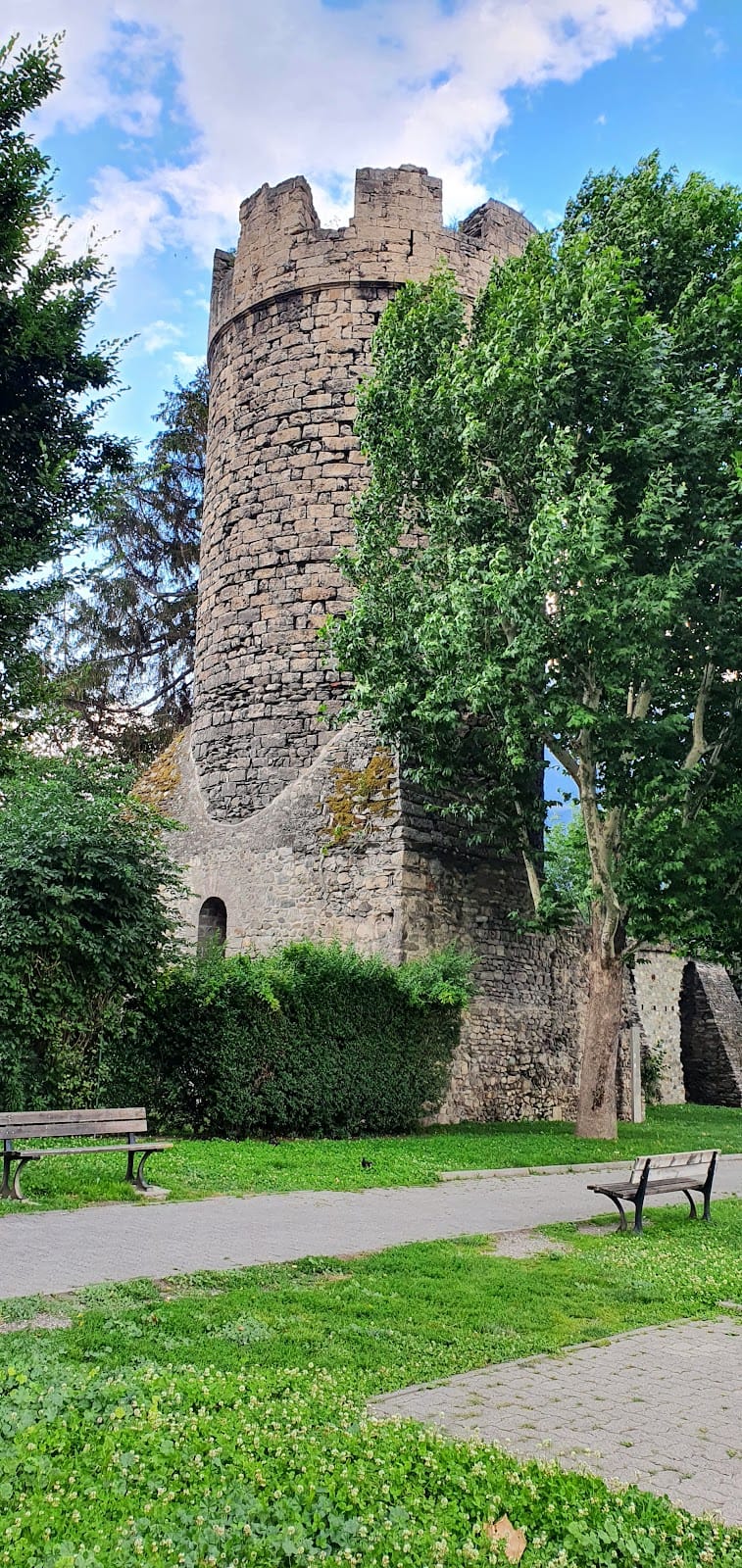
Along the walls, about twenty two-story towers were constructed at regular intervals. Some towers retain much of their original Roman form, while others have been modified or rebuilt using stones from the walls. The Tour du Bailliage, located at the northeastern corner, was heightened in the 12th century with stones from the Roman walls and later restored for modern use.
The Tour Fromage, near the Roman theatre, has undergone several renovations and currently serves as an exhibition space. The Tour du Pailleron, situated close to the public garden and train station, was restored after a fire in 1894 and considered for conversion into a museum.
The Tour Bramafam stands on the site of the former Porta Principalis Dextra. Its 19th-century restoration revealed Roman artifacts during excavation. The Tour du Lépreux features a spiral staircase added in the 15th century leading to a third floor. It was named for housing a leper in the 18th century and later served as a refuge during a cholera outbreak and as an observatory.
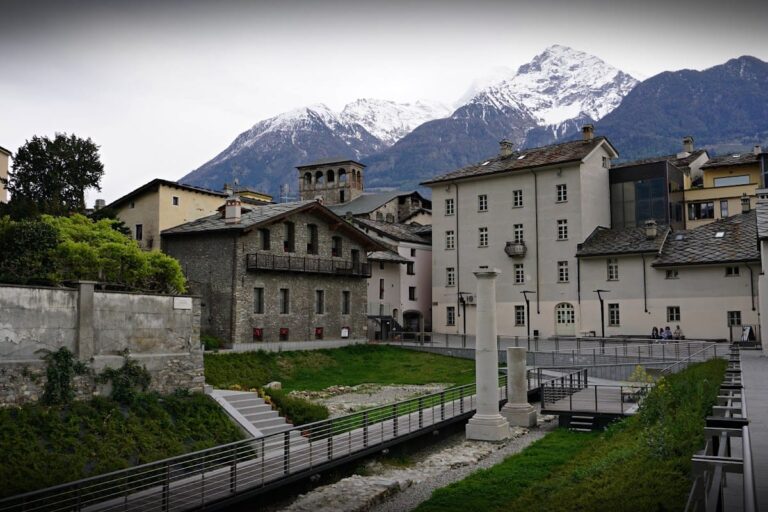
Only fragments of the fortress remain visible today, including the Tourneuve, which was built on the foundations of an earlier Roman tower. The medieval Tour des Seigneurs de la Porte Saint-Ours was constructed atop the ruins of the Porta Praetoria. Its southern side once contained a communal oven and later functioned as the city archive.