Ancient Corinth: A Historic City-State on the Isthmus of Corinth


Visitor Information
Google Rating: 4.7
Popularity: Medium
Google Maps: View on Google Maps
Official Website: archaeologicalmuseums.gr
Country: Greece
Civilization: Byzantine, Greek, Roman
Remains: City

History
Ancient Corinth was situated on the Isthmus of Corinth, a narrow land bridge connecting the Peloponnese to mainland Greece. Its strategic location made it a vital city-state in antiquity. Archaeological evidence shows human presence here since at least 6500 BC, with Neolithic pottery marking early settlement. The site saw continuous occupation through the Early Bronze Age but experienced decline before the Mycenaean period. Around 900 BC, Dorian Greeks reoccupied the area, establishing the foundations of the classical city.
Mythology credits the city’s founding to Corinthos, a descendant of Zeus, or alternatively to the goddess Ephyra. The Acrocorinth, the city’s acropolis, was linked to the gods Poseidon and Helios. Legendary figures such as Sisyphus, known for his eternal punishment, and Jason, leader of the Argonauts, were associated with Corinth, embedding the city deeply in Greek myth.
In the 8th and 7th centuries BC, Corinth was ruled by the Bacchiadae clan. This aristocratic family unified the city and initiated colonial expansion, founding important settlements like Corcyra (modern Corfu) and Syracuse in Sicily. The tyranny period began with Cypselus, who ruled from 658 to 628 BC after expelling the Bacchiadae. His son Periander succeeded him, ruling until 587 BC. Under Periander, Corinth reached a golden age, expanding its colonies and enhancing its wealth and influence.
During classical Greece, Corinth emerged as a major cultural and military power. It was renowned for its wealth, naval innovations such as the trireme warship, and for hosting the Isthmian Games, a pan-Hellenic festival. The city played active roles in the Persian Wars and the Peloponnesian War, often shifting alliances between Athens and Sparta. Corinth’s military and economic strength made it a key player in regional conflicts.
In 146 BC, after the Battle of Corinth, the Romans destroyed the city. It remained mostly abandoned until Julius Caesar refounded it in 44 BC as Colonia Laus Iulia Corinthiensis. This marked the start of its Roman period, characterized by a diverse population and the establishment of imperial cult worship. The city regained prominence under Roman rule, integrating into the empire’s administrative and cultural systems.
During the Byzantine era, Emperor Justinian I fortified Corinth with the Hexamilion wall, a defensive structure about six miles long, to protect the city and the Peloponnese from northern invasions. Despite damage from earthquakes and invasions, Corinth recovered between the 9th and 12th centuries, developing a notable silk industry. The city later became a contested site during the Crusades, falling to Frankish control in 1210. It was conquered by the Ottomans in 1458 and briefly held by the Venetians in the late 17th century.
Archaeological excavations began in 1896, led by the American School of Classical Studies at Athens. These investigations have uncovered remains spanning from the Early Neolithic period through the Roman era, revealing Corinth’s long and varied history.
Remains
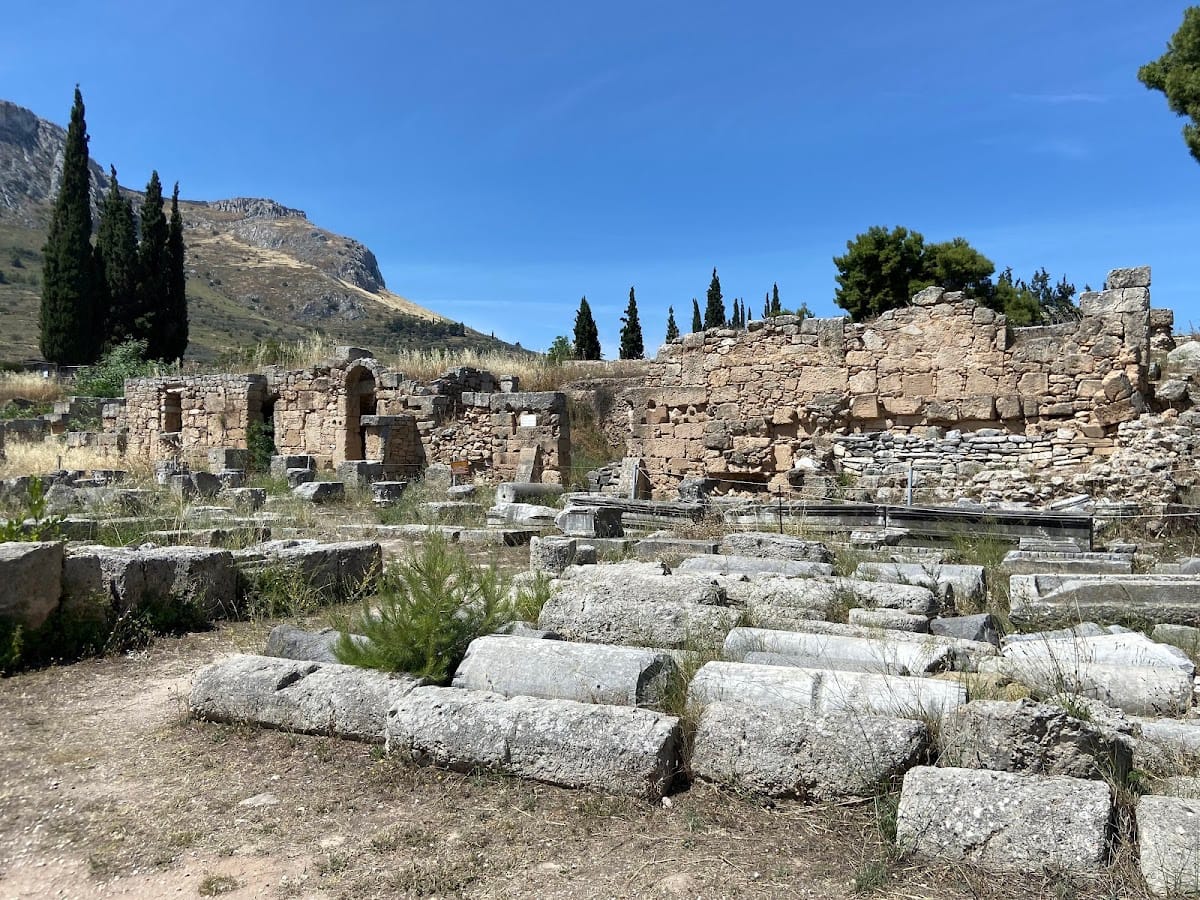
Ancient Corinth was built on two large natural terraces with springs and fertile plains, supporting urban development and water supply. The city’s construction prominently used local oolitic limestone and calcareous marl, the latter also used to produce lightweight ceramic vessels widely traded in antiquity.
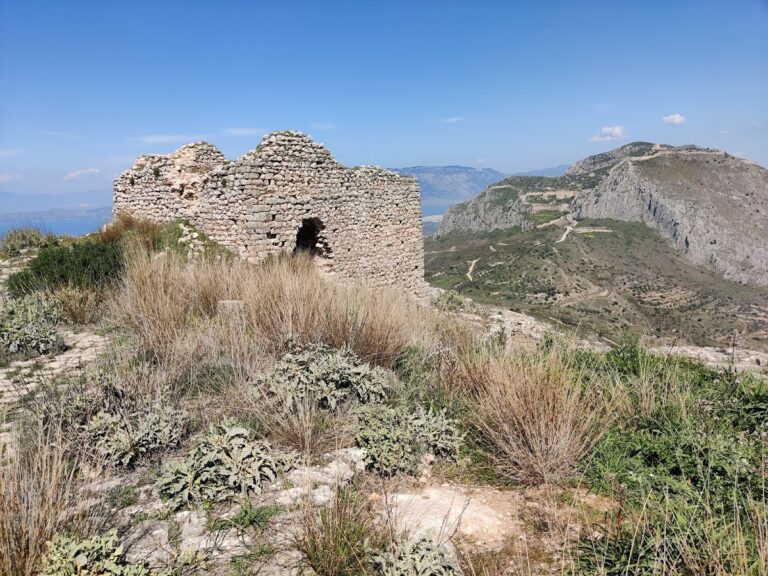
The Acrocorinth is a massive monolithic rock serving as the city’s acropolis. It was continuously occupied and fortified from archaic times through Byzantine, Frankish, Venetian, and Ottoman periods. The site features three circuit walls and housed a temple dedicated to Aphrodite at its summit. This temple was later converted into a church and then a mosque. Excavations at Acrocorinth began in 1929, revealing its long-standing religious and military significance.
Corinth had two main ports: Lechaeum on the Corinthian Gulf and Cenchreae on the Saronic Gulf. Lechaeum was connected to the city by about three kilometers of long walls and facilitated trade with Italy and Sicily. Cenchreae served commerce with the Eastern Mediterranean. A remarkable engineering feature was the diolkos, a stone-built overland ramp constructed under Periander, which allowed ships to be transported across the isthmus between the two harbors.
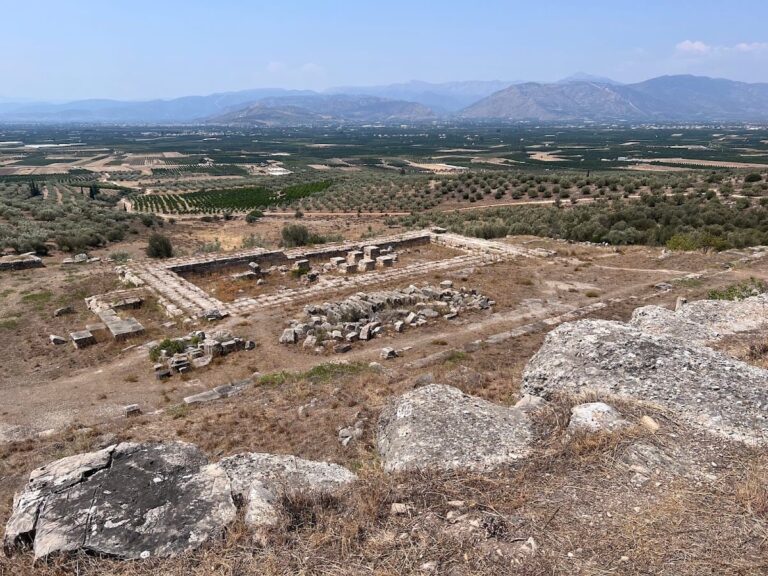
The Temple of Apollo, built around 540–550 BC, stands near the city center as a dominant monument of early classical Corinth. It reflects the city’s prosperity during the 6th century BC and has been a key focus of archaeological study.
Excavations have also uncovered sanctuaries dedicated to Demeter and Kore on the slopes of Acrocorinth, as well as the Sanctuary of Asklepios and the Kenchreian Gate Basilica. These religious sites highlight the city’s diverse cultic practices.
The city’s fortifications include the Hexamilion wall, constructed under Emperor Justinian I. This defensive barrier stretches approximately six miles (10 kilometers) and was built to protect Corinth and the Peloponnese from northern threats.
Roman-era remains include an amphitheatre located within the city. This structure reflects Corinth’s importance during Roman rule and its adoption of Roman entertainment architecture.
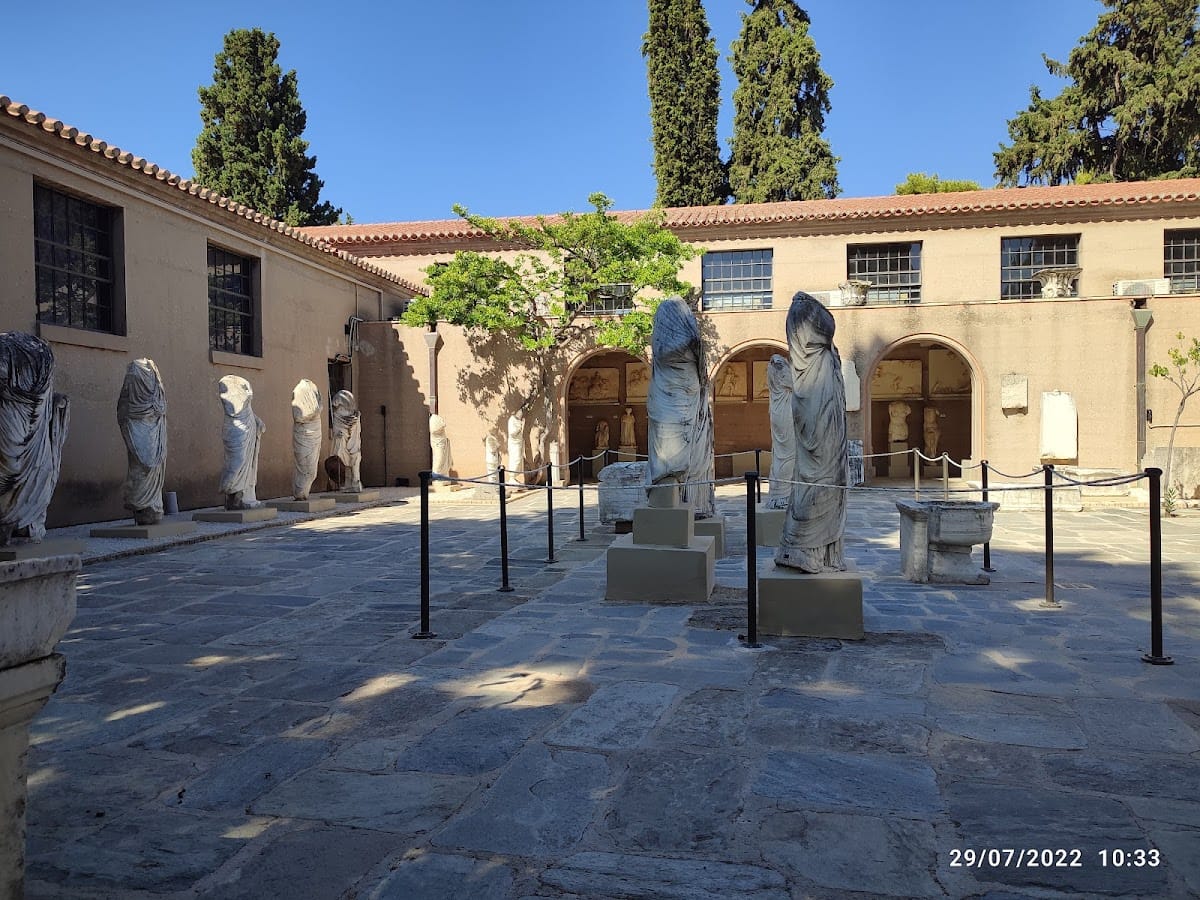
Many archaeological finds such as pottery, inscriptions, sculptures, and architectural fragments have been recovered. These artifacts span from the Early Neolithic period through the Roman era and are preserved in the Archaeological Museum of Ancient Corinth. The museum was built between 1931 and 1932, expanded in 1951, and renovated in the 2000s, serving as a repository for the city’s material heritage.