Anavarza Ruins: A Historic Fortress and City in Cilicia, Southern Türkiye
Table of Contents

Visitor Information
Google Rating: 4.6
Popularity: Low
Google Maps: View on Google Maps
Official Website: www.kulturportali.gov.tr
Country: Turkey
Civilization: Armenian, Byzantine, Roman
Remains: City

Context
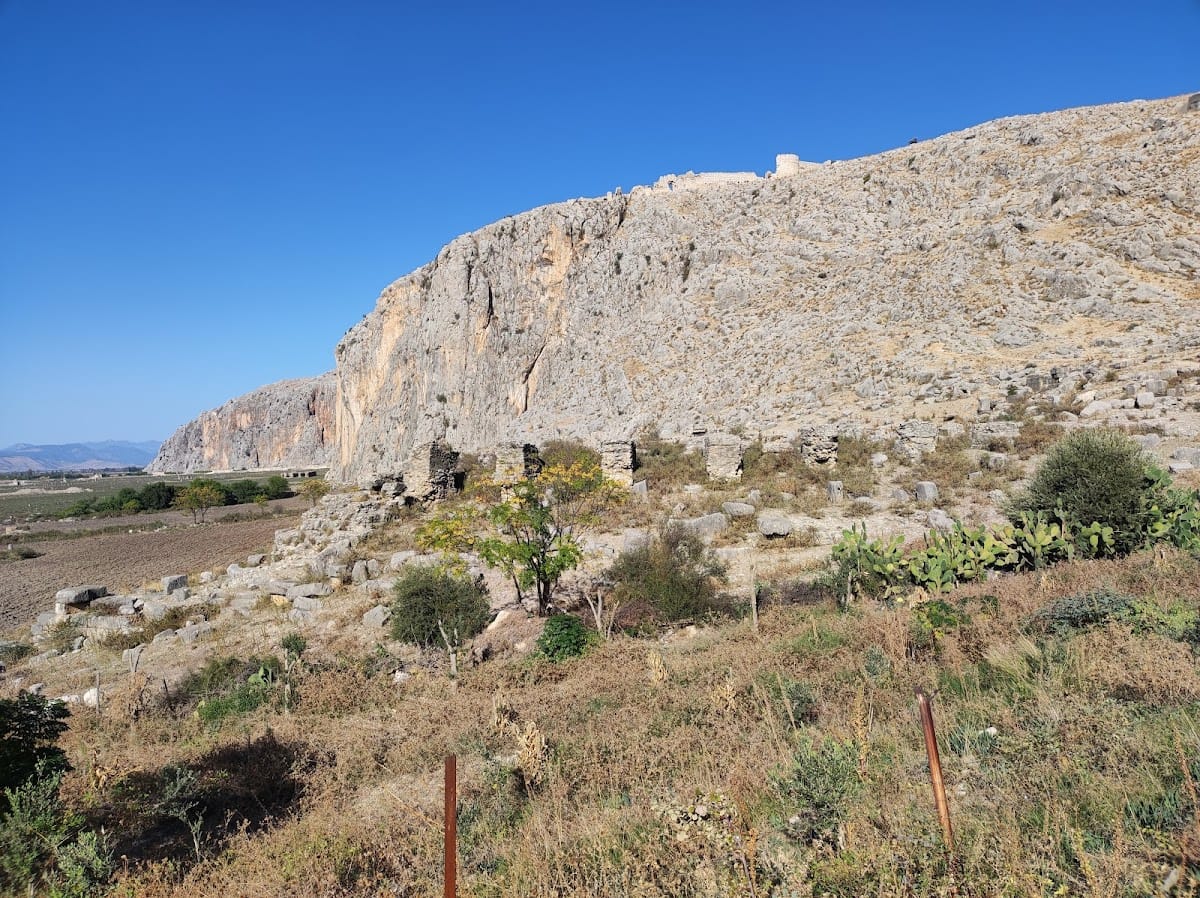
The Anavarza Ruins are situated atop a prominent limestone plateau overlooking the modern village of Dilekkaya in the Kozan district of Adana Province, southern Türkiye. This elevated position, rising approximately 200 meters above the surrounding plain, provided a naturally defensible site commanding views over key regional routes and fertile agricultural lands. The site lies within the historical region of Cilicia, a crossroads between Anatolia and the Levant, which shaped its strategic and economic significance across antiquity and the medieval period.
Archaeological evidence demonstrates continuous occupation from the Hellenistic era through Roman, Byzantine, Armenian, and later Turkic and Mamluk periods. The site’s landscape includes extensive fortifications, urban remains, and necropolises, reflecting its evolving role as a military stronghold, administrative center, and religious hub. Systematic surveys and excavations conducted since the nineteenth century, and intensified in the twentieth and twenty-first centuries by Turkish archaeological teams, have documented a rich stratigraphy and material culture. Anavarza is protected under national heritage laws and remains a focus of conservation and scholarly research.
History
The archaeological site of Anavarza encapsulates a complex historical trajectory shaped by its strategic location in Cilicia, a region contested by successive empires and local powers. Originating as a Hellenistic settlement, Anavarza developed through Roman municipal status, Byzantine provincial administration, Armenian dynastic rule, and later Turkic and Mamluk control. Its history is marked by military engagements, administrative reforms, religious transformations, and urban development, reflecting broader regional dynamics in southeastern Anatolia.
Hellenistic and Early Roman Period (2nd century BCE – 1st century CE)
During the Hellenistic period, Anavarza—known in ancient sources as Anazarbos, Anazarba, or Anazarbus—was established on a commanding limestone outcrop in Cilicia. The toponym likely derives from the Old Persian term “Na-barza,” meaning “Invincible,” indicative of its natural defensive advantages. Archaeological finds, including coinage dated to the 2nd and 1st centuries BCE, confirm settlement activity, although detailed historical records from this era remain limited. The site’s early political status was influenced by regional client kingship under Tarcondimotos, appointed by Roman general Pompey following his 67 BCE campaign against Mediterranean pirates.
In 19 BCE, Emperor Augustus visited the city, bestowing the name Caesarea ad Anazarbum to distinguish it from other cities named Caesarea. The city was placed under the rule of Tarcondimotos II Philopator, maintaining a degree of local autonomy. After his death in 17 CE, Roman general Germanicus incorporated eastern Cilicia, including Anavarza, into the Roman province of Syria. By 72 CE, Emperor Vespasian reorganized Cilicia as a distinct Roman province, with Anavarza administered from the provincial capital, Tarsus. Epigraphic evidence from this period attests to municipal governance and civic organization under Roman provincial structures.
Imperial Roman Period (1st–3rd centuries CE)
Throughout the first two centuries CE, Anavarza remained a secondary urban center relative to Tarsus but gained political and administrative prominence during the civil war of 193–194 CE. The city supported Septimius Severus against rival claimant Pescennius Niger, a decision that resulted in its elevation to metropolis status circa 204–205 CE. This new status granted Anavarza jurisdiction over the provinces of Cilicia, Isauria, and Lycaonia, reflecting its enhanced regional importance within the Roman imperial system.
Archaeological remains from this period include a rock-cut theater, a stadium, and an amphitheater used for gladiatorial training and military exercises, indicating a developed urban culture with public entertainment and athletic events. The city hosted regional athletic games comparable to Olympiads, featuring pentathlon, chariot races, boxing, and wrestling, which attracted participants and spectators from surrounding areas, stimulating local commerce. The urban fabric included colonnaded streets, monumental gates (propylons), and an extensive aqueduct system sourcing water from three distinct mountain springs. Defensive walls extended approximately 1500 meters, standing 8 to 10 meters high, with twenty towers spaced every 70 meters and four principal gates. Residential quarters contained villas adorned with intricate mosaics, such as the renowned “Anavarza Girl” and marine-themed artworks dating to the 4th century BCE, underscoring a culturally rich environment. Numismatic evidence reveals the city minted coins bearing images of local rulers and deities, reflecting its economic vitality and political affiliations.
Late Roman and Early Byzantine Period (4th–6th centuries CE)
In 260 CE, Anavarza was captured by the Sassanian king Shapur I during his incursions into Roman territories. The city later suffered destruction in the 4th century CE at the hands of Isaurian forces led by Balbinos but was subsequently rebuilt under Emperor Theodosius II. By 408 CE, Anavarza was designated the capital of the reconstituted province of Cilicia, underscoring its administrative significance in the Late Roman period. A major earthquake in 525 CE inflicted severe damage, prompting Emperor Justin I to order reconstruction and rename the city Justinopolis. Another devastating earthquake in 561 CE, compounded by a plague epidemic, further weakened the urban fabric and population.
Ecclesiastically, Anavarza functioned as a metropolitan see within the Late Roman province of Cilicia Secunda, overseeing several suffragan bishoprics. Notable bishops such as Athanasius and Maximin are recorded as participants in early church councils, indicating the city’s religious prominence. Archaeological remains attest to multiple churches, including the Apostles’ Church in the city center, an Armenian church on the outer fortress, a small church within the inner castle, and the Rock Church near the royal necropolis, reflecting a diverse Christian community and architectural patronage during this period.
Arab and Byzantine Contestation Period (7th–11th centuries CE)
The 7th century saw the Arab conquest of Anavarza, which was renamed Anyzarba under Islamic administration. In 796 CE, Caliph Harun al-Rashid undertook restoration efforts and resettled migrants from Khorasan, contributing to demographic changes. The city endured repeated Byzantine military assaults in 804, 806, 835, and 855 CE, resulting in significant destruction and the capture of inhabitants. In 878 CE, the emir of Anavarza fled during a Byzantine campaign led by Emperor Basil I. The Hamdanid ruler Sayf al-Dawla invested heavily in fortifying the city in the mid-10th century, reportedly expending three million dirhams to strengthen its defenses.
In 961–962 CE, Byzantine Emperor Nikephoros II Phokas besieged and recaptured Anavarza, reincorporating it into the Byzantine Empire. The city thereafter remained a key fortress on the volatile Byzantine-Arab frontier, with fortifications expanded and maintained to secure this border zone. The period was characterized by military and administrative fluctuations, with the city serving primarily as a fortified stronghold rather than a major urban center.
Armenian Kingdom of Cilicia Period (11th–14th centuries CE)
Following the mid-11th century, Armenian populations from the Kars region were resettled in Anavarza, marking a significant cultural and political transformation. Around 1080 CE, the Armenian noble Rupen established a principality encompassing Anavarza and Sis (modern Kozan), founding the Rubenid dynasty that ruled until 1375. Anavarza became a principal residence and dynastic burial site for this dynasty, with the fortress extensively rebuilt and expanded to serve as a royal stronghold.
In 1098, Crusader leader Bohemond captured the city, incorporating it into the Principality of Antioch, but Byzantine forces retook it in 1111. Throughout the 12th century, Anavarza’s fortress was contested among Crusaders, Byzantines, and Armenians. Emperor John II Komnenos captured it after a 37-day siege in 1137. King Levon II of Armenia (1189–1219) consolidated control, using Anavarza as a royal capital and military bastion. Architectural remains from this period include Armenian fortifications, chapels, and a three-aisled church constructed by Toros I, commemorating his conquests. The city declined following the Mamluk conquest in 1374, which resulted in its destruction and abandonment.
Turkic and Mamluk Period (14th–16th centuries CE)
From the 14th century onward, Turkmen tribes such as the Varsaq and Avshar exerted control over the region. In 1279, Turkmen forces attempted to capture Anavarza. The Kozanoğulları Turkmen principality governed the area, including Anavarza and Sis castles, from the 16th century. The Mamluks conquered the city in 1375, terminating Armenian rule. Subsequently, the Ramazanoğulları principality administered the region until the Ottoman Empire fully incorporated it during the reign of Sultan Selim I. Archaeological evidence indicates a marked decline in urban complexity and population during this period, with the site functioning primarily as a local stronghold and administrative center under successive Turkic and Mamluk authorities.
Daily Life and Importance by Period
Hellenistic and Early Roman Period (2nd century BCE – 1st century CE)
During the Hellenistic and early Roman phases, Anavarza was a modest settlement inhabited predominantly by local Cilician populations influenced by Hellenistic culture. The social structure likely comprised local elites, possibly client kings such as Tarcondimotos, alongside artisans, farmers, and laborers. Epigraphic and numismatic evidence attest to municipal officials managing civic affairs under Roman oversight following Pompey’s campaigns.
The economy centered on agriculture adapted to the plateau’s terrain, supplemented by local crafts and limited trade facilitated by proximity to regional routes. Domestic architecture from this period suggests simple courtyard houses, though detailed interior decoration is scarce. Dietary staples likely included wheat, olives, and locally sourced fish, consistent with regional patterns. Religious practices were predominantly pagan, with local cults venerating Hellenistic deities, although no major temples from this phase have been identified.
Imperial Roman Period (1st–3rd centuries CE)
Following Roman annexation and elevation to metropolis status, Anavarza’s population diversified to include Roman settlers, local Cilicians, freedmen, and slaves. Civic life was organized around magistrates and councils, with inscriptions referencing duumviri and other officials overseeing urban administration and public works. Economic activities expanded, maintaining agriculture while developing artisanal production such as pottery and mosaic workshops.
The city hosted regional athletic games, fostering commerce and hospitality industries. Urban infrastructure included aqueducts, baths, markets, and colonnaded streets supporting public life. Residences ranged from modest homes to luxurious villas decorated with intricate mosaics, including the notable “Anavarza Girl,” reflecting affluent households with access to skilled artisans. Diet incorporated bread, olives, fish, and imported goods, indicating active trade networks. Religious life remained predominantly pagan, with temples and statues dedicated to deities such as Hygieia and Eros. The city’s metropolitan status conferred administrative importance, with military garrisons securing frontier zones. Civic festivals and athletic contests reinforced social cohesion and regional identity.
Late Roman and Early Byzantine Period (4th–6th centuries CE)
After episodes of destruction and reconstruction, Anavarza’s population became increasingly Christianized, as evidenced by the establishment of multiple churches and its role as a metropolitan see. The social elite included bishops like Athanasius and Maximin, alongside traditional civic officials adapting to ecclesiastical governance. Economic life supported urban and religious institutions, with agriculture and local crafts sustaining the population despite demographic declines caused by earthquakes and plagues.
Public amenities such as baths and markets remained operational. Domestic architecture incorporated Christian symbols, with mosaic floors featuring religious motifs. Markets continued to supply essential goods, while transportation adapted to Byzantine road networks. Religious practices centered on Christianity, with churches including the Apostles’ Church and Armenian chapels serving diverse congregations. Ecclesiastical authority played a central role in civic affairs, with Anavarza functioning as a provincial capital within Cilicia Secunda.
Arab and Byzantine Contestation Period (7th–11th centuries CE)
The Arab conquest introduced new ethnic groups, including migrants from Khorasan resettled by Caliph Harun al-Rashid, blending with the existing population. The city’s social fabric became increasingly militarized due to frequent sieges and population displacements. Leadership alternated between Arab emirs and Byzantine governors, with fortifications prioritized over civilian urban development.
Economic activities contracted, focusing on sustaining the fortress and military garrison. Agriculture likely continued in surrounding areas but with reduced urban consumption. Domestic life adapted to a defensive posture, with fewer elaborate residences documented. Markets and trade persisted at a diminished scale, supplying military and civilian needs. Religious life diversified, including early Islamic worship alongside residual Christian communities. Archaeological evidence suggests the presence of one of Anatolia’s earliest mosques dating to the Abbasid period. The city’s role was primarily as a fortified frontier stronghold controlling access between Byzantine and Arab territories.
Armenian Kingdom of Cilicia Period (11th–14th centuries CE)
Armenian resettlement brought a distinct cultural and social identity, with the Rubenid dynasty establishing Anavarza as a principal residence and dynastic burial site. The population included Armenian nobles, military elites, clergy, artisans, and peasants. Social hierarchy was sharply defined, with princely and ecclesiastical authorities wielding significant influence. Economic life revived through fortified agriculture, craft production, and control of regional trade routes.
The fortress was expanded, and Armenian chapels and churches with distinctive architecture and iconography were constructed. Domestic spaces reflected Armenian styles, with evidence of decorated interiors and communal living arrangements. Markets catered to local needs and the military aristocracy, trading textiles, metals, and foodstuffs. Transportation relied on fortified roads and animal caravans. Religious life was predominantly Armenian Apostolic Christian, with chapels and churches serving as centers of worship and community. Anavarza functioned as a royal capital and military bastion within the Armenian Kingdom of Cilicia.
Turkic and Mamluk Period (14th–16th centuries CE)
Following the Mamluk conquest and the decline of Armenian rule, the population shifted toward Turkmen tribal groups such as the Varsaq and Avshar, alongside residual Armenian and local inhabitants. Social organization became tribal and militarized, with principalities like the Kozanoğulları and Ramazanoğulları governing the area. Economic activities were largely pastoral and agricultural, supporting tribal communities and limited urban functions.
The fortress and surrounding settlements exhibited reduced urban complexity, with fewer monumental constructions and diminished market activity. Domestic life adapted to simpler forms, with less emphasis on elaborate decoration. Trade and transportation focused on regional caravan routes controlled by Turkmen rulers. Religious practices reflected Sunni Islam, with mosques replacing earlier Christian churches as primary worship sites. Anavarza’s role diminished to a local stronghold and administrative center under successive Turkic and Mamluk authorities, eventually absorbed into the Ottoman Empire during Sultan Selim I’s reign.
Remains
Architectural Features
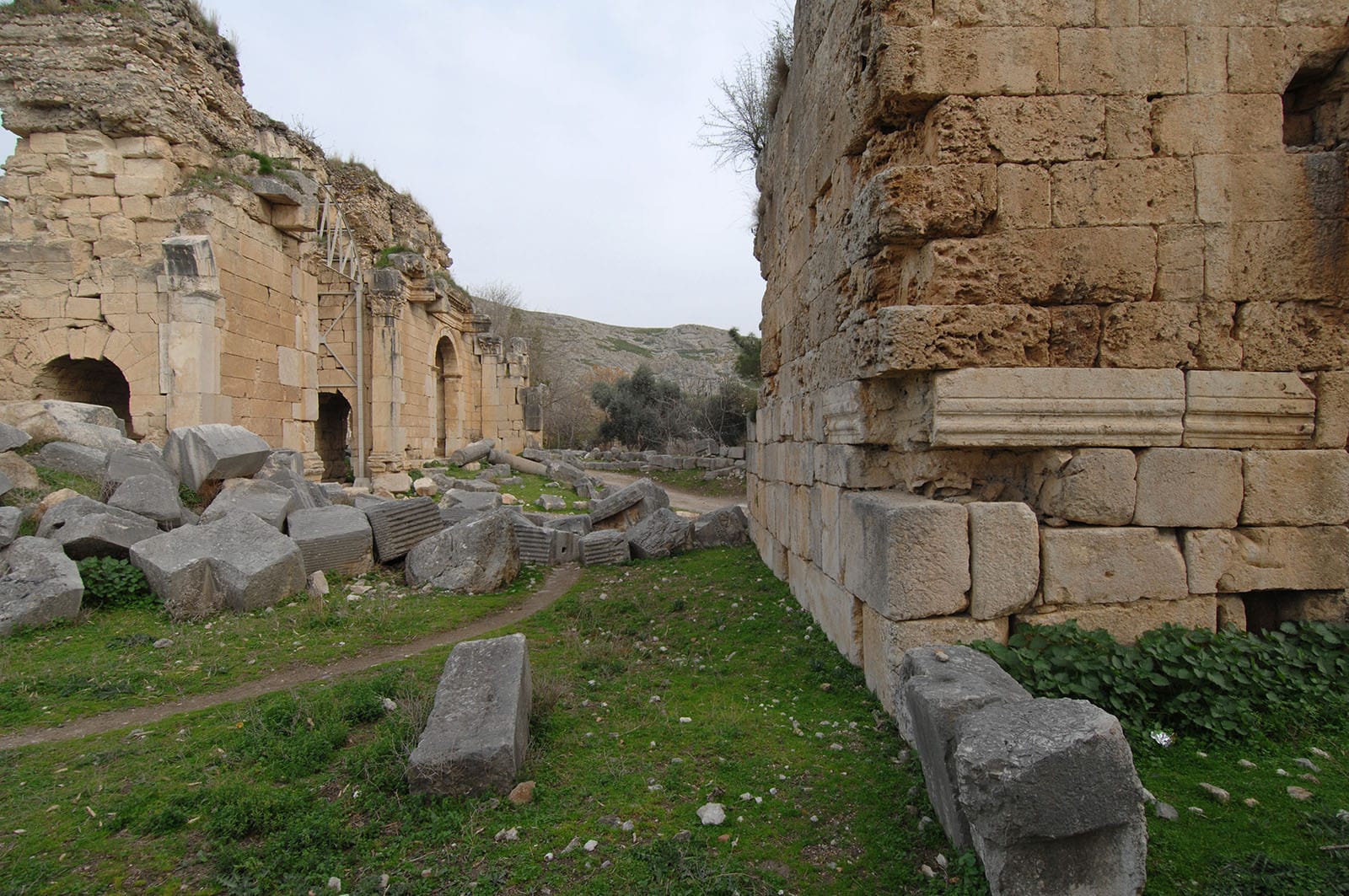
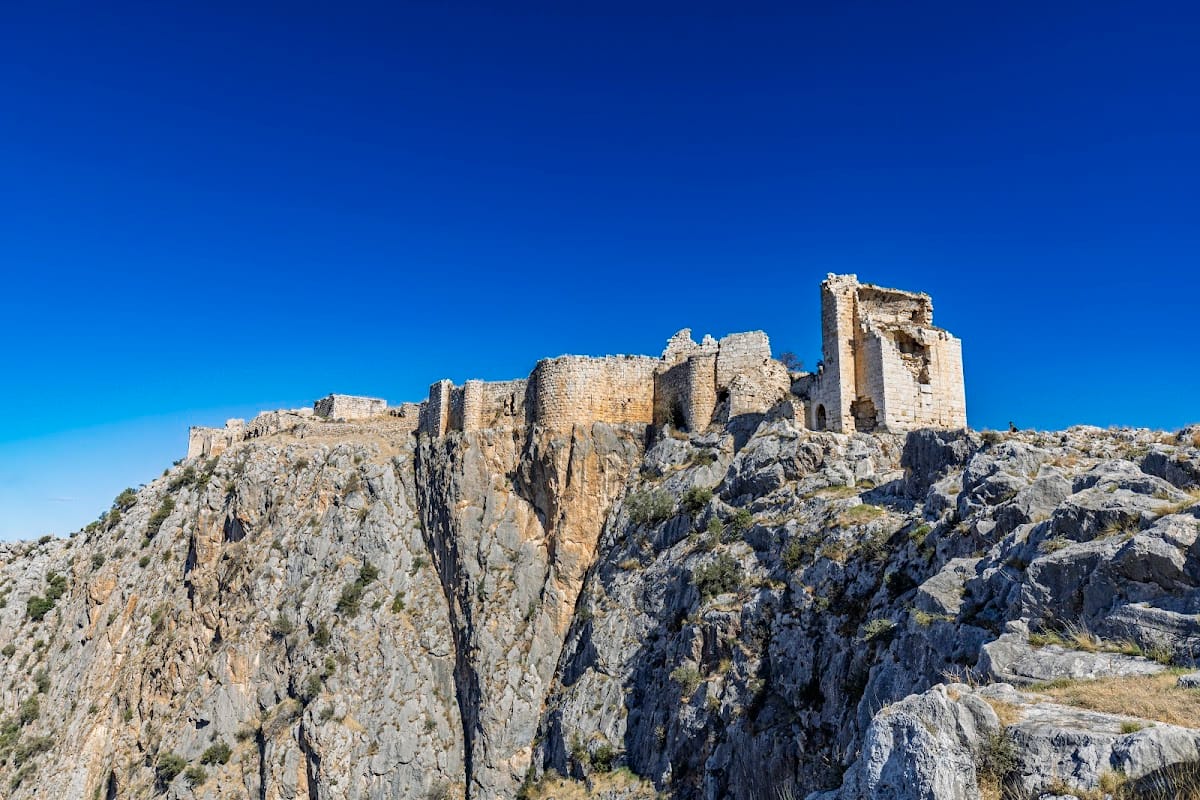
The Anavarza Ruins encompass extensive masonry remains spanning multiple historical periods, situated on a limestone plateau. The city’s fortifications extend approximately 1500 meters eastward, with walls reaching heights between 8 and 10 meters. Originally, twenty towers were positioned at intervals of roughly 70 meters, though only fragments survive. Four principal gates punctuate the walls, with the Alaqapı gate being the most intact, dating to the mid-2nd century CE. The medieval fortress atop the acropolis, constructed in 1188 CE by Byzantine Emperor Leo II and later expanded by Armenian rulers, incorporates Byzantine and Armenian defensive elements built upon Roman foundations. The lower city walls, of later construction, enclose ruins including a triumphal arch and colonnaded streets.
The urban layout features a colonnaded double-lane road excavated in 2013, measuring 34 meters wide and 2700 meters long, serving as the main thoroughfare connecting key monuments. The city’s water supply was sustained by three major aqueducts originating from Bucaq Acanmandaş mountain, Alapinar Bəkirce mountain, and Hamam village. These aqueducts, among the longest in antiquity, are now largely ruined, with only small sections extant. Monumental fountains and water distribution structures remain near the northern city area. Surrounding the city are extensive rock-cut necropolises covering 2 to 3 square kilometers, containing tombs from Roman and Armenian periods.
Key Buildings and Structures
City Walls and Fortifications
The city walls, primarily constructed during the Roman imperial period and modified through Byzantine and Armenian phases, extend about 1500 meters. Built of large ashlar blocks, the walls stand 8 to 10 meters high. Towers were spaced every 70 meters, originally numbering twenty, though only fragments remain. Four gates provided access, including the Alaqapı gate, dating to the mid-2nd century CE and repaired in the early 3rd century. The medieval fortress on the acropolis, erected in 1188 CE, incorporates Byzantine and Armenian defensive structures atop Roman foundations. The Crusaders added a donjon (keep) on the acropolis rock outcrop. Within the fortress are two Armenian chapels and a large three-aisled church constructed by Toros I, featuring a dedicatory Armenian inscription. The lower city walls, built later, enclose a triumphal arch and colonnaded streets.
Alaqapı Gate
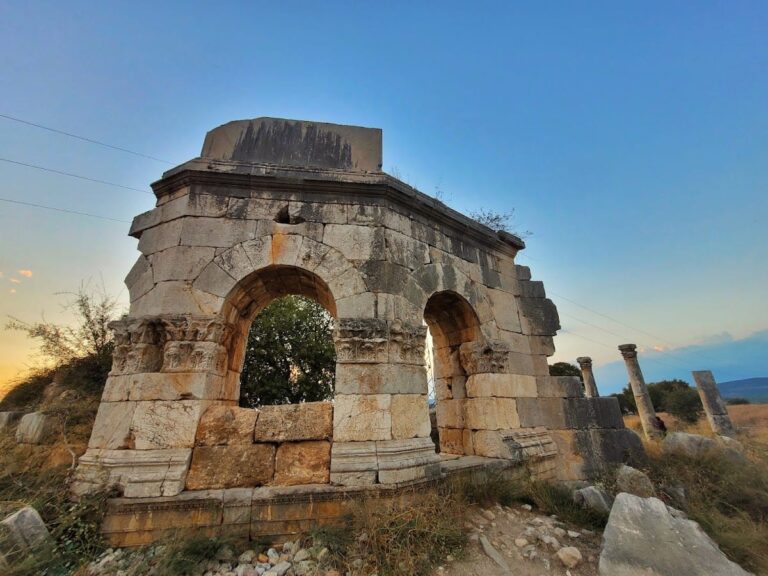
This gate, dating to the mid-2nd century CE, is among Anavarza’s best-preserved ancient monuments. Repairs were undertaken in the early 3rd century CE. The gate partially collapsed in 1948 and sustained damage during the 1998 Ceyhan earthquake. Restoration and reinforcement efforts commenced in 2011 to stabilize the structure. The gate’s masonry consists of large dressed stones, and its architectural design includes defensive features characteristic of Roman city gates.
Aqueducts and Water Supply
Anavarza’s water supply was maintained by three major aqueducts originating from Bucaq Acanmandaş mountain, Alapinar Bəkirce mountain, and Hamam village. Constructed primarily during the Roman period, these aqueducts formed one of the longest water supply systems of the ancient world. Today, only small sections survive due to extensive damage, notably from a powerful earthquake in 1945. Near the northern city area, remains of monumental fountains and water distribution structures constructed with stone and concrete are visible.
Theater
The Roman-period rock-cut theater lies south of the city, partially carved into natural rock and facing the plain. Seating areas hewn from the hillside remain discernible, along with the stage and orchestra spaces, though much of the superstructure is fragmentary.
Stadium
Located near the theater to the south of the city walls, the stadium dates to the late 2nd century CE. Partially carved into the rock, it was used for athletic competitions such as the pentathlon. The seating and track layout remain visible, though some sections are eroded.
Amphitheater
Remains of an amphitheater used for gladiatorial training and military exercises survive near the southern city area, close to the Alaqapı gate. The structure includes partial seating tiers and an arena space constructed with stone masonry. Its condition is fragmentary but identifiable.
Necropolises (Rock-cut Tombs and Burial Sites)
Extensive rock-cut necropolises surround Anavarza on the west, east, and southwest, covering approximately 2 to 3 square kilometers. These burial areas include various tomb types and architectural styles from Roman and Armenian periods. The “Kings’ Tomb” near the northern necropolis is a notable rock-cut chamber measuring about 13 by 9 meters, likely belonging to King Tarcondimotus I or his son. Many tombs have suffered looting and damage, but some inscriptions and reliefs remain. A southern necropolis near the curtain wall shows evidence of modern illegal excavations.
Havariler (Apostles) Church
Situated in the city center, this Byzantine-period church was a major religious building. Earthquakes caused its collapse, leaving only rubble and some surviving columns. These columns indicate the building’s height ranged between 15 and 20 meters. The church’s plan and architectural details are partially preserved in the ruins.
Armenian Church on Outer Fortress
Located on the outer fortress (Xarici Qala) at the mountain’s foot, this Armenian church was preserved until recently but has since collapsed. It formed part of the defensive complex during the Armenian Kingdom of Cilicia period.
Small Church within Inner Fortress
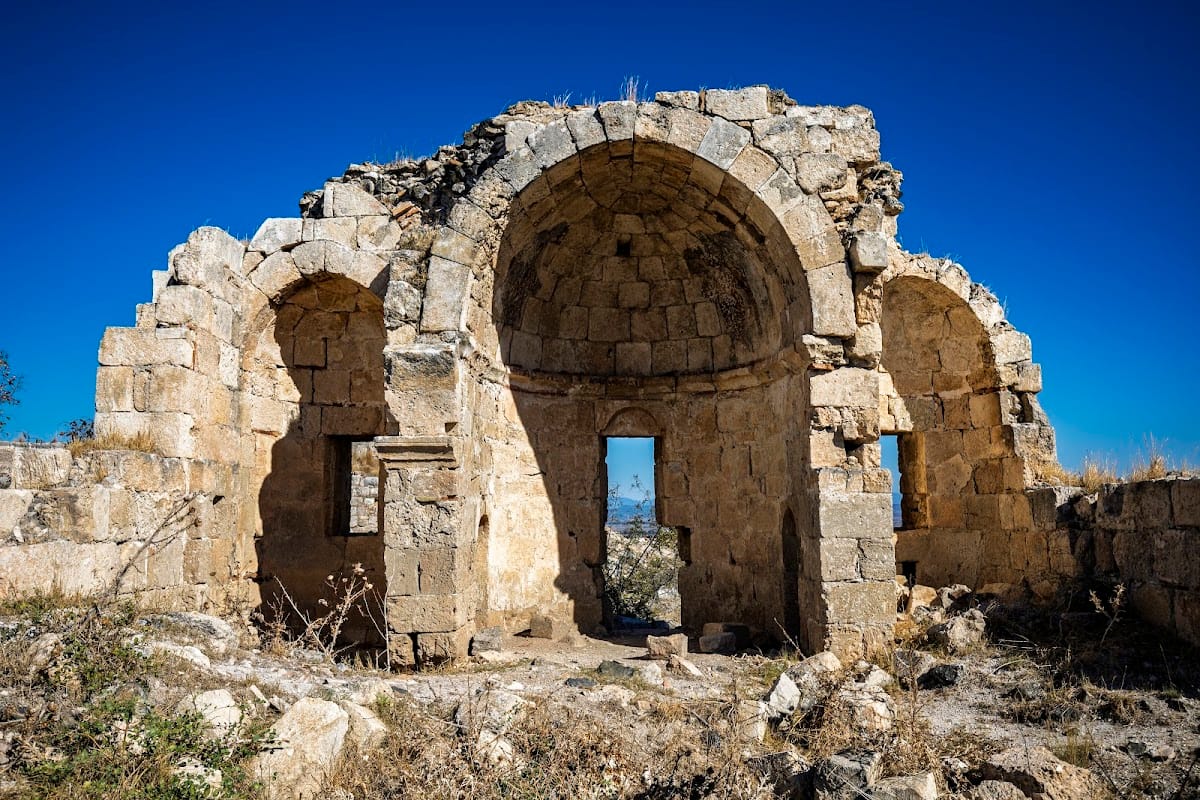
Situated on a prominent hill inside the inner fortress, this small church is constructed of robust stone masonry and has survived to the present day. Crosses placed immediately west of its entrance confirm its religious function. The church dates to the medieval Armenian period.
Rock Church
One of Anavarza’s oldest structures, the Rock Church is carved directly into the rock near the northern necropolis. It is an important early Christian monument, with interior and exterior rock-cut features still visible.
Roman Monumental Gate (Propylon)
Foundations of a monumental Roman gate structure lie beneath the medieval fortress on the acropolis. Dating to the Roman imperial period, this gate served as a significant entrance to the city’s upper area. Only foundations and some masonry remain.
Colonnaded Double-Lane Road
Excavated in 2013, this road is the first known colonnaded double-lane street of the ancient world. Measuring 34 meters wide and 2700 meters long, it formed the city’s main thoroughfare. The road features two parallel lanes separated by a central median and lined with columns, connecting major city monuments during the Roman period.
Triumphal Arch
Located at the southern end of the main street and surrounded by continuous colonnades, the triumphal arch likely dates to the Severan dynasty (late 2nd to early 3rd century CE). It has three openings, each flanked by pairs of black granite columns. Niches for statues are present on the northern facade. Portions of the arch’s masonry remain well preserved.
Gymnasium
Ruins of a gymnasium are present within the city remains, indicating facilities for physical training. The structure includes rooms and open spaces typical of Roman gymnasia, though the remains are fragmentary.
Baths
A large Roman-period bath complex constructed of concrete and faced with fired bricks lies approximately 220 meters northwest of the amphitheater. The baths include rooms for hot and cold bathing and feature vaulted chambers and hypocaust (underfloor heating) systems, though much of the structure is in ruins.
Monumental Aqueduct Dedicated to Domitian
Located about 450 meters north of the probable medieval city wall, this aqueduct dates to circa 90 CE. It extends northwest toward the Sumbas River and formed part of the city’s water supply network. Only sections survive, constructed with stone arches and channels.
Archaeological Discoveries
Excavations and surveys have uncovered numerous mosaics, including the “Anavarza Girl” mosaic discovered in 1960, depicting a female figure. Other mosaics include a 3.40 by 2.60 meter panel in a villa garden featuring geometric motifs, a central male figure with sea dragons, and depictions of the god Eros. A larger mosaic measuring 10.75 by 3.55 meters decorated a pool floor with eighteen species of sea creatures in black, red, yellow, and turquoise on a white background. These mosaics date to the 4th century BCE and Roman period. Many suffered damage during the 1998 Ceyhan earthquake and remain endangered by weathering and neglect.
In 2017, a limestone statue depicting the goddess Hygieia and the god Eros was discovered, dating to the 3rd or 4th century BCE. Surface traces and architectural fragments indicate the presence of shops and columned streets behind the city walls. A monumental fountain and water distribution structures are visible near the northern aqueduct remains. Geophysical surveys conducted between 2004 and 2007 identified approximately 1000 inscriptions from the Roman period, providing valuable epigraphic data on the city’s social, religious, and political life.
Preservation and Current Status
The Alaqapı gate remains one of the best-preserved monuments but suffered partial collapse in 1948 and earthquake damage in 1998. Restoration and reinforcement began in 2011 to prevent further deterioration. The aqueducts and mosaics have been severely damaged by earthquakes and are currently vulnerable to environmental exposure. The Havariler Church exists only as rubble, with some columns standing. The Armenian church on the outer fortress has collapsed recently. The small church within the inner fortress and the Rock Church remain relatively intact. City walls and fortress structures survive in varying states, with some towers and gates fragmentary. Conservation and documentation projects continue under national heritage authorities.
Unexcavated Areas
Despite extensive surveys and excavations, large portions of Anavarza remain unexcavated. Surface surveys and geophysical studies have identified buried remains beneath the city’s plateau and surrounding areas. Some necropolises, particularly on the southern escarpment, have not been fully explored and show signs of illegal excavations. Future archaeological work is subject to conservation policies and research priorities, with no large-scale modern development reported to impede investigations.