Acrocorinth: The Historic Fortress Overlooking Corinth, Greece


Visitor Information
Google Rating: 4.7
Popularity: Medium
Google Maps: View on Google Maps
Country: Greece
Civilization: Unclassified
Remains: Military

History
Acrocorinth is a prominent fortified rock formation located near the city of Corinth in Greece. Built originally by the ancient Greeks, it served as the acropolis and primary fortress overseeing the surrounding Corinthian plain and coastal approaches.
According to legend, the site was sacred to the sun god Helios, as established by the mythical Corinthian king Bellerophon. He granted the lands to his son Aeetes and dedicated the summit itself to the goddess Aphrodite, who was honored there by a temple traditionally attributed to the sorceress Medea. This early mythological association reflects the spiritual importance attached to the location from antiquity.
In historical terms, the first fortifications at Acrocorinth were constructed during the 7th and 6th centuries BCE by Corinthians under the rule of the tyrants Cypselus and his son Periander. These early defenses controlled access to the plain below and helped protect the city. In the 4th century BCE, further strengthening and repairs were undertaken by Macedonian rulers, enhancing the fortress’s military capacity.
The fortress suffered significant destruction in 146 BCE when the Roman general Lucius Mummius sacked Corinth. Later, Julius Caesar ordered repairs in 44 BCE, restoring its strategic function within the Roman realm. In the Byzantine period of the 6th century CE, Emperor Justinian commissioned restoration works to reinforce the site, further adapting it for continued defense through the Middle Ages.
During the medieval era, Acrocorinth passed through several hands. By 1210 CE, the Franks controlled the fortress, with defenders such as the local lord Leon Sgouros known for his desperate resistance ending in suicide after losing the citadel. Ownership then shifted among Latin noble families, the Byzantine Palaiologos dynasty, and the military order known as the Knights Hospitaller. The Ottoman Turks conquered Acrocorinth in 1458, incorporating it into their empire.
The Venetians briefly seized the fortress in 1687, undertaking substantial repairs. However, Ottoman forces regained control in 1715. During the Greek War of Independence between 1821 and 1823, Acrocorinth was the site of several sieges and negotiations before finally coming under Greek control later in 1823. These events highlight the fortress’s enduring military and political importance across many centuries.
Archaeological research at the site began in 1896 under the auspices of the American School of Classical Studies at Athens, uncovering its layered history and varied occupation. Today, Acrocorinth is also noted for its natural environment, protected as a Natura 2000 site supporting diverse flora and fauna.
Remains
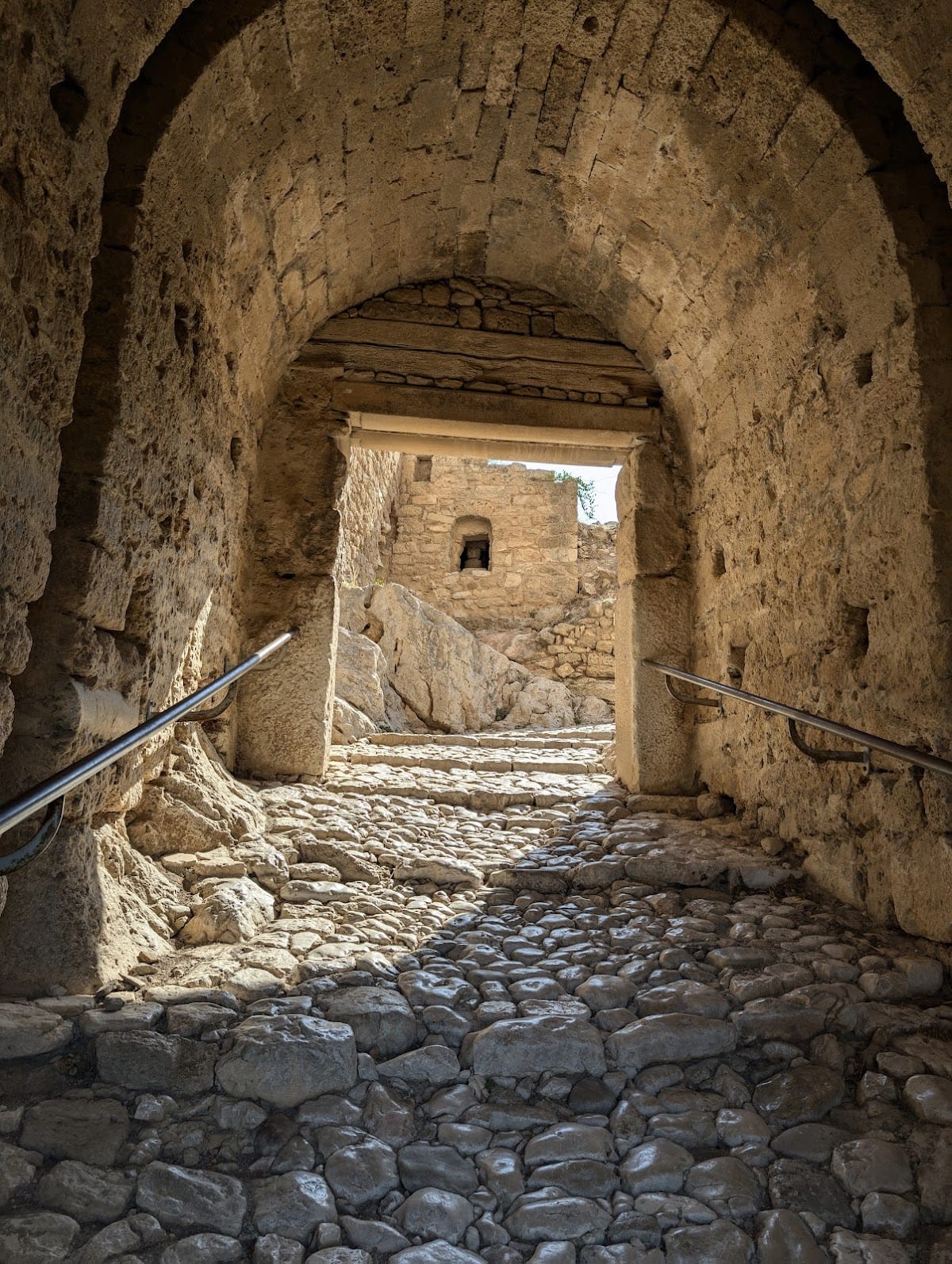
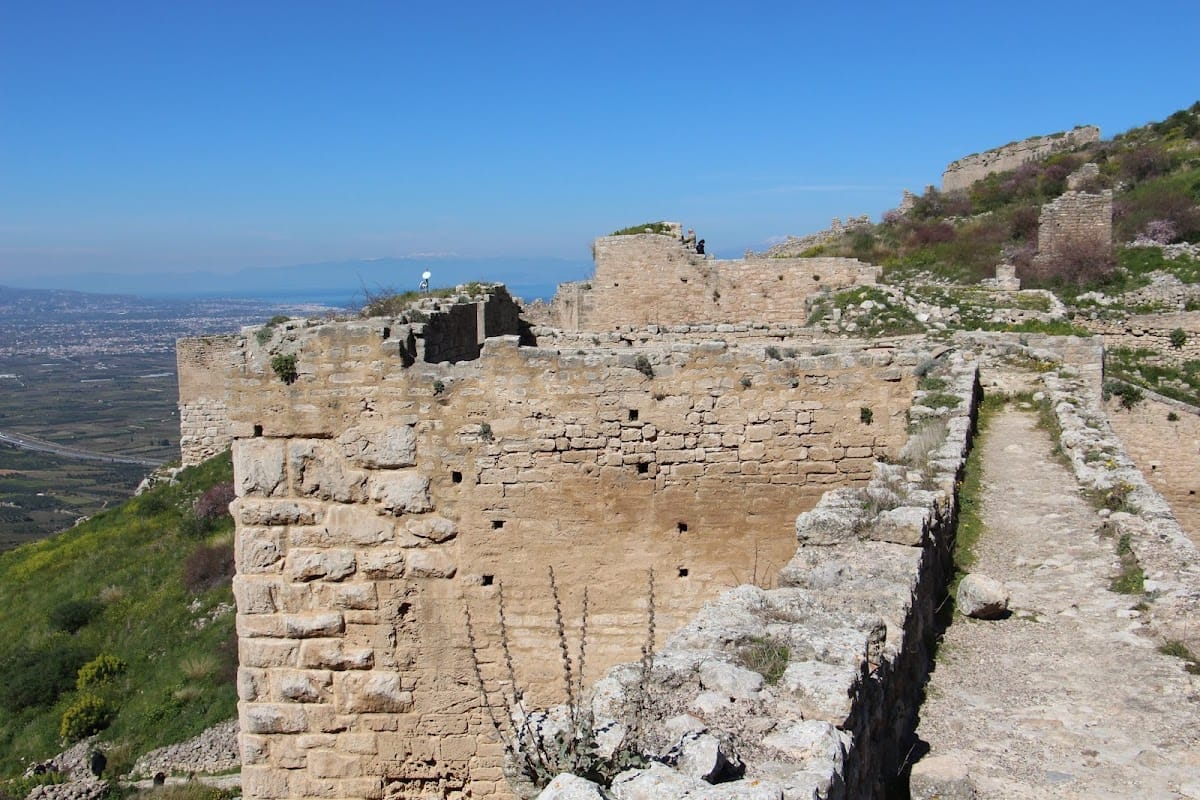
Acrocorinth’s fortress is laid out across two main summits of the 575-meter high rock massif, connected by nearly two kilometers of defensive walls that follow the natural contours of the terrain. The northern, eastern, and southern sides are naturally safeguarded by steep ravines, while access from the west is secured by a sophisticated triple wall system incorporating three vaulted gates. This main entrance area once featured a deep, irregular moat, a medieval drawbridge, and defensive ditches, though parts of these elements have collapsed over time.
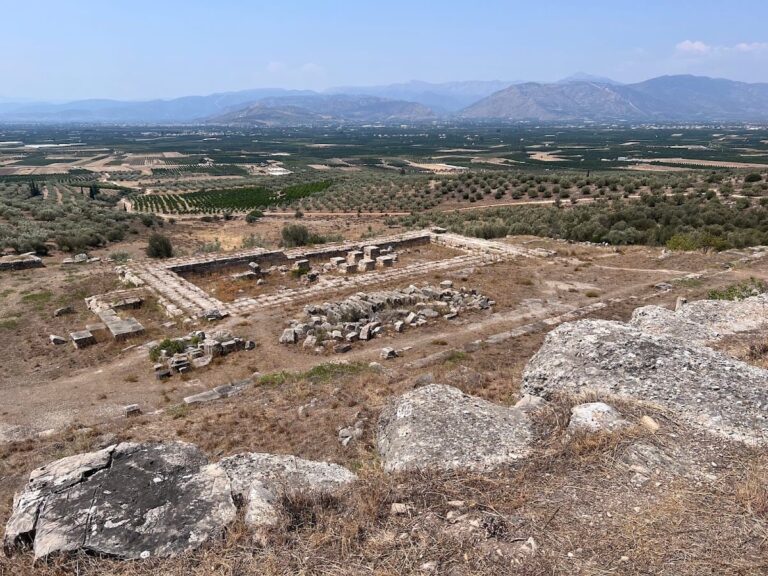
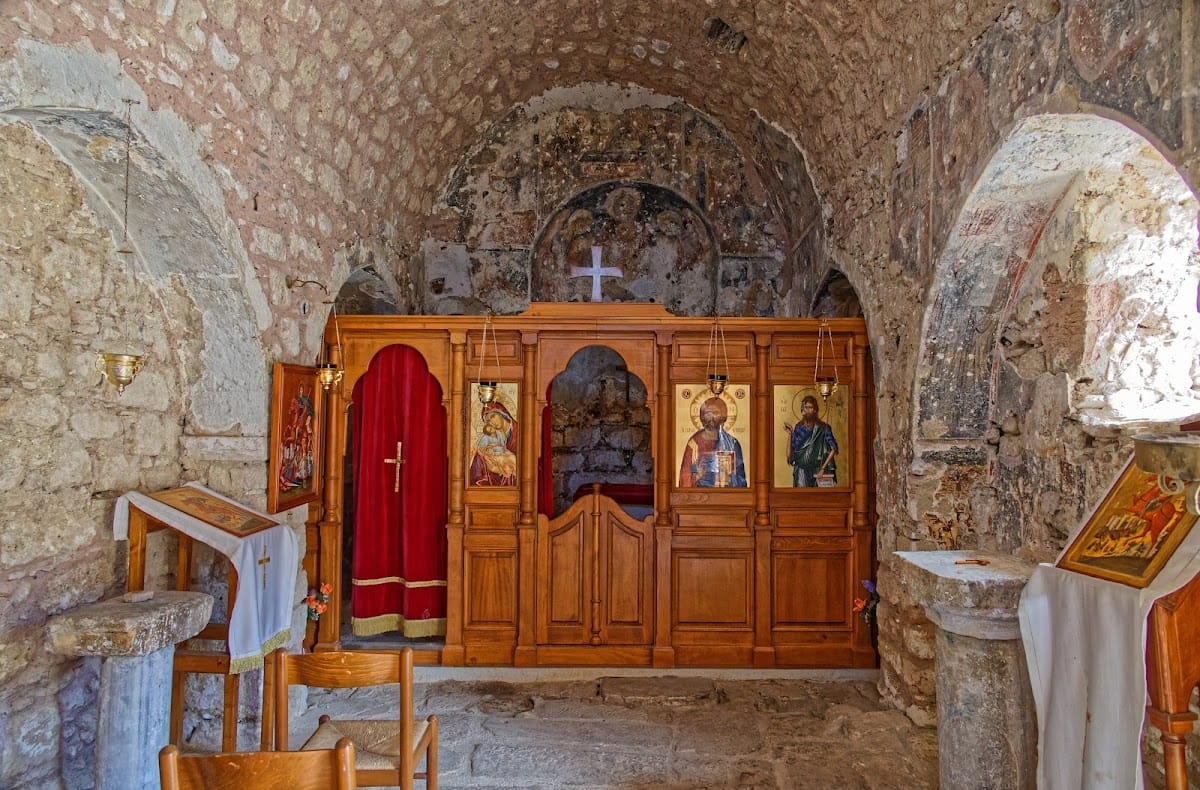
The fortress is structured in three vertical levels: the lower, middle, and upper enclosures. The highest point contains the main castle with continuous walls punctuated by towers. This area encloses a plateau divided into eastern and western sections. On the eastern summit lies the oldest standing structure associated with the site: the temple of Aphrodite. Although the original temple is no longer extant, it survives in the form of a Byzantine chapel built upon its foundations, demonstrating religious continuity.
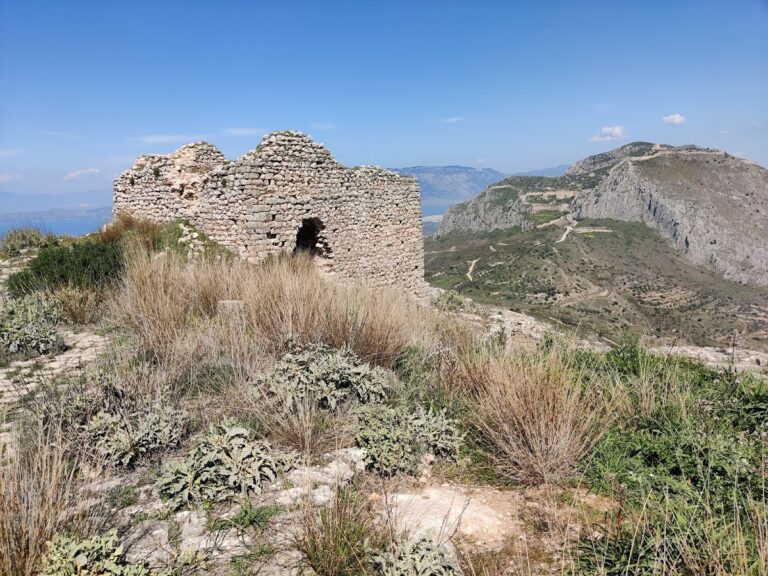
On the western summit are the ruins of a tower dating from the Frankish period, subsequently expanded during the Venetian and Ottoman occupations. These layered modifications illustrate the fortress’s strategic adaptation by successive powers. Within the walls, various building remains include a chapel dedicated to the Prophet Elias, several underground passageways, wells, storerooms, and cisterns designed to supply water during sieges.
The complex also contains religious buildings reflecting its varied history, such as Venetian churches and Ottoman homes. Notably, at least two small mosques have been identified; one includes a cylindrical minaret with a spiral staircase, evidencing Islamic architectural influence during Ottoman rule.
Between the eastern and western summits lies the Peirene fountain, an ancient reservoir referenced by the traveler Pausanias. It was restored in 1930 and historically provided fresh water vital to the fortress’s inhabitants.
Conservation efforts in the 20th century have stabilized and restored several defensive features. The bridge across the moat and the guardhouse at the first gate were reconstructed in the mid-1960s. Further restoration of the first two gates and adjacent walls took place during the 1970s, with additional rehabilitation, including replacement of the wooden entrance bridge, completed by the mid-1990s.
Remnants of artillery from the Venetian period remain visible on site, including a cannon bearing the date 1670. From the fortress high vantage points, expansive views reach over the Patraic and Corinthian Gulfs, parts of southern mainland Greece, and across to islands such as Salamis and Aegina in the Saronic Gulf. These commanding sightlines reinforced the fortress’s role as a sentinel over key sea and land routes throughout its long history.