Roman Theatre of Trieste: A Roman Performance Building in Italy



Site at a Glance
- Rating
- 4.3
- Popularity
- Medium
- Country
- Italy
- Primary era
- Classical
- External website
- Open
- Eras represented
- Classical
- Civilizations
- Roman
- Site type
- Entertainment
- Remains
- Theatre
On this page13 sections
History
The Roman Theatre of Trieste is a Roman performance building in Trieste, Italy, constructed during the last third of the first century BC in the Augustan period, the reign of Augustus from 27 BC to AD 14. It formed part of the original urban plan of Tergeste, the Roman settlement that developed into modern Trieste, and was the only Roman theatre or other Roman spectacle building identified in the city.
Foundation and Imperial Development
Ancient Tergeste was founded approximately in the middle of the first century BC between San Giusto Hill and the sea. The theatre followed a few decades later, at the northern edge of the settlement and almost on the shore of the Gulf of Trieste. Its position within the planned town shows that public performance was incorporated into the civic development of Tergeste from an early stage.
The building’s decorative program was completed under the Julio-Claudian dynasty, the early imperial ruling house that followed Augustus. A later restoration took place at the end of the first or the beginning of the second century AD. This work may have involved rebuilding the seating area and adding statues. The theatre may have reached completion during the reign of Nero, the Roman emperor who ruled from AD 54 to 68.
Quintus Petronius Modestus financed the final repairs and embellishment, probably after returning from Hispania at the beginning of the second century AD. Inscriptions identify him as a military officer, a procurator under the emperors Nerva and Trajan, and a priest of the imperial cult. He was probably born at Tergeste. An earlier proposal that he founded the theatre is no longer accepted, although one of his ancestors may have participated in its original construction.
A statue made slightly larger than life originally represented Nero and was later altered to show Titus. The change probably followed Nero’s posthumous condemnation, known as damnatio memoriae, which led to the alteration or removal of some imperial images. It may also have been connected with Titus’s victory in the siege of Jerusalem. Several scholars, including Werner Gauer, have proposed that the theatre appears on scene 86 of Trajan’s Column, which shows a theatre beside the sea or a watercourse, but this identification remains uncertain.
Later Use and Rediscovery
During the Later Roman Empire, the theatre may also have hosted spectacles resembling those held in amphitheatres. At the end of its use, it was abandoned, quarried for building stone, and stripped of valuable elements. Medieval houses were later built against and over the surviving structure, concealing much of the monument within the developing city.
In 1698, the Triestine historian Ireneo della Croce described ruined walls in an area called Rena Vecchia, a name possibly derived from the Latin word arena. Pietro Nobile identified the buried monument in 1814. An 1884 plan by the historian Antonio Tribel recorded property and street lines that followed the ancient urban arrangement and helped clarify the theatre’s position.
Excavation and Protection
The theatre was uncovered between July 1937 and September 1938, when part of Trieste’s old city was demolished and archaeological excavations were undertaken within Mussolini’s urban program promoting Roman heritage. Vittorio Macchioro directed the work, under the supervision of Bruno Molajoli of the archaeological superintendency. Part of the monument opened to the public on 21 April 1938.
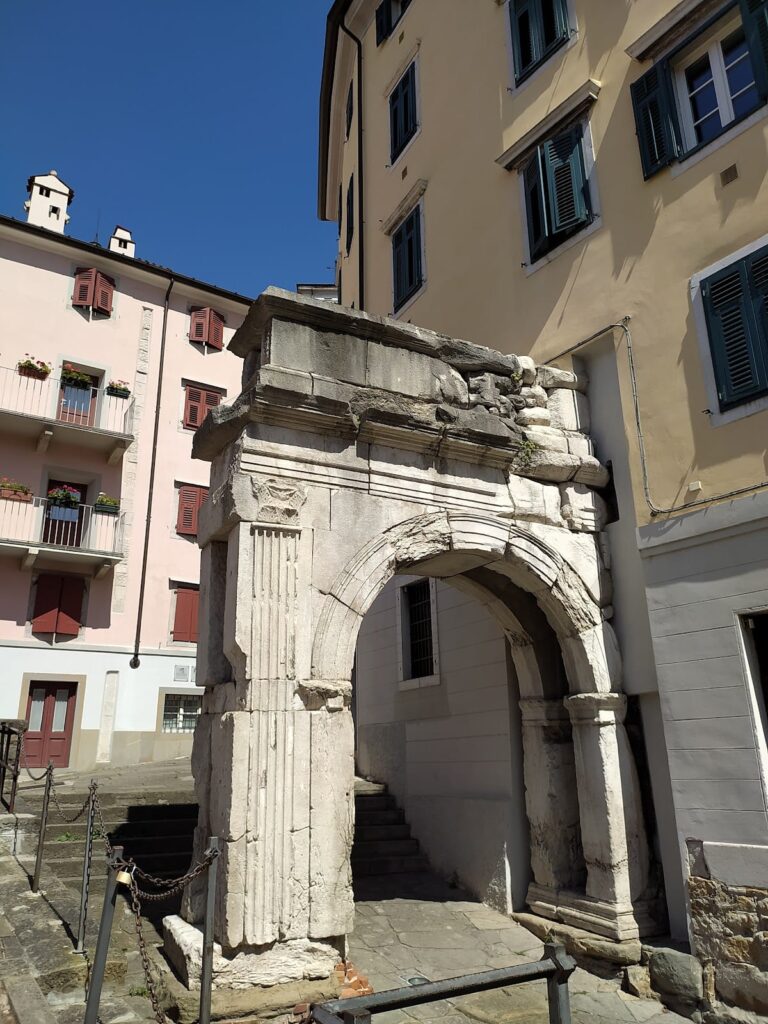
Restoration and heritage protection allowed the monument to resume a performance function. Since a production of Sophocles’ Electra was staged there in 1964, the restored theatre has hosted summer performances. The monument is listed as an Italian cultural property and forms part of Trieste’s archaeological heritage together with the late Republican walls, the Arch of Riccardo, and an early Christian basilica elsewhere in the ancient urban area.
Remains
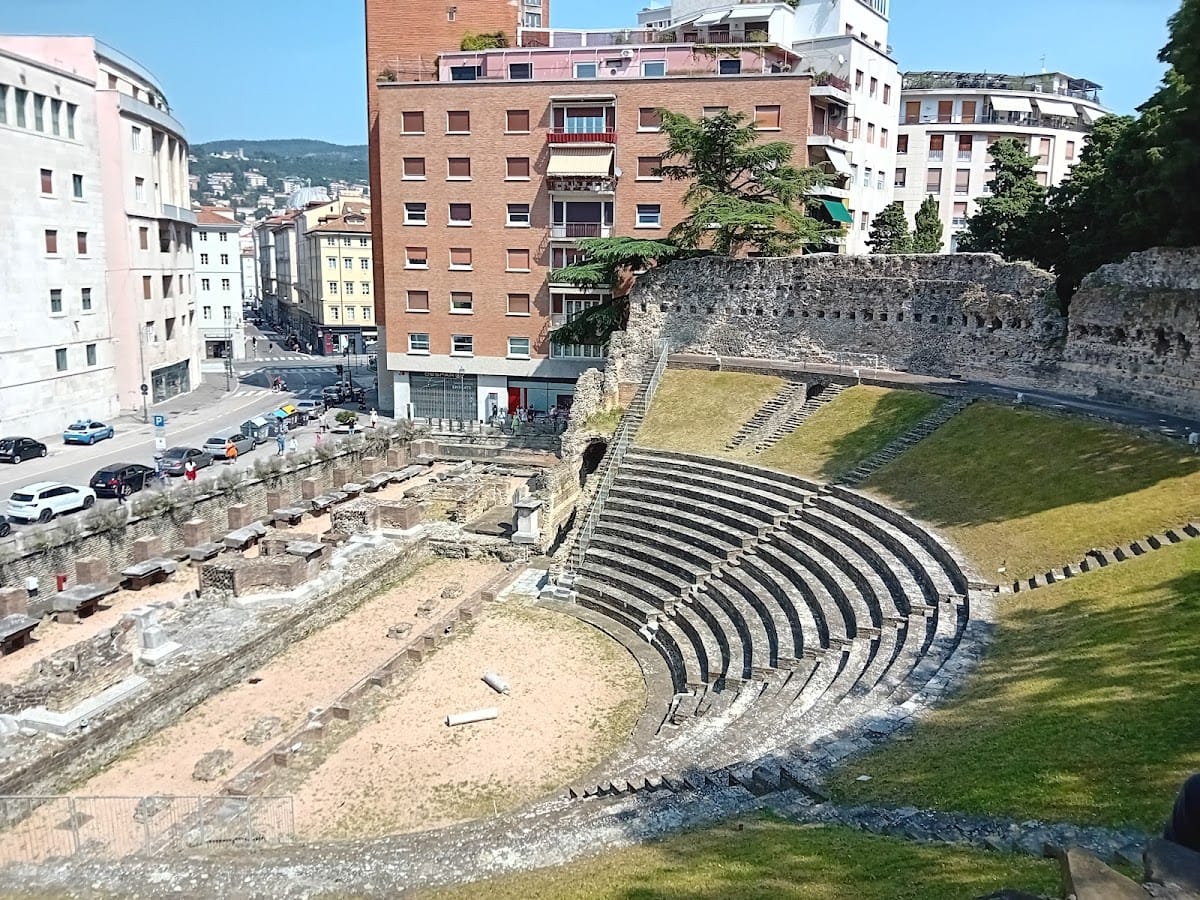
The theatre stands at the foot of San Giusto Hill, between Via del Teatro Romano and Via di Donota in the centre of modern Trieste. In Roman times, a coastal road separated it from the sea, while the seating was set against the first slopes of the hill. The building faced north-northwest and used the natural gradient to support its semicircular cavea, or seating area, reducing the amount of masonry needed to regularize the slope.
Seating and Access
The cavea measures 64.40 metres across, and the semicircular orchestra, the space between the seating and stage, measures 20.34 metres in diameter. Estimates place the capacity at approximately 2,250 to 3,500 spectators. The seating was supported by concentric walls that formed filled compartments. These walls have brick or sandstone rubble faces around a core of opus caementicium, the Roman concrete used as a structural core. Brick facing is generally associated with later repairs, while the original entrance passages contain alternating courses of sandstone and brick.
A semicircular passage divided the cavea into two seating sections. The preserved lower section has twelve rows of stone seats, while the upper section probably had eight or nine rows that may initially have been wooden. Three stairways extended from the top to the bottom of the cavea, dividing it into four wedge-shaped sectors called cunei. Four principal entrances served the audience, with two lateral passages beside the stage and two radial vomitoria, entrance passages leading into the seating area. The latter opened onto a vaulted outer gallery and onto the horizontal passage between the seating sections. The lateral passages also gave performers access to the orchestra.
Outer Wall and Orchestra
The outer wall of the cavea survives to about 15 metres high. Its exterior retains corbel supports for the wooden poles of a velum, a large fabric awning used over parts of a theatre. A large central niche may have held a small shrine. The niche was added after the original construction, although its form recalls Augustan architectural traditions. An installation at the foot of the central stairway may have been an altar.
The orchestra is bordered by a paved semicircular passage that may have provided seats for notables or other privileged spectators. A wall 0.68 metres high, the pulpitum, or raised stage platform, separated the orchestra from the stage. Its eight niches have two rounded backs and six flat backs, and probably helped reduce unwanted echoes. The wall was likely faced with pink slabs. Stairs at both ends connected the orchestra to the stage, whose floor was made of wood.
Stage Complex
The stage complex occupied the side of the theatre facing the former shoreline. Its main wall probably reached at least 15 metres, approximately the height of the outer cavea wall, but much of it has disappeared. Two levels contained doors, columns, and statue niches, with surfaces finished in plaster and polychrome painting or stucco slabs.
Stage Wall and Entrances
The central valva regia opened from an exedra onto the middle of the stage. Two smaller cruciform rooms flanked it, retaining traces of red plaster and probably serving as service rooms or dressing rooms for performers. Two less monumental doors stood symmetrically beside the central entrance, and all three entrances were framed by columns on both sides.
Backstage Buildings and Portico
Square buildings slightly more than 8 metres on each side stood at the two ends of the stage wall. They probably contained service rooms or backstage areas and correspond to the basilicae described in Roman architectural texts. A rear portico closed the stage complex. Measuring 63.85 by 4 metres, it had eighteen columns across its width and faced the beach and sea. Its upper part probably also held fittings for awning poles.
Stage Curtain
A stage curtain is indicated by two rows of pole holes set into the stage floor. Twelve of these holes remain visible, preserving evidence of the mechanism used to raise and lower the curtain.
Sculpture and Inscriptions
The stage wall carried white or yellow marble statues of Athena, Aphrodite, Apollo, Hygieia, Asclepius, and Dionysus. Fragments from the niches of the pulpitum include a satyr and a child. The sculptors probably came from the Trieste or Aquileia areas. A slightly larger-than-life statue of Nero was converted into an image of Titus, while a marble bust identified as Quintus Petronius Modestus was itself adapted from a bust that probably originally represented Medusa.
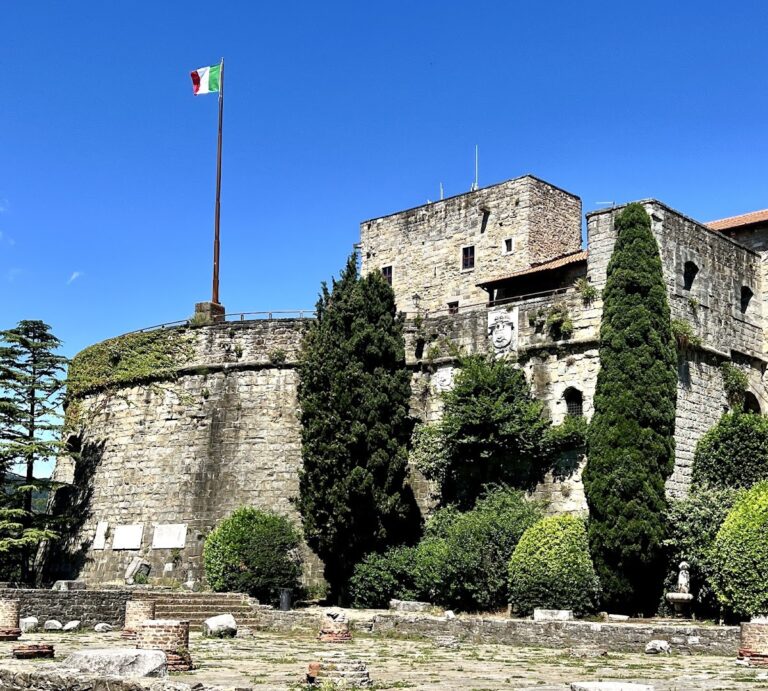
Three or four stone inscriptions found in different parts of the cavea mention Quintus Petronius Modestus. The largest probably came from the outer cavea wall. Their reconstructed text records his military offices, his procuratorship in Hispania, his priesthood of the deified Claudius, and his donation and dedication of works whose exact nature is not specified. The statues, sculptural fragments, architectural decoration, and inscriptions are preserved in the Lapidarium at San Giusto Castle, while copies of two inscriptions are displayed at the theatre.
Roads and Former Shoreline
A coastal road passed in front of the stage wall in Roman times, and another road followed the contours of the hill above the theatre. Modern Via del Teatro Romano approximately follows the ancient route from Aquileia, while Via di Donota partly follows the higher road. Later silting and land reclamation moved the shoreline several hundred metres away from the monument.