Mediana: A Late Roman Imperial Residence near Niš


Site at a Glance
- Rating
- 4.5
- Popularity
- Medium
- Country
- Serbia
- Primary era
- Classical
- External website
- Open
- Eras represented
- Classical
- Civilizations
- Byzantine, Roman
- Site type
- Domestic
- Remains
- Villa
On this page20 sections
History
Mediana is a late Roman archaeological settlement in Serbia, near the modern city of Niš. Built and developed under the Roman Empire at the end of the third or beginning of the fourth century, it grew from a suburban agricultural estate into a luxurious imperial residence and administrative suburb of Naissus, the Roman city corresponding to Niš. Its importance came from its connection with the imperial household, its position beside the road to Serdica and Constantinople, and its role in supplying and accommodating the nearby city.
From agricultural estate to imperial residence
Mediana probably began late in the reign of Diocletian, at the end of the third century, or during the opening years of the fourth century under Constantine the Great, Roman emperor from 306 to 337 and the first emperor to openly support Christianity. At first, the complex functioned as a suburban agricultural estate and a center for distributing food to the municipium of Naissus, a self-governing Roman town. During the fourth century, it became a summer residence for the imperial household, serving recreation, state business, and probably therapeutic stays connected with the thermal waters of nearby Niška Banja.
The settlement stood beside the principal eastward road from Naissus toward Serdica and Constantinople. That route formed part of the wider network connecting the central Balkans with the Danube, the Adriatic, the Ionian Sea, and the eastern Roman provinces. Mediana therefore combined an agricultural and logistical role with direct access to imperial travel and communication.
Constantine, who was born at Naissus, is traditionally credited with building the residence. Another interpretation attributes its construction to Roimetalkes, a close associate of Constantine and a provincial governor. The question of whether Mediana was Constantine’s principal residence remains unresolved, because an octagonal villa near the later Niš Fortress has also been proposed for that role.
Imperial activity in the fourth century
Mediana flourished especially during the fourth century, when Constantine and other members of the imperial household frequently stayed in Naissus. Constantine’s sons Constantius II and Constans spent the winter of 340 at Naissus and issued an edict there. Constans later used the imperial residence as a temporary base. In 350, Vetranio, commander of the Danubian army, is said to have surrendered the imperial insignia to Constantius II at Naissus, probably at the imperial villa.
Julian the Apostate stayed at Naissus for two months late in 361 while campaigning against Constantius II, and wrote political letters there. In 364, the emperors Valentinian I and Valens came to the villa to arrange the division of imperial territories. Several imperial edicts also place Valentinian at Naissus, linking the residence with the practical administration of the empire.
Decline, Christian occupation, and abandonment
Mediana continued in use after Constantine’s death in 337, but a major fire late in the fourth century ended its former level of luxury and imperial importance. Settlement resumed after 386 on a more modest scale. A probable baptistery and two early Christian churches show that Christian communities remained at the site during the late fourth and early fifth centuries, even as its organization became less urban and more rural.
The unfortified settlement was vulnerable to raids. Fifth-century invasions brought repeated plundering and destruction, and the imperial residence lost its function after the devastation of Naissus traditionally associated with Attila’s invasions in the middle of that century. Justinian I later rebuilt the defenses of the wider region, including the walls and military camp at Naissus and a network of surrounding fortifications. A fortress was built on a height south of Mediana, on the slopes of Seličevica, but later Slavic and Avar incursions continued to affect the area.
By the early seventh century, Byzantine authority had withdrawn from Naissus and Mediana amid wars with Persia and increasing Slavic and Avar pressure. Organized activity and settlement life gradually ended at Mediana by the early eighth century.
Excavation and protection
Felix Kanitz investigated Mediana in the 1860s, identifying a Roman fort and the remains of a monumental building with mosaic floors. Systematic research began in 1932. Nikola Vulić supervised excavations in 1935 and 1936 and proposed that the principal mosaic room belonged to Constantine’s palace. Later campaigns in 1972, 2000 and 2001, 2006, 2007, and 2011 revealed further buildings, churches, sculptures, and decorative remains.
A group of marble and porphyry statues was found in 1972. Two men buried at Mediana between the late fourth and early fifth centuries had artificially deformed skulls associated with Germanic populations. Genetic analysis indicates predominantly north-central European ancestry with a small Iron Age steppe component. The remains have been presumed to belong to the Gothic cultural sphere.
A hoard excavated in 1961 contained 227 Roman bronze coins dating from the fourth and fifth centuries. The earliest coin was issued for Constans at Thessalonica between 330 and 335, while the latest was struck for Theodosius II at Cyzicus between 425 and 450. The hoard also included coins associated with Constantine the Great, Constantius II, Constans, Julius Caesar, Valentinian I, Valens, Gratian, Valentinian II, Theodosius I, Flacilla, Arcadius, Magnus Maximus, and Honorius, minted at several cities including Thessalonica, Constantinople, Cyzicus, Nicomedia, Heraclea, and Siscia.
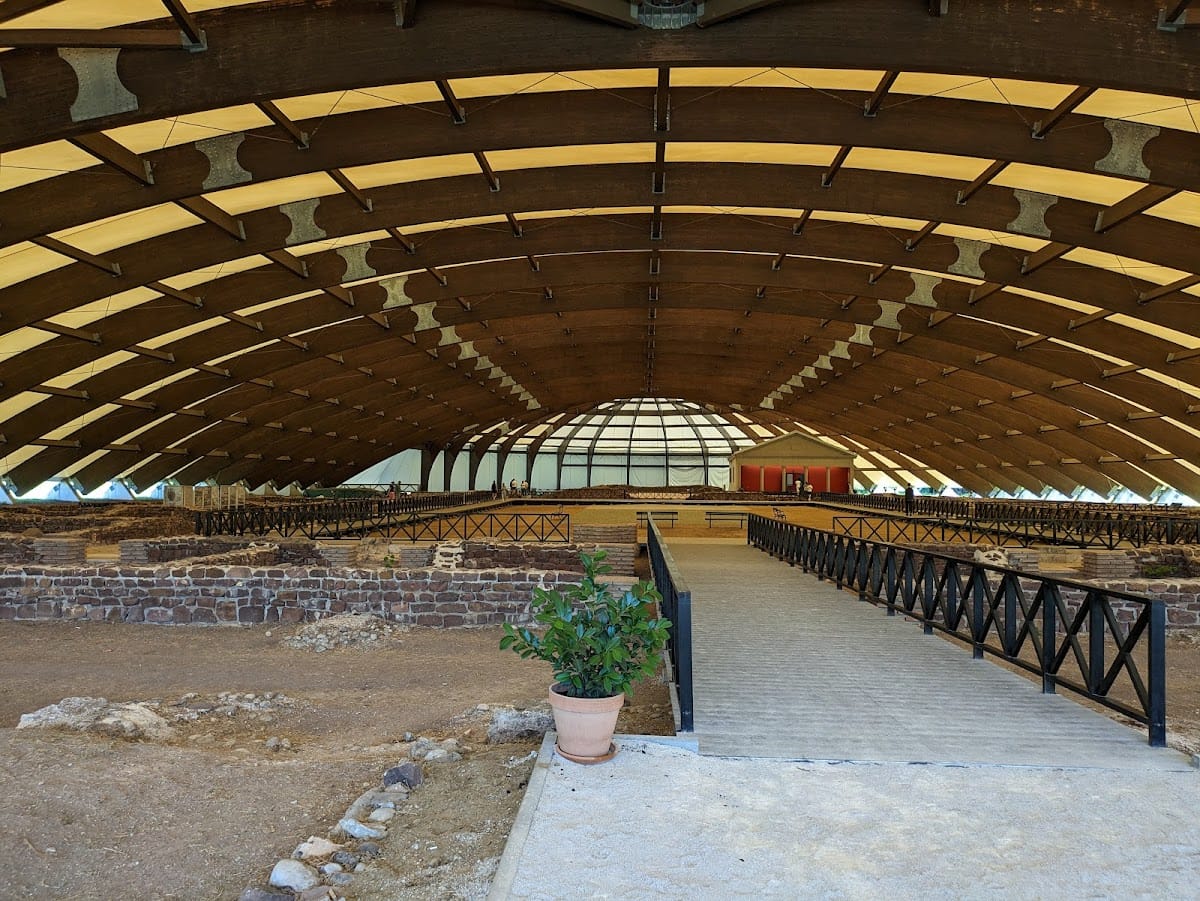
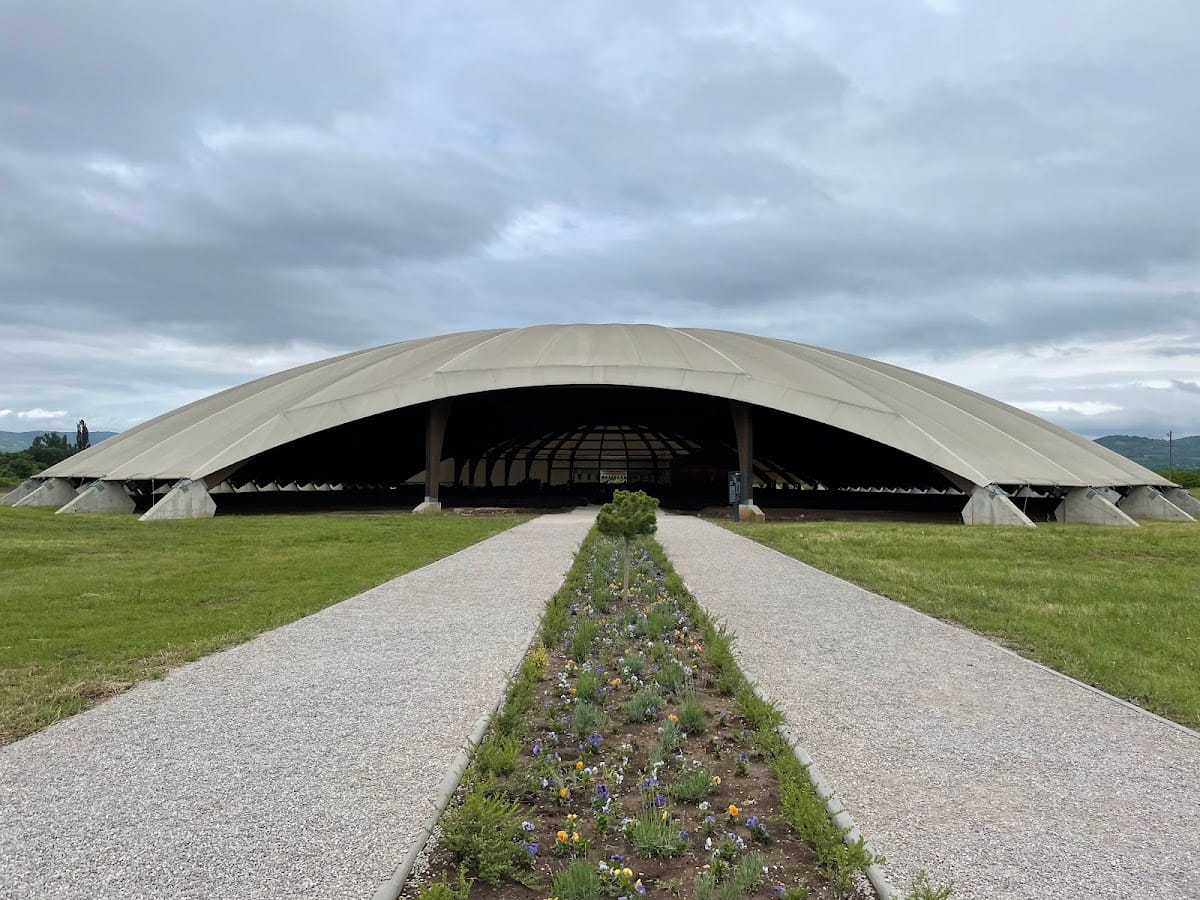
Mediana was placed under state protection on 9 February 1949 and designated a cultural property of exceptional importance in 1979. It entered Serbia’s central register under reference AN 22 in 1981. Conservation, partial reconstruction, and archaeological research have continued, and the site now forms an archaeological park.
Remains
Mediana occupied about 40 hectares, or more than 400,000 square metres, on a loess plateau or river terrace approximately 35 metres above the Nišava valley. It lay near the river, at the foot of the Seličevica hills, and close to the thermal springs of Niška Banja. The Nišava broadly defined its northern side, Seličevica its southern side, Naissus its western side, and the Kutina River its eastern side.
More than 80 buildings have been identified, although the settlement extended beyond the currently protected area. The buildings stood among broad open spaces containing gardens, agricultural land, and woodland rather than forming a dense urban grid. An east-west road ran along the southern side of the central villa and the granary, giving access to both. The most luxurious buildings clustered around the central villa, while agricultural and service structures extended westward toward Naissus.
Central villa and bathing complex
Imperial villa
The principal villa occupied the center of the settlement and is generally identified as the imperial or peristyle villa. It was oriented north-south, measured about 98.6 by 63 metres, and covered approximately 6,000 to 6,800 square metres. Around 945 square metres of its floors were decorated with mosaics. Its central peristyle, a courtyard surrounded by a colonnaded portico, was linked by a corridor of about 100 square metres to the thermae on the west and a small nymphaeum, or monumental fountain, on the east.
The northern side of the peristyle contained a large triclinium, a formal dining and reception room, with a semicircular apsidal end, exterior pilasters, and an entrance approached by three steps. A hypocaust, the Roman system of heating air beneath a raised floor, warmed the room in cold weather, possibly together with heating within the walls. Its central space was hexagonal and held a fountain, while rectangular side rooms, a conch-shaped space, and a paved entrance completed the plan. The mosaic covered about 55 square metres. The room’s different orientation may indicate that it belonged to an earlier building.
The villa’s decoration included marble columns, capitals, bases, pilaster-capital reliefs, parapet slabs, multicoloured marble wall revetment, frescoes, and architectural sculpture. Its mosaics used octagons, rhombs, squares, plant forms, stylized propeller motifs, and lotus flowers. The portico and audience hall together contain about 450 square metres of mosaics. Geometric designs dominate the portico, while the audience hall includes a fragmentary scene of Leda and the Swan with a river deity and a mosaic of Medusa’s head.
A river deity, waterfowl, and part of a principal mythological figure appear in an emblem at the entrance to the apsidal room. The villa’s hexagonal fountain had a lead pipe at its center, and the surrounding spaces and nymphaeum also had mosaic floors. A circular room about six metres across in the villa’s northwest corner contained a lily mosaic, reinforcing the residential and representative character of the complex.
Thermae
The thermae, or Roman bathing complex, stood west of the villa and was probably reached directly from the residential rooms. Its rooms included a changing room, an exercise area, a hot bath, a cold bath, a sweating room, and a furnace. The furnace sent hot air beneath the floors through hypocaust pillars, while the wider water system supplied the baths.
The connecting corridor had high-quality geometric mosaics. The vestibule and changing room had brick floors, while the middle room combined brick paving with mosaic made from relatively large white marble tesserae. These remains preserve the direct relationship between the residential complex, its water installations, and its bathing facilities.
Villas and service infrastructure
Octagonal villa
A second villa with an octagonal and circular plan stood northeast of the central villa in the area formerly called Amađijska Njiva. Felix Kanitz first identified it. About 3,150 square metres have been investigated, revealing octagonal and circular rooms, an extension to the east, and a square courtyard. The building remains only partly excavated.
Conch villa
A smaller fourth-century villa was excavated in 1975 during protective work along the Niš to Niška Banja road. Oriented east-west, it measured about 32.5 metres long and contained an eastern entrance, a triclinium, two square rooms, a probable corridor, and a courtyard with a portico. No heating system was identified, suggesting seasonal use.
The courtyard, corridor, and two square rooms had rammed-earth floors, while the western room had a plaster floor. The southern conch originally had a brick floor that was later replaced by mosaic, and the western conch was paved with bricks. Remains of a third conch suggest that the building may have followed a three-conch plan.
Granary
The granary, or horreum, stood about 150 metres west of the central villa. This rectangular east-west building measured approximately 91 by 27 metres and had a broad southern entrance with a covered portico. Two rows of supports divided its interior, where large storage jars, or dolia, were sunk almost halfway into the ground.
Basins along the western wall reached 1.40 metres in depth and probably held olive oil and wine. Rooms in the southeastern corner and a separate western tract may have housed imperial officials who collected taxes and distributed grain and wine. The western tract probably had an upper storey.
Water tower
The water tower, or castellum aquae, stood about 500 metres southwest of the settlement’s center. As the terminal structure of an aqueduct, it supplied the villa, baths, fountains, basins, wells, and possibly irrigation channels through lead or ceramic pipes. The system included basins, gravity channels, main channels, and inspection channels. A height difference of about 10 metres between the tower and the lower buildings provided pressure for fountains and distribution.
The tower also filtered water. Two basins contained layers of broken sandstone, limestone, and smaller pebbles that acted as a simple mechanical filter. Surfaces exposed to water were coated with waterproof reddish plaster.
Christian buildings
Probable baptistery
A probable baptistery, a building intended for Christian baptism, was discovered in 1981 between the Nišava and the villa-thermae complex. It probably had an octagonal plan more than eight metres across, walls about one metre thick, and surviving masonry approximately 0.40 metres high. Two rooms together measured 14.6 metres in length.
The octagonal room contained a marble-lined baptismal basin, a western apse, and a drainage channel east of the basin. The apse may have served as a consignatorium for anointing. A small part of the mosaic floor survives. Brick construction, thick mortar joints, possible ceramic facade decoration, and capitals with Ionic volutes combine late Roman and early Byzantine features. Its identification remains debated because the building has also been interpreted as a luxury villa.
Churches 1 and 2
Church 1, discovered in 2000, was probably built in the fourth century and measured about 8 by 6 metres without its narthex, or entrance vestibule. Its mortar floor contained a central Chi-Rho monogram, an early Christian sign formed from the first two Greek letters of Christ’s name. The building may have used light materials, possibly timber, and was probably a small church or chapel for Mediana’s Christian inhabitants.
Church 2, excavated in 2007, was a single-nave church from the late fourth or early fifth century. It stood about eight metres from Church 1, faced east-west, and measured approximately 8.50 by 5.85 metres externally. The nave ended in an eastern altar apse and had a western entrance. A rectangular annex occupied the north side.
The church survives mainly at foundation level, with parts of its walls reusing or incorporating earlier structures. It contained an ambo, a raised platform for reading or preaching, measuring about 1.25 by 1.20 metres, a raised apse, and a possible subselium, or raised bench along the apse interior. A channel-like feature beside the northern wall may preserve earlier architecture adapted for the church. Pottery, small finds, and fragments of fresco painting were also recovered.
Military buildings and movable remains
Barracks
Military barracks lay northeast of, and partly west of, the granary. Their northern wing measured about 232 metres and their eastern wing about 137 metres. Two rows of regularly sized small rooms formed the principal arrangement. After the villa was destroyed around 378, later inhabitants reused the barracks as housing and for other activities. Work surfaces of different sizes and construction were also identified.
Sculpture and bronze enclosure
Roman utilitarian objects of ceramic and metal were found together with decorative marble and bronze elements. The marble and porphyry statues discovered in 1972 probably represented Asclepius, the god of healing, Hygieia, associated with health and cleanliness, Dionysus, Heracles, and a satyr. Their uniform dimensions and classicizing style may indicate the work of an experienced court sculptor. A marble female head probably belonged to a statue of Diana or Artemis.
A bronze enclosure discovered with a hoard in 2000 originally had eight panels, four on each side, accompanied by three herms on each side. Four panels survive, three complete and one fragmentary, together with two herms showing Asclepius and Luna, the Roman personification of the Moon, and the base of a probable female deity. The panels carried cross-shaped and radiating bands, hollow-cast lion and Medusa heads, and a colonnade of semicircular niches.
The enclosure may have served as an altar screen in the apse of the triclinium, which may itself have been converted into a sanctuary for healing deities. This evidence has supported the hypothesis of an Asclepius and Hygieia sanctuary at Mediana. One interpretation connects the conversion with Julian the Apostate’s stay in 361, but that reconstruction remains uncertain.