Castle of Batres: A Renaissance Castle-Palace in Spain


Site at a Glance
- Rating
- 4.2
- Popularity
- Low
- Country
- Spain
- Primary era
- Medieval
- External website
- Open
- Eras represented
- Medieval, Early Modern
- Civilizations
- Crown of Castile
- Site type
- Domestic
- Remains
- Castle
On this page10 sections
History
Origins and Renaissance Residence
Castle of Batres is a Renaissance castle-palace in Batres, Spain, built between the fifteenth and sixteenth centuries. Historically associated with the Lords of Batres, it served as their palatial residence near the boundary between the Community of Madrid and Toledo Province.
One of its notable residents was Garcilaso de la Vega, a sixteenth-century Spanish Renaissance poet and soldier. He inherited the Lordship of Batres from his mother, Sancha de Guzmán, linking the castle to his family’s position and residence there. Ownership later passed to the Counts of Oñate and then to the Marquises of Riscal.
Restoration and Protection
In the 1970s, the architect Luis Moreno de Cala y Torres acquired the castle and restored it. He also founded the Castle of Batres School of Gardening and Landscape Design within the enclosure, giving the restored complex an additional educational use.
A decree issued by the Ministry of Education and Science in 1970 declared the castle and its associated historic-artistic ensemble protected. The designation extended to nearby features within and around the enclosure, preserving the castle as part of a wider historical landscape.
Remains
Castle Structure and Grounds
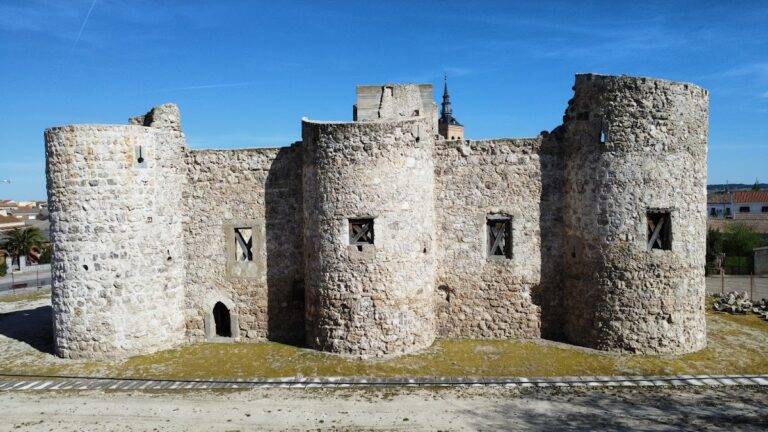
Castle of Batres stands on a hillock whose base forms a natural moat. Several streams pass through the depression and flow toward the nearby Guadarrama River. The building has a quadrangular plan and is made of fired brick on flint foundations, combining a somewhat military character with refined architectural treatment.
Keep and Main Portal
The keep, the principal fortified tower and usually the strongest defensive and residential element of a castle, is the oldest part of the building. It projects forward from the rest of the fortress and is distinguished by its elevated position, proportions, and balanced relationship with the complex. The main portal is in the Isabelline Gothic style, a late Gothic form associated with the reign of Queen Isabella I of Castile and known for elaborate architectural and heraldic decoration. Its coat of arms is associated with the Laso de la Vega and Guzmán families, joined through the fifteenth-century marriage of Garcilaso de la Vega, grand commander of León, and Sancha de Guzmán, heiress to the Lordship of Batres.
Courtyard and Landscaped Setting
The central courtyard is chiefly Plateresque, an early sixteenth-century Spanish style noted for richly detailed ornament. It contains a double gallery with Toledan columns of the Alcarria type and a sixteenth-century iron balcony. A Gothic well occupies the courtyard’s center and retains remains of an earlier structure. Dense woodland and landscaped plantings surround the castle, including holm oak, pine, and cypress.
Associated Historic Ensemble
Enclosure and Water Features
The associated ensemble comprises the Garcilaso Fountain, the Viewpoint Orchard, the underground cellar, the bridge over the Sotillo stream, the Chorro Fountain, the enclosure walls, the storehouse, the Gardener’s House, and the Water Dam. Together these features form the immediate historic setting of the castle and extend its remains beyond the principal building.
Wider Protected Landscape
Outside the enclosure, the protected surroundings include three bridges, riverside drying sheds along the Guadarrama, several mills, and the Los Barrancos Archaeological Landscape. The castle itself survives in very good condition and is described as almost complete.