Kaprun Castle: A Medieval Hill Castle in Austria


Site at a Glance
- Rating
- 4.3
- Popularity
- Medium
- Country
- Austria
- Primary era
- Medieval
- External website
- Open
- Eras represented
- Medieval, Early Modern
- Civilizations
- Holy Roman Empire
- Site type
- Military
- Remains
- Castle
On this page9 sections
History
Kaprun Castle is a medieval hill castle in Kaprun, Austria, built in the twelfth century during the Romanesque period. The settlement’s name was recorded on 9 February 931 as the Celtic Chataprunnin, meaning “wild water,” in the Codex Odalberti, a medieval manuscript containing legal and administrative records. The castle later became an administrative and judicial centre in the Salzburg region.
Medieval origins and noble ownership
Possessions belonging to the lords of Falkenstein-Neuburg were recorded in 1166 in the Codex Falkensteinensis. The castle itself first appears in written evidence in 1280, when it was called the “Tower of Chaprunne” in connection with attacks by the lords of Felben. In 1287, the complex passed to Salzburg Archbishop Rudolf von Hoheneck. The Salzburg archbishops were senior Roman Catholic church officials who also ruled much of the surrounding territory. The lords of Felben regained possession in 1338.
Kaprun was associated with Ekke von Felben, a knight remembered in the regional tradition for violent raids and theft. In 1415, Praxedis, the wife of Jörg von Puchheim and daughter of Ulrich von Felben, received the castle as a fief, meaning property granted by a superior in return for service or allegiance.
Archiepiscopal court and early-modern conflicts
From 1480, Kaprun Castle served as the seat of an archiepiscopal district court, a territorial judicial institution with authority over a defined area. Its judicial and administrative role ended in violence during the Salzburg Peasants’ War, a 1526 uprising in the Salzburg territories, when the castle was set on fire and burned.
Between 1580 and 1600, the Salzburg official Josef Hundt von Ainetperg enlarged the complex according to the ground plan that largely survives today. From around 1600, its public importance declined as administrative officials increasingly governed from Zell am See. The castle nevertheless remained involved in regional unrest. Caspar Vogl, the Kaprun official who had supported the Pinzgau peasants in 1601, was executed in 1606 on the orders of Salzburg Archbishop Wolf Dietrich von Raitenau. During the Zillertal revolt of 1645, about 300 Salzburg musketeers occupied the castle. Various owners are recorded from the seventeenth century onward.
From ruin to protected monument
In 1811, the Bavarian government sold the ruin to foresters. Princess Sophie Löwenstein, the sister of the Prince of Liechtenstein, acquired the estate in 1893. In 1921, Prince Johann II of Liechtenstein sold Kaprun Castle and Fischhorn Castle to Heinrich E. Gildemeister, a Peruvian diplomat and businessman from Bremen.
The Gildemeister family was expropriated after the Anschluss, Nazi Germany’s annexation of Austria in 1938, and recovered the estate after the Second World War. Near the war’s end, the castle was temporarily used as barracks by the Wehrmacht, the armed forces of Nazi Germany from 1935 to 1945. Its roofs were removed in 1945, worsening the condition of the buildings, and the northern ring wall collapsed in 1949.
Minor measures to secure the walls were undertaken in 1975 and 1976. In 1984, the nonprofit Burgverein Kaprun, an association founded by Kaprun entrepreneurs, acquired the castle and initiated extensive renovation. The surrounding land and access road remain owned by members of the Gildemeister family. Kaprun Castle is protected as a historic monument and is used mainly for cultural events and private functions.
Remains
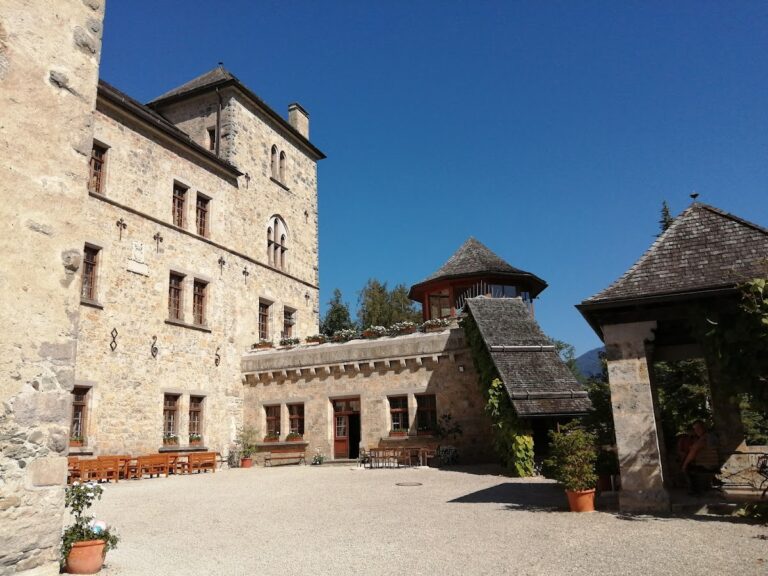
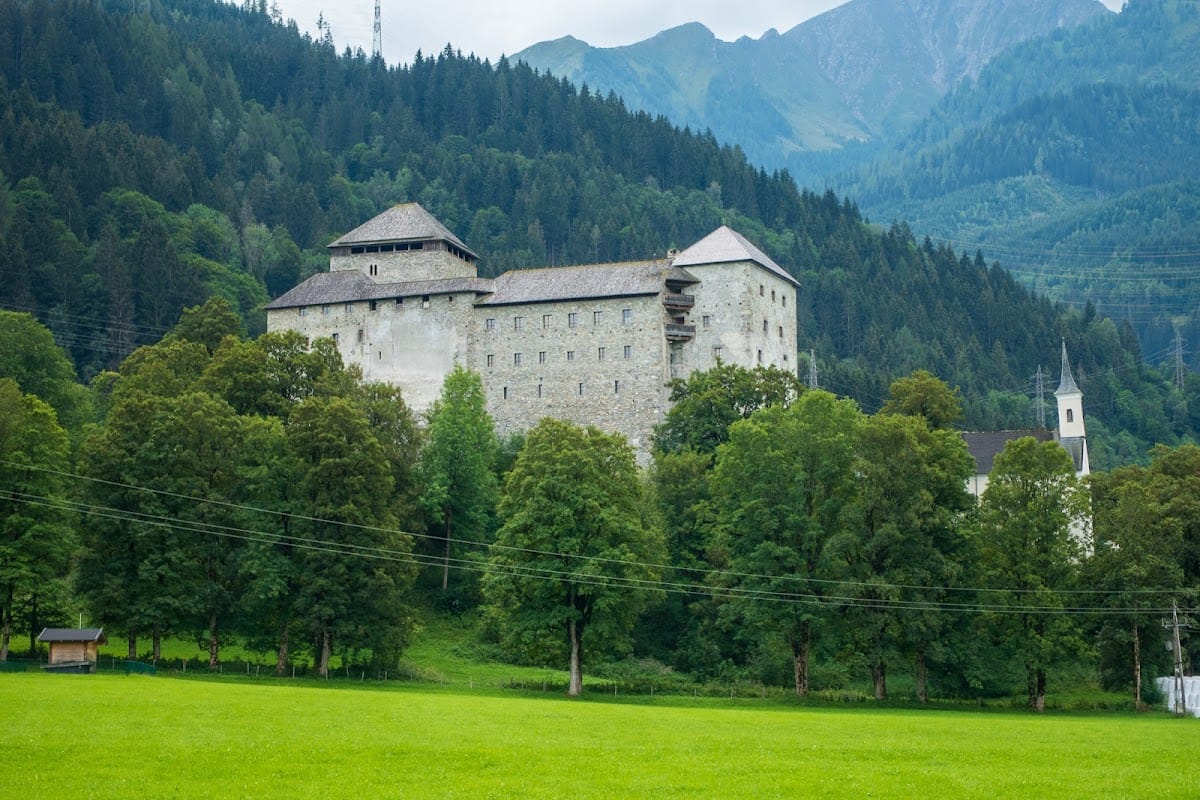
Kaprun Castle stands east of Kaprun on high ground along the southern slope of the Salzach Valley. Its irregular rectangular complex is enclosed on three sides by a forewall and other fortifications. The surrounding landscape forms part of its defensive arrangement, with a stream to the northeast, steep slopes to the north and west, and an artificial ditch to the south. Part of the southern ditch has become a pond.
Fortifications and bell tower
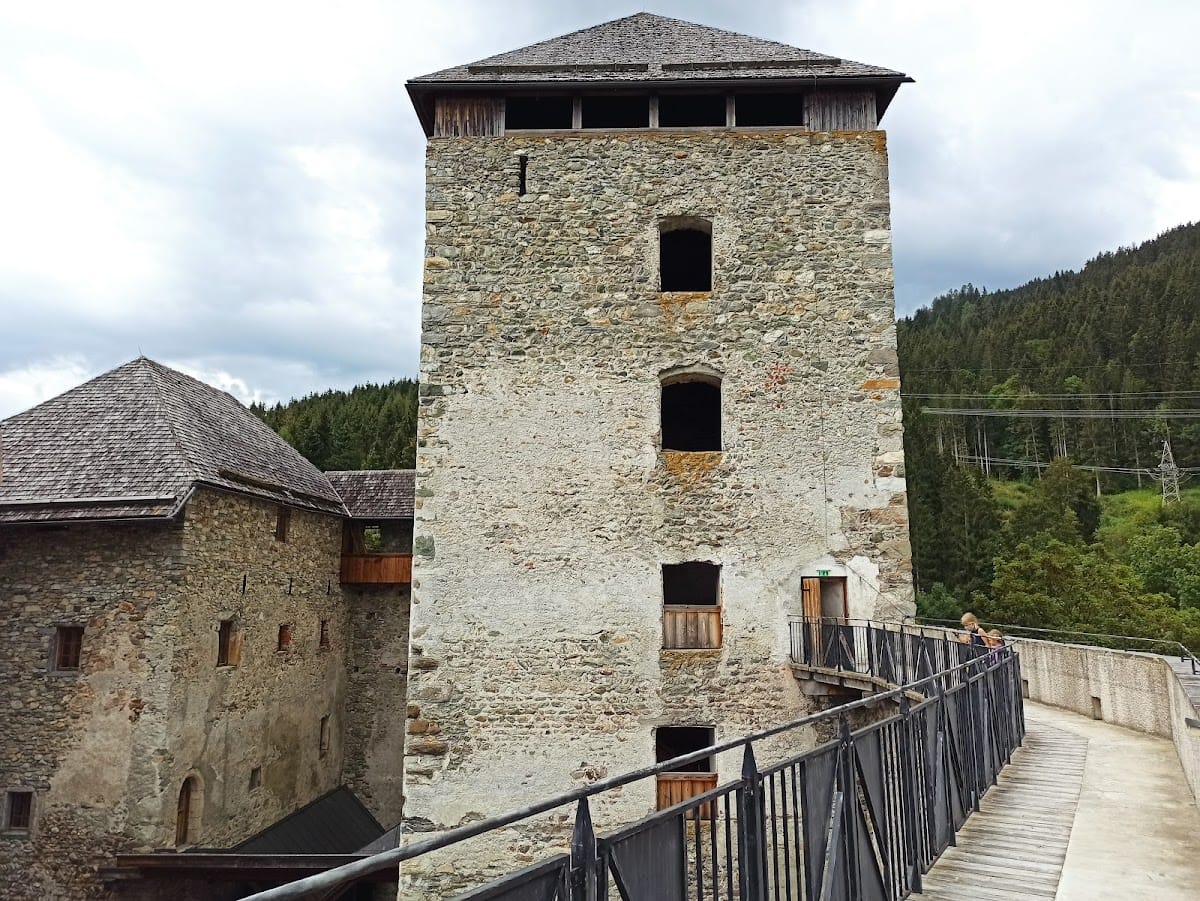
A bridge approaches the southern front and leads to a segmental-arched portal, above which the date 1574 is carved. At the southeastern corner, a substantial bell tower rises above the surrounding walls. Its asymmetrical lighting openings indicate that it once had six storeys. The lower levels retain Romanesque fabric, while projecting, roughly raised corner stones reinforce the tower’s corners. The highest storey contains a two-part window.
The walls are formed from regularly laid horizontal courses of broken stone and were covered with plaster. Two entrances stand high on the protected courtyard side, at the level of the third storey. The lower of these upper levels served as a prison, while the storey above was used as living accommodation.
Residential buildings
A large residential building occupies the northeastern corner and connects to the bell tower by a high wall. Wall decoration indicates that parts of this residential complex belong to the twelfth century. Above its vaulted ground floor, three additional storeys can be identified through surviving fireplaces and window sills.
An open staircase once descended along the west side of the building to the lower level. This arrangement was required when the castle was jointly held by the Walchen and Felben families, two medieval noble families associated with the Salzburg region. The comfortable upper residential storey was added later than the eastern part of the complex, during the second half of the sixteenth century. Its northern facade, facing the Salzach Valley, has three storeys and twelve window axes, each axis being a vertical line defined by aligned windows.
As the northern walls deteriorated, cramping buttresses were added in 1714. Further restoration followed in 1726. These repairs form part of the visible history of the residential complex, which combines medieval fabric with later defensive and domestic alterations.
Saint James Castle Church
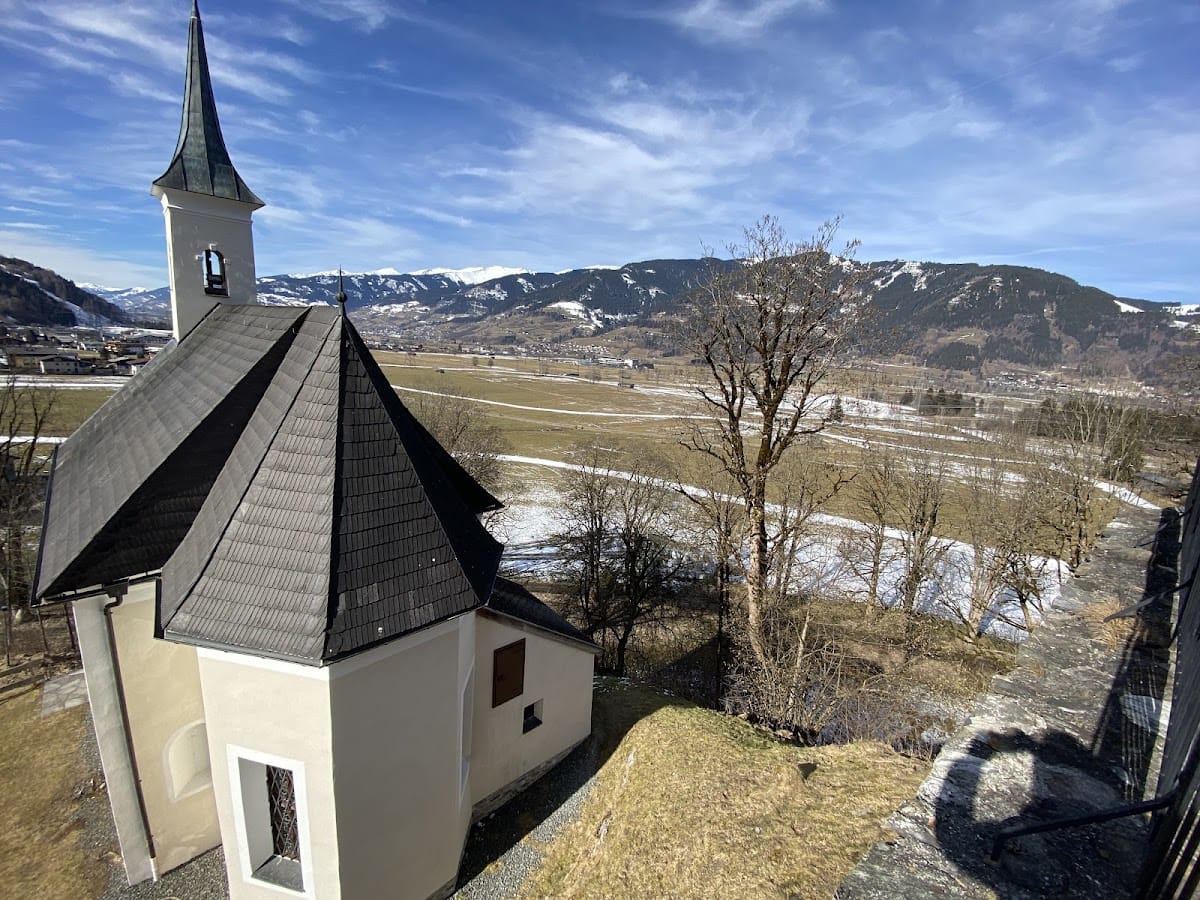
Saint James Castle Church stands at a lower level northeast of the castle. Its present form was first documented in 1562, when the Salzburg official Diether zu Urstein built it to replace a small chapel on the third floor of the northeastern residential building. A small oriel, or projecting windowed feature, from that earlier chapel survives.
The church has a roof turret with round-arched openings for its bells and a late Gothic, round-arched portal. Its nave contains three vaults and is covered by a flat barrel vault, a ceiling formed by a continuous semicircular or segmental curve. Three altars belong to its Baroque furnishings. The painting on the main altar, showing Saint James, was made by Franz Xaver Kurz in 1736.
The church interior suffered severe damage in 1943, and the building was reconstructed in 1960. Its furnishings were also damaged during the Second World War.
Courtyard and restored spaces
The courtyard contains a tribune with 450 seats and a covered stage. Within the restored complex, the gallery hall and knights’ hall provide additional spaces for cultural events and private functions, giving these surviving rooms a continuing public use.