Klammstein Castle: A Medieval Fortress in Austria


Site at a Glance
- Rating
- 4.2
- Popularity
- Low
- Country
- Austria
- Primary era
- Medieval
- External website
- Open
- Eras represented
- Medieval, Modern
- Civilizations
- Duchy of Bavaria, Holy Roman Empire
- Site type
- Military
- Remains
- Castle
On this page8 sections
History
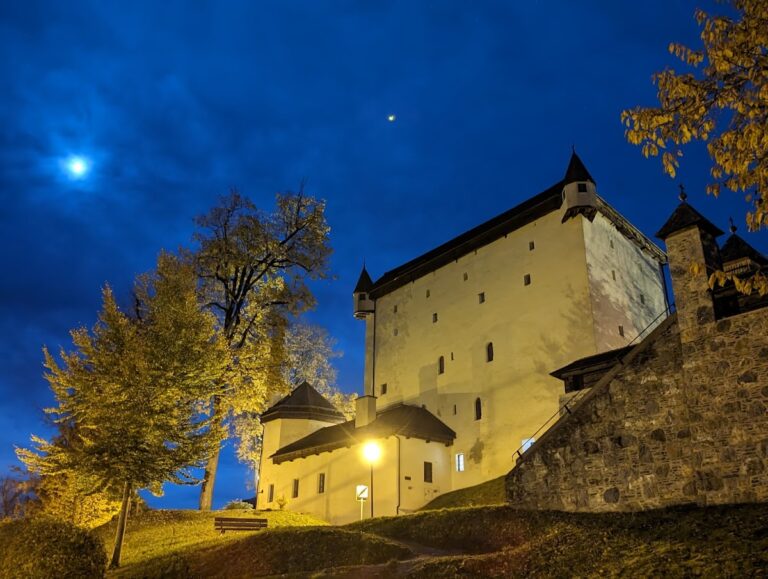
Klammstein Castle is a partly reconstructed hilltop castle ruin in Austria, located at the entrance to the Gastein Valley near Dorfgastein. Medieval nobles built it in the twelfth century to secure estates and authority in the valley. Regarded as the oldest building in the Gastein Valley, it later became an administrative center for the archbishopric of Salzburg, an ecclesiastical principality whose rulers also exercised governmental, judicial, and economic power.
The Sieghartinger estate
From the beginning of the eleventh century, the Sieghartinger counts held a consolidated estate in the valley known as the provincia Castuna and exercised high jurisdiction, meaning authority over serious criminal justice. They entrusted the valley’s administration to a vassal called de Kastune. Klammstein Castle was built on land belonging to the archer Konrad, recorded in 1122 as Conrad the Rough, and helped protect the counts’ possessions.
In the middle of the twelfth century, the family changed its noble designation from von Tengling to von Peilstein. Around 1200, Siegfried von Peilstein also held Moerle and Kleeberg. After his death, his widow Eufemia endowed property in the Gastein Valley to St. Zeno Abbey in Bad Reichenhall in 1208. In 1218, she and her daughter-in-law Adelheid von Moerle sold the valley to Duke Ludwig of Bavaria.
Transfer to Salzburg rule
Duke Ludwig pledged the Gastein possession to Archbishop Eberhard II in 1228 in an arrangement involving the Duchy of Bavaria, the County of Pinzgau, and imperial enfeoffment. In the mid-thirteenth century, Count Heinrich von Ortenburg held the advocacy of the Gastein Valley. Advocacy was protective and administrative authority exercised over a territory or institution. On 9 April 1251, Heinrich transferred his rights to a Salzburg ministerial, a lower-ranking noble who held office or property in the archbishop’s service. Philipp of Spanheim, the Salzburg archbishop-elect, later redeemed those rights through a pledge arrangement.
The Lords of Goldegg subsequently took control of the valley, although the means of their acquisition remains uncertain. In 1272, Archbishop Friedrich II of Salzburg attempted to settle a dispute over Klammstein Castle between his uncles Otto and Konrad von Goldegg and his brothers Otto and Albero von Walchen, who also claimed the castle.
The Goldegg family claimed the county rights for its territorial court, although those rights belonged to the Bavarian dukes. Armed conflict followed, and a treaty in 1286 sought to settle the dispute. The Goldeggs could not raise the sum required by the purchase arrangement. In 1297, the Archbishopric of Salzburg acquired the provincia Castuna, including its rights, especially high jurisdiction, from the Bavarian dukes Otto and Stefan.
Angered that their right of first refusal had been disregarded, the Goldeggs began a war against the archbishopric. In 1327, the archbishopric compensated Friedrich von Goldegg for his claim to high jurisdiction in Gastein. The estates of Klammstein Castle were then incorporated into the archbishopric’s estate register.
Mining administration and decline
During the fourteenth century, ore deposits in the Gastein Valley made the area one of the archbishopric’s principal sources of income. In 1342, the archbishop issued a mining ordinance for Gastein, and an archiepiscopal administrator was installed at Klammstein. This official usually also exercised high jurisdiction in the valley.
The administrators included Albrecht Paumgartner in 1399; Konrad Eisenstang and Albrecht Paumgartner in 1403; Albrecht Pawinger in 1406; Paul Kren as leaseholder in 1411; Heinrich Weißenbacher in 1422; Oswald Keuzl in 1439; Leonhard Peyswegk in 1469; Konrad Strochner in 1471; Hans Strochner in 1490; and Georg von Haunsperg in 1502.
In 1513, Archbishop Leonhard von Keutschach granted Klammstein Castle to Siegmund von Keutschach for life. The district judge and administrator of the court district then moved from the castle to Hofgastein. In 1559, Archbishop Michael von Kuenburg bought back the forests belonging to the Hofmark, a territorial estate or jurisdiction administered by its lord. The Hofmark was subsequently administered again by the district judge.
By 1589, the castle had been abandoned and was decaying. Its wooden structures had rotted, while falling stones from the walls endangered the road into the Gastein Valley. Archbishop Wolf Dietrich therefore authorized the dismantling of the outer walls. By 1608, the castle was considered uninhabitable.
Ruin, excavation, and reconstruction
Stone from the ruin had been used for lime production from at least a generation before 1760. In that year, Sebastian Rainer, the innkeeper at Brandstattgut, sought permission to burn lime, referring to the castle itself as the quarry. A description from 1778 portrayed the ruined castle as a very thick square wall identified as the tower, together with two walls below it.
In 1840, Thomas Lackner bought the tavern at Brandstatt believing that the property retained old rights connected with the Gastein court. When no documents proving those rights were produced, he retained only the right to burn lime. At the end of the nineteenth century, Father A. Ebner of St. Peter’s Abbey prepared a ground plan and description of the ruin. An explosion during construction of the Tauern Railway caused further damage in 1904.
Between 1960 and 1962, a tunnel for the Gastein federal road was built beneath the castle rock. At that time, the exposed main tower stood only a few metres high. In 1972, Adolf Ferner acquired the ruin from the Austrian Federal Forests, renovated the tower, and added new structures. The partly reconstructed complex now contains a museum devoted to the castle’s history and Ferner’s collection, and it serves as the seat of the Peilsteiner Ritterschaft, a modern chivalric association. Klammstein Castle is protected as a listed heritage object in Austria.
Remains
Klammstein Castle occupies the summit of Klammstein, approximately 60 metres above the Gastein road at the entrance to the valley. The surviving fortification is organized around a partly reconstructed main tower and lower wall remains. Its physical form reflects both the medieval masonry and the later changes caused by decay, stone removal, road construction, and twentieth-century renovation.
Main tower
The late nineteenth-century survey measured the main tower at 8.7 metres externally and 5.2 metres internally. It retained a ground floor and an upper storey. Masonry on the south side was 1.75 metres thick, and a narrow passage had been broken through that wall. Slit openings survived on the south side of the ground floor and on both the south and north sides of the upper floor.
The upper storey also retained a segmental-headed wall opening and a rectangular breach. The 1778 description identified the structure as a thick square tower accompanied by two lower walls. The tower was renovated after Adolf Ferner acquired the ruin in 1972, and the present complex combines these surviving elements with partly reconstructed structures.
Road tunnel and museum complex
A tunnel for the Gastein federal road was constructed beneath the castle rock between 1960 and 1962. The renovated complex now includes a museum displaying the history of Klammstein Castle and objects from Adolf Ferner’s extensive collection.