Gorizia Castle: A Historic Fortress in Northeastern Italy


Visitor Information
Google Rating: 4.5
Popularity: Medium
Google Maps: View on Google Maps
Official Website: www.turismofvg.it
Country: Italy
Civilization: Medieval European
Remains: Military

History
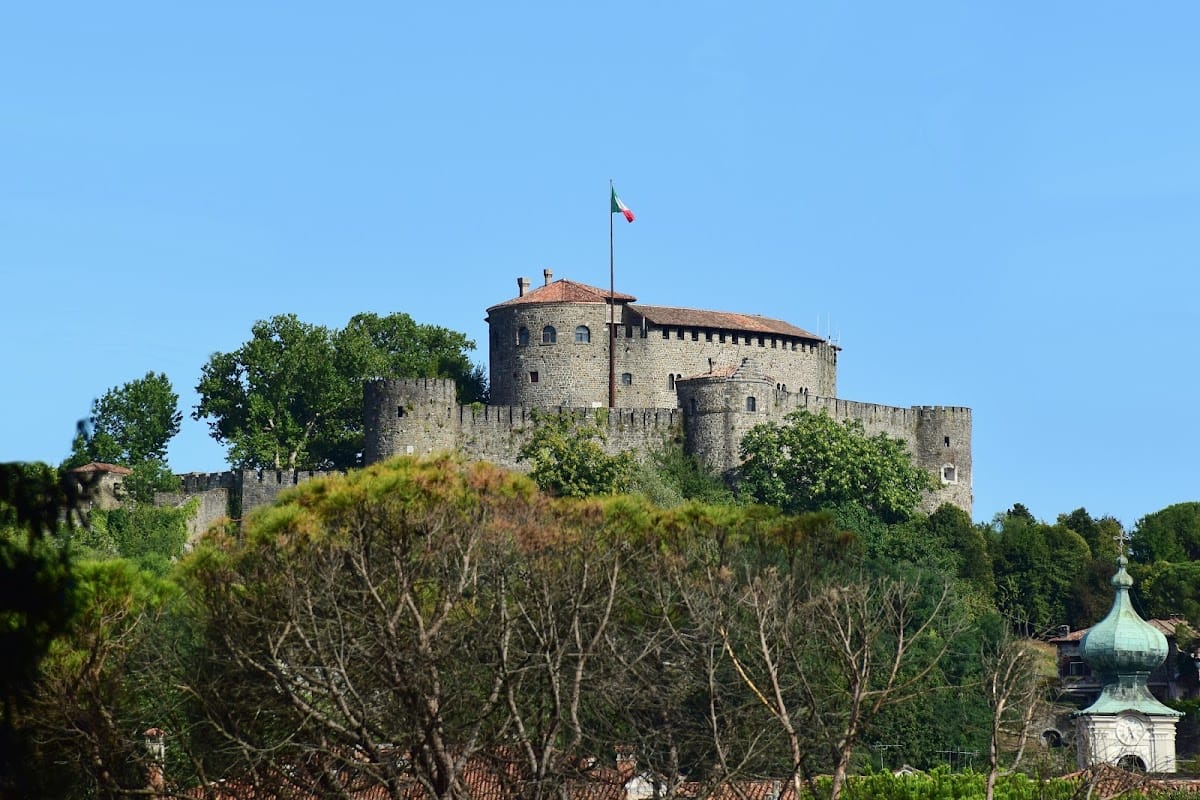
Gorizia Castle stands on a hill 155 meters above sea level, overlooking the city of Gorizia in northeastern Italy. Its origins date back to the 11th century when it was built as a stone fortress, likely replacing earlier wooden earthworks such as a motte-and-bailey with a moat and palisade. The castle became the seat of the Counts of Gorizia, with Henry IV of Spanheim recorded as the first known count around 1146, establishing the noble title linked to the site.
In the 13th century, the castle underwent significant expansion. A lordly palace and a two-storey building were added, enhancing its residential and administrative functions. Outside the castle’s defensive palisade, a small settlement or hamlet developed, protected by its own fortifications. Residents there were required to build their homes in masonry and assist in defending the castle during attacks, reflecting a close relationship between the fortress and the local community.
The earliest visual record of the castle appears on a city seal from 1307, granted by Albert II. This seal shows a stylized keep that matches the castle’s known form. By around 1350, the castle’s appearance resembled that of Bruck Castle near Lienz, indicating a common architectural style among regional fortresses of the period.
After the death of Leonhard, the last Count of Gorizia, in 1500, the castle and its county passed to Emperor Maximilian I of the Habsburg dynasty. This transfer was facilitated by Virgil and Luca di Graben. Despite efforts to strengthen the castle’s defenses, it was captured in 1508 by the Republic of Venice, which claimed the county as a fief under the Patriarchate of Aquileia. During Venetian control, the castle was further fortified to meet the demands of Renaissance warfare, which involved firearms. The original 11th-century keep was demolished at this time. However, Venice held the castle for only thirteen months, losing it in June 1509.
In the 17th century, the castle’s role shifted from noble residence to military use as a prison and barracks. This change led to the loss of much of its medieval character. The 18th century brought further modifications, including the construction of bastions, powder magazines, and defensive walls. Some of these works were overseen by Edmond Halley, a mathematician and astronomer known for his scientific contributions.
The castle suffered damage during World War I bombings. Between 1934 and 1937, architect Ferdinando Forlati, working with military engineers and the Trieste Belle Arti authority, led a restoration project. This effort aimed to remove Renaissance-era white plaster and restore the castle’s medieval appearance, returning it closer to its original form.
Remains
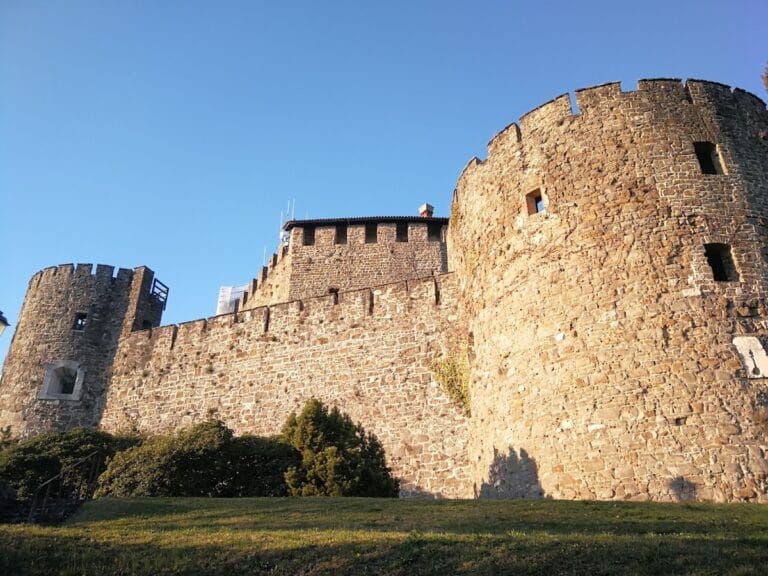
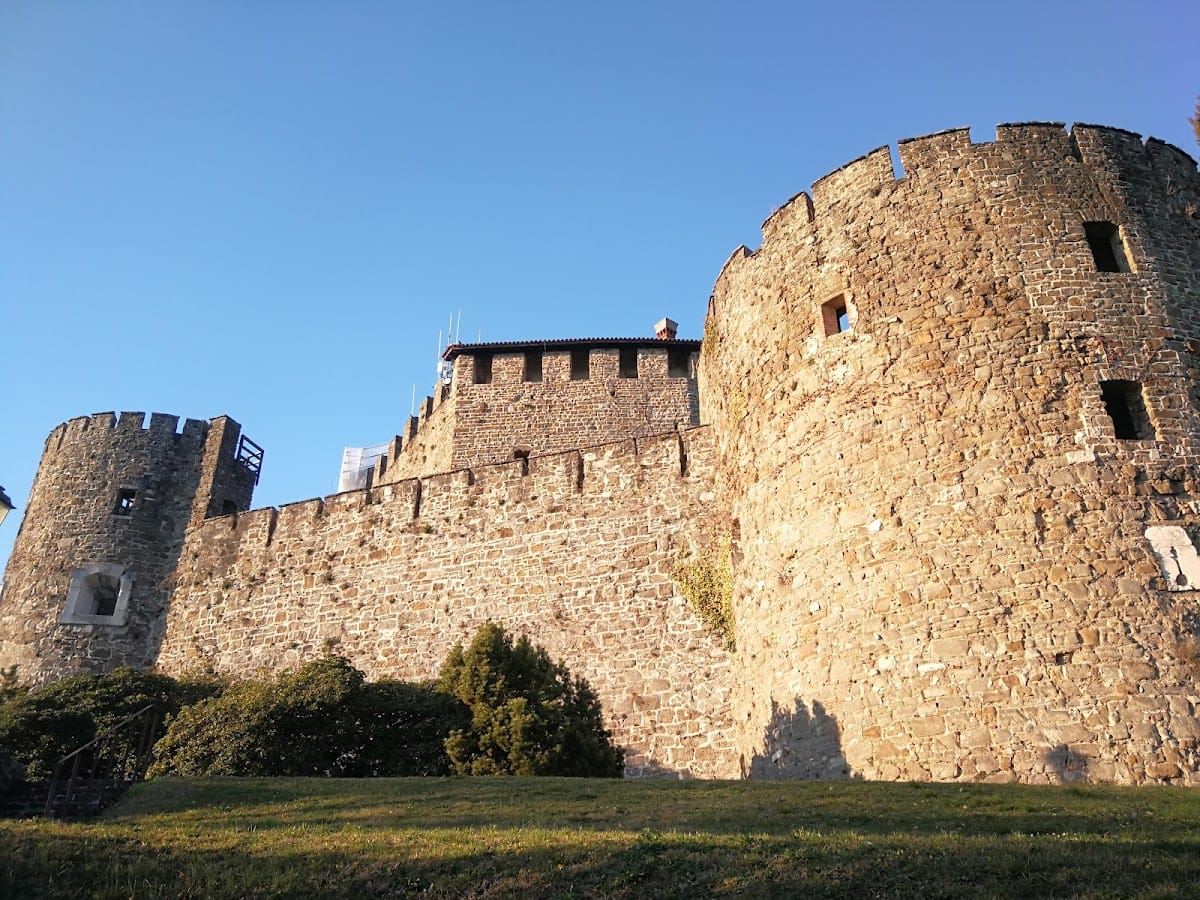
Gorizia Castle occupies a strategic hilltop site with a layout reflecting its long history of construction and adaptation. The core includes the remains of the original 11th-century stone keep, visible today in the central courtyard. This keep formed the earliest stone structure replacing earlier wooden defenses.
The 13th-century expansions added a lordly palace and a two-storey building, integrated into the castle’s overall design. These structures were built using masonry, consistent with the requirement for durable construction in both the castle and the adjacent settlement.
Originally, the castle was protected by earthworks such as a motte (a raised earth mound), a moat, and a wooden palisade. The nearby hamlet had its own defensive barrier, emphasizing the community’s role in the castle’s defense.
Above the main entrance stands a 16th-century statue of the Lion of Saint Mark, the symbol of the Republic of Venice. Although created during Venetian rule, the statue was never installed at the time and was placed in its current position only in 1919.
Inside, the castle now houses the Museum of the Middle Ages of Gorizia. The interiors are furnished with original medieval furniture and include reproductions of white weapons (non-metallic training arms) and siege engines, illustrating the castle’s military history.
The surrounding hill is occupied by a public park, providing a green setting for the castle. The structure’s current condition reflects the 1930s restoration, which removed later Renaissance plaster to reveal the medieval stonework beneath. Despite damage from World War I, the castle remains a well-preserved example of medieval fortification adapted through centuries of use.
Nearby sites